Inquire: Call 0086-755-23203480, or reach out via the form below/your sales contact to discuss our design, manufacturing, and assembly capabilities.
Quote: Email your PCB files to Sales@pcbsync.com (Preferred for large files) or submit online. We will contact you promptly. Please ensure your email is correct.
Notes: For PCB fabrication, we require PCB design file in Gerber RS-274X format (most preferred), *.PCB/DDB (Protel, inform your program version) format or *.BRD (Eagle) format. For PCB assembly, we require PCB design file in above mentioned format, drilling file and BOM. Click to download BOM template To avoid file missing, please include all files into one folder and compress it into .zip or .rar format.
How to Generate NC Drill Files in Altium Designer: Complete PCB Engineer’s Guide
After years of working with Altium Designer across dozens of PCB projects, I’ve learned that NC drill file generation is one of those critical steps that separates smooth manufacturing runs from costly delays. The drill file might seem straightforward compared to complex Gerber configurations, but getting it wrong means holes that don’t align with pads — and that’s a board headed straight for the scrap bin.
This guide walks you through everything you need to know about generating NC drill files in Altium Designer, from basic setup to handling advanced scenarios like blind and buried vias.
NC drill files (Numerical Control drill files) contain the precise coordinate data and tool specifications that CNC drilling machines need to place every hole in your PCB. While Gerber files define your copper traces, solder masks, and silkscreen, the NC drill file tells the manufacturer exactly where to drill and what size bit to use.
The standard format for NC drill files is Excellon, which has become the de facto industry standard. Altium Designer exports drill data in Excellon 2 format, which virtually every PCB fabricator accepts.
What NC Drill Files Contain
Data Element
Description
Manufacturing Purpose
Tool Table
List of drill bit diameters
Tool selection and sequencing
Coordinates
X,Y positions for each hole
CNC machine positioning
Tool Changes
Commands to switch drill bits
Automated tool management
Hole Attributes
Plated vs. non-plated designation
Process routing
Why NC Drill Files Must Match Your Gerber Files
This point cannot be overstated: your NC drill files must use identical format settings as your Gerber files. If your Gerber files use 2:4 format in inches with leading zero suppression, your drill files need exactly the same configuration.
Mismatched settings cause the most common drill file problems:
Drill holes offset from pad centers
Scaled drill patterns (holes appear twice as large or half the size)
Holes appearing in completely wrong locations
I’ve seen experienced engineers waste hours troubleshooting “faulty” drill files when the actual problem was a simple mismatch between Gerber and drill export settings.
Step-by-Step Guide: Generating NC Drill Files in Altium Designer
Step 1: Access the NC Drill Setup Dialog
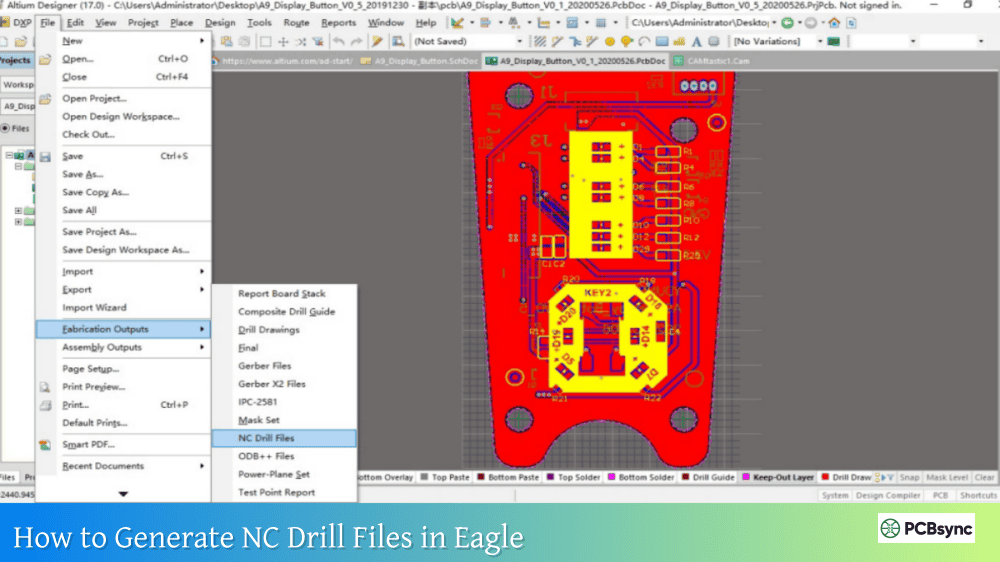
With your PCB document open, navigate to:
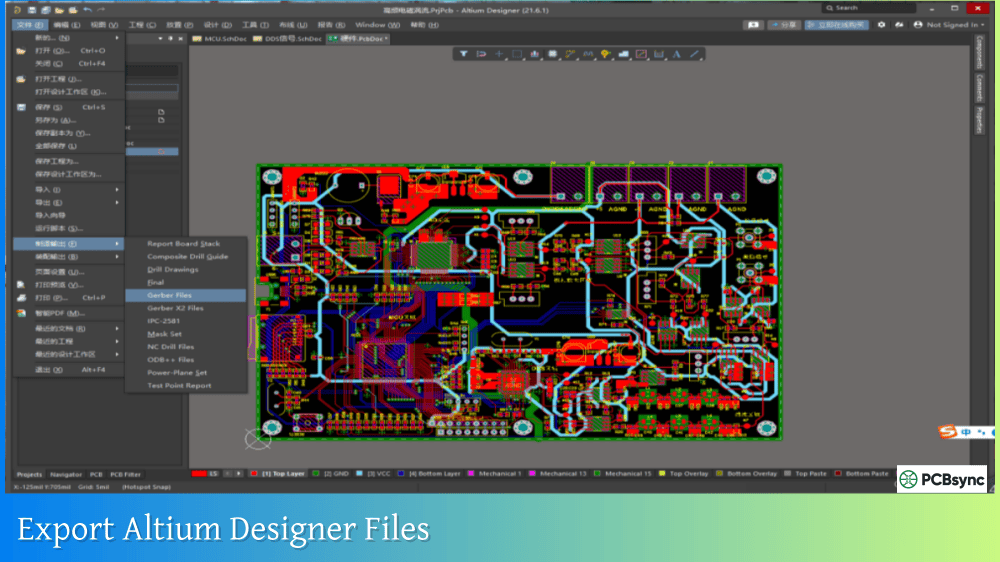
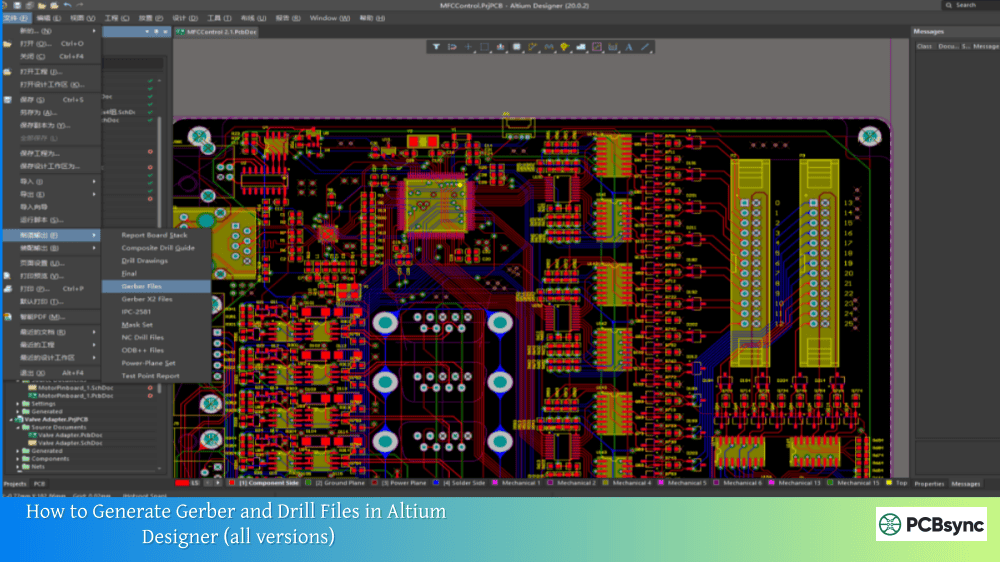
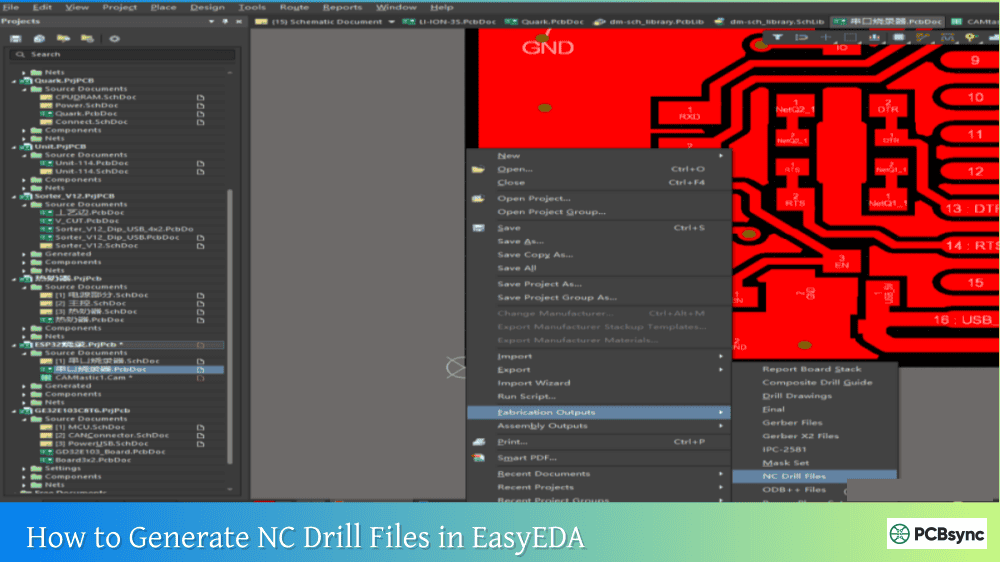
File > Fabrication Outputs > NC Drill Files
This opens the NC Drill Setup dialog where you’ll configure all export parameters. Alternatively, you can access this through an OutputJob file for more repeatable, production-ready workflows.
Step 2: Configure NC Drill Format Settings
The format settings determine how coordinate data is written to your drill file.
Units Selection:
Option
When to Use
Inches
North American manufacturers, imperial designs
Millimeters
European manufacturers, metric designs
Format (Resolution):
Format
Resolution
Use Case
2:3
1 mil (0.001″)
Legacy systems only
2:4
0.1 mil (0.0001″)
Standard for most designs
2:5
0.01 mil (0.00001″)
High-precision designs
For most PCB designs, 2:4 format in inches or 3:3 format in millimeters provides sufficient resolution. Only use higher resolutions if your design has holes placed on grids finer than 1 mil — and verify your manufacturer supports that precision.
Step 3: Configure Zero Suppression Settings
Zero suppression reduces file size by removing unnecessary zeros from coordinates. Three options exist:
Setting
Effect
Recommendation
Keep leading and trailing zeroes
Full coordinate precision
Safest option, highest compatibility
Suppress leading zeroes
Removes zeros at start
Common choice, match to Gerber
Suppress trailing zeroes
Removes zeros at end
Less common, can cause issues
Pro Tip: If you’re experiencing drill alignment problems, try the “Keep leading and trailing zeroes” option. It eliminates a common source of coordinate interpretation errors between different CAM systems.
Step 4: Set Coordinate Origin Reference
Choose how coordinates are referenced:
Reference to absolute origin — Uses the design’s absolute origin point
Reference to relative origin — Uses the relative origin marker
Critical: This setting must match your Gerber file origin setting. If your Gerbers use absolute origin, your drill files must too. Mismatched origins cause the entire drill pattern to shift relative to copper features.
Step 5: Configure Advanced Options
Several additional options affect your output:
Optimize change location commands: Reduces file size by optimizing tool path sequences. Generally safe to enable.
Generate separate NC Drill files for plated & non-plated holes: Creates distinct files for PTH (Plated Through-Hole) and NPTH (Non-Plated Through-Hole) features. Many manufacturers prefer or require this separation.
Use drilled slot command (G85): Enables slot creation using overlapping drilled holes. Enable if your design contains slots.
Generate Board Edge Rout Paths: Creates a separate NC rout file defining the board outline. Useful for complex board shapes or internal cutouts.
Generate EIA Binary Drill File (.DRL): Creates a binary format file in addition to the text-based Excellon file. Note: Some manufacturers have reported issues with .DRL files, so consider whether you actually need this output.
Step 6: Generate the Output
Click OK to generate your NC drill files. Altium Designer creates the output files in your designated project output folder, typically under “Project Outputs for [ProjectName]” or within a “NC Drill Output” subfolder if you’ve enabled separate folders for each output type.
Understanding NC Drill File Output
After generation, you’ll typically see several files depending on your design complexity:
Standard Two-Layer Board Output
File
Extension
Content
Main Drill File
.TXT or .DRL
All through-hole drill data
Drill Tool Report
.DRR
Summary of tools and hole counts
Multilayer Board with Blind/Buried Vias
For complex layer stackups, Altium generates separate drill files for each layer pair:
File Extension
Layer Pair
Description
.TXT
Through-hole
Full stack penetration
.TX1
Top to Layer 2
Blind via (top side)
.TX2
Layer 3 to Bottom
Blind via (bottom side)
.TX3
Layer 2 to Layer 3
Buried via
The specific extensions depend on your layer stack configuration. Always include documentation explaining which file corresponds to which layer pair.
Handling Blind and Buried Vias
Modern HDI (High-Density Interconnect) designs frequently use blind and buried vias to increase routing density. Altium Designer automatically creates separate drill files for each via type based on your layer stack definition.
Configuring Via Types for Proper Drill Output
Before generating drill files for complex designs:
Open the Layer Stack Manager (Design > Layer Stack Manager)
Switch to the Via Types tab
Verify each via type has correct start and end layers defined
Ensure drill pairs are properly configured
Each unique layer pair in your via definitions generates a separate NC drill file with a unique extension.
µVia (Microvia) Considerations
Microvias require laser drilling rather than mechanical drilling. Altium handles this by creating separate drill files for each µVia layer pair, which your manufacturer will process on appropriate laser drilling equipment.
Using OutputJob Files for Repeatable NC Drill Generation
For production environments, I strongly recommend using OutputJob files (.OutJob) rather than generating outputs directly from the PCB menu.
Benefits of OutputJob Configuration
Consistency: Same settings applied every revision
Documentation: Settings saved with the project
Automation: Generate all outputs with single click
Version Control: Track output configuration changes
Setting Up NC Drill in an OutputJob
Create new OutputJob: File > New > Output Job File
In Fabrication Outputs, click Add New Fabrication Output
Select NC Drill Files
Double-click to configure settings
Assign to an output container (folder or PDF)
Settings configured in the OutputJob are stored separately from direct PCB export settings, allowing different configurations for different purposes.
Verifying Your NC Drill Files
Never send drill files to manufacturing without verification. Visual confirmation catches problems that automated checks miss.
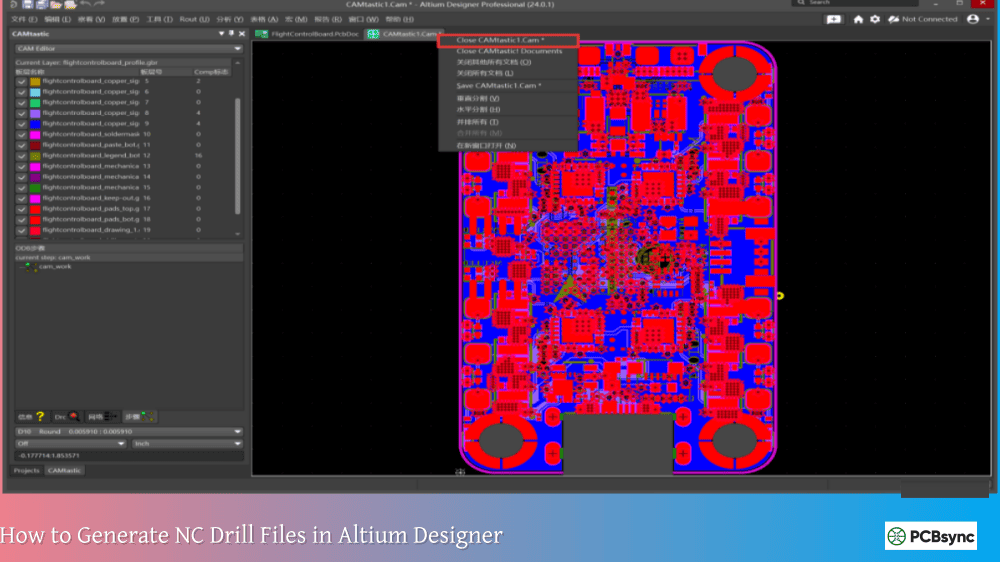
Using Altium’s CAM Editor
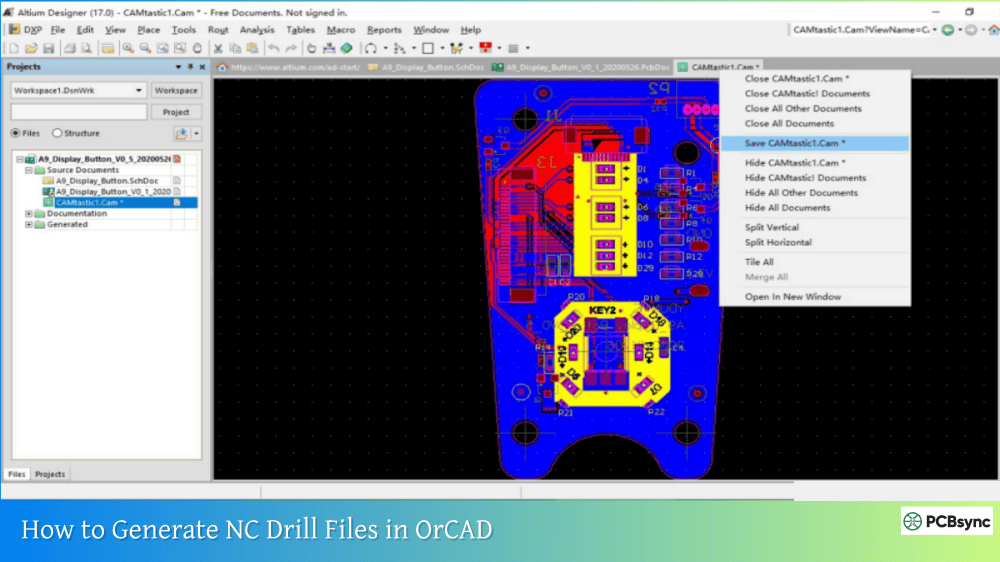
Altium Designer includes CAMtastic, a built-in CAM editor for verifying manufacturing outputs:
After generating outputs, the CAM document may open automatically
If not, import your drill file: File > Import > Drill
Overlay with your Gerber files to verify alignment
Check that all holes center properly on pads
External Verification Tools
Tool
Platform
Cost
Notes
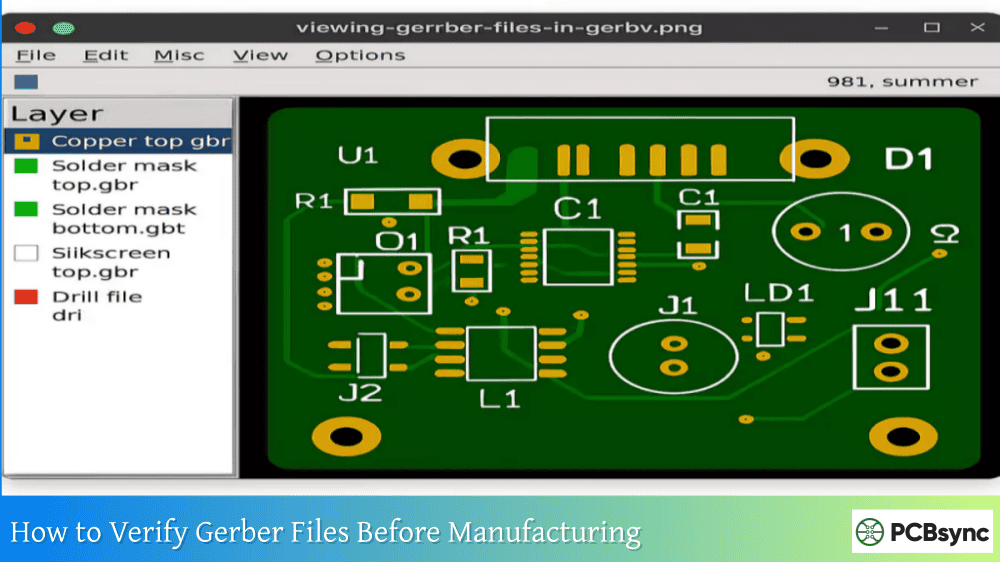
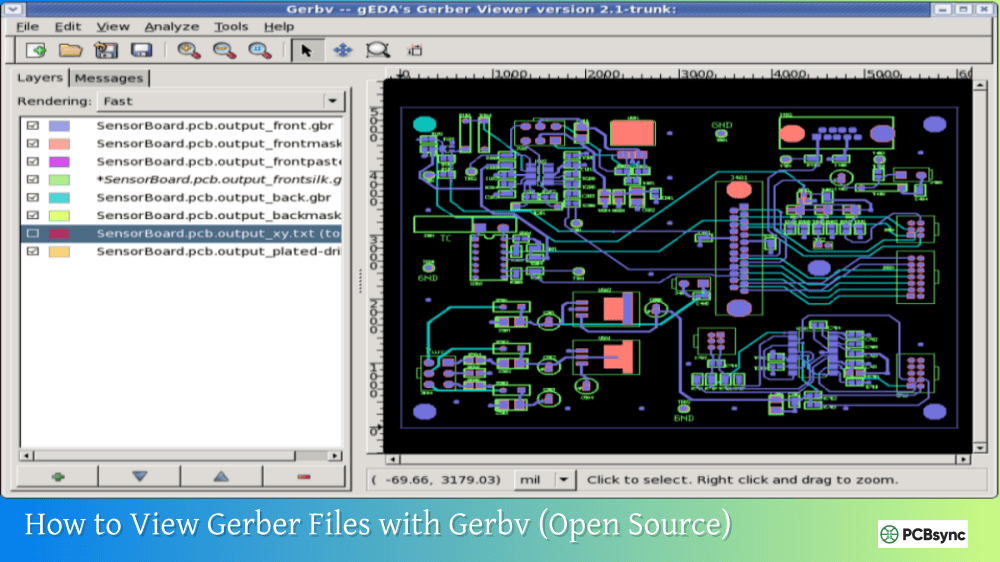
Gerbv
Windows/Linux
Free
Open source, reliable
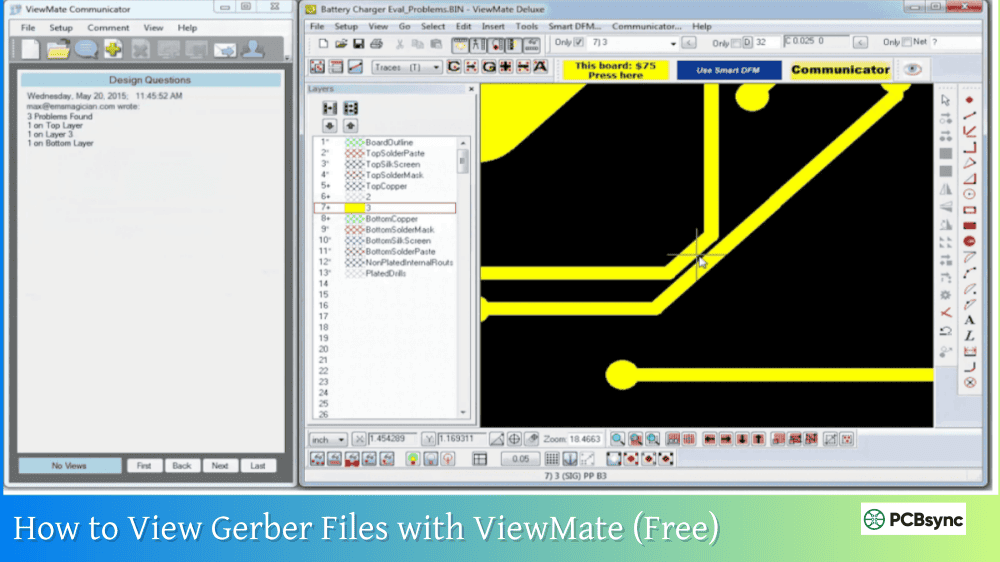
ViewMate
Windows
Free version
Professional quality viewer
GC-Prevue
Windows
Free
Industry standard
Reference Gerber Viewer
Web
Free
Ucamco’s official viewer
Verification Checklist
Before submitting to manufacturing:
Load drill file and all Gerber layers in viewer
Verify holes align with pad centers on all layers
Check that no holes appear outside the board outline
Confirm plated and non-plated holes are in correct files
Verify slot positions and dimensions
Review the drill tool report for expected hole sizes
Common NC Drill File Problems and Solutions
Problem 1: Drill Holes Offset from Pads
Symptoms: Holes appear shifted relative to copper pads when viewing files together
Causes and Solutions:
Cause
Solution
Origin mismatch
Match coordinate origin setting between Gerber and drill
Unit mismatch
Ensure both use same units (inches or mm)
Format mismatch
Use identical format settings (e.g., 2:4)
Problem 2: Drill Pattern Scaled Incorrectly
Symptoms: Entire drill pattern appears too large or too small
Causes and Solutions:
Cause
Solution
Unit interpretation error
Verify units in both export and import
Wrong format setting
Match format between Gerber and drill
Problem 3: Missing Holes in Output
Symptoms: Some holes don’t appear in the generated drill file
Causes and Solutions:
Cause
Solution
Hole on wrong layer pair
Check via layer assignments
Hole size zero
Verify pad/via properties
Filter excluding holes
Check generation options
Problem 4: Manufacturer Rejects .DRL File
Symptoms: Fabricator cannot process the binary drill file
Solution: Some manufacturers prefer the text-based .TXT Excellon file over the binary .DRL format. Disable the “Generate EIA Binary Drill File” option and provide only the .TXT file.
Problem 5: Blind/Buried Via Files Not Generated
Symptoms: Complex via structures missing from output
Solution: Verify Layer Stack Manager has proper drill pairs defined for each via type. Check that “Generate separate NC Drill files for VIA features” is enabled if using IPC 4761 via types.
Read more How to convert PCB Files in different Design software:
Always include clear documentation with your drill files:
README.txt or Fabrication Notes:- List all drill files with layer pair explanations- Specify format settings (units, format, zero suppression)- Note any special requirements (slots, back drilling, etc.)- Include stack-up drawing reference
File Naming Conventions
Use descriptive names that identify the drill file purpose:
For most applications, use 2:4 format in inches or 3:3 format in millimeters. The critical requirement is matching your Gerber file format exactly. Verify your manufacturer supports your chosen resolution before using higher precision formats like 2:5.
Should I generate separate files for plated and non-plated holes?
Yes, enabling “Generate separate NC Drill files for plated & non-plated holes” is recommended. Many manufacturers require this separation because PTH and NPTH features go through different process steps. Even manufacturers who don’t require it can easily merge the files.
Why are my drill holes offset from the pads?
Drill-to-pad offset is almost always caused by mismatched settings between your Gerber and NC drill exports. Check that units, format, zero suppression, and coordinate origin settings are identical in both configurations. If problems persist, try using “Keep leading and trailing zeroes” option.
Do I need to generate the binary .DRL file?
In most cases, no. The text-based Excellon .TXT file is universally accepted and easier for manufacturers to process. Some fabricators have reported issues with binary .DRL files, so unless your manufacturer specifically requests it, you can safely disable this option.
How do I handle blind and buried vias in drill files?
Altium Designer automatically generates separate drill files for each layer pair when your design includes blind or buried vias. Ensure your Layer Stack Manager has correct drill pairs defined, and include clear documentation explaining which file corresponds to which layer span.
Altium Designer NC Drill vs. Other CAD Tools
Having worked with multiple PCB design platforms, I can offer perspective on how Altium’s NC drill generation compares.
Drill Export Comparison Across Tools
Feature
Altium Designer
KiCad
Eagle
OrCAD
Excellon Format
Yes
Yes
Yes
Yes
Auto Layer Pair Detection
Yes
Partial
No
Yes
Separate PTH/NPTH
Option
Manual
Manual
Option
OutputJob Integration
Yes
No
No
Partial
CAM Editor Included
Yes
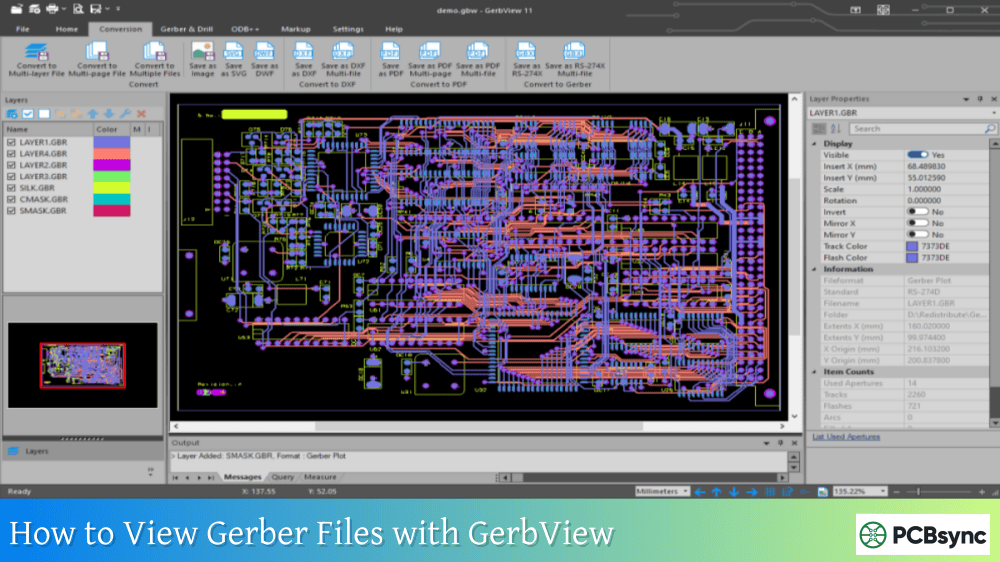
GerbView
Limited
Yes
Blind/Buried Via Support
Excellent
Good
Limited
Good
Altium’s Advantages for Drill File Generation
Altium Designer excels in several areas for NC drill output:
Integrated Layer Stack Management: The Layer Stack Manager and Via Types definition work seamlessly with drill file generation. You define your via structures once, and Altium automatically creates the appropriate drill files for each layer pair.
OutputJob Automation: The ability to configure all fabrication outputs in a single OutputJob file and generate everything with one click streamlines production workflows significantly.
CAMtastic Integration: The built-in CAM editor allows immediate verification of generated outputs without switching to external tools.
Advanced Topics: Back Drilling and Controlled Depth
For high-speed designs, back drilling (also called Controlled Depth Drilling or CDD) removes unused via stubs that can cause signal integrity issues.
Back Drilling in Altium Designer
Altium supports back drilling through the Layer Stack Manager:
Define back drill spans in your layer stack
Enable back drilling for specific via types
Configure back drill depth and tolerance
The NC drill output automatically generates separate files for back drilling operations, including:
Primary drill file for initial through-holes
Back drill file with larger diameter and controlled depth specifications
Configuring Back Drill Parameters
Parameter
Description
Typical Value
Back Drill Diameter
Larger than signal via
0.3-0.5mm larger
Depth Tolerance
Acceptable depth variation
±0.1mm
Stub Length
Remaining via barrel
0.2-0.3mm
Always coordinate back drilling requirements with your manufacturer, as this process requires precise depth control and may not be available from all fabricators.
Slots and Routed Features in NC Drill Files
Slots present unique challenges in drill file generation because they’re not simple circular holes.
Slot Generation Options
Altium provides the G85 drilled slot command option for creating slots:
With G85 Enabled: Slots are defined using the G85 command, which tells the CNC machine to drill overlapping holes from start point to end point.
With G85 Disabled: Slots may be output as rout commands requiring a different manufacturing process.
Slot Best Practices
Consideration
Recommendation
Minimum slot width
Match to available drill sizes
End radius
Equal to half the slot width
Documentation
Include slot dimensions in fab notes
Check with your manufacturer regarding their slot capabilities before finalizing your design.
Integrating NC Drill Generation into Your Workflow
Pre-Generation Checklist
Before generating NC drill files, verify:
Layer stack is complete — All layers defined with correct materials and thicknesses
Via types are configured — Each via type has proper start/end layers
Design rules pass — No undrilled holes or via errors
Origin is set — Board origin placed at consistent location
Post-Generation Verification
After generating outputs:
Open in CAM viewer — Verify all holes are present
Check alignment — Overlay with copper layers
Review tool report — Confirm expected drill sizes
Verify file count — Ensure all layer pairs have files
Conclusion: Ensuring Accurate NC Drill File Generation
Generating NC drill files in Altium Designer is straightforward once you understand the relationship between format settings and manufacturing requirements. The most important principle is consistency — your drill file settings must match your Gerber file settings exactly.
Key takeaways for reliable drill file generation:
Match all format settings between Gerber and NC drill exports
Use consistent origin references (absolute or relative)
Separate PTH and NPTH into distinct files
Verify outputs visually before sending to manufacturing
Include clear documentation with your fabrication package
Use OutputJob files for repeatable, production-ready outputs
Taking the extra time to configure and verify your NC drill files pays dividends in manufacturing success. A properly formatted drill file ensures that every via connects the right layers and every mounting hole lands exactly where your design intended.
Inquire: Call 0086-755-23203480, or reach out via the form below/your sales contact to discuss our design, manufacturing, and assembly capabilities.
Quote: Email your PCB files to Sales@pcbsync.com (Preferred for large files) or submit online. We will contact you promptly. Please ensure your email is correct.
Notes: For PCB fabrication, we require PCB design file in Gerber RS-274X format (most preferred), *.PCB/DDB (Protel, inform your program version) format or *.BRD (Eagle) format. For PCB assembly, we require PCB design file in above mentioned format, drilling file and BOM. Click to download BOM template To avoid file missing, please include all files into one folder and compress it into .zip or .rar format.