Inquire: Call 0086-755-23203480, or reach out via the form below/your sales contact to discuss our design, manufacturing, and assembly capabilities.
Quote: Email your PCB files to Sales@pcbsync.com (Preferred for large files) or submit online. We will contact you promptly. Please ensure your email is correct.
Notes: For PCB fabrication, we require PCB design file in Gerber RS-274X format (most preferred), *.PCB/DDB (Protel, inform your program version) format or *.BRD (Eagle) format. For PCB assembly, we require PCB design file in above mentioned format, drilling file and BOM. Click to download BOM template To avoid file missing, please include all files into one folder and compress it into .zip or .rar format.
How to Generate Gerber Files from Zuken CR-5000: Complete Manufacturing Output Guide
Zuken CR-5000 has been a workhorse in the PCB design industry for decades. While newer tools have emerged, CR-5000 remains deeply embedded in many engineering organizations, particularly in automotive, industrial, and consumer electronics sectors where established workflows and proven reliability matter more than having the latest features.
I’ve worked with CR-5000 across multiple companies and countless projects. The tool has its quirks, but once you understand its manufacturing output system, generating clean Gerber files becomes routine. What trips up most engineers, especially those transitioning from other EDA platforms, is CR-5000’s unique approach to layer management and output configuration.
This guide walks through the complete process of generating Gerber files from Zuken CR-5000, from initial design verification through final output validation. Whether you’re a CR-5000 veteran looking to optimize your workflow or new to the platform and trying to get your first board fabricated, this practical guide covers what you need to know.
Understanding CR-5000’s Output System Architecture
Before diving into step-by-step procedures, understanding how CR-5000 structures manufacturing output helps you navigate the system more effectively.
CR-5000 Board Designer Overview
CR-5000 Board Designer is the layout component where most manufacturing output generation occurs. The tool uses a database-driven architecture where your design data exists as objects with properties rather than simple graphical elements. This approach provides powerful design management but requires understanding how design objects map to manufacturing layers.
The Layer and Class System
CR-5000 organizes design data using layers and classes. Physical layers represent actual PCB layers (copper, mask, silk). Classes categorize types of objects (conductors, components, text). When generating Gerber output, you specify which combinations of layers and classes to include in each output file.
This flexibility is powerful but requires careful configuration. Missing a class means missing features in your output. Including the wrong class puts unwanted data on a layer.
Supported Output Formats
CR-5000 supports multiple manufacturing output formats including Gerber RS-274X (the industry standard extended Gerber), Gerber RS-274D (legacy format with separate aperture files), Excellon NC Drill (standard drill file format), and ODB++ (comprehensive manufacturing data format).
For most fabricators, Gerber RS-274X combined with Excellon drill files provides the best compatibility. ODB++ is gaining adoption but isn’t universally supported yet.
Preparing Your CR-5000 Design for Gerber Generation
Rushing to output generation without proper preparation leads to rejected fabrication submissions. These verification steps catch problems before they become expensive mistakes.
Running Design Rule Checks
CR-5000 provides comprehensive DRC capabilities. Before generating any manufacturing files, run a complete design rule check and resolve all errors.
Access DRC through the Check menu in Board Designer. Select All Checks for comprehensive verification. Critical checks include clearance violations between copper features, minimum trace width violations, drill-to-copper spacing issues, annular ring violations on all layers, net connectivity problems, and silk screen overlapping pad areas.
Address all errors before proceeding. Warnings deserve attention too since what CR-5000 considers acceptable might fall outside your fabricator’s capabilities.
Verifying Layer Stackup Configuration
Your layer stackup must accurately reflect the board you’re manufacturing. Incorrect stackup configuration leads to wrong layer outputs and fabrication problems.
In Board Designer, access layer configuration through Setup and then Layer Settings. Verify that all physical layers are present and correctly ordered, layer types are properly assigned (signal, plane, mixed), copper weights are correctly specified, and dielectric information matches your fabrication specification.
Pad Stack Verification
CR-5000’s pad stack definitions control how pads appear on each layer. Before output generation, verify that minimum drill sizes meet fabricator requirements (typically 0.2mm or larger), annular rings satisfy manufacturing tolerances, thermal reliefs are correctly defined for plane connections, and solder mask and paste mask clearances are appropriate.
Access pad stack definitions through the Library section. Review any custom pad stacks carefully since these are common sources of manufacturing issues.
Design Database Integrity Check
CR-5000’s database-driven architecture means data integrity matters. Run a database check before output generation.
Use the File menu and select Check Database. This identifies any corrupted objects or inconsistent references that could cause output problems. Resolve any issues found before proceeding.
Step-by-Step Guide to Generate Gerber Files from CR-5000
Now let’s walk through the complete Gerber generation process in Zuken CR-5000 Board Designer.
Step 1: Accessing the Plot Output System
Open your design in CR-5000 Board Designer. Navigate to Output and then Plot, or use File and then Plot depending on your CR-5000 version. This opens the Plot Configuration dialog, your control center for Gerber generation.
The Plot Configuration interface allows you to define, configure, and execute manufacturing outputs.
Step 2: Creating Output Plot Definitions
Each manufacturing layer requires its own plot definition. You’ll create definitions for each output file you need.
For a typical 4-layer board, create definitions for Top Copper (Layer 1), Inner Layer 2 (Ground Plane), Inner Layer 3 (Power Plane), Bottom Copper (Layer 4), Top Solder Mask, Bottom Solder Mask, Top Silkscreen, Bottom Silkscreen, Top Paste Mask, Bottom Paste Mask, and Board Outline.
Click New or Add Definition to create each plot definition. Give each definition a clear, descriptive name.
Step 3: Configuring Plot Device Settings
For each plot definition, configure the output device settings. Select Gerber as the output device type. Choose RS-274X for extended Gerber format (recommended). Specify the output file path and name.
Set format parameters including units (inches or millimeters matching your design), number format (typically 2:5 for imperial giving five decimal places, or 3:4 for metric), zero suppression (Leading is standard for most fabricators), and coordinate mode (Absolute is standard).
Step 4: Defining Layer and Class Content
This is where CR-5000’s flexibility becomes apparent. For each plot definition, specify exactly which layers and classes to include.
For copper layers, select the corresponding physical layer (Layer 1, Layer 2, etc.). Include classes for Conductor (traces and copper features), Via (via pads on this layer), Pad (component pads), and Copper Pour (filled copper areas). Include any test point or fiducial classes if used.
For solder mask layers, select the solder mask layer (typically named SMASK_TOP or SMASK_BOT). Include pad mask opening classes. Verify polarity settings match fabricator expectations.
For silkscreen layers, select the silkscreen layer (SILK_TOP or SILK_BOT). Include classes for RefDes (reference designators), Outline (component outlines), and Drawing (any additional silk graphics). Exclude any classes that shouldn’t appear on silk.
For paste mask layers, select the paste mask layer. Include SMD pad paste opening classes. Verify paste reduction settings if applicable.
For board outline, select the outline or mechanical layer. Include only the board boundary class. Exclude internal features unless specifically needed.
Step 5: Aperture Configuration
CR-5000 offers automatic and manual aperture configuration. For most applications, automatic aperture generation works well.
In the plot definition settings, select Auto Aperture or Dynamic Aperture mode. CR-5000 analyzes your design features and creates appropriate apertures during output generation.
If your fabricator provides a specific aperture table, select Fixed Aperture mode. Load their aperture definition file. CR-5000 maps design features to the predefined apertures.
Step 6: Setting Output File Names
Consistent naming helps fabricators identify your layers correctly. Configure meaningful filenames for each plot definition.
Layer Type
Suggested Filename
Extension
Top Copper
BoardName_Top
.GTL
Bottom Copper
BoardName_Bot
.GBL
Inner Layer 2
BoardName_L2
.G2
Inner Layer 3
BoardName_L3
.G3
Top Solder Mask
BoardName_TSM
.GTS
Bottom Solder Mask
BoardName_BSM
.GBS
Top Silkscreen
BoardName_TSilk
.GTO
Bottom Silkscreen
BoardName_BSilk
.GBO
Top Paste Mask
BoardName_TPaste
.GTP
Bottom Paste Mask
BoardName_BPaste
.GBP
Board Outline
BoardName_Outline
.GKO
NC Drill (PTH)
BoardName_PTH
.DRL
NC Drill (NPTH)
BoardName_NPTH
.DRL
Create a dedicated output folder within your project directory to keep manufacturing files organized.
Step 7: Generating the Gerber Files
With all plot definitions configured, you’re ready to generate files. Select the plot definitions you want to output. Use Select All for batch generation or select specific definitions.
Click Plot or Generate to create the output files. CR-5000 processes each definition and writes Gerber files to your specified locations.
Monitor the output log for any warnings or errors. Common messages include aperture generation notices (usually informational) and layer content warnings.
Step 8: Generating NC Drill Files
Drill file generation uses a similar but separate process. Access drill output through Output and then NC Drill, or through the Plot system with drill-specific configuration.
Configure drill output parameters including units matching your Gerber outputs for consistency, coordinate format compatible with your Gerber number format, tool table format (typically header format with tool definitions at file start), and zero suppression matching your Gerber settings.
CR-5000 allows separation of drill output by hole type. Generate separate files for plated through-holes (PTH), non-plated through-holes (NPTH), and blind or buried vias if your design includes them.
Execute the drill output and verify the tool table lists all drill sizes correctly.
Advanced CR-5000 Gerber Generation Techniques
Once you’ve mastered basic output generation, these techniques improve efficiency and handle complex scenarios.
Saving Plot Configurations
CR-5000 allows saving your plot configurations for reuse. After configuring all your plot definitions, save the configuration as a template file.
Use File and then Save Plot Setup within the plot dialog. Name the configuration meaningfully (for example, “4Layer_Standard_Output”). For future designs with similar layer structures, load this configuration and modify only design-specific parameters.
Batch Output Processing
For designs requiring multiple output runs (different fabricators, different revisions), CR-5000 supports batch processing. Create multiple plot configurations for different requirements. Use batch execution to generate all outputs with a single command. This ensures consistency and saves time.
Variant Output Generation
If your design includes variants (different component stuffing options), CR-5000 can generate variant-specific outputs. Configure plot definitions to respect variant settings. Generate separate output packages for each variant. Clearly label output folders by variant identifier.
Panelization Considerations
For panelized output, CR-5000 offers several approaches. You can create panels within CR-5000 using the panelization features, then output the complete panel as a single set of Gerbers. Alternatively, you can output single-board Gerbers and let your fabricator handle panel layout.
For prototype quantities, letting the fabricator panelize is usually simpler. For production volumes where you need specific panel layouts, handling it in CR-5000 gives you control.
Read more How to convert PCB Files in different Design software:
Never submit manufacturing files without independent verification. This step catches errors that are invisible within the source tool.
Using CR-5000’s Built-in Viewer
CR-5000 includes viewing capabilities for generated outputs. After generation, use the plot preview or Gerber viewer function. Check each layer for completeness. Overlay multiple layers to verify registration. Compare drill output with copper layers.
External Gerber Viewer Verification
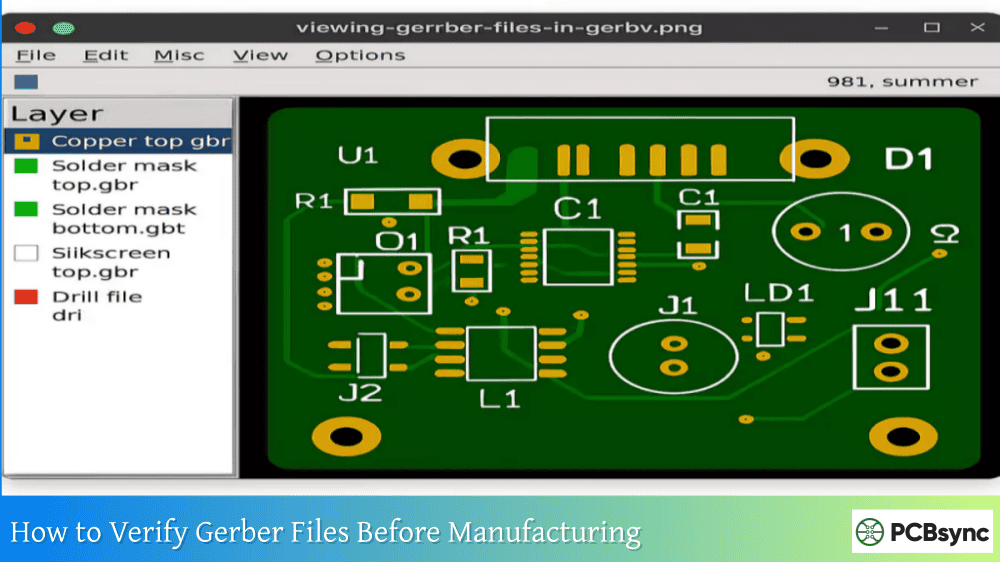
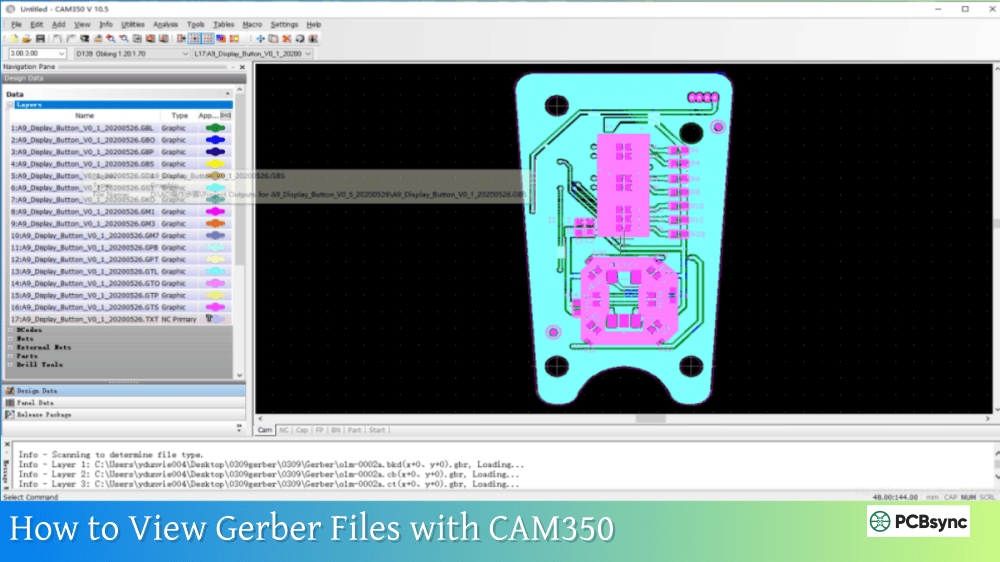
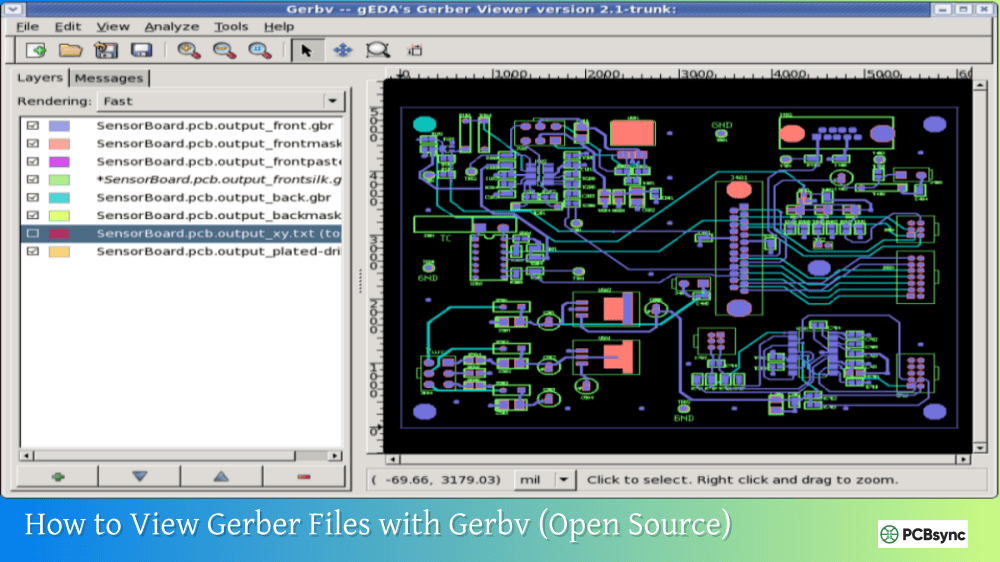
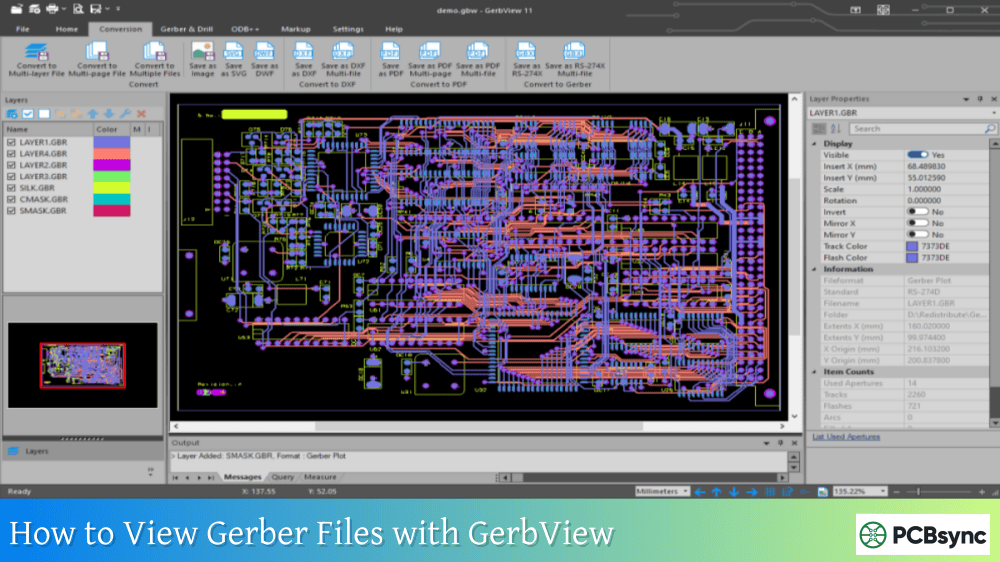
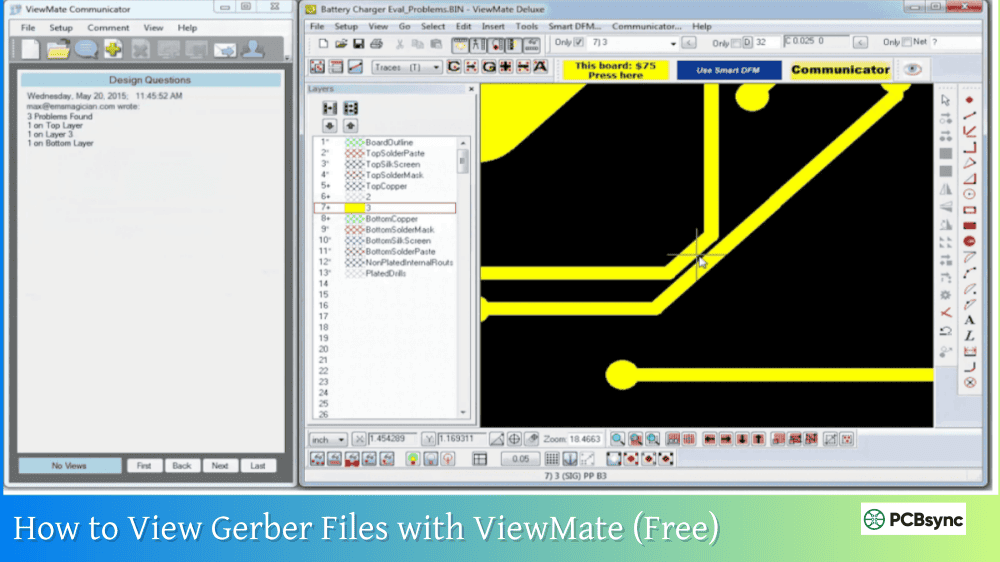
Verification in an external tool provides true independence. Load your complete Gerber package in a third-party viewer to catch any CR-5000-specific output issues, verify files work correctly outside the Zuken environment, and see what your fabricator’s CAM operator will see.
Recommended verification tools include GerbView from the KiCad project (free, cross-platform), ViewMate from Pentalogix (free, Windows-based with measurements), Ucamco Reference Gerber Viewer (free online tool), and ZofzPCB (free, provides 3D visualization).
Critical Verification Checkpoints
During review, systematically check layer-to-layer registration by overlaying copper layers to confirm alignment. Verify drill-to-pad alignment to ensure holes center on pads. Check solder mask clearances for adequate opening around pads. Confirm board outline is complete and correctly positioned. Verify no silkscreen overlaps pad areas. For plane layers, confirm clearances and thermal reliefs appear correctly.
Complete Manufacturing File Package Checklist
Before submission, verify your package includes all necessary files.
Even experienced engineers encounter output problems. Here are solutions to frequently occurring issues.
Missing Features in Gerber Output
When expected features don’t appear in output, verify the correct layer is selected in the plot definition. Check that all required classes are included. Look for layer or class filters that might exclude features. Confirm the feature exists on the expected layer in your design.
Incorrect Aperture Representation
If pads appear wrong (outlined instead of filled, wrong shapes), verify automatic aperture generation is enabled. Check for complex shapes that exceed aperture limits. Review any fixed aperture table mappings. Consider simplifying very complex custom pad shapes.
Drill and Gerber Misalignment
When drill holes don’t align with Gerber artwork, ensure identical origin points for all outputs. Verify units match between Gerber and drill configurations. Check coordinate format consistency. Look for any offset values applied differently.
Plane Layer Problems
If internal planes appear incorrect, verify layer type is correctly set as plane. Check polarity settings since planes often require negative polarity. Ensure thermal relief definitions are correct in pad stacks. Confirm your viewer interprets polarity correctly.
Output File Size Issues
For unexpectedly large files, check polygon complexity settings. Verify coordinate precision isn’t excessive. Look for redundant data in the design. Consider arc interpolation settings for curved features.
Useful Resources for CR-5000 Users
These resources provide additional support for CR-5000 manufacturing output.
For official documentation, Zuken provides CR-5000 documentation through their support portal at zuken.com/support. The CR-5000 Board Designer User Manual covers output generation in detail. Contact your Zuken support representative for technical assistance.
For Gerber format specifications, the official Gerber format specification is maintained by Ucamco at ucamco.com/gerber, covering both RS-274X and RS-274D formats.
For verification tools, ViewMate is available at pentalogix.com for free Gerber viewing. GerbView is part of the KiCad suite at kicad.org. The Ucamco Online Gerber Viewer is available at gerber-viewer.ucamco.com.
For community and peer support, Zuken user groups exist in various regions and can be found through Zuken’s website. EDAboard.com hosts discussions including Zuken tools. LinkedIn has CR-5000 user groups for networking and knowledge sharing.
For training resources, Zuken offers official CR-5000 training courses. Regional Zuken offices provide localized training. Some third-party training providers offer CR-5000 courses.
Frequently Asked Questions
What Gerber format should I use when generating output from CR-5000?
Use Gerber RS-274X (Extended Gerber) for maximum compatibility with PCB fabricators worldwide. This format embeds aperture definitions directly in each file, eliminating the need for separate aperture lists that could get mismatched. CR-5000 also supports the older RS-274D format, but there’s rarely a reason to use it with modern fabrication equipment. Always confirm format preferences with your manufacturer before generating final outputs.
How do I create separate drill files for plated and non-plated holes in CR-5000?
In CR-5000’s NC Drill output configuration, you can filter holes by type. Create one drill output definition configured to include only plated through-holes (PTH). Create a second definition for non-plated holes (NPTH). Configure each with appropriate hole type filtering. Name the files clearly (such as “BoardName_PTH.drl” and “BoardName_NPTH.drl”). This separation is important because plated and non-plated holes require different manufacturing processes.
Why are some features missing from my Gerber output files?
Missing features typically result from incomplete layer/class selection in your plot definition. CR-5000 requires explicit specification of which classes to include on each output layer. Review your plot definition and verify all relevant classes are selected. Common oversights include missing via classes on copper layers, missing text classes on silkscreen, or missing copper pour classes. Also verify the features exist on the correct layer in your design database.
Can I save my plot configurations for use on future designs?
Yes, CR-5000 allows saving plot configurations as template files. After configuring all your plot definitions with layer selections, format parameters, and naming conventions, save the configuration. For future designs with similar layer structures, load this template and modify only design-specific parameters like output paths. This approach ensures consistency across projects and significantly reduces setup time for new designs.
What additional files should I include with my Gerber submission?
Beyond Gerber and drill files, include a fabrication specification document detailing layer stackup, board thickness, copper weights, surface finish requirements, solder mask color, and any special manufacturing instructions. Provide a layer stackup drawing showing physical layer arrangement. For impedance-controlled designs, include target impedance values with tolerances. If ordering assembly services, add pick-and-place centroid data and a complete bill of materials. A readme file summarizing package contents helps fabricators navigate your submission efficiently.
Conclusion
Generating Gerber files from Zuken CR-5000 requires understanding the tool’s layer and class system, but once you’ve configured your output definitions correctly, the process becomes reliable and repeatable.
Start with thorough design verification. Configure each plot definition carefully, paying close attention to layer and class selections. Use consistent naming conventions and organize your output files logically. Always verify your outputs in an external viewer before submitting to your fabricator.
Build template configurations from successful outputs. CR-5000’s ability to save and reload plot setups makes this practical, and the time invested in creating good templates pays dividends across future projects.
CR-5000 has proven itself across countless successful designs. Its manufacturing output system, while requiring more explicit configuration than some newer tools, provides the control needed for complex, demanding applications. Master the output process, and you’ll consistently deliver fabrication packages that translate your designs into physical boards without issues.
When problems occur, approach troubleshooting systematically. Check layer and class selections, verify format parameters, and compare against known-good outputs from previous projects. The CR-5000 user community and Zuken support resources can help with unusual situations.
Your design work deserves manufacturing files that accurately represent it. Take the time to configure CR-5000’s output system correctly, and you’ll build confidence with your fabricators through consistently clean submissions.
Inquire: Call 0086-755-23203480, or reach out via the form below/your sales contact to discuss our design, manufacturing, and assembly capabilities.
Quote: Email your PCB files to Sales@pcbsync.com (Preferred for large files) or submit online. We will contact you promptly. Please ensure your email is correct.
Notes: For PCB fabrication, we require PCB design file in Gerber RS-274X format (most preferred), *.PCB/DDB (Protel, inform your program version) format or *.BRD (Eagle) format. For PCB assembly, we require PCB design file in above mentioned format, drilling file and BOM. Click to download BOM template To avoid file missing, please include all files into one folder and compress it into .zip or .rar format.