Inquire: Call 0086-755-23203480, or reach out via the form below/your sales contact to discuss our design, manufacturing, and assembly capabilities.
Quote: Email your PCB files to Sales@pcbsync.com (Preferred for large files) or submit online. We will contact you promptly. Please ensure your email is correct.
Notes: For PCB fabrication, we require PCB design file in Gerber RS-274X format (most preferred), *.PCB/DDB (Protel, inform your program version) format or *.BRD (Eagle) format. For PCB assembly, we require PCB design file in above mentioned format, drilling file and BOM. Click to download BOM template To avoid file missing, please include all files into one folder and compress it into .zip or .rar format.
How to Generate Gerber Files from Siemens Xpedition: A Complete PCB Engineer’s Guide
If you’ve spent any time in PCB design, you know that moment of truth when your layout is complete and it’s time to hand off manufacturing data. For those of us using Siemens Xpedition (what many of us still call Mentor Xpedition out of habit), generating Gerber files correctly can mean the difference between boards that work on the first spin and costly respins that blow your schedule.
I’ve been working with Xpedition for over a decade, and I’ve learned that while the tool is incredibly powerful for complex designs, the Gerber generation workflow has some quirks that trip up even experienced engineers. This guide walks you through the complete process, from initial setup to final verification.
Before diving into the how-to, let’s briefly cover the fundamentals. Gerber files are the industry-standard format that PCB fabricators use to manufacture your boards. Think of them as the “blueprints” that tell the fab house exactly where to place copper, drill holes, apply solder mask, and print silkscreen.
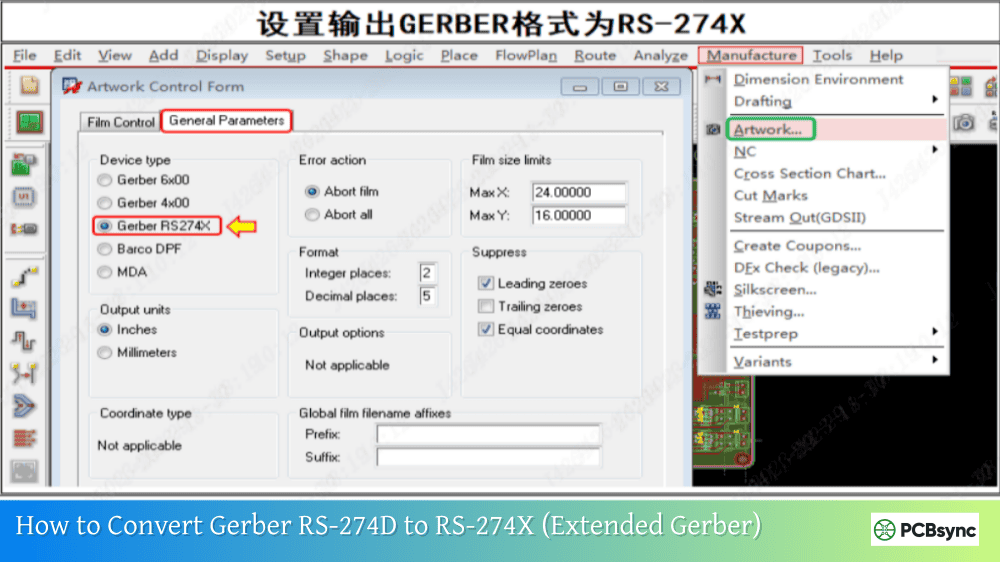
The current standard is RS-274X (also called Extended Gerber or Gerber X2), which includes embedded aperture information. Most modern fabs also accept the newer Gerber X3 format, though RS-274X remains the most widely supported.
Getting clean Gerber files starts well before you open the CAM output menu. Here’s what I always check before generating manufacturing data.
Run Design Rule Checks First
Never generate Gerbers from a design with DRC errors. In Xpedition Layout, run a complete verification:
Open your design in Xpedition Layout
Navigate to Verify > Run DRC
Address all errors (warnings can sometimes be waived, but document them)
Pay special attention to clearance violations and unconnected nets
Verify Your Layer Stackup
Your layer stackup definition directly affects how Gerber files are generated. Check that:
All layer names match your fabricator’s expectations
Copper weights are correctly specified
Dielectric thicknesses are accurate
The stackup matches your impedance calculations
To review your stackup in Xpedition: Setup > Cross Section Editor
Clean Up Your Database
Before output, perform these housekeeping tasks:
Remove unused padstacks and cell definitions
Delete orphan vias and traces
Verify all planes are properly filled (Flood > Plane Shapes)
Check that no geometry extends beyond the board outline
Step-by-Step Gerber File Generation in Siemens Xpedition
Now let’s walk through the actual Gerber generation process. Xpedition uses the CAM Documents feature to define and generate manufacturing outputs.
Step 1: Access the CAM Document Manager
In Xpedition Layout, navigate to:
Output > CAM Documents > CAM Document Manager
This opens the central interface where you’ll configure all your manufacturing outputs. If you’re working with a template that’s already been set up, you’ll see existing CAM document definitions here.
Step 2: Create a New CAM Document Set
For a new design or when starting fresh:
Click New in the CAM Document Manager
Select Gerber as the output format
Choose RS-274X (Extended Gerber) for maximum compatibility
Name your document set something meaningful like “Production_Gerbers_RevA”
Step 3: Configure Layer Mapping
This is where attention to detail really matters. You need to map each physical layer to a Gerber output file.
Physical Layer
Suggested Gerber Name
Content
Top Copper
design_name.GTL
Signal traces, pads, copper pours
Bottom Copper
design_name.GBL
Signal traces, pads, copper pours
Inner Layer 2
design_name.G2
Power or signal plane
Inner Layer 3
design_name.G3
Ground or signal plane
Top Solder Mask
design_name.GTS
Mask openings
Bottom Solder Mask
design_name.GBS
Mask openings
Top Silkscreen
design_name.GTO
Reference designators, logos
Bottom Silkscreen
design_name.GBO
Reference designators
Top Paste
design_name.GTP
SMD pad openings
Bottom Paste
design_name.GBP
SMD pad openings
Board Outline
design_name.GKO
Mechanical boundary
Step 4: Set Gerber Format Parameters
In the CAM document properties, configure these critical settings:
Format Settings:
Coordinate Format: 2:5 (2 integer digits, 5 decimal) for metric, or 2:4 for imperial
Units: Match your design units (preferably millimeters)
Zero Suppression: Leading zero suppression is standard
Polarity: Positive for signal layers, check mask layer requirements
Mirror: Only mirror bottom-side layers if required by your fab
Plot Fills: Enable for plane layers
Include Testpoints: Based on your DFT requirements
Step 6: Generate the Gerber Files
With configuration complete:
Select all documents you want to generate
Click Generate or use Output > Generate CAM Documents
Specify the output directory
Review the generation log for any warnings
Xpedition will create your Gerber files in the specified location. I recommend creating a dedicated “Manufacturing” folder within your project structure.
Generating Drill Files in Xpedition
Gerber files only tell part of the story. You also need NC drill files for all the holes in your board.
Common Gerber Generation Issues in Xpedition and How to Fix Them
After troubleshooting hundreds of Gerber issues, here are the problems I see most frequently.
Missing Plane Fills
Symptom: Inner plane layers appear empty or have missing copper.
Solution: Run plane flood before generating Gerbers. Flood > Plane Shapes > All. Also verify that your plane shape boundaries are properly defined.
Aperture Flash Errors
Symptom: Pads appear as drawn shapes instead of clean flashes.
Solution: Check that all padstacks use standard apertures. Custom pad shapes may need to be converted to aperture macros. In CAM settings, enable “Convert complex pads to regions.”
Misaligned Drill Holes
Symptom: Drill files don’t align with copper pads when overlaid.
Solution: Verify that Gerber and drill files use identical origin points and units. Check the coordinate format matches between outputs.
Siemens Learning Center: Online courses for Xpedition certification
YouTube Xpedition Tutorials: Search for “Xpedition CAM output” for video walkthroughs
Frequently Asked Questions
What Gerber format should I use in Xpedition for maximum compatibility?
RS-274X (Extended Gerber) remains the most widely accepted format across PCB fabricators worldwide. While Gerber X2 offers additional embedded metadata like layer function and material information, not all fab houses fully support it yet. When in doubt, ask your fabricator, but RS-274X is the safe choice that works everywhere.
How do I include panelization information in my Gerber output?
Xpedition handles panelization through the Panel Editor tool. Create your panel layout first, then generate Gerbers from the panel design rather than the individual board. This ensures breakaway tabs, fiducials, and tooling holes are included in your manufacturing data. Some engineers prefer to let the fab house handle panelization—communicate your preference clearly.
Can I generate ODB++ instead of Gerber files from Xpedition?
Yes, Xpedition fully supports ODB++ output, which many fabs prefer because it contains more intelligent design data. Navigate to Output > CAM Documents, create a new document, and select ODB++ as the format. ODB++ bundles all layer data, drill information, and netlist data into a single package, reducing the chance of missing files.
Why are my Gerber files much larger than expected?
Large Gerber files typically result from complex polygon fills or copper pours with many vertices. In Xpedition, you can reduce file size by adjusting the arc resolution settings in CAM output options. Also, verify that you’re using RS-274X with embedded apertures rather than the older RS-274D format, which generates separate aperture files and tends to create larger output.
How do I handle blind and buried vias in Gerber output?
Blind and buried vias require separate drill files for each drill span in your stackup. In Xpedition’s CAM Document Manager, create individual NC Drill outputs filtered by via type and layer span. Clearly label each file (e.g., “DrillL1-L3_Blind.drl”) and include a drill legend or README explaining the via structure to your fabricator.
Wrapping Up
Generating Gerber files from Siemens Xpedition isn’t complicated once you understand the workflow, but it does require attention to detail. The key takeaways are: always verify your design before output, use consistent CAM document templates, and never skip the verification step before sending files to fabrication.
I’ve seen too many engineers rush through Gerber generation only to discover missing layers or format issues after boards arrive from the fab house. Taking an extra fifteen minutes to check your output can save weeks of schedule slip and thousands of dollars in respins.
If you’re new to Xpedition or transitioning from another tool, spend time setting up your CAM document templates correctly. Once configured, you can reuse these templates across projects, making future Gerber generation nearly foolproof.
Inquire: Call 0086-755-23203480, or reach out via the form below/your sales contact to discuss our design, manufacturing, and assembly capabilities.
Quote: Email your PCB files to Sales@pcbsync.com (Preferred for large files) or submit online. We will contact you promptly. Please ensure your email is correct.
Notes: For PCB fabrication, we require PCB design file in Gerber RS-274X format (most preferred), *.PCB/DDB (Protel, inform your program version) format or *.BRD (Eagle) format. For PCB assembly, we require PCB design file in above mentioned format, drilling file and BOM. Click to download BOM template To avoid file missing, please include all files into one folder and compress it into .zip or .rar format.