Inquire: Call 0086-755-23203480, or reach out via the form below/your sales contact to discuss our design, manufacturing, and assembly capabilities.
Quote: Email your PCB files to Sales@pcbsync.com (Preferred for large files) or submit online. We will contact you promptly. Please ensure your email is correct.
Notes: For PCB fabrication, we require PCB design file in Gerber RS-274X format (most preferred), *.PCB/DDB (Protel, inform your program version) format or *.BRD (Eagle) format. For PCB assembly, we require PCB design file in above mentioned format, drilling file and BOM. Click to download BOM template To avoid file missing, please include all files into one folder and compress it into .zip or .rar format.
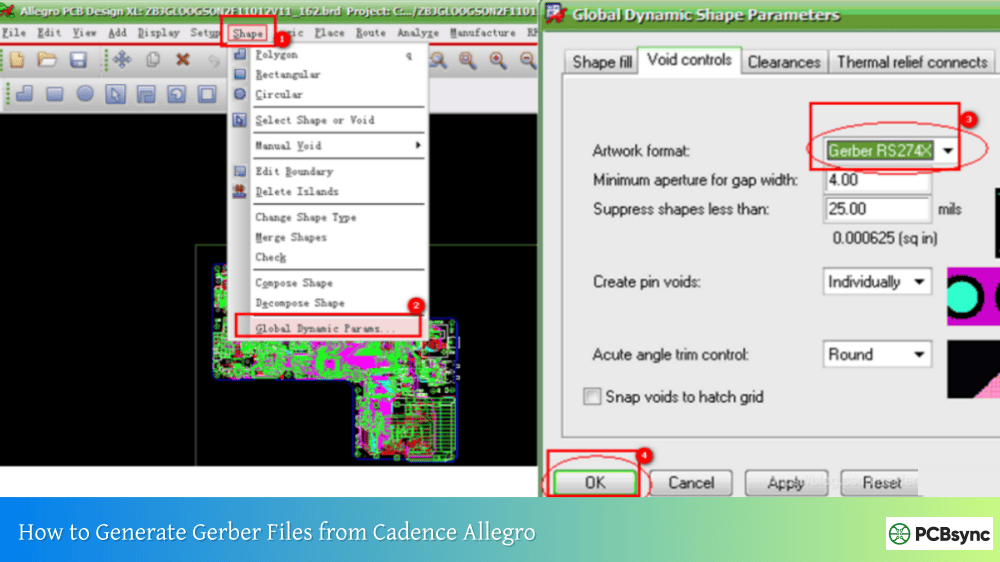
If you have ever tried to export Gerber files from Cadence Allegro or OrCAD PCB Editor, you know it is not exactly intuitive. Unlike KiCad or Eagle where a simple CAM processor gets the job done in minutes, Allegro takes a bottom-up approach that requires you to manually configure each “film” before exporting anything. I have seen entire engineering teams struggle with this process, and fabricators regularly receive incomplete packages from Allegro users who missed a step somewhere.
This guide cuts through the complexity and gives you a reliable, step-by-step method to generate Gerber files from Cadence Allegro that your PCB manufacturer will actually accept. Whether you are running Allegro 16.x, 17.x, or the latest OrCAD release, the fundamental workflow remains the same.
Understanding Gerber Files and Films in Cadence Allegro
Before diving into the export process, it helps to understand Allegro’s terminology. What most PCB software calls “layers,” Allegro refers to as “films,” a term that dates back to when photoplotters exposed actual photographic film for PCB manufacturing. Each film corresponds to a single Gerber file representing one layer of your board.
A complete manufacturing package from Cadence Allegro typically includes these essential files:
For multi-layer boards, you will also need inner copper layers and potentially inner plane layers. The solder mask and drill files are non-negotiable—without them, your fabricator cannot manufacture the board correctly, even if they have perfect copper artwork.
Pre-Export Checklist for Cadence Allegro
Running through these checks before generating Gerber files saves time and prevents embarrassing re-submissions to your manufacturer.
Run Status and Database Checks
Open your board file (.brd) in Allegro PCB Editor and verify the design status. Navigate to Tools → Database Check and ensure all results display green. Red or yellow warnings indicate problems that could translate into manufacturing defects or incomplete Gerber output.
Common issues flagged by database check include:
Unconnected pins or dangling traces
Overlapping geometry causing short circuits
Missing padstack definitions
Constraint violations
Address these issues before proceeding. A clean database check does not guarantee perfect Gerbers, but a failing check almost guarantees problems.
Verify Design Rule Check (DRC) Status
Run a final DRC by selecting Tools → Quick Reports → DRC. Clear any violations or document them explicitly in your fabrication notes. Pay particular attention to:
Minimum trace width violations
Clearance errors between copper features
Drill-to-copper spacing issues
Solder mask expansion problems
Confirm Layer Stackup
Double-check your layer stackup definition matches your intended board construction. Go to Setup → Cross-section and verify the layer order, materials, and thicknesses are correct. This information affects how Allegro generates artwork for inner layers, particularly for negative plane layers.
Setting Up Views in Cadence Allegro for Gerber Generation
Allegro uses Views to group related design elements that should appear together on a single film. You will create separate Views for each Gerber layer before exporting. This step is unique to Allegro and trips up many engineers accustomed to other PCB tools.
Accessing the Color Dialog
Press Ctrl+F5 or navigate to Setup → Colors to open the Color Dialog. This is where you configure which subclasses appear in each View.
Creating Views for Each Gerber Layer
In the Color Dialog, you will notice a Views dropdown that may be empty initially. For each Gerber file you need to generate, create a View containing only the relevant subclasses:
For Top Copper Film:
ETCH/TOP
PIN/TOP
VIA CLASS/TOP
BOARD GEOMETRY/OUTLINE (for reference)
For Bottom Copper Film:
ETCH/BOTTOM
PIN/BOTTOM
VIA CLASS/BOTTOM
For Solder Mask Films:
BOARD GEOMETRY/SOLDERMASK_TOP or SOLDERMASK_BOTTOM
PIN subclasses as needed
VIA CLASS as needed
Save each View configuration with a descriptive name that matches its purpose. This makes the film control setup much easier in the next step.
Generating Gerber Files Using the Artwork Control Form
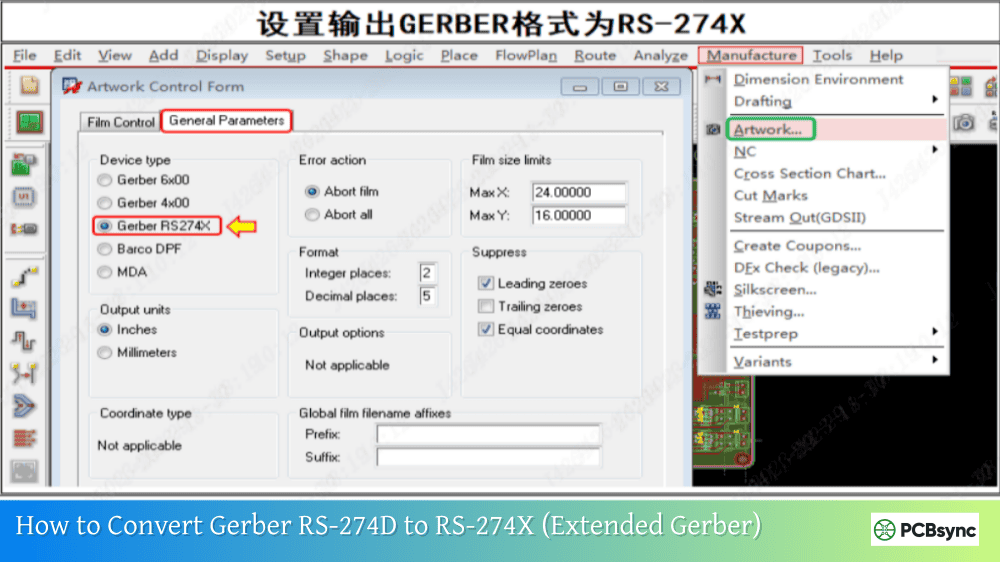
With Views configured, you are ready to export Gerber files. Navigate to Manufacture → Artwork to open the Artwork Control Form. This dialog contains two critical tabs: General Parameters and Film Control.
Configuring General Parameters in Allegro
Click the General Parameters tab and configure these essential settings:
The Undefined Line Width setting deserves special attention. Allegro defaults this to zero, which causes problems when your board outline or other geometry has no explicit line width assigned. Set this to at least 0.1mm (approximately 4 mils) to ensure all lines appear in your Gerber output. Zero-width lines are invisible to your fabricator and can result in missing board outlines.
Adding Films to the Artwork Control Form
Switch to the Film Control tab. Here you will add individual films for each Gerber layer. The process works as follows:
Step 1: Right-click on an existing folder (like TOP) and select Add Manual
Step 2: Enter a descriptive film name such as OUTLINE, TOP_COPPER, or SOLDERMASK_TOP
Step 3: In the Subclass Selection window, expand the relevant categories and check the appropriate subclasses
Step 4: Click OK to add the film to your Available Films list
Repeat this process for each required layer. For a standard two-layer board, you need at minimum:
OUTLINE (Board Geometry → DESIGN_OUTLINE or OUTLINE)
TOP_COPPER (ETCH/TOP, PIN/TOP, VIA CLASS/TOP)
BOTTOM_COPPER (ETCH/BOTTOM, PIN/BOTTOM, VIA CLASS/BOTTOM)
SOLDERMASK_TOP (appropriate mask subclasses)
SOLDERMASK_BOTTOM (appropriate mask subclasses)
SILKSCREEN_TOP (SILKSCREEN_TOP subclass)
SILKSCREEN_BOTTOM (SILKSCREEN_BOTTOM subclass)
Creating the Gerber Artwork Files
Once all films are configured:
Click Select All at the bottom of the Available Films list
Click Create Artwork
Monitor the log window for errors or warnings
Click OK when complete
Allegro generates the Gerber files in a subdirectory called “artwork” within your project folder. Files typically receive .art extensions, though some versions use .pho extensions.
Generating NC Drill Files from Cadence Allegro
Gerber files alone cannot manufacture your PCB. You need NC drill files that specify hole locations and sizes. This is a separate export process in Allegro and is frequently overlooked by new users.
Accessing the NC Drill Dialog
Navigate to Manufacture → NC → NC Drill to open the NC Drill configuration window.
Configuring NC Drill Parameters
Before generating the drill file, click Parameters (or NC Parameters in some versions) to access critical settings:
Critical Setting: Enable Enhanced Excellon Format. By default, Allegro does not export in Excellon format, which causes compatibility problems with many fabricators and Gerber viewers. This single checkbox solves most drill file issues.
Generating the Drill File
Back in the NC Drill window:
Verify the output file name and location
Check Auto Tool Select to automatically assign drill tool numbers
Check Repeat codes for optimized output
Click Drill to generate the file
The drill file appears in your project directory with a .drl or .tap extension. Some Allegro versions also generate supporting files like nc_param.txt containing drill metadata.
Creating Drill Legends (Optional)
For comprehensive documentation, generate a drill legend showing hole sizes and symbols. Navigate to Manufacture → NC → Drill Legend and configure the parameters. This creates a visual reference chart that helps fabricators verify drill tool assignments.
Cadence Allegro Gerber File Extensions and Naming Conventions
Allegro uses file extensions that differ from the Protel/Altium conventions most fabricators expect. Understanding these extensions helps you verify your export and communicate with manufacturers.
Allegro Extension
Layer Type
Equivalent Protel Extension
.art
Artwork (any layer)
Various
.pho
Photo plot output
Various
TOP.art
Top copper
.GTL
BOT.art
Bottom copper
.GBL
SMT.art
Solder mask top
.GTS
SMB.art
Solder mask bottom
.GBS
SST.art
Silkscreen top
.GTO
SSB.art
Silkscreen bottom
.GBO
.drl
Drill file
.TXT or .DRL
.tap
Drill file (TAP format)
.TXT
Many fabricators can handle Allegro naming conventions, but if you encounter issues, consider renaming files to match standard Protel extensions. The actual file content remains valid regardless of the extension.
Read more How to convert PCB Files in different Design software:
Common Gerber Generation Problems in Cadence Allegro
Missing Board Outline in Gerber Files
This problem affects Allegro users constantly. The board outline must exist on a proper subclass (typically BOARD GEOMETRY/OUTLINE or BOARD GEOMETRY/DESIGN_OUTLINE) and must be explicitly included in your artwork film definition.
Solution: Create a dedicated OUTLINE film that includes only the BOARD GEOMETRY/OUTLINE subclass. Verify the outline is a closed polygon with non-zero line width.
Zero-Width Lines Not Appearing
If your board outline or other geometry has zero line width assigned, it will not appear in the Gerber output.
Solution: In General Parameters, set Undefined Line Width to at least 0.1mm or 4 mils.
Drill Holes Misaligned with Pads
Drill misalignment typically results from mismatched units or coordinate origins between Gerber and drill exports.
Solution: Ensure Output Units and Coordinate settings match exactly between Artwork Control Form and NC Drill parameters. Use absolute coordinates for both.
Drill File Not in Excellon Format
Some Gerber viewers and fabricators cannot read Allegro’s default drill format.
Solution: Enable Enhanced Excellon Format in NC Drill Parameters before generating the drill file.
Missing Solder Mask Layers
Users frequently export copper and outline but forget solder mask layers, which are essential for proper board coating.
Solution: Always create separate films for SOLDERMASK_TOP and SOLDERMASK_BOTTOM. Verify both appear in your final file package.
Verifying Your Cadence Allegro Gerber Output
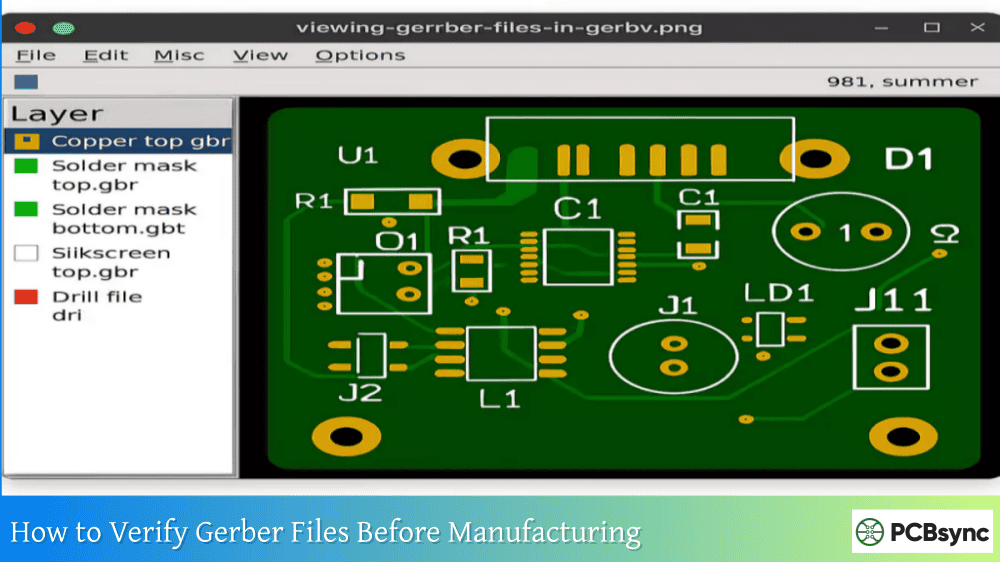
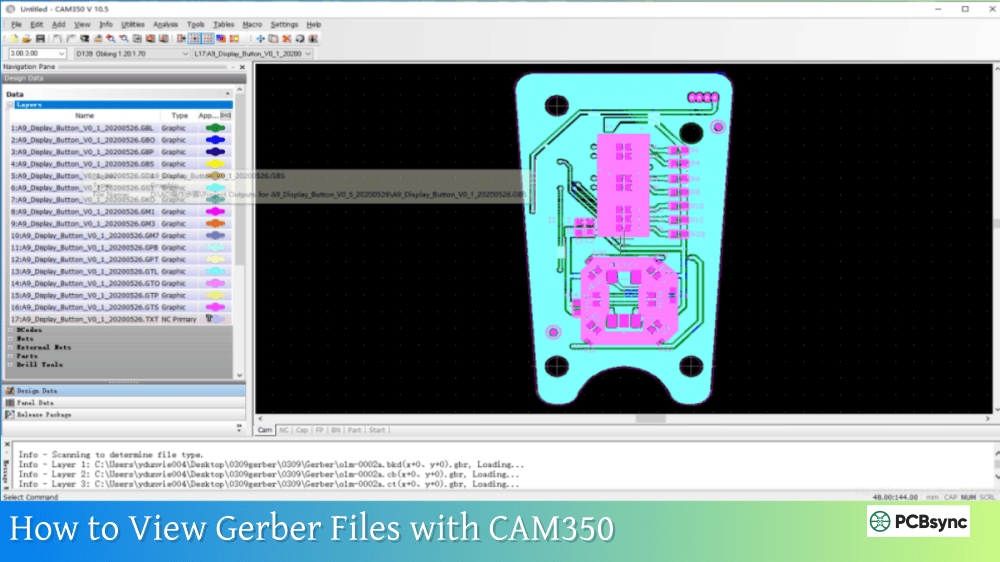
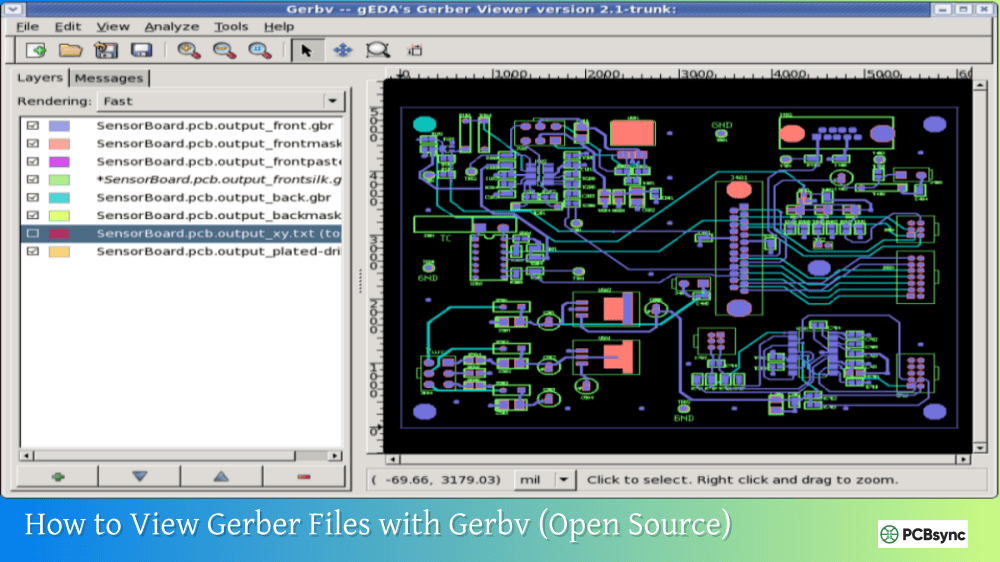
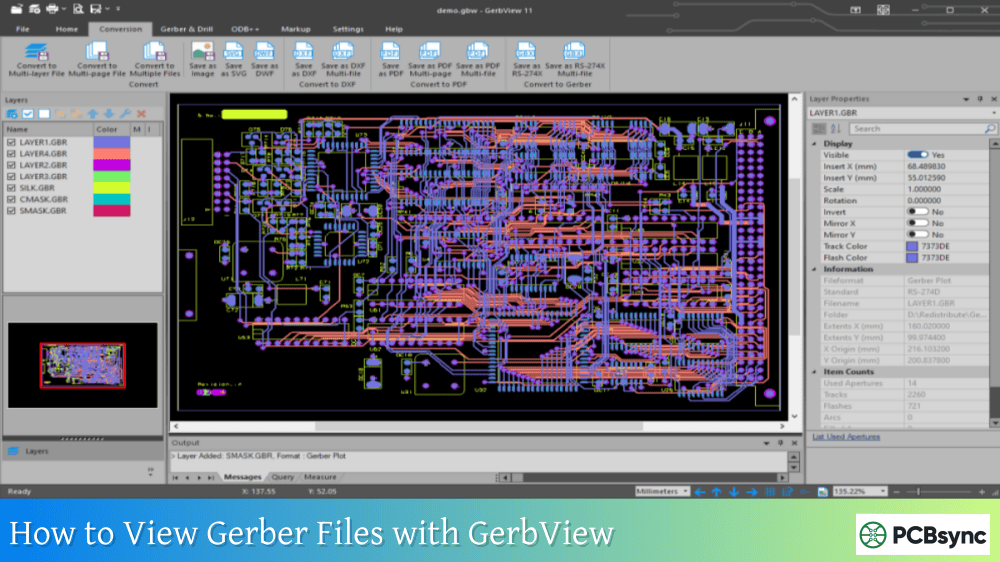
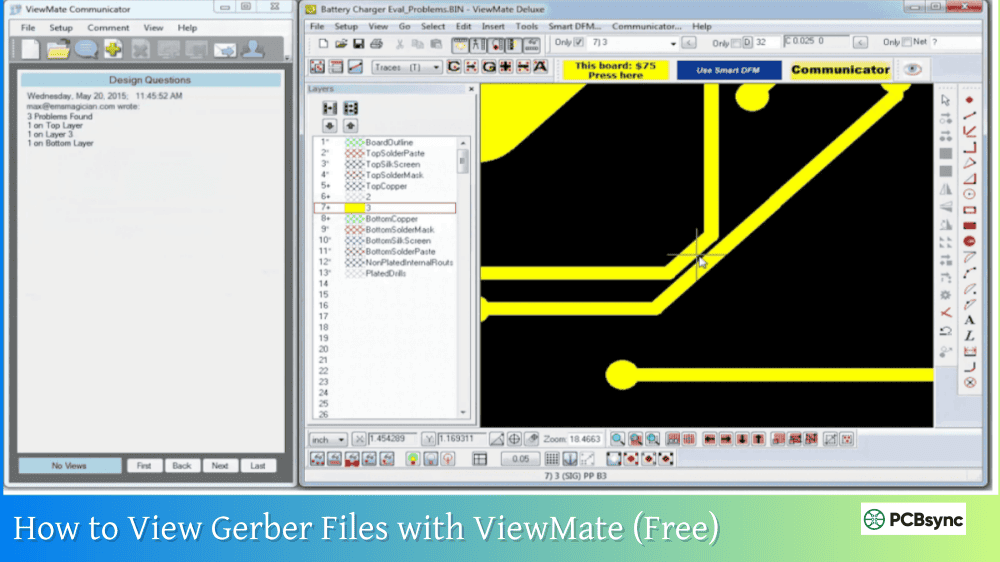
Before sending files to manufacturing, verify them in an independent viewer. Do not rely solely on Allegro’s built-in viewing.
Recommended verification steps:
Load all Gerber files into a third-party viewer
Overlay the drill file on copper layers to check alignment
Verify board outline dimensions match your design intent
Confirm solder mask openings align with pads
Check silkscreen does not overlap solder mask openings
Package all required files into a single .zip archive. Include only manufacturing files, not temporary files or project databases.
Useful Resources for Cadence Allegro Gerber Generation
What is the difference between Allegro and OrCAD for Gerber generation?
Allegro and OrCAD PCB Editor share the same interface and Gerber export process. The main difference is licensing—Allegro targets advanced high-speed designs while OrCAD handles mid-range complexity at a lower price point. The Artwork Control Form and NC Drill procedures are identical in both products.
Why do my Gerber files have .art extensions instead of standard extensions?
Allegro uses .art (artwork) extensions by default. Most modern fabricators can process these files regardless of extension. If your manufacturer requires standard extensions (.GTL, .GBL, etc.), you can safely rename the files. The content format remains Gerber RS274X, which is universally compatible.
How do I export Gerber files for a multi-layer board in Allegro?
For multi-layer boards, create additional films for each inner layer in the Artwork Control Form. Inner signal layers use subclasses like ETCH/IN1, ETCH/IN2, etc. Inner planes may require negative polarity settings depending on your stackup. Also ensure your NC Drill export includes all drill pairs for blind and buried vias if applicable.
Why does my fabricator say the drill file is not in the correct format?
Allegro’s default drill output is not Excellon format, which causes compatibility issues. Go to Manufacture → NC → NC Drill, click Parameters, and enable Enhanced Excellon Format. Regenerate the drill file and resubmit to your fabricator.
Can I automate Gerber generation in Cadence Allegro?
Yes, Allegro supports SKILL programming for automation. You can create scripts that configure artwork films, set parameters, and generate outputs automatically. For simpler needs, save your Artwork Control Form configuration with all films defined, then reuse it across projects by clicking Select All and Create Artwork after verifying layer assignments.
Final Recommendations for Allegro Gerber Export
Generating Gerber files from Cadence Allegro requires more manual configuration than most modern PCB tools, but the process becomes routine once you understand the workflow. Create a standard set of film definitions that you reuse across projects. Document your General Parameters settings and NC Drill configuration so you can replicate successful exports.
Always verify your output in an independent Gerber viewer before sending to manufacturing. The few minutes spent checking alignment and completeness prevents costly delays and board re-spins. Keep your fabricator’s specific requirements on hand, as some manufacturers have preferences for file naming, format settings, or additional documentation.
With practice, Allegro’s Gerber generation becomes second nature, and the software’s detailed control over each film actually provides flexibility that simpler tools lack.
Inquire: Call 0086-755-23203480, or reach out via the form below/your sales contact to discuss our design, manufacturing, and assembly capabilities.
Quote: Email your PCB files to Sales@pcbsync.com (Preferred for large files) or submit online. We will contact you promptly. Please ensure your email is correct.
Notes: For PCB fabrication, we require PCB design file in Gerber RS-274X format (most preferred), *.PCB/DDB (Protel, inform your program version) format or *.BRD (Eagle) format. For PCB assembly, we require PCB design file in above mentioned format, drilling file and BOM. Click to download BOM template To avoid file missing, please include all files into one folder and compress it into .zip or .rar format.