Inquire: Call 0086-755-23203480, or reach out via the form below/your sales contact to discuss our design, manufacturing, and assembly capabilities.
Quote: Email your PCB files to Sales@pcbsync.com (Preferred for large files) or submit online. We will contact you promptly. Please ensure your email is correct.
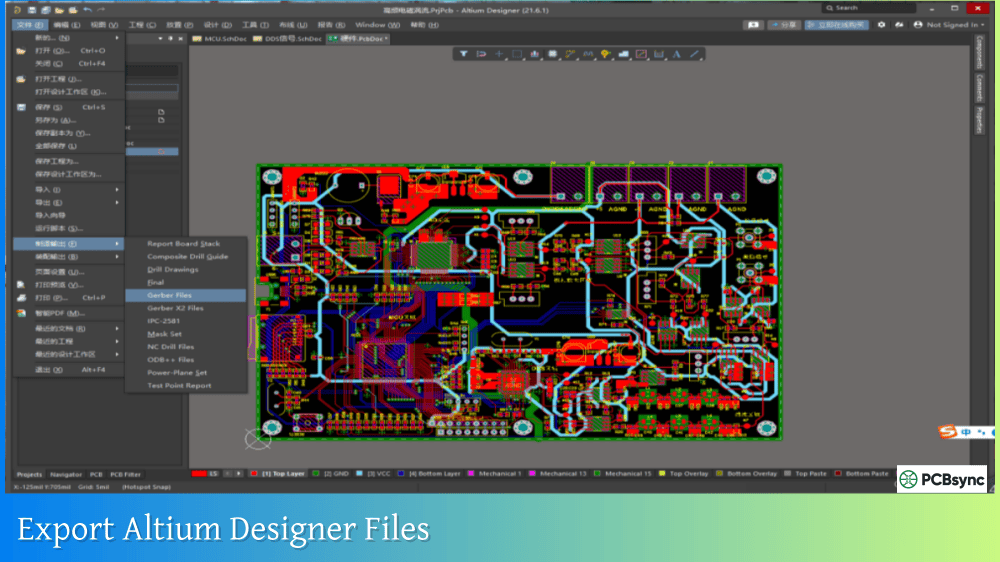
Notes: For PCB fabrication, we require PCB design file in Gerber RS-274X format (most preferred), *.PCB/DDB (Protel, inform your program version) format or *.BRD (Eagle) format. For PCB assembly, we require PCB design file in above mentioned format, drilling file and BOM. Click to download BOM template To avoid file missing, please include all files into one folder and compress it into .zip or .rar format.
How to Export IPC-2581 Files from KiCad: Complete Guide
KiCad introduced native IPC-2581 export capability starting with version 8, allowing designers to generate comprehensive manufacturing data in a single XML file. This feature eliminates the traditional workflow of generating separate Gerber, drill, and BOM files, consolidating everything into one unified package for your manufacturer.
As someone who spent years manually coordinating multiple file types for PCB fabrication and assembly, having IPC-2581 export directly in KiCad significantly streamlines the design-to-manufacturing handoff. This guide walks through the complete process of exporting IPC-2581 files from KiCad, including GUI export, command-line automation, BOM column mapping, and verification procedures.
KiCad 8 added IPC-2581 export as a native feature, making this open-source EDA tool one of the few free solutions supporting the intelligent manufacturing format. The implementation supports both IPC-2581B and IPC-2581C versions, giving designers flexibility to match manufacturer requirements.
KiCad Version Requirements
KiCad Version
IPC-2581 Support
Notes
KiCad 7 and earlier
No
Requires Gerber + separate files
KiCad 8.0
Yes
First version with native export
KiCad 8.0.x
Yes
Improved stability
KiCad 9.0
Yes
Enhanced features
If you are using KiCad 7 or earlier, you will need to upgrade to version 8 or later to access IPC-2581 export functionality.
The IPC-2581 export from KiCad packages all this data into a single XML file that manufacturers can import directly into their CAM systems.
Accessing the IPC-2581 Export Dialog
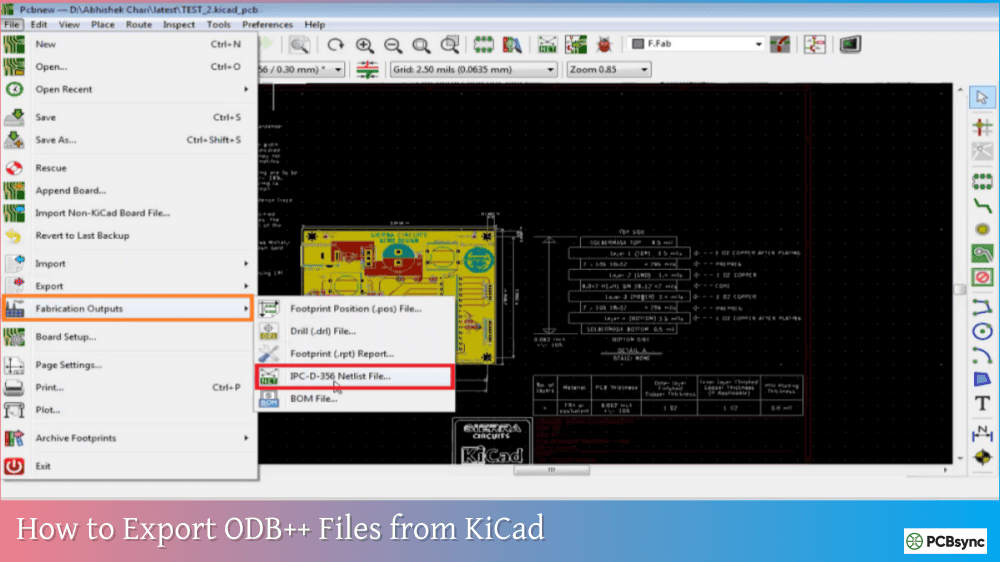
The IPC-2581 export function is located in the Fabrication Outputs menu within KiCad’s PCB Editor.
Opening the Export Dialog
Open your completed PCB design in KiCad’s PCB Editor (Pcbnew). Navigate to File → Fabrication Outputs → IPC2581 File (.xml) to open the Export IPC-2581 dialog.
Menu Path
Description
File → Fabrication Outputs → IPC2581 File (.xml)
Opens export dialog
The dialog presents all configuration options for generating the IPC-2581 file.
Configuring IPC-2581 Export Settings
The Export IPC-2581 dialog in KiCad contains several settings that control the output file content and format.
Basic Export Settings
Setting
Options
Description
Output File
User defined
Name and location for .xml file
Units
mm, in
Measurement system for coordinates
Precision
1-6
Decimal places for dimensions
Version
B, C
IPC-2581 specification version
Compress
Yes/No
Create ZIP archive
Output File Configuration
Click the Browse button to select the destination folder and filename. The default filename matches your project name with the .xml extension.
Output Format
Extension
Use Case
Uncompressed
.xml
Direct viewing, debugging
Compressed
.zip
Smaller file size, email transfer
Enable Compress to generate a ZIP archive containing the IPC-2581 XML file. This reduces file size and simplifies transfer to manufacturers.
Version B is the default in KiCad 8 and provides excellent compatibility with most manufacturers. Version C (default in newer releases) adds advanced features but requires manufacturer support for the latest specification.
Unit Selection
Unit
Precision Range
Typical Use
mm
0.001 – 0.000001 mm
Metric designs, international manufacturers
in
0.001 – 0.000001 inch
Imperial designs, US manufacturers
Match the unit selection to your manufacturer’s preference. Metric (mm) is recommended for most modern manufacturing workflows.
Precision Settings
Precision
Resolution
Use Case
2
0.01 mm
Standard PCB designs
3
0.001 mm
Fine-pitch components
4
0.0001 mm
HDI designs
5
0.00001 mm
Ultra-fine pitch
6
0.000001 mm
Maximum precision
Higher precision values increase file size but provide better accuracy for fine-pitch designs. Precision 3 or 4 is sufficient for most applications.
BOM Column Mapping in IPC-2581 Export
KiCad allows you to map custom footprint fields to IPC-2581 BOM columns, ensuring your component data transfers correctly to manufacturers.
Available BOM Column Mappings
IPC-2581 Column
KiCad Field
Purpose
Internal ID
Custom field
Internal part tracking
Manufacturer Part Number
MPN, Part Number
Component identification
Manufacturer
Manufacturer
Part source
Distributor Part Number
Distributor PN
Ordering reference
Distributor
Distributor
Supply source
Configuring BOM Field Mapping
In the Export IPC-2581 dialog, you can specify which KiCad footprint fields map to each IPC-2581 BOM column.
Field Mapping
KiCad Field Name
Example Value
Manufacturer PN
MPN
RC0603FR-0710KL
Manufacturer
Manufacturer
Yageo
Distributor PN
LCSC
C22688
Distributor
Distributor
LCSC
Leave a field blank to omit that column from the BOM section of the IPC-2581 file.
Setting Up Component Fields in KiCad
Before exporting, ensure your schematic symbols have the necessary fields populated.
Step
Action
1
Open schematic in Eeschema
2
Select component
3
Press E to edit properties
4
Add custom fields (MPN, Manufacturer, etc.)
5
Save and update PCB
Well-populated component fields result in more complete IPC-2581 BOM data.
Read more How to convert PCB Files in different Design software:
Vu2581 from DownStream Technologies is the most widely recommended free viewer for IPC-2581 files.
Verification Checklist
Item
What to Verify
Layer count
Matches design stackup
Board outline
Correct dimensions and shape
Drill sizes
All holes present with correct diameters
Net names
Connectivity data intact
Component count
All parts included
Placement data
Correct positions and rotations
BOM
Complete component list with fields
Using Vu2581 for Verification
Step
Action
1
Download Vu2581 from DownStream or IPC-2581 Consortium
2
Run Vu2581.exe
3
Click Open and select .xml file
4
Review layers, components, and drills
5
Use measurement tools to verify dimensions
Troubleshooting Common Issues
Several issues can arise during IPC-2581 export from KiCad.
Export Errors
Issue
Cause
Solution
Menu option missing
KiCad version too old
Upgrade to KiCad 8 or later
Export fails
Invalid board data
Run DRC and fix errors
Empty BOM
No footprint fields
Add component properties
Missing stackup
Stackup not defined
Configure board stackup
Import Errors at Analysis Tools
Error
Cause
Solution
Missing Stackup
Functional mode issue
KiCad exports full data by default
Invalid XML
File corruption
Re-export file
Missing layers
Board setup incomplete
Verify layer configuration
ANSYS SIwave Import Issues
Some users report issues importing KiCad IPC-2581 files into ANSYS SIwave with errors about missing stackup. This occurs because KiCad’s IPC-2581 export may not include complete stackup information expected by certain analysis tools.
Workaround
Details
Use version B
May have better compatibility
Verify stackup
Configure in Board Setup
Contact tool vendor
Report compatibility issues
Comparing IPC-2581 with Gerber Export
Understanding when to use each format helps you choose the right export method.
IPC-2581 export is available starting with KiCad 8.0, released in early 2024. Earlier versions including KiCad 7, 6, and 5 do not have native IPC-2581 export capability. If you need IPC-2581 output from an older KiCad version, you must upgrade to KiCad 8 or later. The feature is accessed through File → Fabrication Outputs → IPC2581 File (.xml) in the PCB Editor.
What is the difference between IPC-2581 version B and C in KiCad?
Version B (IPC-2581B) is the 2013 specification that includes core fabrication and assembly data with improvements for back drilling and drill type definitions. Version C (IPC-2581C), released in 2020, adds support for flex circuit stackups, bidirectional DFX data exchange, embedded component specifications, and 3D model integration. KiCad 8 defaults to version B for wider compatibility, while newer releases may default to version C. Select the version based on your manufacturer’s import capabilities.
How do I include manufacturer part numbers in the IPC-2581 BOM?
KiCad allows you to map custom footprint fields to IPC-2581 BOM columns. First, add fields like “MPN”, “Manufacturer”, “Distributor”, and “Distributor PN” to your schematic symbols with the appropriate values. When exporting IPC-2581, configure the BOM column mapping in the export dialog or use CLI options like –bom-col-mfg-pn “MPN” to specify which footprint fields map to each BOM column. Leave fields blank to omit columns from the output.
Can I automate IPC-2581 export from KiCad?
Yes, KiCad provides a command-line interface (CLI) for automated IPC-2581 export. Use the command kicad-cli pcb export ipc2581 [options] INPUT_FILE to generate IPC-2581 files without opening the GUI. This enables integration with CI/CD pipelines, batch processing of multiple boards, and automated release workflows. Common options include –output for filename, –precision for decimal places, –version for specification version, and –compress for ZIP output.
Do all PCB manufacturers accept IPC-2581 files from KiCad?
While IPC-2581 adoption is growing, not all manufacturers accept this format yet. Many still primarily work with Gerber files due to established workflows and legacy CAM systems. Before submitting IPC-2581 files, confirm with your manufacturer that they can process this format. Major turnkey assembly services and advanced fabricators increasingly support IPC-2581, particularly for designs requiring assembly data. Consider providing both IPC-2581 and traditional Gerber files for your first submission to ensure compatibility.
Best Practices for IPC-2581 Export from KiCad
Following consistent practices ensures reliable manufacturing data generation.
Before Export
Run DRC to verify design integrity. Configure board stackup in Board Setup if not already defined. Ensure component footprints have manufacturer and distributor fields populated. Verify all layers are correctly defined and named.
During Export
Select the appropriate IPC-2581 version based on manufacturer capability. Use metric units (mm) unless manufacturer requires imperial. Set precision to 3 or 4 for most designs. Configure BOM column mapping to include part numbers. Enable compression for easier file transfer.
After Export
Verify output using Vu2581 or another free viewer. Confirm layer count matches design stackup. Check that BOM contains expected component data. Validate placement coordinates for a few components. Send compressed file with clear revision identification.
The IPC-2581 export in KiCad provides open-source users access to the same intelligent manufacturing format available in commercial EDA tools. With proper configuration and verification, you can generate comprehensive production data that simplifies communication with manufacturers and reduces the potential for file-related errors.
Inquire: Call 0086-755-23203480, or reach out via the form below/your sales contact to discuss our design, manufacturing, and assembly capabilities.
Quote: Email your PCB files to Sales@pcbsync.com (Preferred for large files) or submit online. We will contact you promptly. Please ensure your email is correct.
Notes: For PCB fabrication, we require PCB design file in Gerber RS-274X format (most preferred), *.PCB/DDB (Protel, inform your program version) format or *.BRD (Eagle) format. For PCB assembly, we require PCB design file in above mentioned format, drilling file and BOM. Click to download BOM template To avoid file missing, please include all files into one folder and compress it into .zip or .rar format.