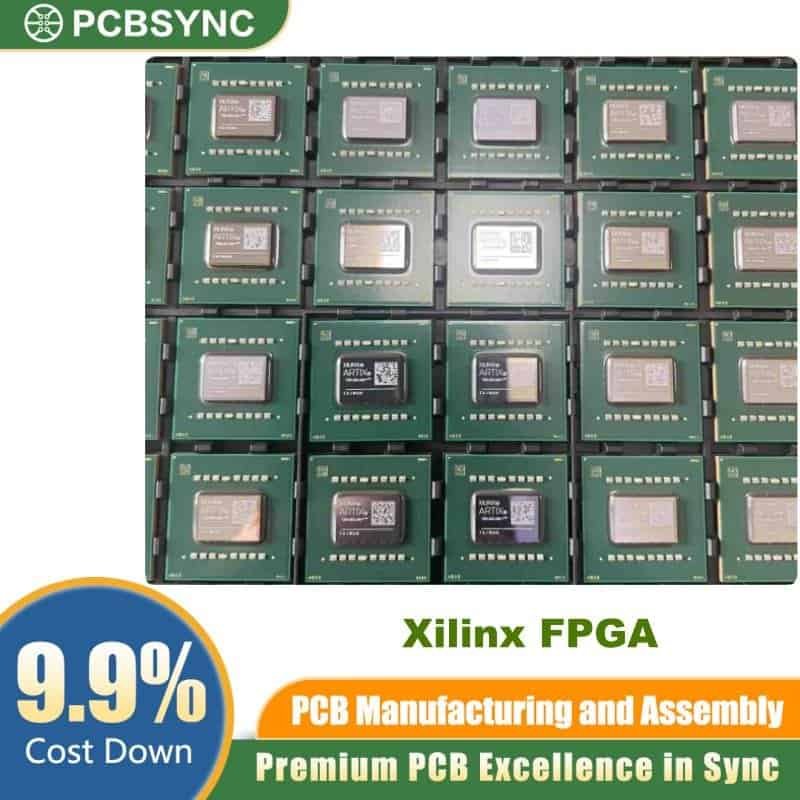
The XC2S200-6FGG767C represents a powerful member of the Spartan-II FPGA family, delivering exceptional performance for embedded systems, digital signal processing, and complex logic applications. This field programmable gate array combines 200,000 system gates with advanced packaging technology, making it an ideal choice for engineers seeking reliable programmable logic solutions.
Key Technical Specifications
Core Performance Features
| Specification |
Value |
| Logic Cells |
5,292 cells |
| System Gates |
200,000 gates |
| CLB Array Configuration |
28 × 42 (1,176 total CLBs) |
| Maximum User I/O |
284 pins |
| Distributed RAM |
75,264 bits |
| Block RAM |
56K bits |
| Speed Grade |
-6 (fastest grade) |
| Operating Temperature |
Commercial (0°C to +85°C) |
Package Specifications
| Package Detail |
Specification |
| Package Type |
FGG767 (Fine-Pitch BGA) |
| Total Ball Count |
767 balls |
| Ball Pitch |
1.0mm fine pitch |
| Technology Node |
0.18μm CMOS |
| Core Voltage |
2.5V |
| Package Marking |
Standard “G” designation for advanced thermal performance |
Advanced Architecture and Design Capabilities
Configurable Logic Block Structure
The XC2S200-6FGG767C features a robust CLB architecture organized in a 28×42 array, providing designers with 1,176 configurable logic blocks. Each CLB contains four logic cells, enabling complex Boolean functions, arithmetic operations, and data storage capabilities. This architecture supports both combinatorial and sequential logic implementation.
Memory Resources
This Spartan-II device offers dual memory solutions:
- Distributed RAM: 75,264 bits spread throughout the logic fabric for fast, localized data storage
- Block RAM: 56K bits of synchronous dual-port RAM organized in dedicated blocks for efficient data buffering
Input/Output Capabilities
With 284 maximum available user I/O pins, the XC2S200-6FGG767C supports multiple I/O standards including LVTTL, LVCMOS, and various differential signaling standards. The 767-ball FGG package provides superior signal integrity and thermal performance compared to smaller packages.
Performance Characteristics
Speed Grade Analysis
| Parameter |
-6 Speed Grade Performance |
| Maximum Operating Frequency |
Up to 263 MHz for internal logic |
| Clock Distribution |
Four Delay-Locked Loops (DLLs) |
| Setup Time |
Industry-leading performance |
| Clock-to-Output Delay |
Optimized for high-speed applications |
The -6 speed grade designation indicates this device operates at the highest performance tier within the XC2S200 family, making it suitable for timing-critical applications.
Application Areas and Use Cases
Industrial Control Systems
The XC2S200-6FGG767C excels in industrial automation, motor control, and process monitoring applications. Its abundant I/O resources and logic capacity enable integration of multiple control loops, communication interfaces, and safety functions.
Communications Infrastructure
Network routers, switches, and telecommunications equipment benefit from the device’s high-speed performance and flexible I/O configuration. The FPGA supports protocol conversion, packet processing, and interface bridging applications.
Digital Signal Processing
With dedicated block RAM and distributed memory resources, this FPGA handles FIR filters, FFT operations, image processing algorithms, and software-defined radio implementations effectively.
Consumer Electronics
Product developers use the XC2S200-6FGG767C for video processing, display controllers, gaming systems, and multimedia applications requiring real-time data manipulation.
Package Technology: FGG767 Fine-Pitch Ball Grid Array
Thermal and Mechanical Advantages
The 767-ball fine-pitch BGA package offers several engineering benefits:
- Enhanced Thermal Dissipation: Larger ball count provides improved heat transfer to the PCB
- Signal Integrity: Shorter interconnect paths reduce parasitic capacitance and inductance
- High Density: 1.0mm ball pitch enables compact board designs while maintaining manufacturability
- Mechanical Reliability: BGA construction provides superior resistance to thermal cycling stress
PCB Design Considerations
| Design Parameter |
Recommendation |
| PCB Stack-up |
Minimum 6-layer for optimal routing |
| Via Technology |
Micro-vias or buried vias for inner balls |
| Solder Mask |
Solder mask defined (SMD) pads |
| Pad Finish |
ENIG or OSP for reliable soldering |
Comparison with Alternative Package Options
Package Selection Guide
| Package Type |
Pin Count |
Board Area |
I/O Capacity |
Best For |
| FGG767 |
767 balls |
Large footprint |
Maximum (284) |
High-I/O applications, complex designs |
| FG456 |
456 balls |
Medium footprint |
Reduced I/O |
Space-constrained designs |
| PQ208 |
208 pins |
Compact |
Limited I/O |
Simple applications, cost-sensitive designs |
The FGG767 package provides the maximum I/O capability for the XC2S200 die, making it the preferred choice for applications requiring extensive external connectivity.
Development Tools and Design Flow
Compatible Design Software
ISE Design Suite serves as the primary development environment for Spartan-II FPGAs. The software provides:
- Synthesis tools for HDL code conversion
- Implementation algorithms for placement and routing
- Timing analysis and constraint management
- Device programming and configuration utilities
Programming and Configuration
The XC2S200-6FGG767C supports multiple configuration modes:
- Master Serial Mode: FPGA controls configuration from external PROM
- Slave Serial Mode: External controller manages configuration process
- JTAG Boundary Scan: In-system programming and debugging
- SelectMAP: High-speed parallel configuration interface
Quality and Reliability
Manufacturing Standards
All XC2S200-6FGG767C devices undergo rigorous testing:
- 100% electrical testing at speed
- Burn-in procedures for enhanced reliability
- Visual inspection for package integrity
- ESD protection testing per JEDEC standards
Environmental Compliance
The device meets international environmental regulations and supports both standard and lead-free (RoHS-compliant) assembly processes when specified with the “G” package designation.
Integration with Xilinx FPGA Ecosystem
The XC2S200-6FGG767C integrates seamlessly within the broader Xilinx FPGA product portfolio, sharing common development tools, IP cores, and design methodologies with other Spartan and Virtex families. This compatibility enables design reuse and simplified migration paths for product evolution.
Ordering Information and Product Codes
Part Number Breakdown
XC2S200-6FGG767C decodes as follows:
- XC2S200: Spartan-II family, 200K gate device
- -6: Speed grade (highest performance)
- FGG767: Package type (767-ball fine-pitch BGA with “G” designation)
- C: Commercial temperature range (0°C to +85°C)
Available Temperature Ranges
| Suffix |
Temperature Range |
Application |
| C |
0°C to +85°C |
Commercial products |
| I |
-40°C to +100°C |
Industrial environments |
Note: The -6 speed grade is exclusively available in the commercial temperature range.
Power Consumption and Thermal Management
Power Requirements
| Power Rail |
Voltage |
Typical Current |
Purpose |
| VCCINT |
2.5V |
Design-dependent |
Core logic power |
| VCCO |
1.8V – 3.3V |
Bank-specific |
I/O buffer power |
Thermal Design Guidelines
Proper thermal management ensures reliable operation:
- Heat sink attachment recommended for continuous high-utilization applications
- Airflow considerations for natural and forced convection cooling
- Thermal interface materials for improved heat transfer
- Power estimation using XPower tool for accurate thermal modeling
Design Best Practices
Optimizing Performance
- Timing Closure: Use timing constraints effectively to guide place-and-route
- Resource Utilization: Balance logic, RAM, and I/O usage for optimal area efficiency
- Clock Domain Management: Minimize asynchronous clock domain crossings
- I/O Planning: Pre-assign critical signals to specific pins for signal integrity
Common Design Pitfalls to Avoid
- Underestimating power requirements during high-utilization scenarios
- Inadequate PCB decoupling capacitor placement
- Ignoring package thermal characteristics in system design
- Overlooking configuration mode selection during early design phases
Support Resources and Documentation
Engineers working with the XC2S200-6FGG767C can access comprehensive technical documentation including:
- Spartan-II Family Data Sheet (detailed electrical specifications)
- Application notes for specific design scenarios
- Reference designs and IP cores
- Package mechanical drawings and PCB footprint files
- Online community forums and technical support channels
Conclusion: Why Choose XC2S200-6FGG767C
The XC2S200-6FGG767C stands out as a versatile, high-performance FPGA solution for demanding applications. Its combination of substantial logic resources, maximum I/O capability through the 767-ball package, and fastest speed grade makes it ideal for complex embedded systems, communications equipment, and industrial control applications. The proven Spartan-II architecture delivers reliable operation while maintaining cost-effectiveness for volume production.
For engineers seeking a programmable logic device that balances performance, capacity, and connectivity, the XC2S200-6FGG767C represents an excellent choice backed by comprehensive development tools and decades of field-proven reliability in diverse applications worldwide.