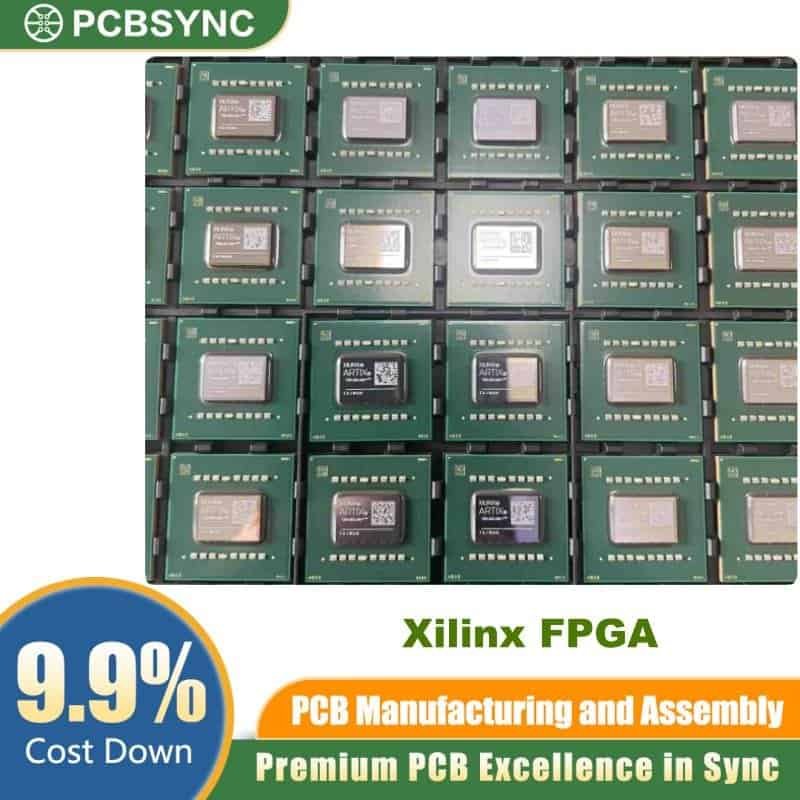
The XC2S200-6FGG766C represents a premium variant from AMD Xilinx’s renowned Spartan-II FPGA family, engineered to deliver exceptional programmable logic performance in a comprehensive 766-ball Fine-Pitch Ball Grid Array package. This field-programmable gate array combines robust processing capabilities with extensive I/O resources, making it an ideal solution for complex digital systems requiring high gate density and superior connectivity.
As part of the Spartan-II architecture, this FPGA delivers 200,000 system gates and 5,292 logic cells, providing designers with substantial resources for implementing sophisticated digital circuits. The -6 speed grade designation ensures optimal performance characteristics for demanding high-speed applications.
Key Technical Specifications
Core Performance Characteristics
| Specification |
Value |
| System Gates |
200,000 |
| Logic Cells |
5,292 |
| CLB Array Configuration |
28 × 42 (1,176 total CLBs) |
| Maximum Operating Frequency |
263 MHz |
| Speed Grade |
-6 (Commercial) |
| Core Voltage |
2.5V |
| Process Technology |
0.18µm |
Memory Resources
| Memory Type |
Capacity |
| Distributed RAM |
75,264 bits |
| Block RAM |
56 Kbits (57,344 bits) |
| Total Memory |
132,608 bits |
Package and I/O Specifications
| Feature |
Specification |
| Package Type |
FGG766 – Fine-pitch Ball Grid Array |
| Total Pins |
766 |
| Maximum User I/O |
Enhanced I/O capability |
| Temperature Range |
Commercial (0°C to +85°C) |
| Package Technology |
Lead-free (RoHS Compliant) available |
Architecture and Design Features
Configurable Logic Blocks (CLBs)
The XC2S200-6FGG766C features a comprehensive array of 1,176 CLBs organized in a 28×42 matrix. Each CLB contains:
- Four-input look-up tables (LUTs) for combinatorial logic
- Dedicated flip-flops for sequential operations
- Fast carry logic for arithmetic functions
- Distributed RAM capability for localized data storage
This architecture enables efficient implementation of complex state machines, data path logic, and custom computing algorithms.
Enhanced I/O Capabilities
The 766-ball package provides exceptional connectivity options:
- Extensive user I/O pins for interfacing with external components
- Support for multiple I/O standards including LVTTL, LVCMOS, and differential signaling
- Programmable pull-up and pull-down resistors
- Individual I/O slew rate control for signal integrity optimization
Block RAM Architecture
The FPGA incorporates 56 Kbits of block RAM distributed in dual-port configurations:
- High-speed synchronous operation
- Configurable data width options
- True dual-port access for simultaneous read/write operations
- Ideal for FIFO buffers, data caching, and lookup tables
Clock Management System
Four Delay-Locked Loops (DLLs) positioned at each corner of the die provide:
- Clock deskew and phase shifting capabilities
- Clock frequency multiplication and division
- Low-jitter clock distribution across the FPGA fabric
- Support for multiple independent clock domains
Application Areas
Industrial Automation and Control
The XC2S200-6FGG766C excels in industrial environments where reliability and programmability are paramount. Common applications include:
- Motor control systems with precise PWM generation
- Programmable logic controllers (PLCs)
- Process monitoring and control systems
- Industrial communication protocol implementations (Modbus, Profibus, EtherCAT)
- Sensor interface and data acquisition systems
Communication Systems and Networking
With its high-speed processing capabilities and extensive I/O resources, this FPGA serves communication applications:
- Protocol conversion and bridging
- Custom network packet processing
- Telecommunications infrastructure equipment
- Data encryption and security processing
- Digital signal processing for modulation/demodulation
Medical Equipment and Instrumentation
The device’s reliability and reconfigurability make it suitable for medical applications:
- Medical imaging systems (ultrasound, digital X-ray processing)
- Patient monitoring equipment
- Diagnostic instrument control
- Laboratory automation systems
- Biosensor signal processing
Consumer Electronics and Multimedia
Engineers leverage the XC2S200-6FGG766C for consumer product development:
- Video processing and display controllers
- Audio DSP and effects processing
- Gaming console logic
- Set-top box implementations
- Custom peripheral controllers
Automotive Electronics
The FPGA supports various automotive control applications:
- Engine control unit (ECU) prototyping
- Advanced driver assistance systems (ADAS) processing
- In-vehicle infotainment system control
- CAN bus interface and processing
- Sensor fusion applications
Configuration and Programming
Configuration Modes
| Configuration Mode |
CCLK Direction |
Data Width |
Serial DOUT |
| Master Serial |
Output |
1-bit |
Yes |
| Slave Serial |
Input |
1-bit |
Yes |
| Slave Parallel |
Input |
8-bit |
No |
| Boundary Scan (JTAG) |
N/A |
1-bit |
No |
Programming Options
The XC2S200-6FGG766C supports multiple programming methodologies:
- JTAG programming via standard IEEE 1149.1 interface
- Configuration from serial PROM devices
- Parallel flash memory configuration
- Microprocessor-based configuration systems
- In-system programmability for field updates
Design Tool Support
Compatible Development Environments
For Xilinx FPGA development, engineers utilize industry-standard tools:
- ISE Design Suite: Complete FPGA design flow including synthesis, implementation, and simulation
- Vivado Design Suite: Modern design environment with enhanced analysis capabilities
- VHDL and Verilog: Full support for both HDL languages
- IP Core Integration: Access to extensive library of pre-verified IP blocks
- ChipScope: Integrated logic analyzer for real-time debugging
Simulation and Verification
Comprehensive simulation support includes:
- Behavioral simulation for functional verification
- Timing simulation with accurate delay models
- Gate-level simulation for final verification
- Support for industry-standard simulators (ModelSim, VCS, Questa)
Performance Optimization
Timing Closure Strategies
Achieving optimal performance requires careful attention to:
- Strategic placement of critical path logic
- Clock domain crossing management
- Pipeline architecture implementation
- Resource utilization balancing across CLB arrays
Power Management
The XC2S200-6FGG766C incorporates power-efficient design features:
- Low static power consumption in 0.18µm CMOS technology
- Dynamic power scaling based on switching activity
- Partial reconfiguration capabilities for power optimization
- Multiple power domains for flexible system design
Package and PCB Design Considerations
FGG766 Package Characteristics
The 766-ball BGA package offers:
- Fine-pitch ball spacing for high-density routing
- Excellent thermal dissipation characteristics
- Reduced package parasitic effects
- Improved signal integrity for high-speed signals
PCB Layout Guidelines
Successful implementation requires attention to:
- Controlled impedance routing for critical signals
- Adequate power plane design with proper decoupling
- Thermal management through vias and copper pours
- Signal layer stack-up optimization for EMI reduction
Decoupling Requirements
Recommended power supply decoupling strategy:
| Capacitor Value |
Quantity per Supply |
Placement |
| 10µF Tantalum |
2-4 |
Near power entry points |
| 1µF Ceramic |
4-8 |
Distributed across die |
| 0.1µF Ceramic |
20-40 |
One per every 3-4 power balls |
| 0.01µF Ceramic |
10-20 |
High-frequency decoupling |
Quality and Reliability
Manufacturing Standards
AMD Xilinx maintains stringent quality controls:
- ISO 9001 certified manufacturing processes
- Automotive-grade quality options available
- Extended temperature range variants for harsh environments
- Comprehensive testing including 100% functionality verification
Reliability Metrics
The Spartan-II family demonstrates:
- MTBF (Mean Time Between Failures) exceeding 1 million hours
- High resistance to single-event upsets (SEU)
- Excellent long-term reliability in field deployment
- Low failure rate in production environments
Comparison with Other Spartan-II Devices
XC2S200 Family Positioning
| Device Model |
System Gates |
Logic Cells |
Block RAM |
Typical Package Options |
| XC2S50 |
50,000 |
1,728 |
32 Kbits |
PQ208, FG256 |
| XC2S100 |
100,000 |
2,700 |
40 Kbits |
PQ208, FG256 |
| XC2S150 |
150,000 |
3,888 |
48 Kbits |
PQ208, FG256, FG456 |
| XC2S200 |
200,000 |
5,292 |
56 Kbits |
PQ208, FG256, FG456, FG766 |
Getting Started with XC2S200-6FGG766C
Evaluation and Development
Designers beginning work with this FPGA should:
- Acquire Development Tools: Download and install ISE WebPACK or licensed version
- Review Documentation: Study the comprehensive Spartan-II datasheets and user guides
- Start with Examples: Leverage reference designs and application notes
- Prototype Design: Use evaluation boards or custom PCB prototypes
- Iterate and Optimize: Refine design through simulation and hardware testing
Common Design Patterns
Successful implementations often employ:
- Hierarchical design methodology for complex systems
- IP core reuse for standard functions
- Constraint-driven implementation for timing closure
- Incremental design approach for large projects
Supply Chain and Procurement
Availability Considerations
The XC2S200-6FGG766C is available through:
- Authorized AMD Xilinx distributors
- Electronic component marketplaces
- Direct manufacturer channels for volume orders
- Specialized FPGA component suppliers
Lead Times and Packaging
Standard ordering information:
- Typical lead times vary based on package type and quantity
- Available in tape-and-reel for automated assembly
- Tray packaging for prototyping and small-scale production
- Volume pricing available for production quantities
Conclusion
The XC2S200-6FGG766C delivers an exceptional combination of logic density, I/O capability, and performance in the comprehensive 766-ball BGA package. Its architecture provides designers with the flexibility to implement complex digital systems while maintaining cost-effectiveness and reliability. Whether developing industrial control systems, communication equipment, medical devices, or consumer electronics, this FPGA offers the resources and performance required for successful product development.
With comprehensive tool support, extensive documentation, and proven reliability in field deployment, the XC2S200-6FGG766C remains a solid choice for engineers seeking a programmable logic solution that balances capability with practical implementation considerations. The device’s mature architecture and widespread industry adoption ensure long-term support and availability for production designs.