Inquire: Call 0086-755-23203480, or reach out via the form below/your sales contact to discuss our design, manufacturing, and assembly capabilities.
Quote: Email your PCB files to Sales@pcbsync.com (Preferred for large files) or submit online. We will contact you promptly. Please ensure your email is correct.
Notes: For PCB fabrication, we require PCB design file in Gerber RS-274X format (most preferred), *.PCB/DDB (Protel, inform your program version) format or *.BRD (Eagle) format. For PCB assembly, we require PCB design file in above mentioned format, drilling file and BOM. Click to download BOM template To avoid file missing, please include all files into one folder and compress it into .zip or .rar format.
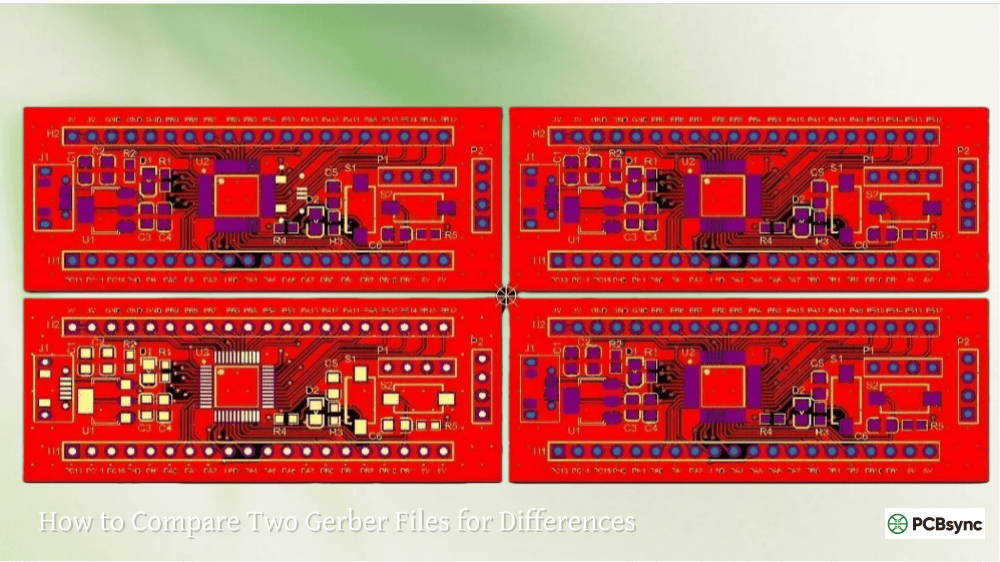
There’s something frustrating about having a beautifully designed PCB that you can only view with specialized CAM software. Whether you need to showcase your board on a website, create documentation for a client, or prepare files for laser cutting, Gerber files aren’t exactly user-friendly outside the PCB world. That’s where SVG comes in. Learning how to convert Gerber to SVG opens up possibilities that simply aren’t available with traditional manufacturing formats. This guide walks through everything you need to know, from understanding why this conversion matters to step-by-step methods using both free and commercial tools.
Gerber files are the backbone of PCB manufacturing, containing precise vector data about copper layers, solder masks, silkscreen, and board outlines. But they’re designed for fabrication equipment, not for human viewing or web publishing. SVG (Scalable Vector Graphics) changes everything by providing a universally readable vector format that works in web browsers, graphic design software, and countless other applications.
Use Case
Why SVG Works Better
Web visualization
Browsers render SVG natively without plugins
Documentation
Embed in HTML, markdown, or technical docs
Client presentations
Share without requiring CAM software
Laser cutting/engraving
Many machines accept SVG directly
Graphic design
Edit in Illustrator, Inkscape, or Figma
PCB art projects
Manipulate layers for artistic purposes
3D modeling textures
Apply board graphics to enclosure models
Social media sharing
Create shareable board previews
Benefits of SVG for PCB Visualization
SVG Advantage
Description
Infinite scalability
Zoom without pixelation or quality loss
Small file size
Typically smaller than equivalent raster images
CSS styling
Change colors dynamically with stylesheets
JavaScript interaction
Add hover effects, tooltips, layer toggles
Transparency support
Layer multiple SVGs for composite views
Text searchability
Embedded text remains selectable
Print quality
Perfect output at any resolution
Universal compatibility
Works in all modern browsers and design tools
Understanding Gerber and SVG Formats
Both Gerber and SVG are vector formats, which is why conversion between them works so well. Understanding their similarities and differences helps you get better results.
Gerber Format Basics
Gerber files use ASCII commands to describe PCB features. Each command specifies coordinates, apertures (tool shapes), and operations like drawing lines or flashing pads.
Gerber Characteristic
Description
File structure
ASCII text with X-Y coordinates
Geometry types
Lines, arcs, circles, polygons, regions
Apertures
Predefined shapes for traces and pads
Polarity
Dark (add copper) and clear (remove copper)
Layer separation
One file per layer typically
Units
Inches or millimeters with configurable precision
SVG Format Basics
SVG uses XML markup to define vector graphics. Elements like paths, circles, rectangles, and groups create the visual representation.
SVG Characteristic
Description
File structure
XML-based markup language
Geometry types
Paths, circles, rectangles, polygons, text
Styling
CSS properties for colors, strokes, fills
Grouping
Logical organization with g elements
Viewbox
Coordinate system and scaling control
Transforms
Rotation, translation, scaling operations
How Gerber Elements Map to SVG
Gerber Element
SVG Translation
Traces (draws)
Path elements with stroke width
Pads (flashes)
Circles, rectangles, or path outlines
Regions/polygons
Filled path elements
Arcs
Arc commands in path data
Clear areas
Mask elements or clipping paths
Aperture macros
Complex path definitions
Methods to Convert Gerber to SVG
Several approaches exist for converting Gerber files to SVG, ranging from command-line tools to commercial applications to browser-based converters.
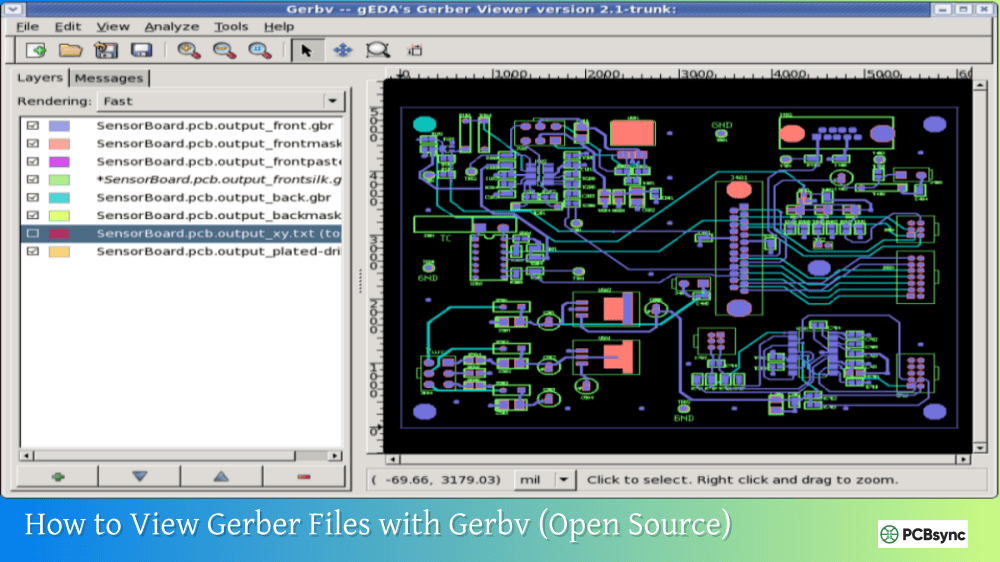
Method 1: Using Gerbv (Free/Open Source)
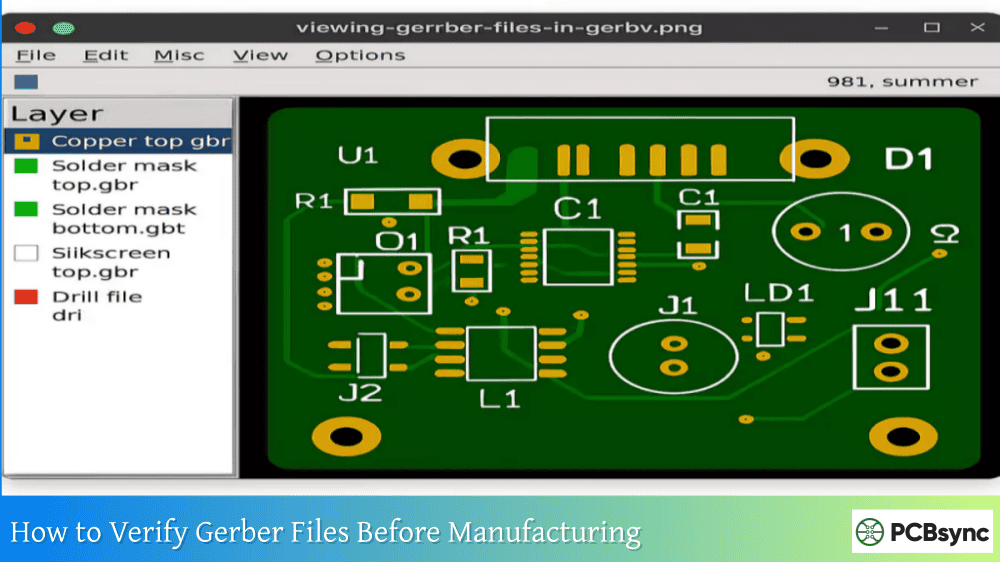
Gerbv is the go-to free tool for Gerber viewing and conversion. Part of the gEDA project, it runs on Linux, macOS, and Windows and offers both GUI and command-line operation.
GUI Conversion Process:
Download and install gerbv from gerbv.github.io
Launch gerbv and open your Gerber file via File → Open Layer(s)
Load additional layers as needed (copper, mask, silk, drill)
Adjust colors for each layer using the layer list
Go to File → Export → SVG
Choose output filename and save
Command-Line Conversion:
Gerbv’s command-line interface is powerful for automation and batch processing:
bash
# Basic single file conversiongerbv -x svg -o output.svg input.gbr# With custom foreground colorgerbv -x svg -f “#FF0000” -o copper_layer.svg top_copper.gbr# Multiple layers with different colorsgerbv -x svg -f “#B87333” -f “#00FF00” -o board.svg copper.gbr silk.gbr# With background color and bordergerbv -x svg -b “#FFFFFF” -B 5 -o output.svg input.gbr
Gerbv Command-Line Options for SVG Export:
Option
Description
-x svg
Set export format to SVG
-o filename
Specify output filename
-f #RRGGBB
Foreground color (use multiple for layers)
-b #RRGGBB
Background color
-B percent
Border around image (default 5%)
-a
Enable antialiasing
-D XxY
Resolution in DPI
-O X,Y
Set origin coordinates
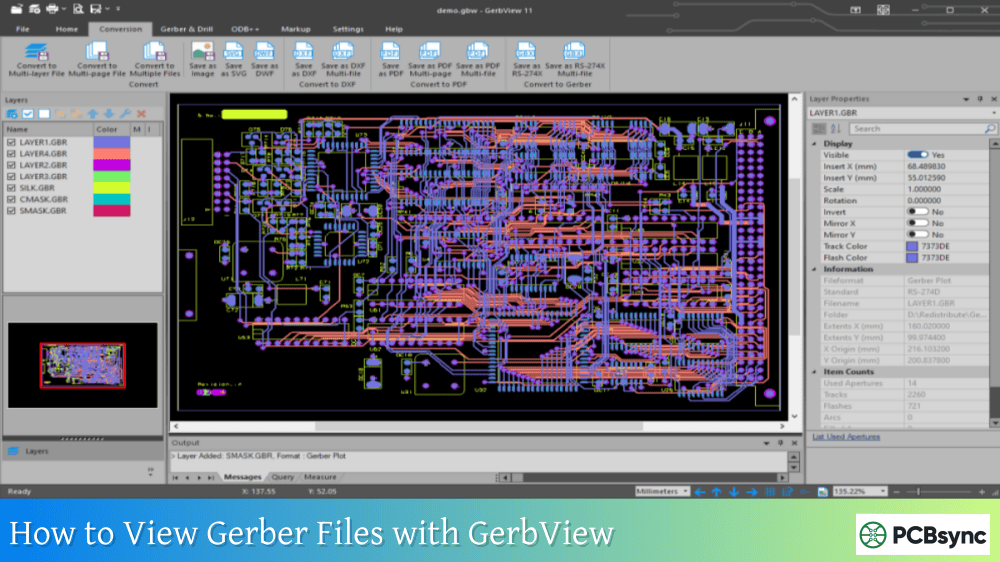
Method 2: Using GerbView (Commercial with Trial)
GerbView by Software Companions offers professional-grade Gerber to SVG conversion with extensive options for controlling output.
Step-by-Step Process:
Download GerbView from gerbview.com (30-day trial available)
The tracespace viewer provides instant online conversion without software installation.
Step-by-Step Process:
Navigate to tracespace.io/view
Drag and drop your Gerber files (or click to browse)
The viewer automatically detects layer types
Preview the rendered board
Right-click on the SVG to save individual layers
Use browser developer tools to extract full SVG code
This method processes everything locally in your browser, so no files are uploaded to any server.
Method 5: Using PCBCupid Online Converter
PCBCupid offers a free online Gerber viewer with SVG export capability.
Step-by-Step Process:
Go to tools.pcbcupid.com/gerber-viewer
Upload your Gerber files
View the rendered layers
Download as SVG
Method 6: Using reaConverter (Batch Processing)
For converting multiple Gerber files to SVG, reaConverter offers efficient batch processing.
reaConverter Feature
Description
Batch conversion
Process hundreds of files at once
Format support
GBR, GBS, CMP, SOL variants
Output options
SVG, PNG, PDF, and more
Command line
Automation via CLI
Watch folders
Automatic conversion of new files
Method 7: Using Python with Gerbolyze
Gerbolyze is primarily designed for embedding SVG into Gerbers, but its underlying library can also help with reverse operations and provides excellent SVG template generation from Gerber files.
bash
pip install gerbolyze
Gerbolyze generates SVG templates from input Gerbers for accurate positioning, which can then be used for further processing.
Converting Multiple Layers to SVG
Real-world PCBs have multiple layers that often need to be converted together. Here are strategies for handling multi-layer conversions.
Creating Composite SVG Files
Approach
Description
Best For
Single multi-layer SVG
All layers in one file with groups
Interactive web viewers
Separate SVG per layer
Individual files for each layer
Selective editing
Layered with CSS classes
Combined with style-based visibility
Toggle functionality
Layer Organization Best Practices
When converting multiple Gerber layers to SVG:
Use consistent naming conventions for layer groups
Maintain coordinate system alignment across layers
Consider z-index ordering for proper stacking
Aligning Multiple SVG Layers
The gerber-to-svg library uses a consistent viewBox calculation, making layer alignment straightforward. The viewBox values are in 1000x Gerber units, so min-x and min-y values can be used to align SVGs from different layers.
Yes, tools like Gerbolyze specialize in converting SVG graphics into Gerber format. This is commonly used for adding artwork, logos, or custom graphics to PCB silkscreen or copper layers. The reverse direction (SVG to Gerber) is actually more common in PCB art workflows than Gerber to SVG.
Will converting Gerber to SVG lose any data?
The visual representation should remain accurate, but some Gerber-specific metadata may not transfer. Aperture definitions, net names (in X2/X3 files), and manufacturing parameters aren’t typically preserved in SVG. However, all geometric data—the shapes, positions, and dimensions—converts accurately.
Which free tool produces the best SVG output?
For most users, gerbv offers the best combination of accuracy, features, and ease of use. Its command-line interface makes it excellent for automation, and the output quality matches commercial tools. For web-focused workflows, the gerber-to-svg JavaScript library provides excellent results with the bonus of browser compatibility.
Can I use the converted SVG for laser cutting or CNC?
Yes, SVG files work with many laser cutters and CNC machines. The board outline layer is typically most useful for this purpose. However, you may need to simplify complex copper geometry or convert filled regions to outlines depending on your equipment’s requirements. Always verify dimensions after conversion.
How do I create an interactive PCB viewer using converted SVGs?
The gerber-to-svg library is designed for this purpose. Convert each layer to SVG, stack them in HTML with appropriate CSS z-index values, and add JavaScript for layer toggling and hover effects. The tracespace viewer source code on GitHub provides an excellent reference implementation for building custom interactive viewers.
Conclusion
Converting Gerber to SVG bridges the gap between PCB manufacturing files and the broader world of web graphics, documentation, and digital design. Whether you’re building an interactive board viewer for your website, creating client documentation, or preparing files for laser cutting, SVG provides the universal format compatibility that Gerber files lack.
For quick one-off conversions, online tools like the tracespace viewer get the job done without installing anything. For regular use or automation, gerbv’s command-line interface offers power and flexibility at no cost. And for web development projects, the gerber-to-svg JavaScript library integrates PCB visualization directly into your applications.
The key to successful conversion is choosing the right tool for your specific needs and understanding how Gerber elements translate to SVG primitives. With the methods and resources in this guide, you’re equipped to convert Gerber to SVG for any purpose, from simple documentation to complex interactive applications.
Inquire: Call 0086-755-23203480, or reach out via the form below/your sales contact to discuss our design, manufacturing, and assembly capabilities.
Quote: Email your PCB files to Sales@pcbsync.com (Preferred for large files) or submit online. We will contact you promptly. Please ensure your email is correct.
Notes: For PCB fabrication, we require PCB design file in Gerber RS-274X format (most preferred), *.PCB/DDB (Protel, inform your program version) format or *.BRD (Eagle) format. For PCB assembly, we require PCB design file in above mentioned format, drilling file and BOM. Click to download BOM template To avoid file missing, please include all files into one folder and compress it into .zip or .rar format.