Inquire: Call 0086-755-23203480, or reach out via the form below/your sales contact to discuss our design, manufacturing, and assembly capabilities.
Quote: Email your PCB files to Sales@pcbsync.com (Preferred for large files) or submit online. We will contact you promptly. Please ensure your email is correct.
Notes: For PCB fabrication, we require PCB design file in Gerber RS-274X format (most preferred), *.PCB/DDB (Protel, inform your program version) format or *.BRD (Eagle) format. For PCB assembly, we require PCB design file in above mentioned format, drilling file and BOM. Click to download BOM template To avoid file missing, please include all files into one folder and compress it into .zip or .rar format.
How to Convert Gerber to PNG/JPG Images: Complete Guide for PCB Visualization
Every PCB designer eventually needs to share their board design with someone who doesn’t have CAM software installed. Maybe it’s a client who wants to see what they’re paying for, a blog post showcasing your latest project, or documentation for your GitHub repository. Whatever the reason, knowing how to convert Gerber to PNG or JPG images is an essential skill that saves time and eliminates the “can you just send me a picture?” requests. This guide covers everything from quick online conversions to high-resolution exports for professional documentation.
Gerber files are the standard for PCB manufacturing, but they’re useless for sharing visual representations of your board. They require specialized software to view and don’t display in web browsers or standard image viewers. Converting Gerber to PNG or JPG images solves this problem by creating universally viewable files.
Use Case
Why Image Conversion Helps
Client presentations
Share board previews without CAM software
Documentation
Include in datasheets and user manuals
Website/portfolio
Showcase projects on blogs and GitHub
Social media
Share designs on Twitter, LinkedIn, forums
Design reviews
Email images for quick feedback
DIY PCB fabrication
Create masks for toner transfer method
CNC milling
Generate images for fab module workflows
Quality verification
Compare manufactured boards to design
PNG vs JPG: Which Format to Choose?
Factor
PNG
JPG
Compression
Lossless
Lossy
Transparency
Supported
Not supported
File size
Larger
Smaller
Best for
Technical accuracy, layers
Web sharing, thumbnails
Color depth
Up to 48-bit
24-bit
Sharp edges
Preserved
May blur
For PCB images, PNG is generally the better choice because it preserves sharp edges on traces and pads without compression artifacts. JPG works well for web thumbnails or when file size is a concern, but avoid it for images used in manufacturing workflows.
Understanding Resolution and DPI for Gerber Images
When converting Gerber to PNG or JPG, resolution matters significantly. The wrong DPI setting can produce blurry images or files too large to handle.
Purpose
Recommended DPI
Notes
Web display
72-150 DPI
Fast loading, adequate detail
Documentation
150-300 DPI
Good balance of size and quality
Printing
300-600 DPI
Sharp output on paper
Toner transfer
600-1200 DPI
Precise masks for DIY PCBs
Archival
300+ DPI
Future-proof high quality
Calculating Image Dimensions
To determine the pixel dimensions of your output image:
Pixels = Board dimension (inches) × DPI
For a 4″ × 3″ board at 300 DPI:
Width: 4 × 300 = 1200 pixels
Height: 3 × 300 = 900 pixels
Higher DPI means larger files and longer processing times, so choose appropriately for your use case.
Methods to Convert Gerber to PNG/JPG
Several approaches exist for converting Gerber files to image formats, from free command-line tools to commercial applications with full GUI interfaces.
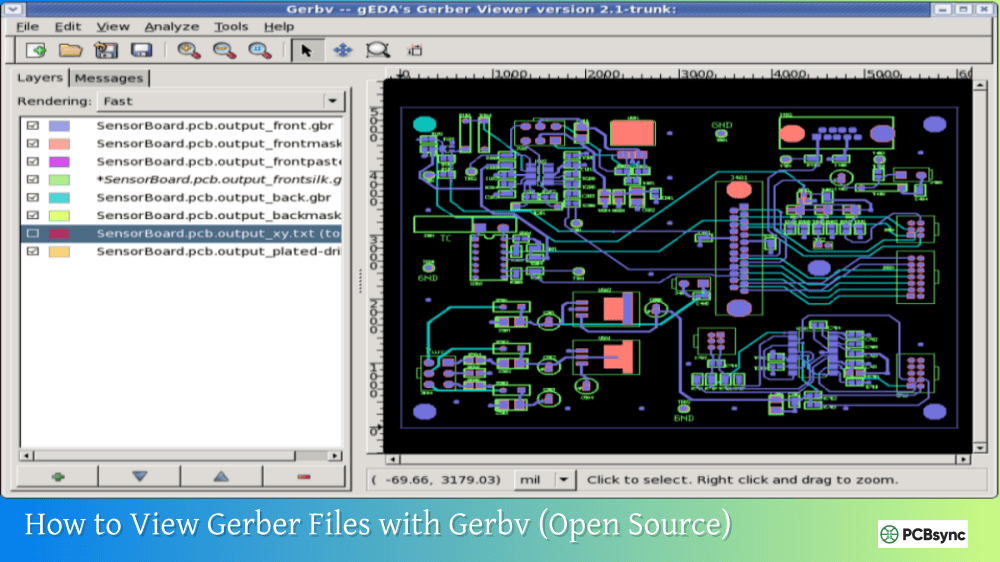
Method 1: Using Gerbv (Free/Open Source)
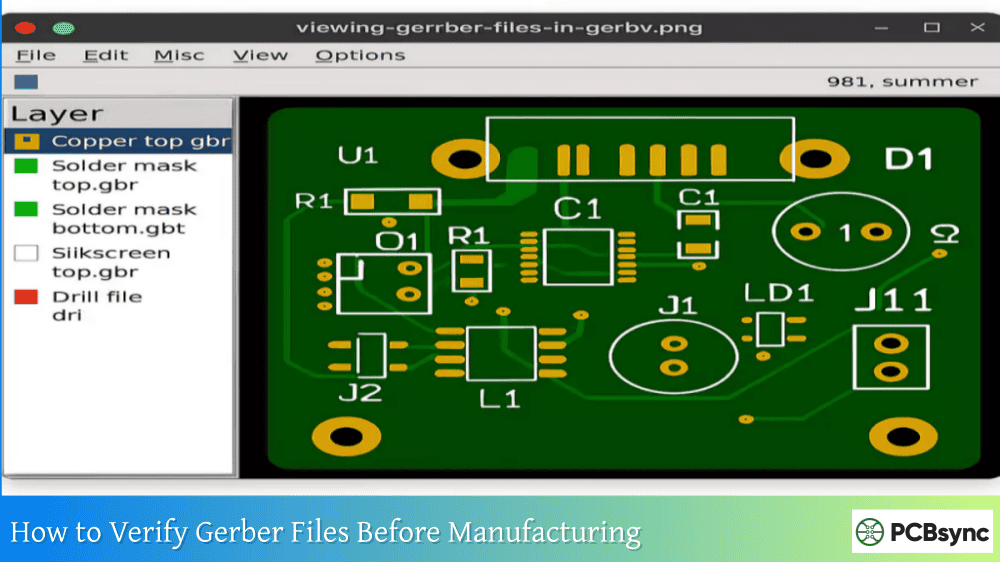
Gerbv is the most popular free tool for Gerber viewing and image export. It runs on Windows, Linux, and macOS and offers both GUI and command-line operation.
GUI Conversion Process:
Download and install gerbv from gerbv.github.io
Launch gerbv and open your Gerber file via File → Open Layer(s)
Load additional layers (copper, mask, silk, drill) as needed
Adjust colors for each layer by right-clicking the layer name
Set the view zoom to your desired output resolution
Go to File → Export → PNG
Configure DPI and save
Command-Line Conversion for PNG:
Gerbv’s command-line interface is powerful for automation and batch processing:
bash
# Basic single file to PNGgerbv -x png -D 300 -o output.png input.gbr# With custom foreground and background colorsgerbv -x png -D 300 -f “#B87333” -b “#FFFFFF” -o copper.png top_copper.gbr# Multiple layers with different colorsgerbv -x png -D 300 -f “#B87333” -f “#00FF00” -o board.png copper.gbr silk.gbr# With antialiasing for smoother edgesgerbv -x png -D 300 -a -o smooth_output.png input.gbr# Setting specific window size in pixelsgerbv -x png -w 1920×1080 -o output.png input.gbr
Gerbv Command-Line Options:
Option
Description
-x png
Set export format to PNG
-D DPI
Resolution in dots per inch
-o filename
Output filename
-f #RRGGBB
Foreground color (use multiple for layers)
-b #RRGGBB
Background color
-a
Enable antialiasing
-B percent
Border around image (default 5%)
-w WxH
Window size in pixels
-W WxH
Window size in inches
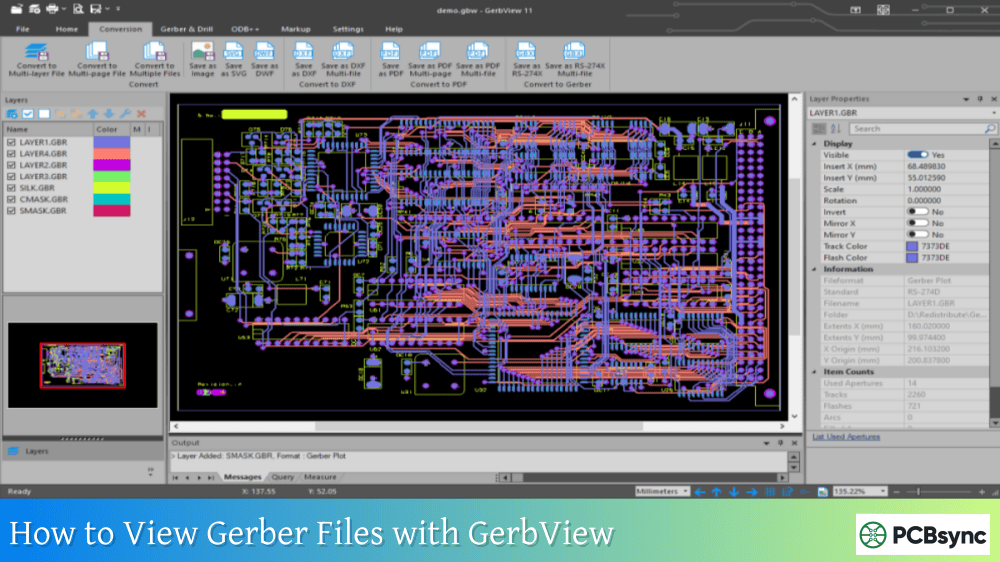
Method 2: Using GerbView (Commercial with Trial)
GerbView by Software Companions provides professional-grade Gerber to image conversion with extensive control over output settings.
Step-by-Step Process:
Download GerbView from gerbview.com (30-day trial available)
Launch and go to File → Add Layer
Select your Gerber files to load
Import Excellon drill files if needed
Adjust layer colors and visibility
Go to File → Export → Raster
Select PNG, JPEG, TIFF, or BMP format
Configure resolution and color depth
Save the image
GerbView Raster Export Settings:
Setting
Options
Recommendation
Format
PNG, JPEG, TIFF, BMP, WebP
PNG for quality, JPEG for size
Resolution
Custom DPI
300 for documentation
Color depth
1-bit to 24-bit
24-bit for color layers
Compression
Various
PNG compression level 6
Background
Transparent/Color
Transparent for overlay work
Method 3: Using Online Gerber Viewers
Several online tools let you view Gerber files and capture images without installing software.
Popular Online Viewers:
Service
URL
Features
Tracespace
tracespace.io/view
SVG rendering, local processing
GerbLook
gerblook.org
Quick visualization, layer toggle
PCBWay Viewer
pcbway.com/project/OnlineGerberViewer.html
2D/3D view
JLCPCB Viewer
jlcpcb.com/RGE
Manufacturing-focused
HQDFM/NextPCB
nextpcb.com/free-online-gerber-viewer
DFM analysis included
Using Online Viewers for Image Capture:
Upload your Gerber files to the viewer
Adjust layer visibility and colors
Set the view to your desired zoom level
Use browser screenshot (or right-click → Save image if available)
Crop and save using any image editor
Note: Online viewers process files locally in your browser, so your design data typically isn’t uploaded to servers. However, for confidential designs, desktop software is safer.
Method 4: Using GerberRender Script
GerberRender is a command-line script that creates realistic PCB renders from Gerber files.
What DPI should I use when converting Gerber to PNG?
For web display, 150 DPI is usually sufficient. For documentation or printing, use 300 DPI. For DIY PCB fabrication using toner transfer, 600-1200 DPI provides the precision needed for accurate masks. Higher DPI creates larger files and takes longer to process, so choose based on your actual needs.
Can I convert multiple Gerber layers into a single image?
Yes, most tools support loading multiple layers and exporting them as a composite image. In gerbv, load all layers, set appropriate colors and transparency for each, then export. The layers will be rendered together in the output image. Use alpha channel values in hex colors (e.g., #FF000088) to control layer transparency.
Why does my exported image look different from the Gerber viewer?
Common causes include: different background colors, missing layers, inverted polarity on negative layers, or transparency settings. Ensure all layers are loaded, check that negative layers (like power planes) are properly inverted, and verify the background color matches your expectations. Also confirm your export resolution is high enough to show fine details.
Which format is better for toner transfer PCB fabrication?
PNG is strongly recommended for toner transfer because it uses lossless compression that preserves sharp edges on traces and pads. JPG’s lossy compression can introduce artifacts that affect the precision of your mask. Use at least 600 DPI, preferably 1200 DPI, and export in black and white for maximum contrast.
How do I automate Gerber to PNG conversion for multiple files?
Use gerbv’s command-line interface in a shell script or batch file. For example, a bash loop can process all Gerber files in a directory:
bash
for file in *.gbr; do gerbv -x png -D 300 -o “${file%.gbr}.png” “$file”done
For more complex workflows, Python scripts using subprocess calls to gerbv provide additional flexibility for file naming, color management, and error handling.
Conclusion
Converting Gerber to PNG or JPG images is straightforward once you understand the tools and options available. For most users, gerbv provides everything needed, from quick GUI exports to powerful command-line automation. Commercial tools like GerbView offer additional features for professional workflows, while online viewers work well for quick checks without software installation.
The key to successful conversion is choosing the right resolution for your purpose and using PNG format when accuracy matters. Whether you’re creating documentation, sharing designs online, or preparing files for DIY fabrication, the methods in this guide will help you produce high-quality images from your Gerber files every time.
Remember that image exports are for visualization only, not manufacturing. Always send original Gerber files to your PCB fabricator, and use images for documentation, review, and sharing purposes.
Inquire: Call 0086-755-23203480, or reach out via the form below/your sales contact to discuss our design, manufacturing, and assembly capabilities.
Quote: Email your PCB files to Sales@pcbsync.com (Preferred for large files) or submit online. We will contact you promptly. Please ensure your email is correct.
Notes: For PCB fabrication, we require PCB design file in Gerber RS-274X format (most preferred), *.PCB/DDB (Protel, inform your program version) format or *.BRD (Eagle) format. For PCB assembly, we require PCB design file in above mentioned format, drilling file and BOM. Click to download BOM template To avoid file missing, please include all files into one folder and compress it into .zip or .rar format.