Inquire: Call 0086-755-23203480, or reach out via the form below/your sales contact to discuss our design, manufacturing, and assembly capabilities.
Quote: Email your PCB files to Sales@pcbsync.com (Preferred for large files) or submit online. We will contact you promptly. Please ensure your email is correct.
Notes: For PCB fabrication, we require PCB design file in Gerber RS-274X format (most preferred), *.PCB/DDB (Protel, inform your program version) format or *.BRD (Eagle) format. For PCB assembly, we require PCB design file in above mentioned format, drilling file and BOM. Click to download BOM template To avoid file missing, please include all files into one folder and compress it into .zip or .rar format.
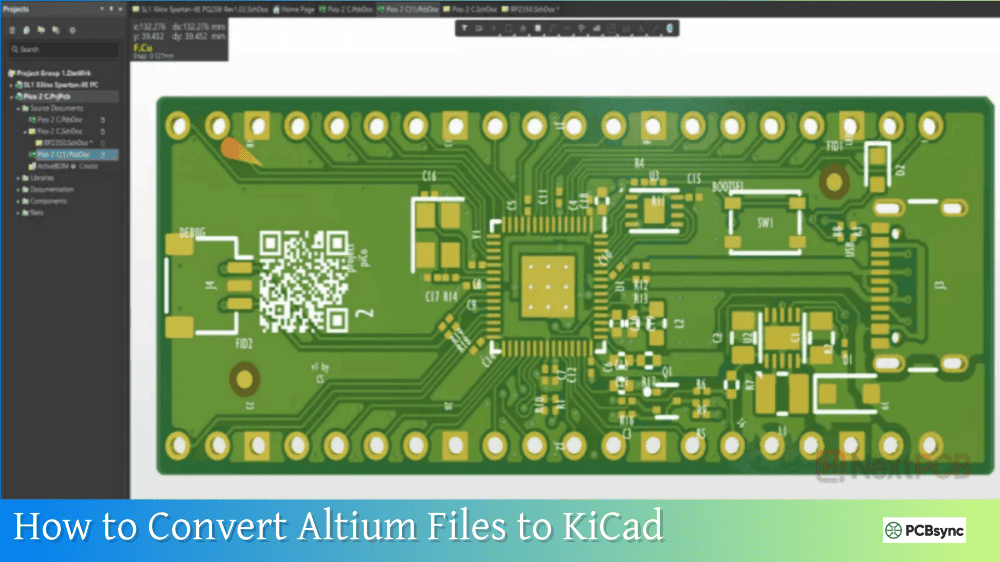
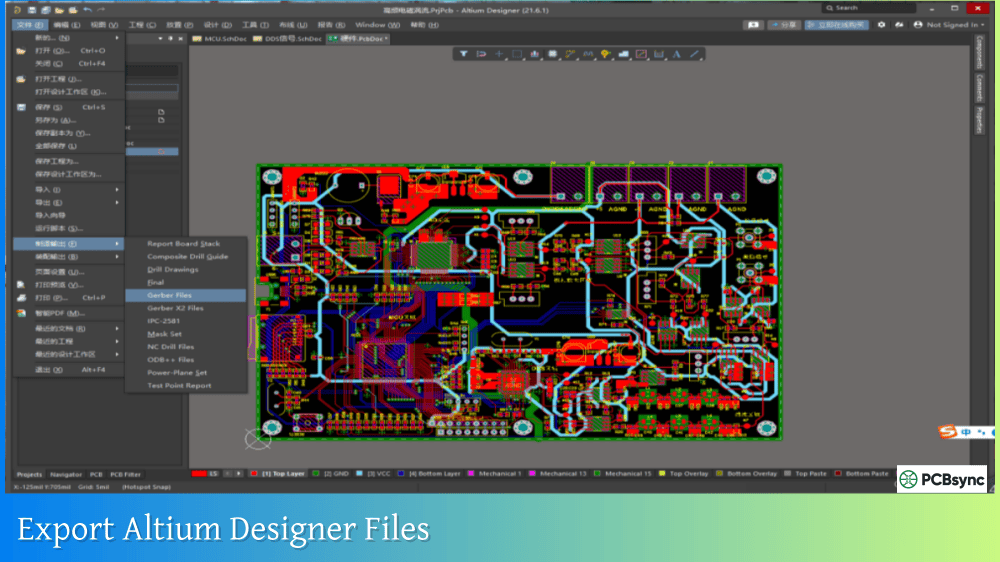
Converting Altium Designer projects to KiCad has become remarkably easier over the past few years. Whether you’re transitioning away from expensive licensing, collaborating with teams using open-source tools, or simply working with reference designs distributed in Altium format, KiCad now handles these imports with impressive fidelity.
Having worked through numerous Altium-to-KiCad migrations myself, I can tell you the process has matured significantly. KiCad 7 introduced native Altium import support, KiCad 8 expanded library compatibility, and KiCad 9 now supports complete project file imports. This guide walks you through every step of the conversion process, from understanding which files you need to verifying your converted design.
The reasons engineers convert Altium designs to KiCad vary widely. Some are driven by budget constraints—Altium Designer subscriptions aren’t cheap, and KiCad offers professional-grade capabilities at zero cost. Others need to work with reference designs from semiconductor manufacturers who distribute their evaluation boards in Altium format.
Common scenarios driving Altium to KiCad conversion include:
Cost Reduction: Small companies and individual engineers often find Altium’s pricing prohibitive. KiCad provides a fully functional PCB design suite without licensing fees, making it attractive for startups and hobbyists scaling to production.
Collaboration Requirements: When working with clients or partners who use KiCad, receiving an Altium project creates friction. Converting to a common format eliminates compatibility headaches during design reviews and modifications.
Reference Design Access: Many chip vendors provide evaluation board designs in Altium format. Engineers using KiCad need conversion capability to leverage these validated designs as starting points.
Tool Evaluation: Engineers evaluating whether KiCad can replace Altium in their workflow often import existing projects to assess how well their designs translate to the new environment.
Understanding Altium Designer File Types
Before starting any conversion, you need to know which files matter. Altium Designer projects consist of multiple file types, each serving a specific purpose.
The essential files for conversion are your schematic documents (.SchDoc), PCB layout (.PcbDoc), and any custom libraries the project references. Project files (.PrjPcb) can now be imported directly in KiCad 9.0.3 and later, significantly streamlining the workflow.
KiCad Version Requirements for Altium Import
KiCad’s Altium import capabilities have evolved rapidly across recent versions. Using the latest stable release is strongly recommended for the best conversion results.
KiCad Version
Altium Support Level
KiCad 6.x and earlier
No native support (requires third-party tools)
KiCad 7.x
Schematic (.SchDoc) and PCB (.PcbDoc) import
KiCad 8.x
Added symbol library (.SchLib) and footprint library (.PcbLib, .IntLib) support
KiCad 9.x
Added project file (.PrjPcb) import with flat schematic support
If you’re running KiCad 6 or earlier, upgrade before attempting any Altium import. The improvement in import quality between versions is substantial, and older releases require third-party conversion tools that produce less reliable results.
Preparing Your Altium Project for Conversion
Proper preparation prevents most conversion failures. Spending fifteen minutes organizing your Altium project before import saves hours of troubleshooting afterward.
Pre-Conversion Checklist
Verify Project Integrity:
Open the project in Altium Designer and run a full design rule check
Ensure all schematic sheets link correctly to the PCB layout
Confirm that component footprints are properly assigned
Library Organization:
Locate all custom libraries your project uses
Note the paths to .SchLib, .PcbLib, and .IntLib files
Standard Altium libraries typically convert without issues
File Format Considerations:
Altium supports both binary and ASCII file formats
Binary format (.SchDoc, .PcbDoc) is standard and imports correctly
ASCII format may provide better compatibility in edge cases
Multi-Sheet Designs:
For hierarchical schematics, note the top-level sheet
KiCad imports hierarchical designs correctly when you select the top sheet
Flat (non-hierarchical) multi-sheet designs require KiCad 9.0.3+ for direct import
Taking notes on your layer stack configuration helps during the layer mapping step of the import process.
Method 1: Importing Altium Projects in KiCad 9
KiCad 9.0.3 introduced direct project import, which is the fastest method for complete migrations. This approach handles schematics, PCB layout, and libraries in a single operation.
Step-by-Step Project Import
Step 1: Launch the Import Wizard
Open KiCad’s Project Manager and navigate to File → Import Non-KiCad Project → Altium Project. This opens the project import dialog.
Step 2: Select Your Altium Project File
Browse to your Altium project folder and select the .PrjPcb file. Click Open to proceed.
Step 3: Choose Output Directory
Select an empty folder where KiCad should save the converted project files. Using an empty folder prevents any file conflicts and keeps your converted design organized.
Step 4: Configure Layer Mapping
The layer mapping dialog appears, showing Altium layers on one side and KiCad layers on the other. You have two options here:
Auto-Match Layers: Click this button for automatic mapping. Works well for most standard designs.
Manual Mapping: Adjust individual layer assignments if your design uses non-standard layer configurations.
Altium Layer
KiCad Equivalent
Top Layer
F.Cu
Bottom Layer
B.Cu
Mid Layer 1, 2, etc.
In1.Cu, In2.Cu, etc.
Top Overlay
F.SilkS
Bottom Overlay
B.SilkS
Top Solder
F.Mask
Bottom Solder
B.Mask
Top Paste
F.Paste
Bottom Paste
B.Paste
Keep-Out Layer
Edge.Cuts or User.Drawings
Mechanical 1-16
User.1 through User.9
Step 5: Execute Import
Click OK or Import to begin the conversion. KiCad processes the project and opens the converted files in an unsaved state.
Step 6: Save the Converted Project
Review the imported schematic and PCB, then save all files. The project is now native KiCad format and ready for editing.
Method 2: Importing Schematics and PCBs Separately
For KiCad 7 and 8 users, or when troubleshooting problematic conversions, importing schematics and PCB layouts separately provides more control.
Importing Altium Schematics into KiCad
Open KiCad’s Schematic Editor in standalone mode (launch Eeschema directly, not from the Project Manager)
Go to File → Import → Non-KiCad Schematic
Change the file filter to Altium Designer Schematic (*.SchDoc)
Select your schematic file and click Open
For hierarchical designs, select the top-level sheet—KiCad automatically imports sub-sheets
KiCad creates a project-specific symbol library containing all components from the imported schematic. This ensures your design remains self-contained.
Importing Altium PCB Layouts into KiCad
Open KiCad’s PCB Editor in standalone mode (launch Pcbnew directly)
Navigate to File → Import → Non-KiCad Board File
Change the file filter to Altium Designer PCB (*.PcbDoc)
Select your PCB file and click Open
Review any warnings displayed during import
The PCB import includes copper geometry, vias, component footprints, board outline, and in most cases, 3D models. Design rules do not transfer—you’ll need to recreate these in KiCad.
Linking Imported Files into a Project
After importing schematics and PCB separately:
Create a new KiCad project
Copy or move the imported schematic (.kicad_sch) and PCB (.kicad_pcb) files into the project folder
Add the files to your project through the Project Manager
Run Tools → Update PCB from Schematic to verify connectivity
Method 3: Using the altium2kicad Converter Tool
For legacy KiCad versions or when native import fails, the open-source altium2kicad tool provides an alternative conversion path.
Online Converter Option
The quickest approach for simple projects:
Visit www2.futureware.at/KiCad/
Create a ZIP file containing your .PcbDoc and .SchDoc files
Upload the ZIP (maximum 40MB file size)
Download the converted KiCad files
Open the resulting .pro file in KiCad
This online service handles basic conversions without requiring any local software installation.
Based on community feedback and personal experience, these problems occur most frequently:
Missing 3D Models: While KiCad imports many 3D models successfully, some fail to transfer. STEP files generally work better than proprietary formats. Reassign missing models manually through the footprint properties.
Teardrop Artifacts: Altium’s teardrop feature sometimes creates DRC violations in KiCad. Consider removing teardrops in Altium before export, then re-adding them using KiCad’s teardrop extension after import.
Design Rules Not Imported: KiCad does not import Altium design rules. Recreate trace width rules, clearance constraints, and other DRC parameters manually. This is tedious but necessary for design integrity.
Flat Schematic Handling: KiCad versions before 9.0.3 don’t support flat (non-hierarchical) multi-sheet schematics. Each sheet must be imported individually and manually linked.
Mechanical Layer Mapping: Altium’s 16 mechanical layers don’t map directly to KiCad’s user layers. Verify critical mechanical information (assembly drawings, dimensions) transferred correctly.
Custom Pad Shapes: Complex pad geometries occasionally convert incorrectly. Inspect BGA footprints and connectors with unusual pad shapes carefully.
Useful Resources for Altium to KiCad Conversion
These resources provide additional help when tackling complex conversions:
The KiCad forum is particularly valuable for unusual conversion problems. Many experienced users have encountered and solved obscure issues.
Best Practices for Ongoing Altium and KiCad Workflows
If your organization uses both tools, establishing consistent practices prevents ongoing conversion headaches.
Standardize Your Layer Usage: Document which Altium mechanical layers map to which KiCad user layers. Apply this mapping consistently across all projects.
Maintain Library Discipline: Keep a single source of truth for component libraries. Either convert Altium libraries to KiCad format and maintain only the KiCad versions, or use KiCad’s direct Altium library support for truly shared libraries.
Version Your Conversions: Store both original Altium files and converted KiCad files under version control. This creates an audit trail and enables re-conversion if needed.
Document Conversion Decisions: When manual fixes are required during conversion, document what was changed and why. This helps future engineers understand design decisions that may not be obvious.
Frequently Asked Questions
Does KiCad support Altium ASCII file formats?
Yes. KiCad 9 added support for Altium ASCII schematic file format import in addition to the standard binary format. For PCB files, both binary and ASCII formats import correctly. If you’re having trouble with binary files, ask your Altium users to export in ASCII format as a troubleshooting step.
Can I import Altium CircuitMaker or CircuitStudio files into KiCad?
Yes. KiCad’s Altium importer supports files from CircuitMaker and CircuitStudio, which use file formats compatible with Altium Designer. The import process is identical—simply select the appropriate .SchDoc or .PcbDoc file.
Will my Altium design rules transfer to KiCad?
No. Design rules (trace widths, clearances, via sizes, etc.) do not import from Altium to KiCad. You must recreate these rules manually in KiCad’s Board Setup dialog. This is one of the most time-consuming aspects of conversion for complex designs with many custom rules.
How do I handle multi-sheet flat schematics from Altium?
KiCad 9.0.3 introduced support for flat schematic import through the project import feature. For earlier KiCad versions, import each schematic sheet individually using the standalone Schematic Editor, then manually organize them into a project structure.
What’s the best KiCad version for Altium imports?
Use the latest stable release—currently KiCad 9. Each major version has significantly improved Altium import capability. KiCad 9.0.3 specifically added project file import which dramatically simplifies the workflow. Check the KiCad blog for release notes on import-related bug fixes in point releases.
Final Thoughts
Converting Altium files to KiCad is no longer the painful process it once was. KiCad’s native import support has matured to the point where most designs convert with minimal manual intervention. The key steps remain consistent: use the latest KiCad version, understand which files you need, map layers carefully, and always verify the converted design thoroughly.
For engineers transitioning permanently to KiCad, the investment in learning the conversion process pays dividends. You gain access to a powerful, free PCB design tool while preserving your existing design work. For those who need occasional access to Altium designs shared by clients or vendors, KiCad’s import capability eliminates the need for expensive software licenses.
Take your time with the first few conversions, document what works, and build a library of converted components. Each subsequent import becomes faster as you develop familiarity with both the process and the quirks of your specific design patterns.
Inquire: Call 0086-755-23203480, or reach out via the form below/your sales contact to discuss our design, manufacturing, and assembly capabilities.
Quote: Email your PCB files to Sales@pcbsync.com (Preferred for large files) or submit online. We will contact you promptly. Please ensure your email is correct.
Notes: For PCB fabrication, we require PCB design file in Gerber RS-274X format (most preferred), *.PCB/DDB (Protel, inform your program version) format or *.BRD (Eagle) format. For PCB assembly, we require PCB design file in above mentioned format, drilling file and BOM. Click to download BOM template To avoid file missing, please include all files into one folder and compress it into .zip or .rar format.