Inquire: Call 0086-755-23203480, or reach out via the form below/your sales contact to discuss our design, manufacturing, and assembly capabilities.
Quote: Email your PCB files to Sales@pcbsync.com (Preferred for large files) or submit online. We will contact you promptly. Please ensure your email is correct.
Notes: For PCB fabrication, we require PCB design file in Gerber RS-274X format (most preferred), *.PCB/DDB (Protel, inform your program version) format or *.BRD (Eagle) format. For PCB assembly, we require PCB design file in above mentioned format, drilling file and BOM. Click to download BOM template To avoid file missing, please include all files into one folder and compress it into .zip or .rar format.
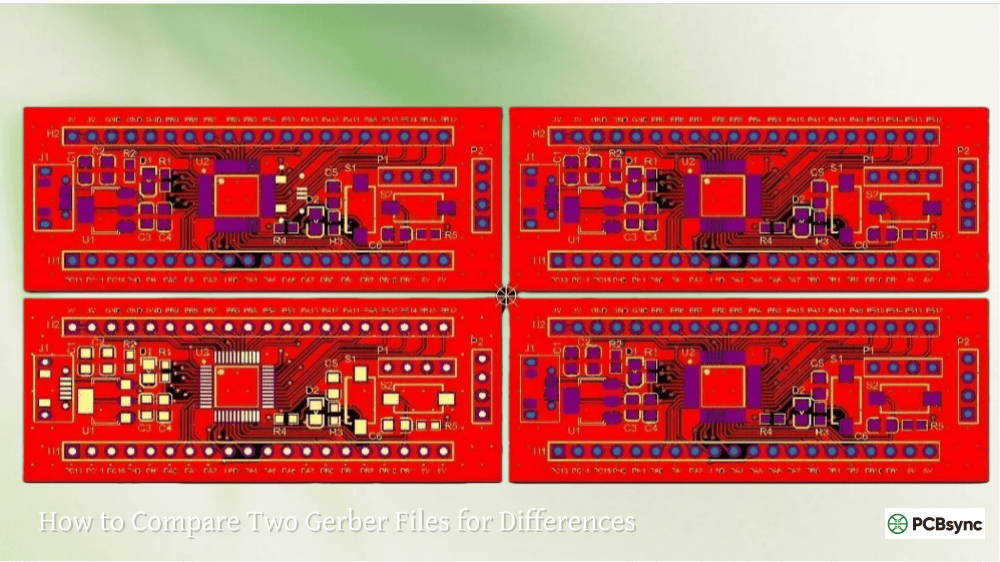
When you’re working through revision B of a PCB design and the customer swears they only changed one resistor value, how do you verify what actually changed in the Gerber files? Manual inspection of complex multilayer boards is practically impossible—even experienced engineers miss subtle differences when eyeballing two nearly identical layouts. The ability to compare two Gerber files for differences is an essential skill that saves countless hours and prevents manufacturing mistakes. This guide covers the methods, tools, and best practices for identifying exactly what changed between PCB revisions.
Validating design after moving between software tools
Lost features, altered dimensions
Vendor Communication
Verifying manufacturer received correct files
Wrong board fabricated
Audit Trail
Documenting exactly what changed and when
Compliance failures, liability issues
Error Investigation
Tracing when a problem was introduced
Repeated errors in future revisions
The challenge is that Gerber files contain thousands of coordinate commands, aperture definitions, and drawing operations. Two files can look identical on screen yet have critical differences buried in the data. Automated comparison tools reveal these hidden changes that visual inspection misses.
Methods for Comparing Gerber Files
Several approaches exist for identifying differences between Gerber files, ranging from simple visual overlay to sophisticated automated analysis.
Visual Overlay Comparison
The most basic comparison method involves loading both Gerber files into a viewer and displaying them overlaid on each other. Using contrasting colors for each file makes differences visible where the colors don’t match.
Pros: Simple, requires no specialized software, intuitive results.
Cons: Misses subtle differences, time-consuming for large boards, depends on human attention.
XOR (Exclusive OR) Comparison
XOR comparison is a mathematical operation borrowed from the integrated circuit industry. When two Gerber files are XOR’d together, any areas that are identical cancel out, leaving only the differences visible.
How XOR comparison works:
File A
File B
XOR Result
Copper present
Copper present
Empty (no difference)
Copper absent
Copper absent
Empty (no difference)
Copper present
Copper absent
Difference shown
Copper absent
Copper present
Difference shown
The result is another Gerber file containing only the differences. If the two original files are identical, the XOR output is completely empty. Any features in the XOR file represent changes between revisions.
Color-Coded Graphical Comparison
Advanced comparison tools use color coding to show additions, deletions, and unchanged areas simultaneously:
Color
Meaning
Green
Added in new revision
Red
Removed from old revision
Gray/Yellow
Unchanged between versions
This approach provides more context than XOR comparison by showing what was added versus removed, not just that something changed.
Layer-by-Layer Automated Analysis
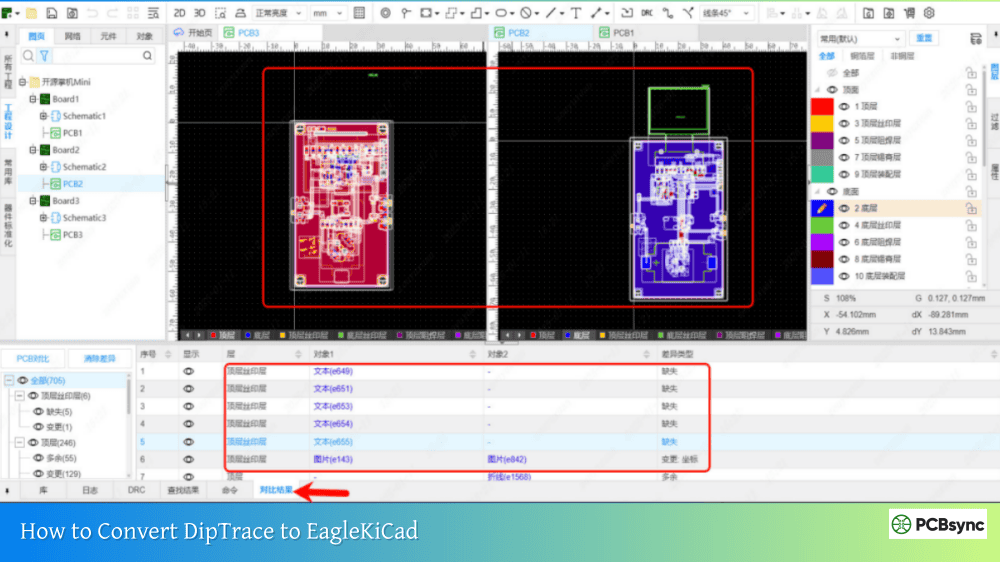
Professional CAM software performs automated layer comparison that identifies and catalogs all differences. The software generates a report listing each change with coordinates, affected features, and often a visual marker on the design.
Step-by-Step Gerber Comparison Process
Regardless of which tool you use, the comparison process follows a consistent workflow.
Step 1: Prepare Files for Comparison
Before comparing, ensure both file sets are properly organized:
Verify file completeness. Both revisions should contain the same set of layers. Missing layers in either set will generate false “differences” during comparison.
Match layer assignments. Ensure top copper compares to top copper, not bottom copper. File naming conventions vary between CAD tools, so verify layer mapping before proceeding.
Check coordinate origins. Both file sets should share the same coordinate origin. If origins differ, every feature will appear as a difference even if the designs are identical.
Step 2: Load Files into Comparison Tool
Import both Gerber file sets into your comparison software:
Load the baseline (old) revision first. This establishes the reference against which changes are measured.
Load the new revision second. The comparison will identify what changed relative to the baseline.
Verify layer pairing. Confirm the tool correctly matched corresponding layers from each revision.
Step 3: Align Layers if Necessary
If the two designs have different origins or scaling:
Use alignment features. Most comparison tools include alignment functions that let you specify reference points to register the two datasets.
Pick unambiguous alignment features. Choose mounting holes, fiducial marks, or board corners that exist in both revisions and haven’t moved.
Verify alignment visually. After automatic alignment, spot-check several locations to confirm correct registration.
Step 4: Run Comparison
Execute the comparison function:
Select comparison method. Choose graphical overlay, XOR, or automated difference detection depending on your tool’s capabilities.
Configure sensitivity settings. Some tools allow filtering of minor differences below a threshold size to focus on significant changes.
Process all relevant layers. Compare copper layers, solder mask, silkscreen, and drill files—changes can occur on any layer.
Step 5: Review and Document Results
Analyze the comparison output:
Examine each flagged difference. Don’t assume all changes are intentional. Unexpected differences may indicate export errors or unintended modifications.
Correlate with ECO documentation. Verify that changes match the engineering change order. Missing expected changes or unexpected modifications require investigation.
Save comparison results. Export reports, screenshots, or XOR files for documentation and audit trail purposes.
Tools for Comparing Gerber Files
Multiple software options support Gerber comparison, from free viewers to professional CAM systems.
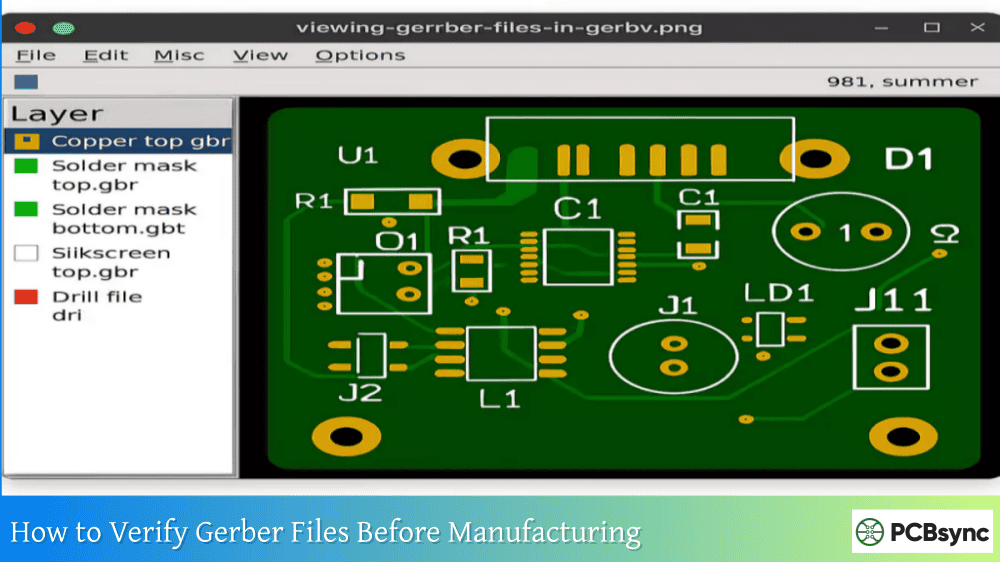
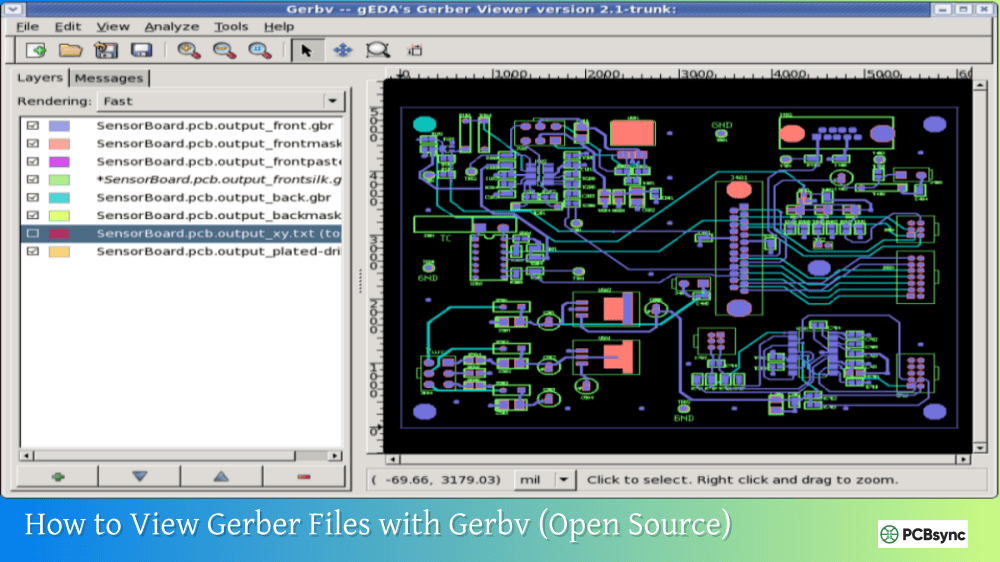
Gerbv, the free open-source Gerber viewer, includes an XOR rendering mode useful for comparison.
Gerbv XOR Comparison Steps
Step 1: Load the first Gerber file (baseline revision).
Step 2: Load the corresponding layer from the second revision as a separate layer.
Step 3: Right-click on one of the layers and select the XOR rendering mode from the display options.
Step 4: Areas that are identical will cancel out. Remaining visible features represent differences.
Step 5: Toggle layers on and off to understand whether differences represent additions or deletions.
Limitations: Gerbv’s XOR mode works but lacks the sophisticated difference cataloging and navigation features of commercial tools. For complex boards with many changes, manual review of XOR results becomes tedious.
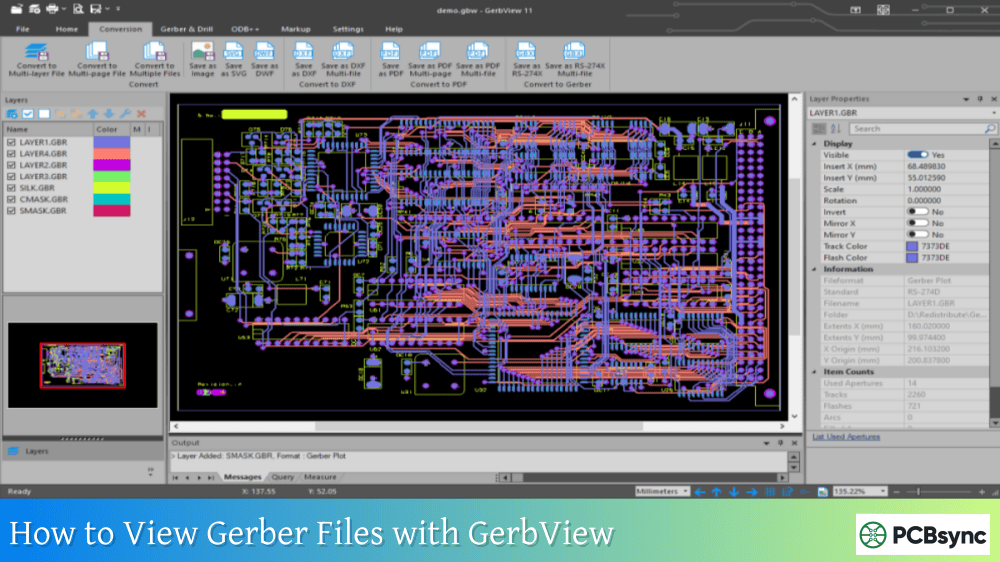
Using GerbView for Color-Coded Comparison
GerbView offers a dedicated comparison feature with intuitive color-coded output.
GerbView Comparison Steps
Step 1: Load both revisions into GerbView as separate layers.
Step 2: Select the Compare Layers tool from the Home tab.
Step 3: Select the two layers to compare and press OK.
Step 4: GerbView displays both files overlaid with color coding: one color for the old revision, another for the new, and a third where they match.
Step 5: Enable “Only Show Differences” mode to hide unchanged areas and focus on modifications.
Step 6: Use the “Unchanged Color” slider to adjust visibility of common features.
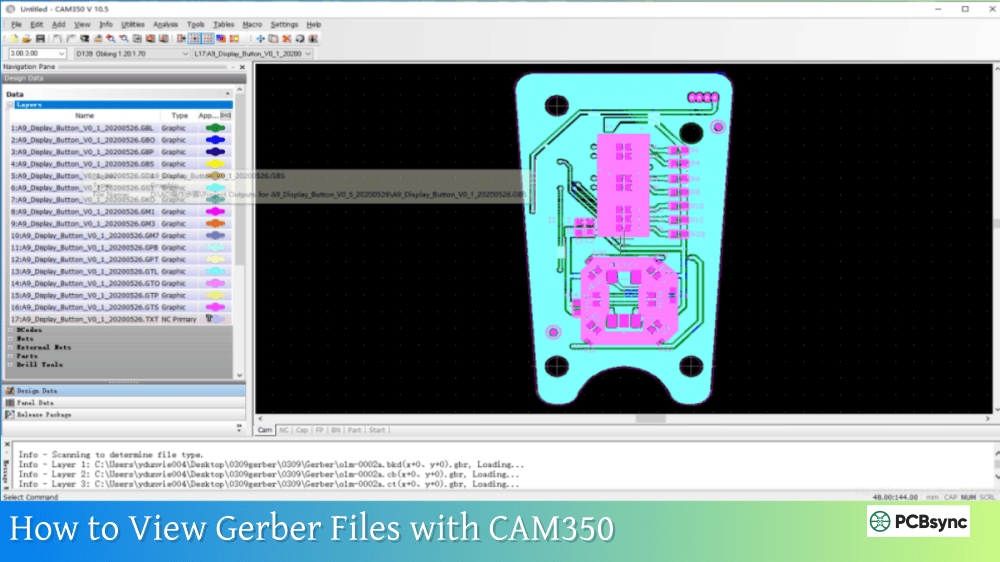
Using CAM350 for Automated Comparison
CAM350 provides comprehensive automated comparison with difference flagging and navigation.
CAM350 Layer Compare Process
Step 1: Load both Gerber files as separate layers within the same job.
Step 2: Navigate to Analysis → Compare Layers.
Step 3: Select the two layers to compare.
Step 4: CAM350 processes the comparison and reports the number of differences found.
Step 5: A Control Panel appears listing all detected differences with layer and location information.
Step 6: Click entries in the Control Panel to navigate directly to each difference location.
Step 7: Review each difference in context against the surrounding design.
Best Practices for Gerber File Comparison
Experience with hundreds of revision comparisons has revealed several practices that improve accuracy and efficiency.
Establish Consistent File Naming
Use consistent naming conventions across revisions so comparison tools can automatically match corresponding layers. Inconsistent naming forces manual layer pairing and increases error risk.
Compare All Layers, Not Just Copper
Changes can occur on any layer. Solder mask modifications affect assembly. Silkscreen changes impact component identification. Drill file differences alter hole placement. Compare every layer type, not just copper routing.
Document Comparison Results
Save comparison outputs as part of your revision documentation. When questions arise later about what changed and when, having archived comparison results provides answers without re-running analysis.
Verify Unexpected Differences
If comparison reveals changes not documented in the ECO, investigate before proceeding. Unexpected differences may indicate CAD software bugs, export errors, or unauthorized modifications.
Use Comparison as Release Gate
Make Gerber comparison a required step before releasing files to manufacturing. Verify that intended changes are present and no unintended changes occurred during the export process.
Can I compare Gerber files from different CAD tools?
Yes, Gerber files from different CAD tools can be compared since Gerber is a standardized format. However, different CAD packages may generate slightly different representations of the same design. Polygon fills might use different algorithms, trace segments might be divided differently, and coordinate precision may vary. These implementation differences can create apparent “differences” that don’t represent actual design changes. When comparing files from different CAD tools, focus on functionally significant differences (missing pads, added traces, moved components) rather than minor rendering variations in ground planes or fill patterns.
How do I compare drill files between revisions?
Drill files (Excellon format) can be compared using the same tools and methods as Gerber files. Load both drill files into your comparison software and perform overlay or XOR comparison. Look for added holes, deleted holes, moved hole positions, and changed hole sizes. Some comparison tools support drill-specific analysis that reports tool table differences in addition to graphical comparison. When comparing drill files, pay particular attention to coordinate format settings—mismatched formats can make identical files appear completely different due to scaling or offset issues.
What if the two Gerber files have different coordinate origins?
Different coordinate origins cause every feature to appear as a difference during comparison, producing useless results. Before comparing, align the two datasets to a common reference. Most comparison tools include alignment features where you specify corresponding points in each file (board corners, mounting holes, fiducials). The software calculates the offset and registers the files before comparison. If your tool lacks automatic alignment, you may need to manually adjust the origin of one file set in your CAD software and re-export before comparing.
How do I filter out insignificant differences during comparison?
Some comparison tools allow setting a minimum feature size threshold that ignores differences below that size. This filters out minor variations in fill patterns or trace edge resolution that don’t affect board functionality. Start with a conservative threshold (zero) for initial comparison to see all differences, then increase the threshold if reviewing minor variations becomes overwhelming. Always review at least a sample of filtered differences to ensure you’re not hiding significant changes. For critical designs, compare with zero threshold and manually categorize each difference as significant or insignificant.
Can I automate Gerber comparison for continuous integration?
Yes, command-line comparison tools enable automated comparison as part of continuous integration pipelines. GrbDiff (Python script) and some commercial tools support batch processing and scripted operation. Configure your CI system to run comparison between the current build and previous release, generating difference reports automatically. Fail the build if unexpected differences appear, requiring engineer review before proceeding. This approach catches unintended changes early and creates an automatic audit trail of design evolution. Some teams integrate comparison with version control hooks, running comparison automatically when Gerber files are committed.
Conclusion
The ability to compare two Gerber files for differences is fundamental to professional PCB development. Whether tracking revisions, validating ECOs, verifying CAD migrations, or investigating manufacturing problems, reliable comparison methods prevent errors that cost time and money.
Start with free tools like Gerbv or online comparison services for occasional needs. As comparison becomes a regular part of your workflow, consider dedicated software like GerbView or CAM350 that provides automated difference detection, navigation, and reporting.
Make comparison a standard gate in your release process. Before any Gerber package goes to manufacturing, compare it against the previous revision and verify that all changes are intentional and documented. This simple discipline catches export errors, unintended modifications, and missing ECO implementation before they become expensive manufacturing problems.
The few minutes invested in systematic Gerber comparison pays dividends in reduced respins, cleaner revision history, and confidence that your manufactured boards match your design intent.
Inquire: Call 0086-755-23203480, or reach out via the form below/your sales contact to discuss our design, manufacturing, and assembly capabilities.
Quote: Email your PCB files to Sales@pcbsync.com (Preferred for large files) or submit online. We will contact you promptly. Please ensure your email is correct.
Notes: For PCB fabrication, we require PCB design file in Gerber RS-274X format (most preferred), *.PCB/DDB (Protel, inform your program version) format or *.BRD (Eagle) format. For PCB assembly, we require PCB design file in above mentioned format, drilling file and BOM. Click to download BOM template To avoid file missing, please include all files into one folder and compress it into .zip or .rar format.