Inquire: Call 0086-755-23203480, or reach out via the form below/your sales contact to discuss our design, manufacturing, and assembly capabilities.
Quote: Email your PCB files to Sales@pcbsync.com (Preferred for large files) or submit online. We will contact you promptly. Please ensure your email is correct.
Notes: For PCB fabrication, we require PCB design file in Gerber RS-274X format (most preferred), *.PCB/DDB (Protel, inform your program version) format or *.BRD (Eagle) format. For PCB assembly, we require PCB design file in above mentioned format, drilling file and BOM. Click to download BOM template To avoid file missing, please include all files into one folder and compress it into .zip or .rar format.
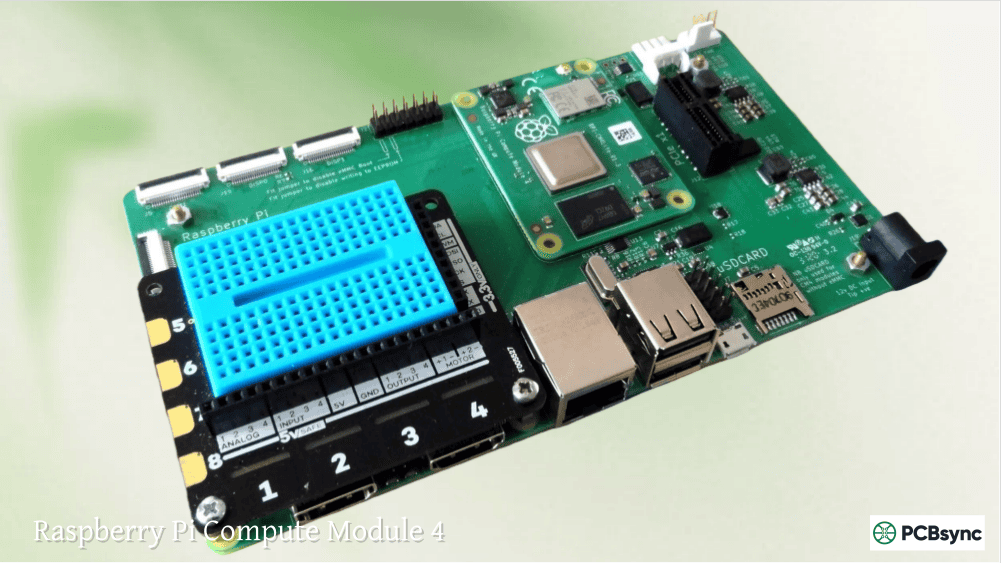
Picking the right Raspberry Pi Compute Module 4 variant shouldn’t require a flowchart and three cups of coffee, but here we are. With 32 different CM4 variants on the market, engineers face a genuine decision matrix when speccing out embedded projects.
I’ve made this choice dozens of times across industrial control systems, digital signage deployments, and prototype runs. The difference between selecting a CM4108032 versus a CM4008032 might seem trivial on paper, but it cascades through your BOM costs, carrier board design, and field serviceability.
This guide breaks down the CM4 variants decision with real engineering tradeoffs—not marketing speak.
The CM4 part numbers follow a logical structure that encodes every key specification. Once you crack the code, ordering becomes straightforward.
CM4 Part Number Breakdown
Position
Meaning
Options
CM4
Base model
Always “CM4”
1st digit
Wireless
0 = No WiFi, 1 = WiFi/BT
2nd digit
RAM (GB)
01, 02, 04, 08
3rd-4th digits
eMMC (GB)
00 (Lite), 08, 16, 32
So when you see CM4108032, you’re looking at a CM4 with WiFi (1), 8GB RAM (08), and 32GB eMMC (032). Meanwhile, CM4008032 is identical except it lacks wireless connectivity (0 instead of 1).
The “Lite” designation applies to any variant with “00” in the eMMC position—these modules have no onboard storage and require a microSD card on the carrier board.
Complete CM4 Variants Pricing Reference
Part Number
Wireless
RAM
eMMC
Price (USD)
CM4001000
No
1GB
Lite
$30
CM4001008
No
1GB
8GB
$35
CM4001016
No
1GB
16GB
$40
CM4001032
No
1GB
32GB
$45
CM4002000
No
2GB
Lite
$40
CM4002032
No
2GB
32GB
$55
CM4004000
No
4GB
Lite
$55
CM4004032
No
4GB
32GB
$70
CM4008000
No
8GB
Lite
$80
CM4008032
No
8GB
32GB
$95
CM4101000
Yes
1GB
Lite
$35
CM4104000
Yes
4GB
Lite
$60
CM4108000
Yes
8GB
Lite
$85
CM4108032
Yes
8GB
32GB
$100
Prices reflect 2025 MSRP and may vary by distributor.
eMMC vs Lite: The Storage Decision
This is typically the first fork in your decision tree, and it has the most significant implications for your carrier board design.
Why Choose CM4 with eMMC
The eMMC variants (8GB, 16GB, or 32GB) integrate flash storage directly on the module. From a PCB engineer’s perspective, this simplifies carrier board design considerably.
Performance advantages of eMMC:
The CM4’s eMMC uses an 8-bit bus interface, delivering roughly 2x the read performance and 3x the write performance compared to typical microSD cards. In benchmarks, the CM4 eMMC achieves around 83-90 MB/s sequential read speeds—competitive with good microSD cards but with significantly better random I/O performance.
For applications involving frequent small file operations (database queries, logging, configuration reads), eMMC’s random I/O advantage matters more than raw sequential throughput.
Reliability considerations:
Industrial deployments favor eMMC because there’s no removable media to work loose from vibration, no card to corrupt from unexpected power loss, and no slot mechanism to wear out over thousands of insertion cycles. The eMMC is soldered to the module—it goes nowhere.
When eMMC makes sense:
Production deployments where the OS image is finalized
The Lite variants trade integrated storage for flexibility and cost savings. But there’s a catch that trips up many first-time CM4 users.
Critical design requirement: CM4 Lite modules require a carrier board with a microSD card slot. The SDIO interface pins are only routed to the connector on Lite modules—on eMMC variants, these pins connect to the onboard flash instead. You cannot add microSD capability to an eMMC module later.
Cost advantages:
A CM4 Lite with 8GB RAM (CM4008000 or CM4108000) saves $15-20 compared to the equivalent 32GB eMMC variant. At production volumes, this adds up quickly.
Flexibility benefits:
With Lite modules, you can swap storage media without replacing the compute module. Field technicians can image cards at their desk and hot-swap them on site. During development, you can try different OS configurations without reflashing through USB boot mode.
When Lite makes sense:
Development and prototyping phases
Cost-sensitive volume production
Applications requiring user-accessible storage
Scenarios where field storage replacement is valuable
Carrier boards with M.2 NVMe (boot from faster storage anyway)
Storage Decision Matrix
Factor
eMMC Preferred
Lite Preferred
Reliability priority
✓
Development flexibility
✓
Cost sensitivity
✓
No SD slot on carrier
✓
Using NVMe boot
✓
Vibration environment
✓
Field serviceability
✓
WiFi vs No WiFi: The Connectivity Decision
The wireless option adds only $5 to any CM4 configuration but carries implications beyond the obvious connectivity feature.
Why Choose CM4 with WiFi
Wireless CM4 variants include a fully certified dual-band radio module supporting 802.11 b/g/n/ac WiFi and Bluetooth 5.0 with BLE. The certification is the key value here.
Compliance simplification:
Raspberry Pi has completed modular wireless compliance certification for the CM4. When you design a product using the wireless CM4, you can leverage this certification rather than performing full RF testing on your end product. This saves weeks of compliance lab time and potentially thousands in testing fees.
Antenna options:
Wireless CM4 modules include both an onboard PCB trace antenna and a U.FL connector for external antennas. Software configuration switches between them. The external antenna kit (sold separately) is essential if your enclosure is metallic or otherwise RF-blocking.
When WiFi makes sense:
Products requiring wireless connectivity
Bluetooth peripheral support needed
Want to leverage existing RF certification
Remote configuration or monitoring requirements
IoT gateway applications
Why Choose CM4 Without WiFi
The non-wireless CM4 variants aren’t just $5 cheaper—they serve specific engineering purposes.
Reduced EMI concerns:
In some industrial environments or RF-sensitive applications, having a transmitting radio onboard creates compliance headaches or interference issues. Medical devices, test equipment, and certain manufacturing environments often mandate no unintentional radiators.
Simplified compliance:
While the wireless certification helps when you want WiFi, it can complicate matters if you don’t. Some regulatory environments treat devices with any wireless capability differently, regardless of whether it’s enabled. Starting without wireless avoids these conversations entirely.
Lower power consumption:
The wireless subsystem draws power even when idle. For battery-powered or energy-harvesting applications, eliminating unused wireless saves precious milliamps.
Let me decode the most popular CM4 variants you’ll encounter in the field.
CM4108032: The Flagship
The CM4108032 represents the fully-loaded option: WiFi, 8GB RAM, and 32GB eMMC. At around $100, it’s the premium choice for demanding applications where you want maximum headroom. Typical uses include media players, edge AI systems, and development work where you’d rather not hit memory limits.
CM4008032: Professional Non-Wireless
The CM4008032 matches the CM4108032’s 8GB RAM and 32GB eMMC but omits wireless. This is my go-to for industrial applications where the device connects via Ethernet and I want to avoid any RF considerations. Saves $5 per unit while eliminating an unused subsystem.
CM4104000: Balanced Wireless Lite
For wireless projects using NVMe storage or where microSD flexibility matters, the CM4104000 provides 4GB RAM with WiFi at a reasonable price point. The 4GB RAM handles most embedded Linux workloads comfortably.
CM4001000: Budget Baseline
The CM4001000 is the entry-level variant at $30: 1GB RAM, no WiFi, no eMMC. Useful for dedicated appliances with modest memory requirements and cost constraints. Digital signage players, simple automation controllers, and status displays often work fine with this configuration.
Practical Selection Guidelines
After specifying CM4 variants for numerous projects, here’s my decision framework.
Start with RAM
RAM cannot be upgraded later, and Linux systems benefit significantly from memory headroom. My recommendations:
1GB: Only for single-purpose appliances with controlled workloads
2GB: Adequate for lightweight services, basic GUIs
4GB: Sweet spot for most embedded applications
8GB: Required for containers, heavy processing, development
Then Consider Storage
If your carrier board has M.2 NVMe and you plan to boot from SSD, choose Lite—you’re paying for eMMC you won’t use.
If you need the simplicity and reliability of onboard storage, pick the appropriate eMMC size:
8GB: Minimal OS installations
16GB: Standard Raspberry Pi OS with applications
32GB: Media storage, logging, containers
Finally, Wireless
Add WiFi ($5) if:
You need WiFi or Bluetooth functionality
You might need it later (retrofitting is impossible)
The pre-certification value exceeds $5 in saved testing
Skip WiFi if:
Ethernet-only design
EMC/RF constraints exist
Every dollar matters at volume
Useful Resources for CM4 Projects
Here are resources I reference regularly when working with CM4 variants:
Official Documentation
Raspberry Pi CM4 Datasheet: Complete electrical specifications and mechanical drawings
CM4 IO Board Design Files: Reference carrier board schematics in KiCad format
CM4 Product Brief PDF: Quick reference for all variants and pricing
Community Resources
Jeff Geerling’s CM4 Review: Thorough benchmarks comparing eMMC vs SD vs NVMe performance
Raspberry Pi Forums Compute Module section: Active troubleshooting community
Jeff Geerling’s PCIe Database: Compatibility testing for carrier boards and peripherals
Compliance Information
pip.raspberrypi.com: Official compliance certificates for all regions
CM4 EMC and regulatory documentation
Frequently Asked Questions About CM4 Variants
Can I use a CM4 Lite module in a carrier board designed for eMMC variants?
Yes, physically. Both variants use identical 100-pin connectors. However, you must ensure the carrier board has a microSD slot—the SDIO pins are only functional on Lite modules. Without a microSD slot, you’d need to boot from USB or network, which limits practicality.
What’s the real-world performance difference between eMMC and microSD?
In benchmarks, CM4 eMMC delivers roughly 2-3x better random I/O performance compared to good microSD cards. Sequential performance is similar. For boot time and application responsiveness, eMMC provides a noticeably snappier experience. NVMe via PCIe is faster than both by a significant margin.
Can I add WiFi to a non-wireless CM4 later?
No. The wireless radio is integrated into the module’s PCB. Non-wireless variants physically lack the radio hardware—it’s not just disabled. If you might need wireless, buy the wireless variant upfront. The $5 premium is cheap insurance.
Which CM4 variant should I use for a home NAS project?
For NAS applications, I typically recommend CM4008032 or CM4004032 (without WiFi). You’ll connect via Ethernet anyway, and the larger RAM helps with file caching. The eMMC provides reliable OS storage while your actual data lives on SATA or NVMe drives connected through the carrier board.
Are extended temperature range CM4 variants available?
Yes. Raspberry Pi offers industrial-grade CM4 variants rated for -40°C to +85°C operation. These carry an “ET” suffix in the part number and are available through authorized distributors. They’re priced higher and often require minimum order quantities.
Final Thoughts
The 32 CM4 variants might seem overwhelming, but most projects quickly narrow to two or three realistic options once you’ve established RAM requirements, storage strategy, and wireless needs.
For most embedded projects, the CM4104032 (4GB RAM, 32GB eMMC, WiFi) or its non-wireless equivalent CM4004032 hits the sweet spot of capability and cost. Development work benefits from 8GB variants like the CM4108032 or CM4008032 to avoid memory constraints during iteration.
Remember: you can always buy more storage through NVMe, but you can’t upgrade RAM or add wireless after the fact. When in doubt, spec up on the unchangeable features and optimize cost elsewhere in your BOM.
Inquire: Call 0086-755-23203480, or reach out via the form below/your sales contact to discuss our design, manufacturing, and assembly capabilities.
Quote: Email your PCB files to Sales@pcbsync.com (Preferred for large files) or submit online. We will contact you promptly. Please ensure your email is correct.
Notes: For PCB fabrication, we require PCB design file in Gerber RS-274X format (most preferred), *.PCB/DDB (Protel, inform your program version) format or *.BRD (Eagle) format. For PCB assembly, we require PCB design file in above mentioned format, drilling file and BOM. Click to download BOM template To avoid file missing, please include all files into one folder and compress it into .zip or .rar format.