Inquire: Call 0086-755-23203480, or reach out via the form below/your sales contact to discuss our design, manufacturing, and assembly capabilities.
Quote: Email your PCB files to Sales@pcbsync.com (Preferred for large files) or submit online. We will contact you promptly. Please ensure your email is correct.
Notes: For PCB fabrication, we require PCB design file in Gerber RS-274X format (most preferred), *.PCB/DDB (Protel, inform your program version) format or *.BRD (Eagle) format. For PCB assembly, we require PCB design file in above mentioned format, drilling file and BOM. Click to download BOM template To avoid file missing, please include all files into one folder and compress it into .zip or .rar format.
As a PCB engineer, I’ve learned that choosing the right voltage regulator IC can make or break a design. Power management seems straightforward until you’re debugging thermal issues at 3 AM or chasing down mysterious noise on your sensitive analog rails. Understanding voltage regulator IC types isn’t just academic knowledge—it’s essential for building reliable, efficient electronic systems.
This comprehensive guide covers the three main categories of voltage regulator ICs: standard linear regulators, low-dropout (LDO) regulators, and switching regulators. Whether you’re powering microcontrollers, designing battery-operated devices, or building high-performance analog systems, you’ll find practical guidance for selecting the right regulator for your application.
A voltage regulator IC is an integrated circuit that maintains a stable, constant output voltage regardless of changes in input voltage or load current. Think of it as the gatekeeper between your power source and the sensitive electronics that depend on clean, stable power to function properly.
Every electronic system needs regulated power rails. Microcontrollers typically require 3.3V or 1.8V, sensors might need 5V, and communication modules often have their own specific requirements. Raw power sources—whether batteries, wall adapters, or upstream power rails—rarely provide these exact voltages with the stability modern ICs demand. Voltage regulators bridge this gap.
The three main voltage regulator IC types each approach this task differently:
Standard Linear Regulators act like variable resistors, dissipating excess voltage as heat to maintain stable output. They’re simple but can be inefficient when input and output voltages differ significantly.
LDO (Low-Dropout) Regulators are specialized linear regulators designed to operate with minimal voltage difference between input and output. When I need to explain LDO operation to colleagues, I describe it as a more efficient cousin of standard linear regulators—same basic principle, but optimized for situations where input voltage barely exceeds output requirements.
Switching Regulators use inductors and rapid on-off switching to transfer energy efficiently. They’re more complex but achieve efficiencies that linear approaches simply cannot match.
Linear Voltage Regulator ICs Explained
Linear regulators represent the oldest and simplest approach to voltage regulation. Understanding how they work provides the foundation for appreciating more advanced topologies.
How Standard Linear Regulators Work
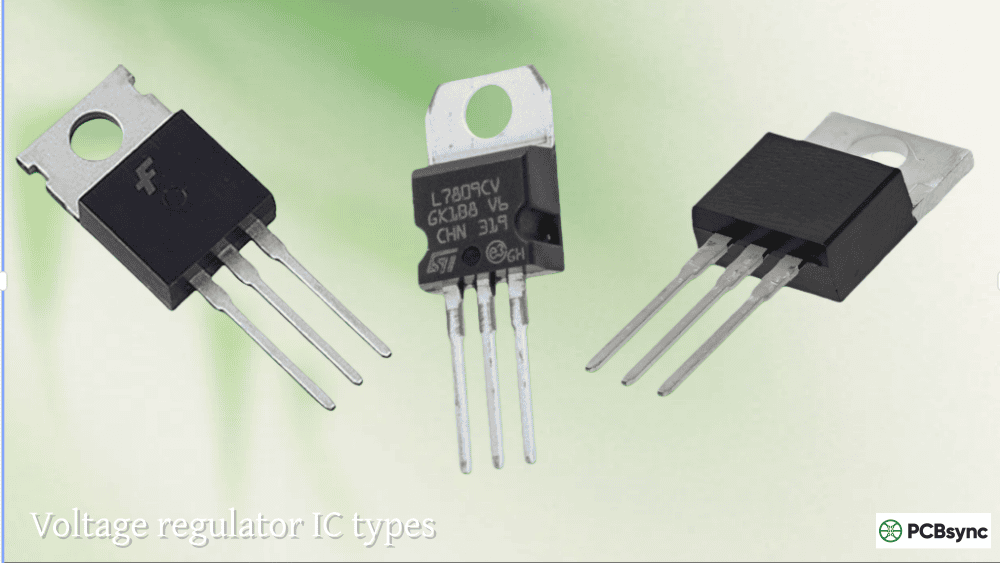
A standard linear regulator uses a pass transistor (typically an NPN Darlington configuration) controlled by a feedback loop. The error amplifier compares a fraction of the output voltage against an internal reference, then adjusts the pass transistor’s conduction to maintain the desired output.
The classic 78xx series (like the LM7805) exemplifies this topology. These workhorses have powered countless projects since their introduction, delivering fixed output voltages with minimal external components—typically just input and output capacitors.
The key limitation? Standard linear regulators require significant headroom—typically 2V to 3V—between input and output. This “dropout voltage” represents the minimum input-output differential needed for proper regulation. Drop below this threshold, and the regulator falls out of regulation, unable to maintain its specified output.
Advantages of Standard Linear Regulators
Despite their age, standard linear regulators still earn their place in many designs:
Simplicity: Three pins (input, output, ground), two capacitors, done. Layout is trivial compared to switching alternatives.
Low noise: No switching means no switching noise. The output is remarkably clean, limited only by the internal reference noise.
Low cost: Parts like the LM7805 cost pennies in volume. Hard to beat for non-critical applications.
Fast transient response: Linear regulators respond quickly to load changes because there’s no inductor slowing things down.
When Standard Linear Regulators Fall Short
The efficiency equation for linear regulators is unforgiving:
Efficiency = (Vout / Vin) × 100%
Converting 12V to 5V? Best-case efficiency is only 42%. At 1A output, you’re dissipating 7W as heat—that’s a lot of thermal management for a “simple” circuit.
The high dropout voltage also limits battery-powered applications. A 7805 regulating from a 9V battery becomes useless once the battery drops below about 7V, leaving significant capacity untapped.
LDO Explained: Low-Dropout Regulator ICs
LDO regulators emerged to address the dropout voltage limitations of standard linear regulators. The term “Low Dropout” specifically refers to their ability to maintain regulation with much smaller input-output differentials—often as low as 100mV to 500mV.
The Technology Behind LDO Regulators
The key difference between LDO and standard linear regulators lies in the pass element topology. Standard regulators use NPN Darlington configurations in emitter-follower mode, which inherently require significant base-emitter voltage drop plus saturation voltage.
LDO regulators typically employ PMOS or PNP transistors in a different configuration—open drain or open collector—that allows the pass device to be driven into saturation. This means the pass transistor can operate with only its saturation voltage (often just tens of millivolts) between input and output.
Two main LDO architectures dominate the market:
PMOS LDO: Uses a P-channel MOSFET as the pass element. The error amplifier drives the gate negative (relative to source) to reduce drain-source resistance as input voltage approaches output voltage. PMOS LDOs typically have higher dropout at lower output voltages.
NMOS LDO: Uses an N-channel MOSFET requiring a charge pump or auxiliary voltage rail (VBIAS) to drive the gate above the output voltage. NMOS LDOs can achieve extremely low dropout (40mV to 150mV) independent of output voltage, but add complexity.
Critical LDO Specifications to Understand
When selecting an LDO, several specifications matter beyond basic voltage and current ratings:
Dropout Voltage (VDROPOUT): The minimum input-output differential for regulation. This varies with load current—always check the specification at your actual operating current, not just the headline number.
Quiescent Current (IQ): Current consumed by the LDO’s internal circuitry. Critical for battery-powered applications where every microamp counts. Modern ultra-low-IQ LDOs achieve sub-microamp quiescent current.
Power Supply Rejection Ratio (PSRR): Measures how well the LDO attenuates input noise. Expressed in dB, higher is better. PSRR varies with frequency—check the curves at frequencies relevant to your application.
Output Noise: The LDO’s own noise contribution to the output, typically specified as µVRMS over a bandwidth (like 10Hz to 100kHz). Ultra-low-noise LDOs designed for precision applications can achieve below 10µVRMS.
Load Regulation: Output voltage variation with changing load current. Specified as percentage change per amp or millivolt change across the load range.
Line Regulation: Output voltage variation with changing input voltage. Good LDOs maintain tight output regardless of input fluctuations.
Transient Response: How quickly and cleanly the LDO recovers from sudden load changes. Critical for powering digital ICs with rapidly varying current demands.
LDO Application Examples
LDOs excel in specific scenarios:
Post-regulation: Following a switching regulator to clean up ripple and noise. The switching converter handles the heavy lifting efficiently, while the LDO provides pristine power for sensitive loads.
Battery-powered devices: When running from lithium cells (3.7V nominal) powering 3.3V logic, the small headroom requirement of an LDO maximizes usable battery capacity.
Noise-sensitive circuits: Powering Altera FPGA core voltages, precision ADCs, RF synthesizers, or audio circuits where switching noise would degrade performance.
Space-constrained designs: LDOs require minimal external components and come in tiny packages (0.65mm × 0.65mm flip-chip options exist).
Switching Regulator IC Types and Topologies
Switching regulators achieve what linear regulators cannot: efficient voltage conversion regardless of input-output differential. The secret lies in using inductors and capacitors as energy storage elements, combined with high-frequency switching to transfer energy in controlled packets.
Buck Converter: Step-Down Switching Regulators
The buck converter (step-down converter) is the most common switching topology. It converts a higher input voltage to a lower, regulated output voltage with typical efficiencies of 85% to 95%.
How it works: A switch (usually a MOSFET) rapidly connects and disconnects the input voltage to an inductor. During the “on” time, current builds in the inductor, storing energy in its magnetic field. During the “off” time, the inductor releases its stored energy to the output through a diode (asynchronous buck) or second MOSFET (synchronous buck). The output capacitor smooths the resulting voltage.
Key parameters: Switching frequency (typically 100kHz to several MHz), inductor value, output capacitance, and control loop bandwidth all interact to determine ripple, transient response, and efficiency.
Best applications: Any scenario requiring efficient step-down conversion—12V to 5V, 5V to 3.3V, 3.3V to 1.8V. Essential for battery-powered devices and any high-current application where linear regulation would generate excessive heat.
Boost Converter: Step-Up Switching Regulators
Boost converters generate an output voltage higher than the input—something impossible for linear regulators.
How it works: The switch connects the inductor to ground, building current. When the switch opens, the inductor’s stored energy adds to the input voltage, pushing current through a diode to charge the output capacitor. The output voltage can theoretically reach very high levels, though practical limits exist based on duty cycle and component ratings.
Key considerations: Boost converters can’t be fully shut down by simply disabling the controller—a direct path exists from input to output through the inductor and diode. Inrush current at startup can also be problematic.
Best applications: Generating higher voltages from battery cells, LED backlighting, bias voltage generation, and portable device power systems where the load requires voltage higher than the battery can provide directly.
Buck-Boost Converter: Versatile Voltage Conversion
Buck-boost converters can produce output voltage either higher or lower than the input, making them ideal for applications where input voltage varies above and below the desired output.
Inverting buck-boost: The traditional topology produces a negative output voltage relative to input ground. Simple and efficient, but the inverted polarity limits applications.
Four-switch buck-boost: Uses four MOSFETs to achieve non-inverting operation. More complex but provides seamless transition between buck and boost modes as input voltage varies.
SEPIC and Ćuk topologies: Alternative approaches that provide non-inverting operation with isolation between input and output grounds.
Best applications: Battery-powered systems where the battery voltage spans above and below the required output voltage during discharge. For example, generating 3.3V from a single lithium cell that varies from 4.2V (fully charged) to 3.0V (discharged).
Isolated Topologies: Flyback and Forward Converters
When galvanic isolation between input and output is required, transformer-based topologies become necessary.
Flyback: The transformer stores energy during the switch on-time and transfers it to the secondary during off-time. Simple and cost-effective for lower power applications (typically under 100W).
Forward: Energy transfers to the secondary during the switch on-time. More efficient than flyback at higher power levels but requires reset circuitry for the transformer.
Applications: AC-DC power supplies, medical equipment, industrial systems, and any application where safety isolation is mandated.
Comprehensive Voltage Regulator IC Types Comparison
Parameter
Standard Linear
LDO Regulator
Switching Regulator
Efficiency
Low (30-60% typical)
Moderate to high (Vout/Vin dependent)
High (80-97%)
Dropout Voltage
2V to 3V
100mV to 500mV
N/A (can buck or boost)
Output Noise
Very low (<50µV)
Low (10-500µVRMS)
Higher (10-50mV ripple)
External Components
2 (input/output caps)
2-3 (caps, possibly noise bypass)
5-10+ (inductor, caps, feedback network)
PCB Footprint
Small
Small to medium
Larger
Design Complexity
Simple
Simple to moderate
Complex
EMI Generation
Negligible
Negligible
Significant
Conversion Capability
Step-down only
Step-down only
Buck, boost, or both
Cost
Very low
Low to moderate
Moderate to high
Thermal Management
May need heatsink
May need heatsink at current
Usually minimal
Transient Response
Fast
Fast
Moderate
PSRR
High
Very high
Lower
Selecting the Right Voltage Regulator IC Type
Choosing between regulator types requires balancing multiple factors. Here’s my practical decision framework:
Start With Efficiency Requirements
Calculate the power dissipation for a linear solution:
Power Loss = (Vin – Vout) × Iload
If this exceeds what your thermal design can handle (typically 0.5W to 1W for surface-mount ICs without heatsinks), a switching regulator becomes mandatory.
Consider Noise Sensitivity
What’s downstream of this regulator? Precision ADCs, RF circuits, PLLs, and audio systems all suffer from power supply noise. If PSRR and low output noise are critical, LDOs typically provide the cleanest power. For the absolute lowest noise, consider a cascaded approach: switching pre-regulator followed by an LDO post-regulator.
Evaluate Input Voltage Range
Battery-powered applications face variable input voltages. If your battery voltage will drop below the output plus dropout threshold, you’ll either need an LDO with lower dropout or a switching solution.
If the input voltage spans both above and below the required output (common with single-cell lithium batteries needing 3.3V output), a buck-boost topology is necessary.
Account for PCB Constraints
Switching regulators require careful layout to manage EMI. Hot loops must be minimized, inductors positioned strategically, and ground planes properly managed. If board space is tight or layout expertise limited, an LDO’s simplicity becomes very attractive.
Check Quiescent Current for Battery Applications
Sleep mode current matters for battery life. Ultra-low-IQ LDOs draw hundreds of nanoamps; switching regulators typically require several microamps just to maintain their oscillator and control circuits. For always-on but lightly loaded rails in portable devices, LDOs often win despite lower efficiency at full load.
LDO if dropout acceptable; buck-boost for full battery range
12V/24V industrial to 3.3V
Switching (buck)
Efficiency mandatory at this differential
Precision ADC supply
Ultra-low-noise LDO
PSRR and noise floor critical
RF/wireless module
LDO
Switching noise degrades RF performance
High-current CPU/FPGA
Multiphase buck
Current and efficiency requirements
Portable audio
LDO or LC-filtered buck
Noise floor affects SNR
Always-on IoT sensor
Ultra-low-IQ LDO
Sleep current dominates battery life
Automotive (off battery)
Automotive-rated LDO/buck
Wide input range, protection features
Useful Resources for Voltage Regulator Design
Design Tools and Calculators
Texas Instruments WEBENCH Power Designer provides complete switching regulator designs with component selection, schematic, and layout suggestions. Invaluable for speeding up development.
Analog Devices LTspice offers free SPICE simulation with extensive power component models. Essential for validating designs before building hardware.
Manufacturer Design Studios (TI, ADI, Microchip, ST all offer online tools) help with component selection and thermal analysis.
Technical Documentation
TI Application Note SNVA558 (“Linear and Switching Voltage Regulator Fundamental”) provides excellent foundational knowledge on regulator architectures and design considerations.
Analog Devices AN-140 (“Basic Concepts of Linear Regulator and Switching Mode Power Supplies”) offers detailed explanation of operating principles and trade-offs.
Component Databases
DigiKey and Mouser parametric search tools allow filtering by input voltage, output voltage, current, package, and features. Essential for finding the right part among thousands of options.
Octopart aggregates availability and pricing across distributors, useful for production planning.
Frequently Asked Questions About Voltage Regulator IC Types
What is the main difference between an LDO and a standard linear regulator?
The key difference lies in dropout voltage—the minimum input-to-output differential required for regulation. Standard linear regulators (like the 78xx series) typically require 2V to 3V headroom due to their NPN Darlington pass transistor topology. LDO regulators use PMOS or PNP pass transistors that can operate with much smaller headroom, often 100mV to 500mV. This makes LDOs essential for applications where input voltage is only slightly higher than the required output, such as powering 3.3V logic from a lithium battery.
When should I choose a switching regulator over an LDO?
Choose a switching regulator when efficiency is paramount, especially when the input-output voltage differential is large. A simple calculation helps: multiply (Vin – Vout) by your load current to get power dissipation in a linear regulator. If that exceeds about 0.5W to 1W (the typical limit for surface-mount packages without heatsinks), switching becomes necessary. Also choose switching when you need to boost voltage above the input, when battery life is critical, or when high currents make linear thermal dissipation impractical.
Can I use an LDO to filter switching regulator noise?
Yes, this is a common and effective strategy. The switching regulator handles the bulk of voltage conversion efficiently, while a downstream LDO provides the clean, low-noise power required by sensitive circuitry. The LDO needs only operate with small headroom (200mV to 500mV is common), minimizing its inefficiency. This cascaded approach delivers both high overall efficiency and excellent noise performance. The LDO’s PSRR suppresses the switching ripple, typically by 40dB to 80dB depending on frequency.
Why do some LDOs require specific output capacitor ESR ranges?
LDO stability depends on the interaction between the internal error amplifier, pass transistor, and output capacitor. Many older LDO designs require output capacitor ESR within a specific range (typically 0.1Ω to 3Ω) to provide proper phase margin in the control loop. Too low ESR (like some ceramic capacitors) can cause oscillation; too high ESR causes excessive output ripple and poor transient response. Modern LDOs increasingly feature internal compensation that allows stable operation with low-ESR ceramic capacitors, but always verify this in the datasheet before assuming ceramic capacitors will work.
What causes switching regulator EMI, and how can I minimize it?
Switching regulator EMI originates from rapid current transitions in the power stage—specifically the “hot loops” where high di/dt current flows during switching transitions. The inductance of these loops creates voltage spikes that radiate electromagnetic interference. Minimizing EMI requires tight PCB layout: keep hot loop area as small as possible, place input capacitors immediately adjacent to the switching IC, use solid ground planes beneath the power stage, and route the switch node minimally. Additional techniques include slowing switching edges (trading efficiency for EMI), adding input/output filtering, using shielded inductors, and selecting regulators with spread-spectrum or controlled slew-rate features.
Conclusion: Matching Voltage Regulator IC Types to Your Application
Understanding voltage regulator IC types empowers you to make informed design decisions. Standard linear regulators remain useful for their simplicity and low noise when efficiency isn’t critical. LDO regulators shine when you need clean power with minimal headroom—with LDO explained as the bridge between simplicity and efficiency. Switching regulators deliver the efficiency necessary for battery-powered and high-power applications, at the cost of added complexity and potential EMI.
The best designs often combine multiple regulator types: switching regulators for efficient bulk conversion, LDOs for clean post-regulation of sensitive rails. Don’t let the variety of voltage regulator IC types overwhelm you—focus on the fundamental trade-offs of efficiency, noise, and complexity, and the right choice becomes clear for each rail in your system.
Power management is the foundation every other circuit depends upon. Take the time to understand these building blocks, and your designs will be more reliable, more efficient, and easier to debug when something inevitably goes wrong at 3 AM.
Inquire: Call 0086-755-23203480, or reach out via the form below/your sales contact to discuss our design, manufacturing, and assembly capabilities.
Quote: Email your PCB files to Sales@pcbsync.com (Preferred for large files) or submit online. We will contact you promptly. Please ensure your email is correct.
Notes: For PCB fabrication, we require PCB design file in Gerber RS-274X format (most preferred), *.PCB/DDB (Protel, inform your program version) format or *.BRD (Eagle) format. For PCB assembly, we require PCB design file in above mentioned format, drilling file and BOM. Click to download BOM template To avoid file missing, please include all files into one folder and compress it into .zip or .rar format.