Inquire: Call 0086-755-23203480, or reach out via the form below/your sales contact to discuss our design, manufacturing, and assembly capabilities.
Quote: Email your PCB files to Sales@pcbsync.com (Preferred for large files) or submit online. We will contact you promptly. Please ensure your email is correct.
Notes: For PCB fabrication, we require PCB design file in Gerber RS-274X format (most preferred), *.PCB/DDB (Protel, inform your program version) format or *.BRD (Eagle) format. For PCB assembly, we require PCB design file in above mentioned format, drilling file and BOM. Click to download BOM template To avoid file missing, please include all files into one folder and compress it into .zip or .rar format.
If you’ve ever tuned an FM radio, used a mobile phone, or worked with any microcontroller-based project, you’ve benefited from phase-locked loop technology—probably without even realizing it. The PLL IC is one of those foundational building blocks in electronics that quietly makes modern communication and digital systems possible.
I’ve used PLLs in everything from clock recovery circuits to frequency synthesizers over the years. Once you understand how they work, you’ll start seeing applications everywhere. This guide breaks down the phase locked loop explained in practical terms, covering the working principle, key components, popular ICs, and real-world applications that matter to design engineers.
A phase-locked loop is a closed-loop feedback control system that generates an output signal whose phase (and therefore frequency) is locked to the phase of an input reference signal. In simpler terms, a PLL takes an input signal and produces an output signal that precisely tracks the input’s frequency and maintains a constant phase relationship with it.
Think of it like a servo system, but operating in the frequency domain instead of the mechanical domain. The PLL continuously compares its output to the reference input and makes corrections to minimize any difference—keeping the two signals synchronized.
The basic concept isn’t new. The earliest PLL systems appeared in the 1930s for radio receivers, and by 1969, complete PLL circuits became available as single integrated circuits. Today, PLLs operate from fractions of a hertz up to many gigahertz, finding applications across radio, telecommunications, computers, and countless other systems.
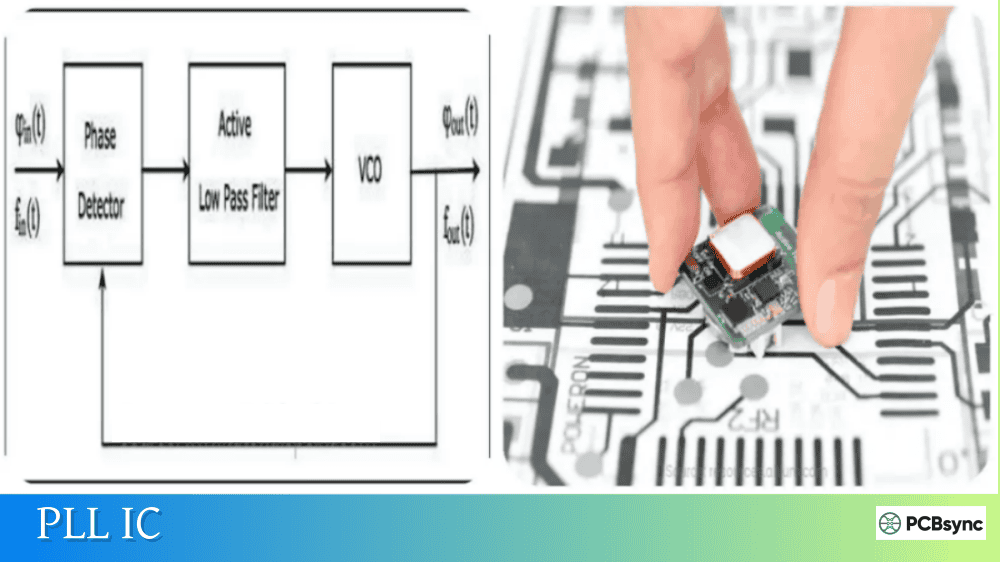
Block Diagram of a PLL IC
Every PLL consists of three fundamental building blocks connected in a feedback configuration:
Phase Detector (Phase Comparator)
The phase detector compares the phase of the input reference signal with the phase of the feedback signal from the VCO. It generates an output voltage proportional to the phase difference between these two signals.
Common phase detector types include:
Type
Description
Characteristics
Analog Multiplier
Multiplies input signals together
90° phase lock point, limited capture range
XOR (Exclusive-OR)
Digital logic gate comparison
Simple, but limited to 50% duty cycle signals
Phase-Frequency Detector (PFD)
Edge-triggered flip-flop based
Full frequency capture range, zero phase error
Charge Pump
Current source output PFD
Drives loop filter directly, common in modern PLLs
Loop Filter (Low-Pass Filter)
The loop filter removes high-frequency components from the phase detector output and produces a smooth DC control voltage for the VCO. This filter is critical—it determines the loop bandwidth, stability, capture range, and lock time.
The filter design involves trade-offs:
Narrow bandwidth: Better noise rejection but slower lock time
Wide bandwidth: Faster acquisition but more susceptible to noise
Most practical designs use a lag-lead filter that provides both integration (for zero steady-state error) and phase lead (for stability margin).
Voltage-Controlled Oscillator (VCO)
The VCO generates a periodic output signal whose frequency is determined by an input control voltage. When no control voltage is applied, the VCO runs at its “free-running” or center frequency. Applying a positive or negative control voltage shifts the frequency up or down.
Key VCO parameters include:
Center frequency (fo): Default operating frequency
Tuning range: How far the frequency can deviate from center
Tuning sensitivity (KVCO): Frequency change per volt of control voltage
Phase noise: Spectral purity of the output signal
How a PLL IC Works: The Phase Locked Loop Explained
Understanding PLL operation becomes clearer when you follow the signal flow through its three operating modes:
Free-Running Mode
When no input signal is present, the VCO oscillates at its natural free-running frequency (fo), determined by external timing components (typically a resistor and capacitor). The loop is open, and no phase comparison occurs.
Capture Mode
When an input signal is applied within the capture range, the phase detector begins comparing the input frequency with the VCO output. If there’s a frequency difference, the phase detector produces a beat signal containing both AC and DC components.
The DC component passes through the low-pass filter and begins adjusting the VCO frequency. With each cycle, the VCO frequency moves closer to the input frequency. This process continues until the frequencies match.
Lock Mode (Tracking Mode)
Once the VCO frequency equals the input frequency, the loop enters lock mode. Now only a constant phase difference exists between the signals, producing a steady DC voltage at the phase detector output. This voltage maintains the VCO precisely at the input frequency.
In lock mode, the PLL tracks any frequency variations in the input signal, continuously adjusting the VCO to maintain synchronization. The loop remains locked as long as the input frequency stays within the lock range.
Key PLL Parameters and Specifications
When selecting a PLL IC or designing a PLL circuit, these parameters determine performance:
Parameter
Definition
Importance
Lock Range
Frequency range over which PLL maintains lock
Determines maximum tracking capability
Capture Range
Frequency range over which PLL can acquire lock
Always smaller than lock range
Lock Time
Time required to achieve lock from an unlocked state
Critical for frequency-hopping applications
Phase Noise
Noise energy at frequency offsets from carrier
Key specification for communication systems
Jitter
Time-domain variation in signal edges
Critical for clocking and data recovery
Loop Bandwidth
Effective bandwidth of the feedback loop
Affects noise, stability, and lock time
Understanding Lock Range vs. Capture Range
This distinction confuses many engineers. The lock range (or tracking range) is always wider than the capture range. Here’s why:
Capture range is limited by the loop filter bandwidth—high-frequency beat signals get filtered out before they can steer the VCO
Lock range isn’t limited by the filter because once locked, there’s no beat signal—just a DC voltage
A PLL can maintain lock over a wider range than it can initially acquire lock. This means you might need to sweep the input frequency slowly through the capture range to achieve lock, after which the PLL can track much larger frequency excursions.
Popular PLL Integrated Circuits
Several PLL ICs have become industry standards over the decades:
NE/LM565 PLL IC
The 565 is the classic general-purpose PLL, available since the early days of monolithic PLL development.
Key Specifications:
Frequency range: 0.1 Hz to 500 kHz
Supply voltage: ±6V to ±12V (or 12V to 24V single supply)
Center frequency stability: 200 ppm/°C typical
TTL-compatible square wave output
Applications: FM demodulation, frequency shift keying (FSK) demodulation, frequency multiplication, tone decoding.
CD4046 CMOS PLL
The 4046 is a versatile CMOS PLL offering two types of phase comparators in one package.
Key Specifications:
Supply voltage: 3V to 18V
Maximum VCO frequency: ~1.4 MHz at 10V supply
Two phase comparator options (XOR and edge-triggered)
Very low power consumption (70µW at 5V)
Applications: Voltage-to-frequency conversion, frequency synthesis, motor speed control, signal conditioning.
74HC4046A High-Speed CMOS PLL
An enhanced version of the CD4046 with higher speed capability.
Key Specifications:
VCO frequency up to 17 MHz
Improved speed and drive capability
Compatible with 74HC logic family
Modern PLL Frequency Synthesizers
For high-frequency applications, specialized PLL synthesizer ICs integrate the PLL, VCO, and programmable dividers:
IC Family
Manufacturer
Frequency Range
Key Features
ADF4xxx
Analog Devices
MHz to 18 GHz
Integer/Fractional-N, integrated VCO options
LMX2xxx
Texas Instruments
MHz to 14 GHz
Low phase noise, integrated VCO
MAX2870/1/2
Analog Devices (Maxim)
23.5 MHz to 6 GHz
Wideband, fractional-N
Si5xxx
Skyworks (Silicon Labs)
kHz to GHz
Clock generators, jitter attenuators
PLL IC Applications
The versatility of PLLs makes them essential across numerous applications:
FM Demodulation
One of the original PLL applications. When a PLL locks onto an FM signal, the VCO tracks the instantaneous frequency of the modulated carrier. The control voltage driving the VCO therefore represents the original modulating signal—this is the demodulated audio.
Advantages of PLL FM demodulators:
High linearity (determined by VCO linearity)
Excellent noise immunity
No alignment required (unlike LC discriminators)
Suitable for integrated circuit implementation
Frequency Synthesis
Frequency synthesizers generate precise, stable frequencies derived from a single reference oscillator. By placing a programmable frequency divider in the feedback path, a PLL can generate output frequencies that are exact multiples of the reference.
Example: With a 10 kHz reference and a divide-by-100 counter in feedback, the PLL locks when the VCO reaches 1 MHz (1 MHz ÷ 100 = 10 kHz).
Changing the divider ratio changes the output frequency in steps equal to the reference frequency. This forms the basis of virtually every radio transmitter and receiver’s local oscillator.
Clock Generation and Multiplication
Microprocessors often need clock frequencies higher than the system crystal provides. A PLL multiplies the crystal frequency to generate the required internal clock.
Example: A microcontroller with a 10 MHz crystal and an internal 4× PLL multiplier operates at 40 MHz internally while radiating less EMI than a 40 MHz crystal would produce.
Clock and Data Recovery (CDR)
High-speed serial data streams often arrive without an accompanying clock signal. A PLL-based CDR circuit extracts timing information from the data transitions themselves, regenerating a synchronized clock for proper data sampling.
In precision motor control applications, a PLL compares the motor’s tachometer output against a reference frequency. Any speed deviation generates a correction signal that adjusts the motor drive, maintaining precise speed regardless of load variations.
Signal Conditioning and Noise Filtering
PLLs can clean up noisy signals by locking onto the fundamental frequency and regenerating a clean output. The VCO produces a spectrally pure signal that tracks the input frequency while rejecting noise outside the loop bandwidth.
Spread Spectrum Clocking
To reduce EMI from high-speed digital circuits, spread spectrum PLLs intentionally modulate the clock frequency over a small range. This spreads the radiated energy across a wider bandwidth, reducing peak emissions at any single frequency.
PLL Design Considerations
When implementing a PLL IC in your design, pay attention to these practical considerations:
Loop Filter Design
The loop filter is often external to the PLL IC, giving you control over loop dynamics. Key considerations:
Phase margin: Aim for 45° to 60° for stability without excessive ringing
Bandwidth: Set based on lock time requirements and reference spurious rejection
Component tolerances: Use stable capacitors (C0G/NP0 ceramics or film types)
Reference Signal Quality
The reference input quality directly affects output quality. A noisy reference produces a noisy output—the PLL can’t clean up noise within its loop bandwidth. Use crystal oscillators or other low-jitter sources for demanding applications.
Power Supply Considerations
PLLs are sensitive to power supply noise. Use:
Dedicated regulators for VCO supplies
Adequate decoupling (0.1µF ceramic plus bulk capacitance)
Separate analog and digital grounds joined at a single point
PCB Layout
For high-frequency PLLs:
Keep VCO components close together
Minimize loop area in the charge pump to VCO path
Use ground planes to shield sensitive traces
Separate noisy digital sections from analog sections
For complex programmable logic needs in your designs, Altera FPGA devices often include built-in PLLs for clock management, simplifying system integration.
PLL IC Comparison Table
Here’s a quick reference for selecting common PLL ICs:
IC
Type
Frequency Range
Supply Voltage
Phase Detector
Best For
LM565
Analog
0.1Hz – 500kHz
±6V to ±12V
Analog multiplier
FM demodulation, FSK
CD4046
CMOS
DC – 1.4MHz
3V – 18V
XOR + PFD
Low-power, general purpose
74HC4046
HC CMOS
DC – 17MHz
2V – 6V
XOR + PFD
Higher speed applications
ADF4351
RF Synth
35MHz – 4.4GHz
3.3V
PFD + Charge Pump
Wideband synthesis
Si5351
Clock Gen
2.5kHz – 200MHz
3.3V
Internal
Multi-output clock generation
Useful Resources for PLL Design
Design Tools
ADIsimPLL (Analog Devices): Comprehensive PLL design and simulation
TICS Pro (Texas Instruments): Clock tree and PLL design software
What is the difference between lock range and capture range in a PLL?
The lock range (also called tracking range) is the frequency band over which a PLL can maintain synchronization once it has already achieved lock. The capture range is the narrower frequency band within which the PLL can initially acquire lock. The capture range is limited by the loop filter bandwidth—high-frequency difference signals get filtered out before they can steer the VCO toward lock. Once locked, there’s no frequency difference to filter, so the PLL can track a wider range.
Why would I use a PLL instead of a crystal oscillator?
Crystal oscillators provide excellent stability at a single fixed frequency, but PLLs offer capabilities crystals cannot: frequency multiplication (generating higher frequencies from a lower reference), frequency synthesis (generating many different frequencies from one reference), and tracking/synchronization with external signals. Most systems use both—a crystal provides the stable reference, and a PLL generates the various clock frequencies needed throughout the system.
How do I reduce phase noise in a PLL design?
Phase noise comes from several sources: the reference oscillator, the phase detector, the VCO, and the loop filter components. To minimize it: use a low-noise reference oscillator (TCXO or OCXO for demanding applications), select a PLL IC with low phase detector noise floor, choose a VCO with good phase noise characteristics, and optimize loop bandwidth to balance reference noise (filtered by narrow bandwidth) against VCO noise (reduced by wider bandwidth). Clean power supplies and proper PCB layout also help significantly.
What causes a PLL to lose lock?
A PLL loses lock when the input frequency moves outside the lock range faster than the loop can track, when the input signal amplitude drops below the phase detector’s sensitivity, when power supply disturbances upset the VCO or phase detector, or when excessive noise causes the phase detector to generate erroneous correction signals. Poor loop filter design with insufficient phase margin can also cause the PLL to oscillate and lose lock.
Can I use a PLL IC for both frequency multiplication and division?
Yes, by changing the configuration of dividers in the reference and feedback paths. With a divider only in the feedback path (divide-by-N), the output frequency is N times the reference—this is frequency multiplication. Adding a divider in the reference path (divide-by-R) as well gives Fout = Fref × (N/R), allowing both multiplication and division. Most modern frequency synthesizer ICs include programmable R and N dividers specifically for this flexibility.
Conclusion
The PLL IC remains one of the most versatile and essential building blocks in electronic design. Whether you’re demodulating FM signals, synthesizing radio frequencies, generating system clocks, or recovering data timing, understanding how the phase locked loop explained here operates gives you a powerful tool for solving frequency and timing challenges.
Key takeaways:
A PLL synchronizes its output to a reference input through negative feedback control
The three core blocks—phase detector, loop filter, and VCO—work together to achieve and maintain lock
Lock range is always wider than capture range due to loop filter characteristics
Application determines which PLL parameters matter most (phase noise for RF, jitter for clocking)
Loop filter design critically affects stability, lock time, and noise performance
Start with established ICs like the CD4046 for learning or the ADF4xxx family for RF applications. Use manufacturer design tools to simulate loop behavior before building hardware. With practice, you’ll develop intuition for PLL behavior that serves you well across countless applications.
Inquire: Call 0086-755-23203480, or reach out via the form below/your sales contact to discuss our design, manufacturing, and assembly capabilities.
Quote: Email your PCB files to Sales@pcbsync.com (Preferred for large files) or submit online. We will contact you promptly. Please ensure your email is correct.
Notes: For PCB fabrication, we require PCB design file in Gerber RS-274X format (most preferred), *.PCB/DDB (Protel, inform your program version) format or *.BRD (Eagle) format. For PCB assembly, we require PCB design file in above mentioned format, drilling file and BOM. Click to download BOM template To avoid file missing, please include all files into one folder and compress it into .zip or .rar format.