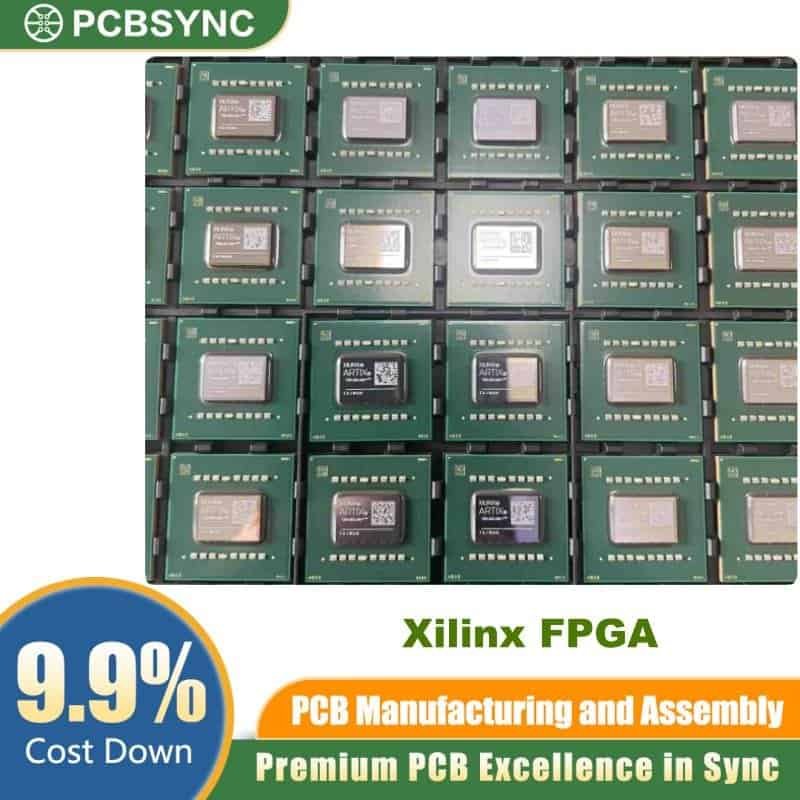
Overview of XC2S400E-6FGG456C FPGA
The XC2S400E-6FGG456C is a powerful field-programmable gate array (FPGA) from AMD (formerly Xilinx), belonging to the renowned Spartan-IIE family. This advanced FPGA delivers exceptional performance for embedded systems, digital signal processing, and complex logic applications. Designed with 0.15-micron technology, the XC2S400E provides a cost-effective solution for designers requiring high-density programmable logic with extensive I/O capabilities.
As a member of the Spartan-IIE series, this FPGA represents the second generation of ASIC replacement technology, offering unlimited in-system reprogrammability and outstanding flexibility for modern digital designs. Engineers and developers seeking reliable Xilinx FPGA solutions will find the XC2S400E-6FGG456C an excellent choice for prototyping and production applications.
Key Technical Specifications
Core FPGA Features
| Parameter |
Specification |
| Logic Cells |
10,800 cells |
| System Gates |
400,000 gates |
| Configurable Logic Blocks (CLBs) |
5,400 CLBs |
| Block RAM |
288 Kbits (16 blocks × 18 Kbits) |
| Distributed RAM |
163,840 bits |
| Maximum Operating Frequency |
357 MHz |
Package and I/O Specifications
| Parameter |
Specification |
| Package Type |
456-BBGA (Ball Grid Array) |
| Package Code |
FGG456 |
| Total I/O Pins |
329 user I/Os |
| Speed Grade |
-6 (high performance) |
| Operating Voltage |
1.8V core voltage |
| Process Technology |
0.15-micron CMOS |
Environmental and Reliability
| Parameter |
Specification |
| Operating Temperature |
Commercial Extended (0°C to +85°C) |
| Lead-Free Status |
RoHS Compliant |
| Configuration |
SRAM-based, unlimited reprogrammability |
| Package Dimensions |
23mm × 23mm (approximate) |
Advanced Architecture Features
SelectRAM Memory Hierarchy
The XC2S400E-6FGG456C incorporates AMD’s proprietary SelectRAM hierarchical memory architecture, providing designers with flexible memory options:
- Distributed RAM: 16 bits per Look-Up Table (LUT), totaling 163,840 bits for small, fast memory applications
- Block RAM: Four columns of true dual-port 4K-bit block RAM, configurable as single-port or dual-port memory
- Total Memory Capacity: 288 Kbits of dedicated block RAM for buffering, FIFO implementations, and data storage
Digital Clock Management (DLL)
The FPGA features four Delay-Locked Loops (DLLs) that provide:
- Precise clock management and distribution
- Clock multiplication and division capabilities
- Clock de-skewing for synchronous system designs
- Clock mirroring for off-chip synchronization
- Zero propagation delay between external and internal clocks
VersaRing Routing Architecture
The innovative VersaRing routing technology delivers:
- Enhanced pin-swapping flexibility without redesign
- Pin-locking capabilities for PCB layout compatibility
- Reduced time-to-market by allowing concurrent PCB and logic development
- Predictable timing across design iterations
I/O Standards and Flexibility
Supported I/O Standards
The XC2S400E-6FGG456C supports 19 selectable I/O standards, including:
- LVTTL (Low-Voltage TTL)
- LVCMOS (3.3V, 2.5V, 1.8V, 1.5V)
- PCI 33MHz and 66MHz
- GTL+ (Gunning Transceiver Logic Plus)
- SSTL (Stub Series Terminated Logic)
- HSTL (High-Speed Transceiver Logic)
- Differential signaling standards (LVDS, LVPECL)
I/O Features
Each Input/Output Block (IOB) includes:
- Programmable pull-up/pull-down resistors
- Three-state buffers for bidirectional communication
- Independent Clock Enable (CE) signals
- Configurable as D-type flip-flops or level-sensitive latches
- Shared clock signals with individual control
Application Use Cases
Industrial Automation and Control
The XC2S400E excels in industrial environments requiring:
- Real-time control systems
- Motor drive control
- PLC (Programmable Logic Controller) implementations
- Sensor data acquisition and processing
- Industrial communication protocol handling
Digital Signal Processing
Ideal for DSP applications including:
- Digital filters (FIR, IIR)
- FFT (Fast Fourier Transform) implementations
- Image and video processing
- Audio signal processing
- Adaptive filtering algorithms
Communication Systems
Perfect for telecommunications infrastructure:
- Protocol converters and bridges
- Network packet processing
- Data encryption/decryption
- Communication interface controllers
- Software-defined radio (SDR) components
Embedded System Development
Valuable for embedded applications such as:
- Custom peripheral controllers
- Hardware acceleration for embedded processors
- I/O expansion and control
- Real-time data acquisition systems
- Prototype development for ASIC verification
Configuration and Programming
Configuration Methods
The XC2S400E-6FGG456C supports multiple configuration modes:
- Master Serial Mode: Direct configuration from external serial PROM
- Slave Serial Mode: Configuration via external controller
- Slave Parallel Mode: High-speed parallel configuration interface
- Boundary Scan Mode (JTAG): IEEE 1149.1 compliant for testing and programming
Development Tools
Compatible with industry-standard design tools:
- Xilinx ISE Design Suite: Legacy tool for Spartan-IIE development
- Vivado Design Suite: Advanced synthesis and implementation
- Hardware Description Languages: VHDL, Verilog, SystemVerilog support
- IP Core Library: Access to pre-verified IP blocks
- Programming Solutions: Platform Flash in-system programmable PROMs
Performance Advantages
Superior to Mask-Programmed ASICs
The XC2S400E-6FGG456C offers significant advantages over traditional ASICs:
- Zero NRE Costs: Eliminates expensive mask and tooling costs
- Rapid Development: Weeks instead of months for design implementation
- Risk Mitigation: Reprogrammability allows design changes without hardware replacement
- Field Upgrades: Update functionality after deployment
- Faster Time-to-Market: Concurrent development of hardware and software
Design Flexibility
Key flexibility benefits include:
- Unlimited reprogramming cycles
- In-system reconfiguration capability
- Design iteration without hardware changes
- Prototyping platform for ASIC validation
- Cost-effective low-volume production
Package Information and Physical Characteristics
456-BBGA Package Details
The FGG456 package provides:
- Ball Grid Array (BGA) configuration for high-density interconnection
- 456 total balls for signal, power, and ground connections
- 23mm × 23mm body size (approximately) for compact PCB layouts
- 1.0mm ball pitch for standard PCB manufacturing compatibility
- Lead-free construction meeting RoHS environmental standards
Thermal Characteristics
Important thermal specifications:
- Junction-to-ambient thermal resistance (θJA)
- Junction-to-case thermal resistance (θJC)
- Recommended operating conditions: 0°C to +85°C ambient
- Thermal management considerations for high-performance applications
Design Considerations and Best Practices
Power Supply Design
Critical power requirements include:
- Core Voltage (VCCINT): 1.8V ±5% tolerance
- I/O Voltage (VCCO): Banks support multiple voltages (1.5V, 1.8V, 2.5V, 3.3V)
- Auxiliary Voltage (VCCAUX): 2.5V for DLL and other auxiliary circuits
- Decoupling: Multiple bypass capacitors per power pin recommended
- Power Sequencing: Follow recommended power-up/power-down sequences
PCB Layout Guidelines
Optimal PCB design practices:
- Controlled impedance traces for high-speed signals
- Proper ground plane design for signal integrity
- Adequate thermal vias beneath BGA package
- Differential pair routing for LVDS signals
- Length matching for synchronous buses
Signal Integrity
Ensuring signal integrity requires:
- Termination strategies for different I/O standards
- Impedance matching for high-speed interfaces
- Crosstalk minimization through proper spacing
- Power supply noise reduction techniques
- Clock distribution network optimization
Product Status and Availability
Lifecycle Information
Important Notice: The XC2S400E-6FGG456C is classified as obsolete and is no longer manufactured by AMD (Xilinx) as per notification XCN12026. This product is NOT RECOMMENDED FOR NEW DESIGNS.
Alternatives and Substitutes
For new projects, consider these modern alternatives:
- Spartan-6 Family: Direct successor with improved performance
- Spartan-7 Family: Latest generation with enhanced features
- Artix-7 Family: Higher performance for demanding applications
- AMD Zynq: SoC combining FPGA fabric with ARM processors
Existing Inventory
Despite obsolescence status, the XC2S400E-6FGG456C may still be available through:
- Authorized distributors with remaining stock
- Electronic component brokers
- Surplus and excess inventory suppliers
- Consignment and auction channels
Technical Support and Documentation
Available Resources
Engineers working with the XC2S400E-6FGG456C can access:
- Datasheet DS077: Complete electrical and timing specifications
- User Guides: Detailed architecture and configuration documentation
- Application Notes: Design examples and best practices
- Package Information: Mechanical drawings and PCB footprints
- IBIS Models: For signal integrity simulation
Community Support
Additional assistance available through:
- TechForum: AMD/Xilinx community discussion boards
- Online Resources: Application notes and reference designs
- FAE Support: Field application engineers for complex issues
- Training Materials: Video tutorials and webinars
Comparison with Similar FPGAs
Within Spartan-IIE Family
| Model |
Logic Cells |
System Gates |
Block RAM |
I/O Pins |
| XC2S50E |
1,728 |
50,000 |
72 Kbits |
182 |
| XC2S100E |
2,700 |
100,000 |
72 Kbits |
202 |
| XC2S150E |
3,840 |
150,000 |
144 Kbits |
265 |
| XC2S200E |
5,292 |
200,000 |
144 Kbits |
265 |
| XC2S300E |
6,912 |
300,000 |
216 Kbits |
329 |
| XC2S400E |
10,800 |
400,000 |
288 Kbits |
329 |
| XC2S600E |
15,552 |
600,000 |
432 Kbits |
514 |
Frequently Asked Questions
What makes the XC2S400E-6FGG456C suitable for ASIC replacement?
The XC2S400E combines high logic density, flexible I/O standards, and reprogrammability, making it an ideal alternative to custom ASICs. It eliminates NRE costs, reduces development time, and allows field upgrades impossible with traditional ASICs.
Can I still use the XC2S400E in production designs?
While technically functional, AMD officially designates this device as obsolete and not recommended for new designs. Existing products using this FPGA can continue, but new projects should consider current-generation alternatives like Spartan-7 or Artix-7 families.
What development tools support the XC2S400E-6FGG456C?
The primary development tool is Xilinx ISE Design Suite (version 14.7 and earlier). Modern Vivado Design Suite does not support Spartan-IIE devices. ISE remains available for download from AMD’s legacy tools section.
How does the speed grade “-6” affect performance?
The -6 speed grade represents the highest performance option for Spartan-IIE devices, offering maximum operating frequencies up to 357 MHz for internal logic and optimized setup/hold times for I/O operations.
What is the difference between FGG456 and FG456 packages?
The FGG456 designation indicates a Fine-pitch BGA package, while FG456 may refer to the non-fine-pitch version. Both have 456 balls, but ball pitch and mechanical details differ. Always verify package specifications with your PCB manufacturer.
Ordering Information and Part Number Decode
Part Number Breakdown: XC2S400E-6FGG456C
- XC2S: Spartan-IIE FPGA family
- 400E: 400,000 system gates, Extended temperature range
- -6: Speed grade (highest performance)
- FGG456: Package type (Fine-pitch BGA, 456 pins)
- C: Commercial temperature grade (0°C to +85°C)
Related Part Numbers
- XC2S400E-6FT256C: 256-pin FTBGA package variant
- XC2S400E-7FGG456C: -7 speed grade (slower, lower power)
- XC2S400E-6FGG456I: Industrial temperature range (-40°C to +100°C)
Conclusion
The XC2S400E-6FGG456C represents a mature, proven FPGA platform from AMD’s Spartan-IIE family, offering 400,000 system gates, 10,800 logic cells, and 329 I/O pins in a compact 456-ball BGA package. While now obsolete and not recommended for new designs, it remains a valuable solution for legacy system maintenance, educational purposes, and understanding FPGA architecture fundamentals.
For engineers working with existing XC2S400E-based products, comprehensive documentation, development tools, and community support remain available. However, for new projects, consider modern alternatives from the Xilinx FPGA portfolio, including Spartan-7 and Artix-7 families, which offer superior performance, lower power consumption, and long-term availability.
Whether you’re maintaining legacy systems, exploring FPGA technology, or evaluating alternatives, understanding the XC2S400E-6FGG456C’s capabilities and limitations ensures informed design decisions for your digital logic applications.