Inquire: Call 0086-755-23203480, or reach out via the form below/your sales contact to discuss our design, manufacturing, and assembly capabilities.
Quote: Email your PCB files to Sales@pcbsync.com (Preferred for large files) or submit online. We will contact you promptly. Please ensure your email is correct.
Notes: For PCB fabrication, we require PCB design file in Gerber RS-274X format (most preferred), *.PCB/DDB (Protel, inform your program version) format or *.BRD (Eagle) format. For PCB assembly, we require PCB design file in above mentioned format, drilling file and BOM. Click to download BOM template To avoid file missing, please include all files into one folder and compress it into .zip or .rar format.
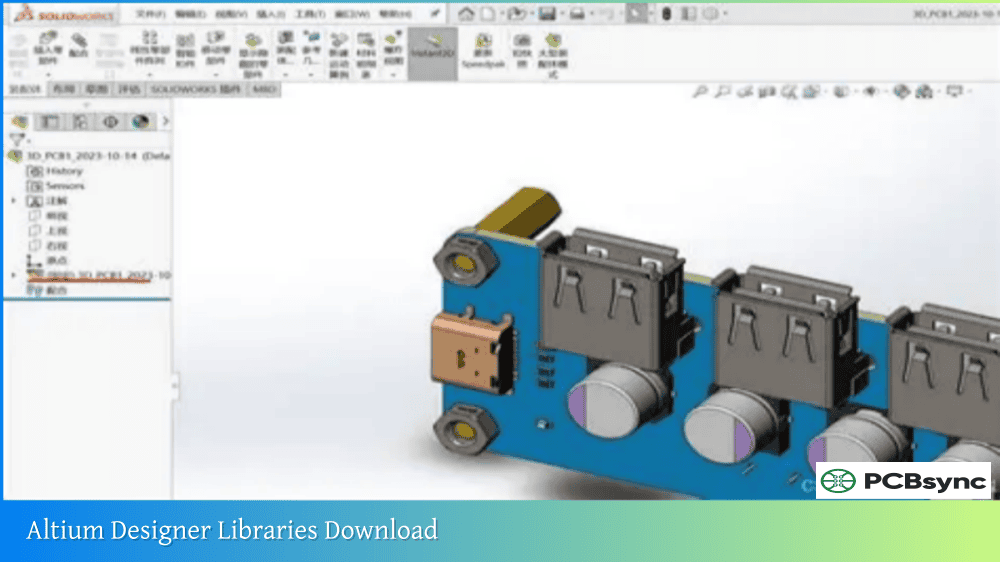
Getting your PCB design to fit perfectly inside a mechanical enclosure shouldn’t require endless email exchanges, manual file exports, and the frustrating game of “who has the latest version.” Yet that’s exactly how many engineering teams still operate. The good news is that Altium Designer & SolidWorks integration has evolved dramatically, offering real-time collaboration between electrical and mechanical engineers that eliminates the traditional file-passing nightmare.
I’ve worked on projects where the disconnect between ECAD and MCAD teams caused weeks of delays and multiple board respins. After implementing proper integration between Altium and SolidWorks, those same teams now catch interference issues during design rather than after prototype assembly. This guide walks you through setting up that integration, from initial installation to advanced collaboration workflows.
Why ECAD-MCAD Integration Matters for Modern Product Development
Before diving into setup procedures, let’s understand why Altium Designer & SolidWorks integration deserves your attention.
Eliminate manual file translation: Traditional workflows require exporting DXF, STEP, or IDF files from your PCB tool, sending them to mechanical engineers, waiting for feedback, and repeating the process endlessly. Every export-import cycle introduces potential errors and version confusion.
Real-time design synchronization: With proper integration, changes made in either tool sync automatically. When the mechanical engineer adjusts the board outline or adds mounting holes, those modifications appear in Altium Designer for acceptance or rejection.
Catch problems early: Component interference with enclosure walls, connector accessibility issues, and thermal management concerns become visible during design rather than during prototype assembly—when fixes are exponentially more expensive.
Accelerate time-to-market: Teams using integrated ECAD-MCAD workflows consistently report faster development cycles. When electrical and mechanical designers work from synchronized data, fewer iterations are needed to reach production-ready designs.
Understanding the Integration Options
Altium offers two primary approaches for working with SolidWorks: the MCAD CoDesigner plugin (recommended for active collaboration) and traditional file export/import methods (suitable for one-way data transfer).
Integration Methods Comparison
Feature
MCAD CoDesigner
STEP/Parasolid Export
Real-time synchronization
✅ Yes
❌ No
Bidirectional changes
✅ Yes
❌ One-way only
Component placement sync
✅ Yes
❌ No
Board outline changes
✅ Push/Pull
❌ Manual reimport
Mounting hole additions
✅ Automatic
❌ Manual
Requires Altium 365
✅ Yes
❌ No
Works offline
❌ No
✅ Yes
Learning curve
Medium
Low
Setup complexity
Medium
Low
For teams actively collaborating between disciplines, MCAD CoDesigner provides the most efficient workflow. For occasional exports to mechanical engineers who don’t need to send changes back, STEP export remains a valid option.
Prerequisites for Altium Designer & SolidWorks Integration
Before beginning setup, ensure you have the necessary software and licenses.
Software Requirements
Component
Minimum Version
Recommended
Altium Designer
20.1+
Latest release
SolidWorks
2019+
2022 or newer
Altium 365 Workspace
Required
—
MCAD CoDesigner Plugin
Match Altium version
Latest compatible
Operating System
Windows 10 64-bit
Windows 11
License Requirements
Altium side: An active Altium Designer subscription with access to MCAD CoDesigner extension and Altium 365 Workspace.
SolidWorks side: Standard, Professional, or Premium edition. The CoDesigner plugin itself is free for SolidWorks users—it’s included with the Altium 365 Workspace access.
Step-by-Step MCAD CoDesigner Installation for SolidWorks
Setting up the integration requires configuration on both the Altium Designer and SolidWorks sides.
Part 1: Verify Altium Designer Configuration
First, confirm MCAD CoDesigner is installed in Altium Designer:
Open Altium Designer
Click your profile picture in the upper right corner
Select Extensions and Updates
Click the Installed tab
Scroll to Software Extensions
Verify MCAD CoDesigner appears in the list
If MCAD CoDesigner is not installed:
Click the Purchased tab in Extensions and Updates
Scroll to Software Extensions
Find the MCAD CoDesigner icon
Click the download arrow to install
Restart Altium Designer to complete installation
Part 2: Install the SolidWorks Plugin
The CoDesigner plugin for SolidWorks must be downloaded and installed separately:
Visit the Altium downloads page (altium.com/products/downloads)
Locate MCAD CoDesigner Plugins
Download the SolidWorks version matching your Altium Designer release
Close SolidWorks completely
Run the installer with administrator privileges
Follow the installation wizard prompts
Restart SolidWorks
Part 3: Enable the CoDesigner Add-In in SolidWorks
After installation, the add-in may need manual activation:
Open SolidWorks
Navigate to Tools → Add-Ins
Find Altium CoDesigner in the list
Check both the Active Add-ins and Start Up boxes
Click OK
The Altium CoDesigner icon should now appear in the SolidWorks sidebar. If you don’t see it, check the Task Pane on the right side of the SolidWorks window.
Part 4: Connect to Your Altium 365 Workspace
Both tools must connect to the same Altium 365 Workspace:
In Altium Designer:
Go to View → Panels → MCAD CoDesigner to open the panel
Sign in with your Altium account if prompted
Verify you’re connected to the correct Workspace
In SolidWorks:
Open the Altium CoDesigner panel from the sidebar
Click Sign In
Enter your Altium account credentials
Select the appropriate Workspace from the dropdown
Both the electrical and mechanical engineer must be members of the same Workspace. The Workspace administrator can invite users through the Altium 365 web interface.
Configuring CoDesigner Settings in SolidWorks
Proper configuration prevents common issues and optimizes the collaboration workflow.
Essential SolidWorks CoDesigner Settings
Access settings by clicking your profile icon in the CoDesigner panel, then selecting Settings.
Common folder for storing models: If you work with multiple PCB designs sharing components, configure a common folder for component storage. This saves disk space and loading time.
3D Copper and Vias: Enable these checkboxes if you need detailed copper geometry in your mechanical models. Note that this increases file size and processing time.
Component filtering: For designs with many small passive components, use the filter option to exclude components below a certain size from the mechanical view. This improves SolidWorks performance.
Default templates: Configure default part templates to avoid prompts when CoDesigner creates new components. Navigate to System Options → File Locations → Document Templates in SolidWorks.
Settings for SolidWorks PDM Users
If your mechanical team uses SolidWorks PDM:
Set the common component folder under PDM control
Synchronize the folder with local storage before collaborating
Enable Prompt to check out file if opened in read-only mode in PDM settings
Check new components into PDM after changes are applied
Basic Collaboration Workflow
Once configured, the push-pull workflow enables seamless data exchange.
Pushing a Design from Altium Designer to SolidWorks
Frequently Asked Questions About Altium SolidWorks Integration
Does the SolidWorks CoDesigner plugin cost extra?
No. The CoDesigner plugin for SolidWorks is free for mechanical engineers. However, it requires connection to an Altium 365 Workspace, which is included with an active Altium Designer subscription. The electrical engineer needs the Altium subscription; mechanical engineers only need a free Altium account and Workspace access granted by the administrator.
Can I use CoDesigner with SolidWorks PDM?
Yes. CoDesigner has been developed and tested with SolidWorks PDM Professional. You’ll need to configure the common component folder under PDM control and synchronize before collaborating. Decals are stored directly in the part file to simplify PDM file management.
What happens to my design if the mechanical engineer makes changes I don’t want?
Every change pushed from SolidWorks appears in your Altium Designer CoDesigner panel for review. You can preview each modification and choose to accept or reject it individually. Rejected changes include optional comments explaining why, so the mechanical engineer understands the constraints.
Can I still use STEP export if I have CoDesigner?
Absolutely. STEP and Parasolid export remain available for situations where you need to share with external partners who don’t have Workspace access, create documentation, or interface with other MCAD tools. CoDesigner complements rather than replaces traditional export methods.
Which SolidWorks versions work with CoDesigner?
CoDesigner supports SolidWorks 2019 and newer versions (Standard, Professional, and Premium editions). For best compatibility, use recent versions of both Altium Designer and SolidWorks. Check the version compatibility matrix in Altium’s documentation before updating either tool to ensure the CoDesigner plugin version matches.
Final Recommendations for Successful Integration
After implementing Altium Designer & SolidWorks integration across multiple organizations, here’s my practical advice:
Start with a test project: Before integrating your critical designs, practice the workflow with a simple test board. This helps both teams understand the push-pull process without deadline pressure.
Establish communication protocols: Decide when to push changes, how to comment on modifications, and who approves what. Technical integration works best when accompanied by process agreements.
Keep 3D models current: Component interference detection only works when your footprints include accurate 3D models. Invest time in maintaining quality 3D libraries.
Use incremental collaboration: Rather than completing the entire PCB design before sharing with mechanical, push early and often. Small, frequent exchanges catch issues faster than large, infrequent ones.
Train both teams: The workflow involves both electrical and mechanical engineers. Ensure everyone understands both their responsibilities and their counterpart’s perspective.
The days of emailing STEP files back and forth, wondering which version is current, and discovering mechanical conflicts during prototype assembly are over. With proper Altium Designer & SolidWorks integration, electrical and mechanical teams work from synchronized data throughout the design process—delivering better products faster.
Inquire: Call 0086-755-23203480, or reach out via the form below/your sales contact to discuss our design, manufacturing, and assembly capabilities.
Quote: Email your PCB files to Sales@pcbsync.com (Preferred for large files) or submit online. We will contact you promptly. Please ensure your email is correct.
Notes: For PCB fabrication, we require PCB design file in Gerber RS-274X format (most preferred), *.PCB/DDB (Protel, inform your program version) format or *.BRD (Eagle) format. For PCB assembly, we require PCB design file in above mentioned format, drilling file and BOM. Click to download BOM template To avoid file missing, please include all files into one folder and compress it into .zip or .rar format.