Inquire: Call 0086-755-23203480, or reach out via the form below/your sales contact to discuss our design, manufacturing, and assembly capabilities.
Quote: Email your PCB files to Sales@pcbsync.com (Preferred for large files) or submit online. We will contact you promptly. Please ensure your email is correct.
Notes: For PCB fabrication, we require PCB design file in Gerber RS-274X format (most preferred), *.PCB/DDB (Protel, inform your program version) format or *.BRD (Eagle) format. For PCB assembly, we require PCB design file in above mentioned format, drilling file and BOM. Click to download BOM template To avoid file missing, please include all files into one folder and compress it into .zip or .rar format.
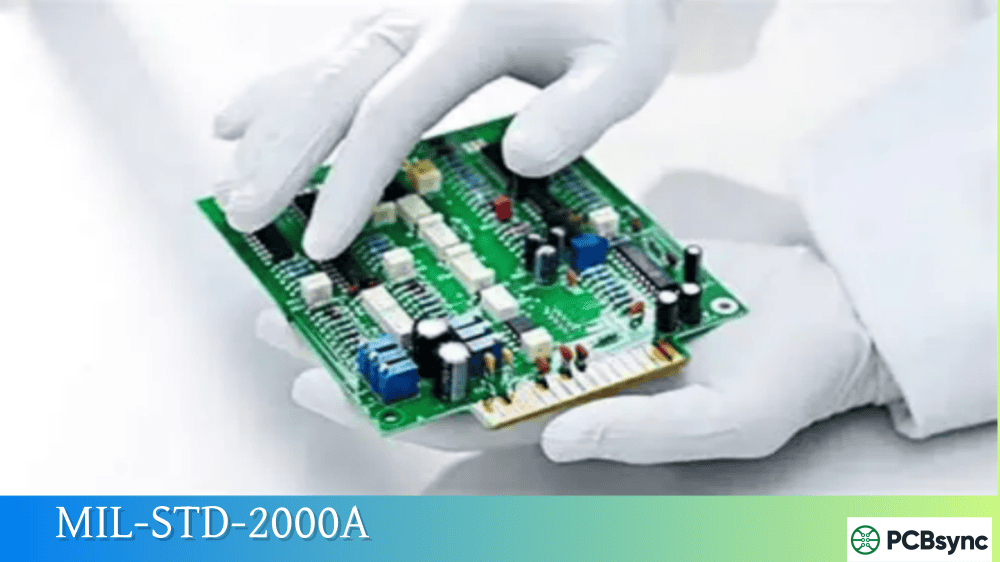
Having worked in defense electronics manufacturing for over two decades, I’ve witnessed the evolution of military soldering standards firsthand. MIL-STD-2000A shaped how an entire generation of aerospace and defense contractors approached solder joint quality. Even though the standard was officially cancelled in 1995, its influence persists in legacy programs, and understanding its requirements remains essential for engineers supporting older military systems or transitioning to modern industry standards.
This comprehensive guide covers everything you need to know about MIL-STD-2000A—its origins, technical requirements, current status, and how it compares to the IPC J-STD-001 standard that effectively replaced it.
MIL-STD-2000A, officially titled “Standard Requirements for Soldered Electrical and Electronic Assemblies,” was a United States Department of Defense military standard that established comprehensive requirements for materials, procedures, and acceptance criteria for making soldered connections in electrical and electronic assemblies.
The standard was released on February 14, 1991, superseding both MIL-STD-2000 (dated January 16, 1989) and MIL-S-45743E. It was developed and maintained by the Naval Air Engineering Center in Lakehurst, New Jersey, and approved for use by all Departments and Agencies of the Department of Defense.
MIL-STD-2000A covered soldered connections for:
Leads and wires inserted in plated-through holes
Surface mounted components attached to lands
Wires and leads attached to terminals
Complete assembly evaluation including component mounting
The standard explicitly excluded the manufacture of discrete devices, microcircuits, multichip microcircuits, and film microcircuits from its scope—those fell under separate military specifications.
Why MIL-STD-2000A Was Created
Before MIL-STD-2000A consolidated military soldering requirements, defense contractors navigated a confusing patchwork of specifications. The military recognized that inconsistent soldering standards across different programs led to quality variations, increased defect rates, and reliability problems in mission-critical equipment.
The standard addressed a fundamental truth in electronics manufacturing: soldering is no longer just a joining technique—it’s a critical reliability factor. Modern electronics assembly is essentially a solder application process, and when that process fails due to solderability problems with component leads, circuit boards, or equipment, solder joint repair becomes a significant cost driver.
History of Military Soldering Standards Leading to MIL-STD-2000A
Understanding MIL-STD-2000A requires context about the military soldering specifications that preceded it. The evolution tells us much about how the DoD approached standardization.
High-reliability manual soldering for guided missiles and aerospace
MIL-S-50827A
Various
Soldering requirements (superseded)
DOD-STD-2000/1B
1987
Component series soldering requirements
DOD-STD-2000/2A
1987
Soldering requirements series
DOD-STD-2000/3A
1987
Soldering requirements series
DOD-STD-2000/4A
October 1987
General purpose soldering requirements
MIL-STD-2000
January 1989
Consolidated soldering standard
MIL-STD-2000A
February 1991
Final revision before cancellation
MIL-S-45743E deserves particular mention. This specification covered high-reliability manual soldering for guided missiles and aerospace equipment requiring extraordinary control of the soldering environment and techniques. When MIL-STD-2000A was released in 1991, it superseded MIL-S-45743E, consolidating high-reliability and general-purpose requirements into a single document.
The DOD-STD-2000 series (slash sheets 1 through 4) addressed different aspects of soldering for electrical and electronic equipment. MIL-STD-2000 in 1989 rolled these into one standard, and MIL-STD-2000A refined those requirements two years later.
MIL-STD-2000A Current Status: Cancelled Without Replacement
Here’s what trips up many engineers and quality professionals: MIL-STD-2000A was officially cancelled on June 7, 1995, without a direct replacement document. The cancellation notice (MIL-STD-2000A Notice 1) stated explicitly that future acquisitions shall not cite any soldering process requirements from this standard.
This cancellation was part of the DoD’s broader initiative in the 1990s to reduce unique military specifications and adopt industry standards where appropriate. The transition aligned with the philosophy that commercial best practices, developed collaboratively with industry, could meet military requirements while reducing costs and complexity.
Document
Date
Status
MIL-STD-2000
January 16, 1989
Superseded by MIL-STD-2000A
MIL-STD-2000A
February 14, 1991
Cancelled June 7, 1995
MIL-STD-2000A Notice 1
June 7, 1995
Cancellation notice
Despite the cancellation, MIL-STD-2000A didn’t simply disappear. Many legacy military programs still reference the standard in their technical data packages, and some contractors continue using it as an internal workmanship standard. This creates interesting situations during audits, which we’ll address in the FAQ section.
Key Technical Requirements in MIL-STD-2000A
Even though the standard is cancelled, understanding its technical requirements provides valuable context for engineers working with legacy systems or comparing historical military practices to current industry standards.
Materials Requirements
MIL-STD-2000A specified detailed requirements for soldering materials:
Material
Requirement
Solder Alloy
Tin-lead compositions per applicable specifications
Flux
Rosin-based flux types; restrictions on high-activity flux
Cleaning Agents
Approved solvents for flux residue removal
Solder Paste
Composition and application requirements for SMT
The standard mandated maintenance of solder purity through regular testing of wave solder pots and hand soldering equipment. Contaminated solder leads to poor wetting, increased defects, and unreliable joints.
Workmanship Standards
MIL-STD-2000A established strict workmanship criteria covering:
Solder Joint Characteristics:
Wetting and filleting requirements
Acceptable void limits
Fillet geometry for through-hole and surface mount connections
Lead heel fillet requirements for SMD components
Component Mounting:
Lead bend radius requirements
Stress relief configurations
Component orientation and spacing
Prohibition on stacking (piggybacking) of components
Through-Hole Requirements:
Minimum hole fill percentages
Clinched lead termination criteria
Unsupported hole requirements
Inspection Requirements
One of MIL-STD-2000A’s defining characteristics was its rigorous inspection regime:
Inspection Type
Requirement
Visual Inspection
100% inspection of all solder connections
Magnification
Specified power levels for different feature sizes
Documentation
Individual article records and summary reports
Defect Tracking
Daily defect rate calculation required
Rework Documentation
All rework must be documented and reported
The standard required manufacturers to calculate defect rates for printed wiring assemblies and maintain daily records. This data-driven approach was ahead of its time and laid groundwork for statistical process control in electronics manufacturing.
Personnel Certification Requirements
MIL-STD-2000A included comprehensive personnel certification requirements in Section 5.1.4. The standard defined multiple certification levels:
Personnel Type
Requirements
Operator
Trained and certified to perform soldering operations
Inspector
Certified to inspect and accept/reject solder connections
Process Examiner
Higher-level certification for process oversight
Trainer
Certified to train and certify operators/inspectors
The standard required recertification every two years for examiners and trainers, ensuring personnel maintained current skills. This certification requirement influenced how defense contractors structured their training programs and continues to echo in current IPC certification schemes.
Electrostatic Discharge (ESD) Control
MIL-STD-2000A addressed ESD protection requirements for handling sensitive electronic components during soldering operations. This included:
Workstation grounding requirements
Personnel grounding (wrist straps, heel straps)
Handling procedures for ESD-sensitive devices
Storage and transportation requirements
MIL-STD-2000A vs. IPC J-STD-001: Understanding the Transition
When MIL-STD-2000A was cancelled, the electronics industry had already developed IPC J-STD-001 as a joint industry standard for soldered electrical and electronic assemblies. First published in 1992, J-STD-001 was designed as a “parallel document” to complement and eventually replace MIL-STD-2000.
Aspect
MIL-STD-2000A
IPC J-STD-001
Issuing Authority
U.S. Department of Defense
IPC (Industry association)
Status
Cancelled (1995)
Active (Current revision: J)
Classification
Single military standard
Three product classes
Certification
DoD-specific program
IPC Certification program
Updates
No longer maintained
Updated every 3-5 years
Lead-Free
Not addressed
Comprehensive coverage
Global Recognition
U.S. military only
Worldwide acceptance
IPC J-STD-001 Product Classes
One significant difference is how J-STD-001 classifies products:
Class
Description
Applications
Class 1
General Electronic Products
Consumer electronics where function is primary requirement
Class 2
Dedicated Service Electronic Products
Industrial equipment, communications gear
Class 3
High-Performance Electronic Products
Military, aerospace, medical life support
For military applications, Class 3 requirements apply—these represent the most stringent criteria and closely align with what MIL-STD-2000A required. Many defense contracts now specify “IPC J-STD-001 Class 3” as the soldering requirement.
Related IPC Standards
J-STD-001 works alongside companion standards that together cover what MIL-STD-2000A addressed:
For space and military applications, additional addenda apply:
Addendum
Application
J-STD-001ES
Space applications addendum
J-STD-001FS/IPC-A-610FS
Space and military addendum
Why MIL-STD-2000A Still Matters Today
Despite being cancelled nearly three decades ago, MIL-STD-2000A remains relevant for several reasons:
Legacy Program Support
Many military systems have service lives measured in decades. Aircraft, ships, and weapons systems designed in the 1980s and 1990s may still reference MIL-STD-2000A in their technical data packages. Engineers supporting these systems need to understand the original requirements.
Contractual Requirements
Some older contracts and purchase orders still cite MIL-STD-2000A. While technically the standard shouldn’t be specified for new work, contracts already in place may still invoke it. This creates compliance questions that procurement and quality teams must navigate.
Training Foundation
Many soldering operators and inspectors working in defense electronics received their foundational training under MIL-STD-2000A. Understanding the standard helps trainers bridge knowledge gaps when transitioning personnel to J-STD-001.
Internal Workmanship Standards
Some contractors adopted MIL-STD-2000A as their internal workmanship standard and never fully transitioned away. While not ideal from a compliance perspective, these companies may produce acceptable product if their internal standard meets customer requirements.
When You Encounter MIL-STD-2000A on Legacy Programs
If you’re working on a program that references MIL-STD-2000A, consider these steps:
Review Contract Requirements: Determine if MIL-STD-2000A is contractually mandated or if it can be replaced with J-STD-001 Class 3.
Request Contract Modification: Work with your contracts team to propose updating to current industry standards. Most customers prefer J-STD-001 because it’s actively maintained.
Document Equivalency: If you must work to MIL-STD-2000A, document how your processes (likely based on J-STD-001) meet or exceed the legacy requirements.
Maintain Training Records: Ensure personnel have current J-STD-001 certification, which demonstrates competency in soldering practices that meet or exceed MIL-STD-2000A requirements.
Transitioning from MIL-STD-2000A to J-STD-001
For organizations still referencing MIL-STD-2000A internally, transitioning to J-STD-001 involves:
Activity
Considerations
Gap Analysis
Compare internal procedures against J-STD-001 Class 3
Personnel Certification
Establish IPC certification program
Documentation Update
Revise work instructions and inspection criteria
Customer Communication
Notify customers of transition to current standards
Training
Update training materials and conduct refresher training
Frequently Asked Questions About MIL-STD-2000A
Is MIL-STD-2000A still valid for military contracts?
No, MIL-STD-2000A was officially cancelled on June 7, 1995, without a superseding document. The cancellation notice explicitly states that future acquisitions shall not cite any soldering process requirements from this standard. For new military programs, IPC J-STD-001 Class 3 is the appropriate specification to invoke for high-reliability soldering requirements.
What replaced MIL-STD-2000A?
While no direct DoD replacement was issued, the industry standard IPC J-STD-001 effectively replaced MIL-STD-2000A for soldering requirements. J-STD-001 was developed collaboratively between IPC and the military, and its Class 3 requirements provide equivalent or superior criteria for high-performance electronic products. The standard is actively maintained, with the current revision being J-STD-001J (released March 2024).
Can a company still use MIL-STD-2000A as their workmanship standard?
Technically, yes—a company can adopt any workmanship standard they choose for internal purposes. However, this approach has drawbacks: the standard is no longer maintained, doesn’t address lead-free soldering, and may create confusion during customer audits. Most companies have transitioned to J-STD-001, which is globally recognized and regularly updated. If your customer’s contract or drawing specifies MIL-STD-2000A, work with them to update the requirement to J-STD-001 Class 3.
How do MIL-STD-2000A certification requirements compare to IPC certification?
MIL-STD-2000A required personnel certification with recertification every two years for examiners and trainers. IPC J-STD-001 certification similarly requires recertification every two years to maintain current status. The IPC certification program is more structured, with defined Certified IPC Trainer (CIT), Certified IPC Specialist (CIS), and Certified IPC Application Specialist (CIS) levels. IPC certification is more widely recognized and provides standardized training across the industry.
What should I do if an auditor finds we’re referencing MIL-STD-2000A?
This is a common audit finding. Your response depends on why you’re referencing the cancelled standard. If it’s contractually required, document this and work with your customer to update the requirement. If it’s an internal reference that was never updated, create a corrective action plan to transition to J-STD-001. Most auditors recognize J-STD-001 Class 3 as meeting or exceeding MIL-STD-2000A requirements, so demonstrating equivalency is straightforward. The key is having a documented plan to address the gap.
Common Defect Categories Under MIL-STD-2000A
MIL-STD-2000A categorized defects systematically, requiring manufacturers to track and report defect data. Understanding these categories helps engineers diagnose production problems and maintain quality.
Solder Joint Defects
Defect Type
Description
Impact
Insufficient Wetting
Solder fails to flow and adhere properly
Weak mechanical and electrical connection
Cold Solder Joint
Grainy, dull appearance from inadequate heat
Intermittent connection, reliability failure
Excessive Solder
Too much solder obscuring joint inspection
Hidden defects, bridging risk
Solder Bridging
Unintended connection between adjacent conductors
Short circuit
Voids
Gas pockets within solder joint
Reduced thermal/electrical conductivity
Fractures
Cracks in solder or at interfaces
Intermittent or open connection
Disturbed Joint
Movement during solidification
Compromised mechanical integrity
Component Mounting Defects
Defect Type
Description
Impact
Improper Lead Bend
Bend radius too tight or incorrect location
Stress fractures, component damage
Insufficient Stress Relief
Lead lacks proper bend configuration
Thermal cycling failures
Component Misregistration
Component offset from land pattern
Poor solder joints, insufficient coverage
Improper Orientation
Polarized component reversed or rotated
Circuit malfunction, potential damage
Excessive Height
Component not seated properly
Mechanical stress, assembly interference
Printed Wiring Board Defects
Defect Type
Description
Impact
Conductor Damage
Scratches, nicks, or lifted traces
Open circuits, reliability concerns
Laminate Damage
Delamination, blistering, or measling
Moisture ingress, reliability failure
Partial Hole Fill
Solder doesn’t fully fill barrel
Reduced current capacity, weak joint
Conductor Separation
Trace lifting from substrate
Open circuit
MIL-STD-2000A required manufacturers to categorize defects as either “rework” (correctable) or “repair” (requiring deviation approval), with detailed documentation for both. This distinction carried significant implications for cost and schedule.
Process Control Requirements in MIL-STD-2000A
Beyond inspection, MIL-STD-2000A emphasized process control as the foundation for quality. The standard recognized that inspecting quality into a product is less effective than building quality through controlled processes.
Solderability Testing
The standard mandated solderability testing for components and printed wiring boards before assembly. Poor solderability was recognized as a root cause of many soldering defects, and catching it before assembly prevented costly rework.
Test Aspect
Requirement
Component Leads
Verified before assembly
PWB Lands
Tested per sampling plan
Ceramic Boards
Specific test methods required
Documentation
Test results maintained
Solder Pot Maintenance
For wave soldering operations, MIL-STD-2000A required regular analysis to maintain solder purity. Contamination from copper, gold, and other metals accumulates over time and degrades solder joint quality.
Parameter
Monitoring Requirement
Tin Content
Periodic analysis
Lead Content
Periodic analysis
Copper Contamination
Maximum limits specified
Dross Removal
Regular maintenance
Temperature
Continuous monitoring
Statistical Process Control
While MIL-STD-2000A predated widespread SPC adoption, it included provisions for sample-based inspection as an alternative to 100% inspection when statistical process control programs were in place. This forward-thinking approach recognized that well-controlled processes could justify reduced inspection without compromising quality.
Conclusion: The Legacy of MIL-STD-2000A
MIL-STD-2000A represented the culmination of decades of military soldering standardization. It consolidated multiple predecessor specifications into a comprehensive standard that established rigorous requirements for materials, processes, inspection, and personnel certification. While cancelled in 1995, its influence persists in how the defense electronics industry approaches soldering quality.
For today’s engineers, the practical takeaway is clear: use IPC J-STD-001 Class 3 for new military and aerospace programs. This active, industry-maintained standard provides equivalent or superior requirements while staying current with technology advances like lead-free soldering and new component packages.
However, if you encounter MIL-STD-2000A on legacy programs, understanding its requirements helps you support older systems, navigate contract transitions, and communicate effectively with customers about workmanship standards. The fundamentals of good soldering—proper materials, controlled processes, trained personnel, and rigorous inspection—remain constant regardless of which specification governs the work.
The evolution from MIL-STD-2000A to J-STD-001 also illustrates a broader trend in defense acquisition: the shift from unique military specifications to industry standards developed collaboratively with commercial partners. This approach leverages broader industry expertise, reduces costs, and ensures standards stay current with technological change—benefits that serve both the warfighter and the taxpayer.
Inquire: Call 0086-755-23203480, or reach out via the form below/your sales contact to discuss our design, manufacturing, and assembly capabilities.
Quote: Email your PCB files to Sales@pcbsync.com (Preferred for large files) or submit online. We will contact you promptly. Please ensure your email is correct.
Notes: For PCB fabrication, we require PCB design file in Gerber RS-274X format (most preferred), *.PCB/DDB (Protel, inform your program version) format or *.BRD (Eagle) format. For PCB assembly, we require PCB design file in above mentioned format, drilling file and BOM. Click to download BOM template To avoid file missing, please include all files into one folder and compress it into .zip or .rar format.