Inquire: Call 0086-755-23203480, or reach out via the form below/your sales contact to discuss our design, manufacturing, and assembly capabilities.
Quote: Email your PCB files to Sales@pcbsync.com (Preferred for large files) or submit online. We will contact you promptly. Please ensure your email is correct.
Notes: For PCB fabrication, we require PCB design file in Gerber RS-274X format (most preferred), *.PCB/DDB (Protel, inform your program version) format or *.BRD (Eagle) format. For PCB assembly, we require PCB design file in above mentioned format, drilling file and BOM. Click to download BOM template To avoid file missing, please include all files into one folder and compress it into .zip or .rar format.
Ceramic capacitors are probably the most abundant components on any military PCB. They’re in every power supply, across every IC power pin, and throughout analog signal paths. Most engineers grab them from the standard library without much thought—until a capacitor fails during environmental testing or loses half its capacitance at operating temperature. That’s when MIL-PRF-55681 becomes more than just a specification number.
MIL-PRF-55681 is the U.S. Department of Defense specification for ceramic dielectric fixed capacitors used in military and aerospace applications. After dealing with capacitor-related failures on several programs (including one memorable incident where X7R capacitors lost so much capacitance at temperature that the voltage regulator became unstable), I’ve learned to take this specification seriously. This guide covers what engineers need to understand when selecting, designing with, and procuring military ceramic chip capacitors.
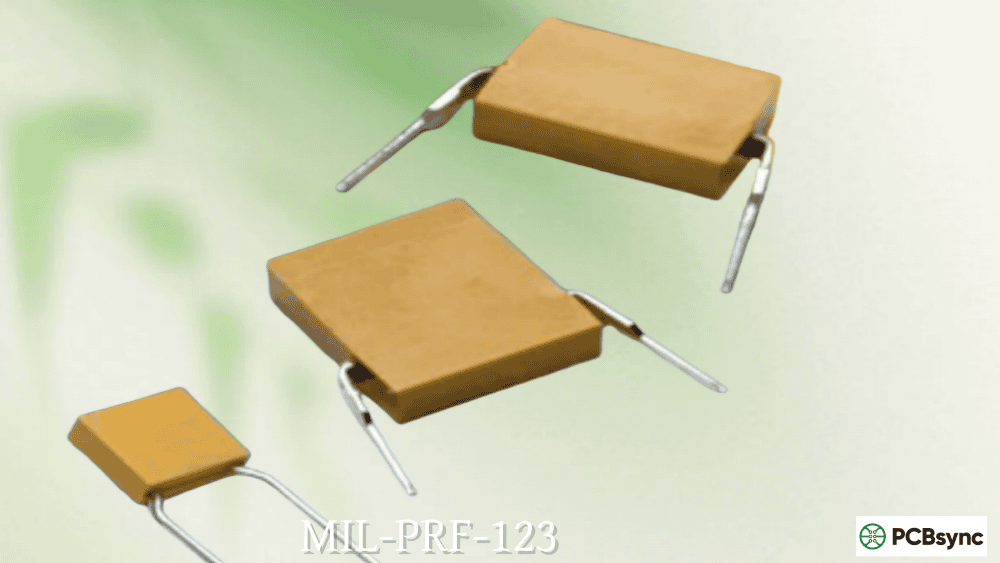
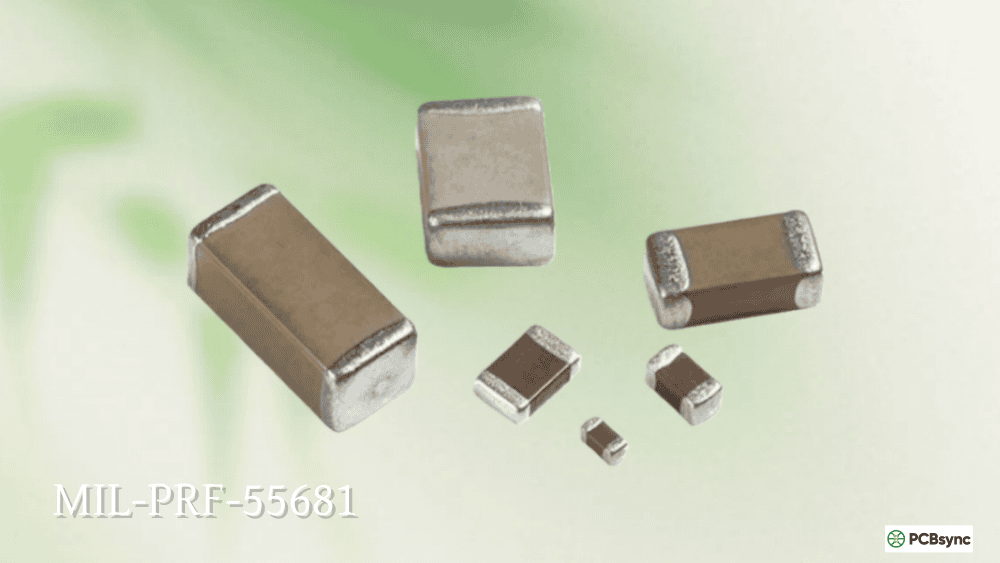
MIL-PRF-55681 establishes performance requirements for ceramic dielectric chip capacitors intended for military and space applications. The specification covers multilayer ceramic capacitors (MLCCs) in surface mount configurations, defining dielectric types, quality levels, electrical characteristics, environmental testing, and qualification requirements.
This specification replaced the older MIL-C-55681 and continues to evolve as ceramic capacitor technology advances. The “PRF” designation indicates performance-based requirements—manufacturers have flexibility in how they achieve compliance as long as the finished products meet specified performance criteria.
Scope of MIL-PRF-55681 Coverage
Dielectric Class
Common Types
Temperature Characteristics
Primary Applications
Class I (COG/NPO)
C0G, U2J
Ultra-stable, near-zero TC
Timing, filters, RF circuits
Class II
X7R, X5R
Moderate stability
Bypass, coupling, bulk
Class III
Y5V, Z5U
High capacitance density
Non-critical bypass
MIL-PRF-55681 capacitors range from tiny 0201 packages through large 2225 sizes, with capacitance values from a few picofarads to hundreds of microfarads depending on dielectric type and voltage rating.
Why MIL-PRF-55681 Matters for Military Designs
The specification addresses several critical factors that commercial capacitor datasheets often obscure or ignore:
Defined temperature behavior: Military capacitors are fully characterized across -55°C to +125°C (or +150°C), with clear specifications for capacitance change, dissipation factor, and insulation resistance at temperature extremes.
DC bias characterization: Class II dielectrics lose capacitance under DC bias—a critical issue that MIL-PRF-55681 addresses through specified test conditions and limits.
Established failure rates: Demonstrated failure rate levels (M, P, R, S) enable meaningful reliability predictions, unlike commercial parts with unverified MTBF claims.
Controlled manufacturing: Qualified manufacturers maintain statistical process control, lot traceability, and consistent materials that commercial production doesn’t require.
Long-term availability: QPL qualification represents a commitment to maintain production capability, reducing obsolescence risk for long-life military programs.
MIL-PRF-55681 Dielectric Classifications
Understanding dielectric types is essential for proper capacitor selection. The performance differences between Class I and Class II materials are dramatic and have significant design implications.
Class I Dielectrics (COG/NPO)
Class I capacitors use paraelectric materials that provide exceptional stability but limited capacitance density.
Characteristic
COG/NPO Specification
Temperature coefficient
0 ±30 ppm/°C
Capacitance change with temp
<±0.5% (-55°C to +125°C)
Capacitance change with voltage
Negligible
Capacitance change with time
Negligible (no aging)
Dissipation factor
<0.1% typical
Dielectric absorption
Very low
When to use Class I:
Timing circuits where capacitance stability matters
Filters and tuned circuits
Sample-and-hold applications
RF matching networks
Any circuit where capacitance variation causes problems
Class II Dielectrics (X7R, X5R)
Class II capacitors use ferroelectric materials that provide high capacitance density at the cost of stability.
Characteristic
X7R Specification
X5R Specification
Temperature range
-55°C to +125°C
-55°C to +85°C
Capacitance change
±15% over temp range
±15% over temp range
DC bias effect
-20% to -80% typical
-20% to -80% typical
Aging rate
-1% to -2% per decade
-2% to -3% per decade
Dissipation factor
<2.5%
<2.5%
Critical Class II consideration—DC bias derating:
Applied Voltage (% of rated)
Typical Capacitance Loss
0%
0% (nominal)
25%
10-20%
50%
20-40%
75%
40-60%
100%
50-80%
This DC bias effect is the single biggest source of capacitor-related design problems I’ve encountered. A 10µF capacitor rated at 16V might only provide 4µF of actual capacitance when operating at 12V DC bias.
Class III Dielectrics (Y5V, Z5U)
Class III materials maximize capacitance density but with severe stability tradeoffs.
Characteristic
Y5V Typical
Z5U Typical
Temperature range
-30°C to +85°C
+10°C to +85°C
Capacitance change
+22%/-82%
+22%/-56%
DC bias sensitivity
Severe
Severe
Aging rate
High
High
Class III capacitors have limited use in military applications due to their narrow temperature range and extreme parameter variation. Most MIL-PRF-55681 procurement focuses on Class I and Class II types.
MIL-PRF-55681 Quality and Failure Rate Levels
The specification defines quality levels based on demonstrated reliability, enabling proper component selection for different application criticalities.
Failure Rate Designations
Level
Failure Rate (%/1000 hrs)
Designation
Typical Applications
M
1.0%
Standard military
General military equipment
P
0.1%
High reliability
Avionics, tactical systems
R
0.01%
Very high reliability
Strategic, shipboard
S
0.001%
Space grade
Satellites, spacecraft
These failure rates are demonstrated through extended life testing at elevated temperature and voltage stress—not theoretical calculations or accelerated test extrapolations.
BX Life Rating
MIL-PRF-55681 also specifies BX life—the time at which X% of parts are expected to fail under specified conditions:
Rating
Meaning
B1
1% failure point
B10
10% failure point
Longer BX life indicates better reliability. Space-grade capacitors typically require demonstrated B1 life exceeding 100,000 hours at rated conditions.
MIL-PRF-55681 Part Numbering System
Military capacitor part numbers encode complete specifications. Learning to decode these numbers streamlines design and procurement.
Part Number Structure
A complete MIL-PRF-55681 part number follows this format:
CKR05BX104KR
Let me break this down:
Segment
Example
Meaning
CK
CK
Ceramic chip capacitor
R
R
Established reliability
05
05
Size code (0805)
B
B
Dielectric (X7R)
X
X
Voltage rating (16V)
104
104
Capacitance (100,000pF = 0.1µF)
K
K
Tolerance (±10%)
R
R
Failure rate level
Size Code Designations
Code
EIA Size
Dimensions (L×W×H mm)
01
0402
1.0 × 0.5 × 0.5
02
0603
1.6 × 0.8 × 0.8
04
0805
2.0 × 1.25 × 1.25
05
0805
2.0 × 1.25 × 0.85
06
1206
3.2 × 1.6 × 1.6
11
1210
3.2 × 2.5 × 2.5
12
1812
4.5 × 3.2 × 2.5
17
1825
4.5 × 6.4 × 2.5
21
2220
5.7 × 5.0 × 2.5
Dielectric Type Codes
Code
Dielectric
Temperature Range
Capacitance Change
A
C0G (NPO)
-55°C to +125°C
±30 ppm/°C
B
X7R
-55°C to +125°C
±15%
C
X5R
-55°C to +85°C
±15%
D
Z5U
+10°C to +85°C
+22%/-56%
R
BX (COG variant)
-55°C to +125°C
±30 ppm/°C
Voltage Rating Codes
Code
Voltage (VDC)
R
10V
X
16V
Z
25V
M
50V
T
100V
Y
200V
Capacitance Value Coding
The three-digit code follows the standard EIA format:
Proper application requires understanding voltage derating, thermal considerations, and the non-ideal behaviors of ceramic capacitors.
Voltage Derating Guidelines
Operating Condition
Recommended Derating
Standard military
50% of rated voltage
High reliability
60% of rated voltage
Space applications
70% of rated voltage
High-temperature operation
Additional 10%
Example: For a 50V-rated capacitor in a space application, maximum working voltage should be 15V (50V × 0.30).
Accounting for DC Bias Effects
When selecting Class II capacitors, calculate effective capacitance including DC bias derating:
Design Need
Selection Approach
10µF at 5V DC
Start with 22µF rated at 10V
4.7µF at 12V DC
Consider 15µF rated at 25V
Bulk bypass
Use multiple smaller values in parallel
Many designers now parallel multiple smaller capacitors rather than using a single large value, reducing the percentage of total capacitance lost to DC bias.
Thermal Management Considerations
Factor
Impact
Mitigation
Self-heating
ESR causes internal heating
Use low-ESR parts, parallel units
Ambient temperature
Reduces capacitance (Class II)
Specify adequate margin
PCB hot spots
Local temperature rise
Placement away from power devices
Thermal cycling stress
Flex cracking risk
Proper pad design
PCB Layout Best Practices
Design Rule
Recommendation
Pad geometry
Follow manufacturer guidelines
Via placement
No via-in-pad unless filled
Thermal relief
Balance solderability vs. thermal
Large capacitors (>1206)
Strain-relief mounting
Flex circuits
Use flexible terminations
MIL-PRF-55681 vs. Commercial Ceramic Capacitors
Understanding the differences justifies the cost premium for military-grade capacitors.
Performance Comparison
Parameter
Commercial
Industrial/Automotive
MIL-PRF-55681
Temperature range
-25°C to +85°C
-55°C to +125°C
-55°C to +150°C
DC bias characterization
Typical curve only
Specified
Fully specified
Life testing
1000 hrs typical
2000 hrs
2000-10,000 hrs
Failure rate
Unknown/estimated
Estimated
Demonstrated
Lot traceability
None
Limited
Complete
Voltage screening
None/sample
Enhanced
100%
DPA (cross-section)
Not performed
Optional
Required
Cost Comparison
Capacitor Type
Relative Cost
Commercial MLCC
1×
Automotive grade
2-5×
MIL-PRF-55681 M-level
10-20×
MIL-PRF-55681 S-level
50-100×
When to Specify MIL-PRF-55681
Military-grade capacitors are essential when:
Contract requirements mandate them
Operating temperature exceeds +85°C
Voltage stress approaches rated limits
Long service life (15+ years) is required
Failure rate data is needed for reliability predictions
Applications cannot tolerate capacitance drift
Traceability for failure analysis is required
Procuring MIL-PRF-55681 Capacitors
Military ceramic capacitor procurement is generally straightforward, with multiple qualified sources and reasonable availability.
What is the difference between Class I (C0G) and Class II (X7R) capacitors in MIL-PRF-55681?
Class I capacitors like C0G use paraelectric materials that maintain nearly constant capacitance regardless of temperature, voltage, or time. They’re ideal for timing circuits, filters, and precision applications but offer limited capacitance values (typically under 0.1µF in reasonable sizes). Class II capacitors like X7R use ferroelectric materials that provide much higher capacitance density but with significant tradeoffs: capacitance varies ±15% over temperature, drops 20-80% under DC bias, and decreases 1-2% per decade due to aging. For bypass and bulk capacitance applications where exact value matters less, Class II works well. For anything requiring stable capacitance, specify Class I despite the size penalty.
How does DC bias affect MIL-PRF-55681 ceramic capacitors?
DC bias causes Class II ceramic capacitors to lose significant capacitance—often 50% or more at rated voltage. This happens because the ferroelectric dielectric material’s domains align under DC stress, reducing the material’s ability to store charge. The effect is worse with higher-K dielectrics (X5R loses more than X7R) and smaller case sizes (higher volumetric efficiency means more aggressive dielectric formulations). MIL-PRF-55681 requires DC bias characterization, but designers must still account for this effect. As a practical rule, assume you’ll get 40-50% of nominal capacitance at typical operating voltages. Size your capacitors accordingly or use Class I dielectrics where this behavior is unacceptable.
Can I use automotive-grade (AEC-Q200) capacitors instead of MIL-PRF-55681 parts?
Not as a direct substitution in military applications. While AEC-Q200 automotive capacitors undergo more rigorous testing than standard commercial parts, they’re not equivalent to MIL-PRF-55681. Key differences include: military specs require wider temperature range qualification (-55°C to +150°C vs. -40°C to +125°C typical automotive), demonstrated failure rates with statistical confidence levels, 100% voltage screening, destructive physical analysis on production samples, and complete lot traceability. Some programs may accept automotive-grade parts under Source Control Drawings for non-critical applications, but this requires engineering justification, customer approval, and often additional testing. For any application where the military specification is called out, use QPL-listed parts.
Why do MIL-PRF-55681 capacitors cost so much more than commercial equivalents?
The cost difference comes from several factors: extended testing (2000+ hour life tests at elevated stress), 100% voltage screening (commercial parts use statistical sampling), destructive physical analysis requirements, tighter process controls and documentation, lower production volumes spreading fixed costs, qualified materials and controlled supply chains, and ongoing qualification maintenance. A commercial 0.1µF capacitor costs under $0.01 because it’s made by the billions with minimal testing. A MIL-PRF-55681 equivalent might cost $0.50-$2.00 because every lot is tested extensively, documentation is maintained, and the manufacturer commits to long-term availability. For programs with 20-year lifecycles and zero tolerance for field failures, this premium is justified.
How do I select the correct failure rate level (M, P, R, S) for my application?
Failure rate selection should flow from system reliability requirements, not arbitrary choice. M-level (1%/1000 hours) suits general military equipment where component failures don’t have severe consequences. P-level (0.1%/1000 hours) is appropriate for most avionics, tactical systems, and applications requiring moderate reliability. R-level (0.01%/1000 hours) serves strategic systems, submarines, and high-reliability ground systems. S-level (0.001%/1000 hours) is reserved for space applications and critical strategic systems where any failure has mission-ending consequences. Work with your reliability engineer to allocate failure rates across your BOM based on system MTBF requirements. Don’t over-specify—S-level parts cost significantly more and have longer lead times. But don’t under-specify for critical applications where reliability matters.
Practical Guidelines for MIL-PRF-55681 Selection
Working with military ceramic capacitors across numerous programs has taught me these lessons:
Account for DC bias—always. The single most common capacitor-related design error is ignoring DC bias effects on Class II capacitors. Calculate effective capacitance at your operating voltage, not nameplate value.
Derate voltage conservatively. The 50% derating rule exists for good reason. Capacitors stressed near rated voltage fail more frequently and age faster.
Prefer Class I for critical circuits. The size and cost penalty for C0G capacitors is worth it when capacitance stability matters to your circuit function.
Specify complete part numbers. Incomplete specifications cause procurement delays. Include size, dielectric, voltage, capacitance, tolerance, and failure rate.
Mind the flex cracking risk. Large MLCCs (1206 and above) on boards that flex during handling or thermal cycling are prone to cracking. Use appropriate mounting techniques.
Document your selections. Record why you chose specific dielectric types and failure rates. Your future self (or the engineer who inherits your design) will thank you.
MIL-PRF-55681 ceramic capacitors provide the reliability military systems demand. Understanding dielectric behavior, proper derating, and correct specification ensures these ubiquitous components don’t become failure points in your designs.
Inquire: Call 0086-755-23203480, or reach out via the form below/your sales contact to discuss our design, manufacturing, and assembly capabilities.
Quote: Email your PCB files to Sales@pcbsync.com (Preferred for large files) or submit online. We will contact you promptly. Please ensure your email is correct.
Notes: For PCB fabrication, we require PCB design file in Gerber RS-274X format (most preferred), *.PCB/DDB (Protel, inform your program version) format or *.BRD (Eagle) format. For PCB assembly, we require PCB design file in above mentioned format, drilling file and BOM. Click to download BOM template To avoid file missing, please include all files into one folder and compress it into .zip or .rar format.