Inquire: Call 0086-755-23203480, or reach out via the form below/your sales contact to discuss our design, manufacturing, and assembly capabilities.
Quote: Email your PCB files to Sales@pcbsync.com (Preferred for large files) or submit online. We will contact you promptly. Please ensure your email is correct.
Notes: For PCB fabrication, we require PCB design file in Gerber RS-274X format (most preferred), *.PCB/DDB (Protel, inform your program version) format or *.BRD (Eagle) format. For PCB assembly, we require PCB design file in above mentioned format, drilling file and BOM. Click to download BOM template To avoid file missing, please include all files into one folder and compress it into .zip or .rar format.
Resistors might be the most overlooked components in military electronics. They’re everywhere on the board, they’re inexpensive compared to ICs, and engineers tend to assume they’ll just work. Until they don’t. I learned this lesson the hard way on a program where commercial-grade chip resistors started drifting out of spec after thermal cycling—something that MIL-PRF-55342 qualified parts would have survived without issue.
MIL-PRF-55342 is the U.S. Department of Defense specification governing fixed chip resistors for military and aerospace applications. If you’re designing high-reliability circuits that use surface mount resistors, this specification defines what separates military-grade components from their commercial counterparts. This guide covers what engineers actually need to know when specifying, designing with, and procuring MIL-PRF-55342 resistors.
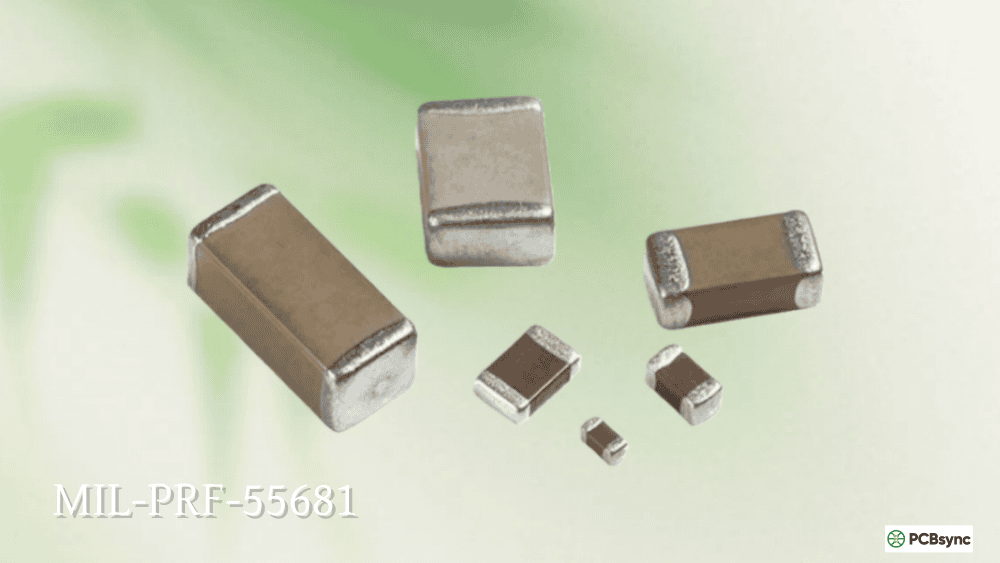
MIL-PRF-55342 establishes the performance requirements for fixed film chip resistors intended for military and aerospace applications. The specification covers surface mount (SMD) resistors using thin-film or thick-film technology, defining quality levels, electrical characteristics, environmental testing, and qualification requirements.
This specification replaced the older MIL-R-55342 and has become the standard reference for anyone procuring chip resistors for defense programs. The “PRF” designation indicates a performance-based specification—it tells manufacturers what the resistors must do, not precisely how to make them.
Scope of MIL-PRF-55342
The specification covers several resistor technologies and configurations:
Technology
Construction
Typical TCR
Applications
Thin-film
Sputtered metal film (NiCr, TaN)
±25 to ±50 ppm/°C
Precision analog, RF circuits
Thick-film
Screen-printed resistive paste
±100 to ±200 ppm/°C
General purpose, power handling
MIL-PRF-55342 resistors are available in standard chip sizes from 0201 through 2512, covering the range of surface mount applications common in military electronics.
Why MIL-PRF-55342 Matters
From a design engineering perspective, MIL-PRF-55342 compliance ensures several things commercial datasheets can’t guarantee:
Extended temperature operation: Military resistors are characterized and rated from -55°C to +125°C (or +150°C for some styles), compared to commercial parts rated 0°C to +70°C.
Tight parameter control: Resistance tolerance, TCR (temperature coefficient of resistance), and power derating are specified and tested more rigorously.
Long-term stability: Load life testing at elevated temperature verifies resistance stability over thousands of hours—critical for equipment with 20+ year service lives.
Moisture resistance: Testing per MIL-STD-202 ensures performance in humid environments that would degrade commercial parts.
Established reliability: Failure rate data based on actual testing supports MTBF calculations and reliability predictions.
MIL-PRF-55342 Characteristic and Failure Rate Levels
The specification uses a system of characteristic letters and failure rate levels to define resistor performance. Understanding these designations is essential for proper part selection.
Characteristic Designations
Characteristic
TCR (ppm/°C)
Technology
Typical Use
C
±100
Thick-film
General purpose
H
±50
Thick/Thin-film
Moderate precision
K
±25
Thin-film
Precision circuits
T
±10
Precision thin-film
High precision analog
A
±5
Ultra-precision
Instrumentation
The characteristic letter appears in the part number and directly affects how the resistor behaves with temperature changes. For precision analog designs, the difference between a C-characteristic (±100 ppm/°C) and a T-characteristic (±10 ppm/°C) resistor is substantial.
Failure Rate Levels
MIL-PRF-55342 defines failure rate levels based on demonstrated reliability:
Level
Failure Rate (%/1000 hrs)
Designation
Application
M
1.0%
Standard
General military
P
0.1%
High reliability
Avionics, missiles
R
0.01%
Very high reliability
Strategic systems
S
0.001%
Space grade
Satellites, spacecraft
These failure rates are demonstrated through extensive life testing, not just calculated estimates. The S-level designation indicates the highest reliability, appropriate for space and strategic applications where field repair isn’t an option.
Resistance Tolerance Options
Tolerance Code
Tolerance
Typical Applications
D
±0.5%
Precision analog
F
±1%
General precision
G
±2%
Less critical circuits
J
±5%
General purpose
Most military designs use F (±1%) or D (±0.5%) tolerance parts. Tighter tolerances are available but add cost and may not be necessary if the circuit design accommodates variation.
MIL-PRF-55342 Part Numbering System
The military part numbering system for chip resistors encodes everything you need to know about the part. Learning to read these numbers saves time during design and procurement.
Part Number Structure
A complete MIL-PRF-55342 part number follows this format:
M55342/XX-XXXXX-XR
Let me break down a real example:
M55342/06-B10D0-FR
Segment
Value
Meaning
M55342
M55342
Specification reference
/06
06
Slash sheet (size 0805)
B
B
Style (rectangular chip)
10
10
Resistance code (100Ω)
D
D
Tolerance (±0.5%)
0
0
TCR characteristic
F
F
Failure rate (1%)
R
R
Termination finish
Slash Sheet Size Designations
Slash Sheet
Size Code
Dimensions (L×W)
Power Rating
/01
0402
1.0mm × 0.5mm
0.063W
/02
0603
1.6mm × 0.8mm
0.1W
/04
0805
2.0mm × 1.25mm
0.125W
/06
1206
3.2mm × 1.6mm
0.25W
/07
1210
3.2mm × 2.5mm
0.33W
/08
2010
5.0mm × 2.5mm
0.5W
/09
2512
6.35mm × 3.2mm
1.0W
Resistance Code System
MIL-PRF-55342 uses a four-character code for resistance values:
Code
Value
Calculation
10D0
100Ω
10.0 × 10^1
22D1
2.21kΩ
22.1 × 10^2
47D5
475kΩ
47.5 × 10^4
10M0
10MΩ
10.0 × 10^6
The letter indicates the decimal point position:
D = ×10
E = ×100
F = ×1000
M = ×1,000,000
MIL-PRF-55342 Testing Requirements
The testing requirements differentiate military chip resistors from commercial equivalents. Every test exists because of real-world failures that occurred in the field.
Group A Testing (Electrical)
Group A tests verify basic electrical parameters on every production lot.
Test
Method
Requirements
DC resistance
MIL-STD-202 TM 303
Within specified tolerance
Visual/mechanical
MIL-STD-202
Workmanship, marking
Terminal strength
MIL-STD-202 TM 211
No damage after pull test
Group B Testing (Environmental)
Group B tests evaluate environmental performance on periodic samples.
Test
Conditions
Acceptance Criteria
Temperature cycling
-55°C to +125°C, 100 cycles
ΔR ≤1.0%
Moisture resistance
10 cycles per MIL-STD-202
ΔR ≤1.0%, no damage
Short-time overload
2.5× rated power, 5 seconds
ΔR ≤1.0%
Vibration
Per MIL-STD-202 TM 204
No opens or damage
Shock
Per MIL-STD-202 TM 213
No physical damage
Group C Testing (Life Test)
Group C tests verify long-term reliability through accelerated aging.
Test
Conditions
Duration
Criteria
Load life
+70°C, rated power
2000 hours
ΔR ≤1.0% (thin-film)
Load life
+70°C, rated power
2000 hours
ΔR ≤2.0% (thick-film)
High temperature exposure
+150°C, no load
1000 hours
ΔR ≤0.5%
Group D Testing (Solderability/Resistance to Solder Heat)
Test
Method
Purpose
Solderability
MIL-STD-202 TM 208
Verify terminal wetting
Resistance to solder heat
MIL-STD-202 TM 210
Survive reflow process
Designing with MIL-PRF-55342 Resistors
Proper application of military chip resistors requires understanding derating, thermal management, and layout considerations.
Power Derating Guidelines
MIL-PRF-55342 resistors must be derated at elevated temperatures:
Operating Temperature
Power Derating
≤+70°C
100% rated power
+85°C
80%
+100°C
60%
+125°C
35%
+150°C
0% (storage only)
Always calculate actual power dissipation and verify adequate margin. I’ve seen designs fail thermal qualification because someone forgot that the 125°C ambient on a spec sheet meant only 35% of nameplate power rating.
When power requirements exceed single resistor ratings, paralleling is common:
Configuration
Power Handling
Considerations
2 parallel
2× single rating
Match values within 1%
3 parallel
3× single rating
Current sharing concerns
Series
Same as single
Voltage division
MIL-PRF-55342 vs. Commercial Chip Resistors
Understanding the differences helps justify the cost premium for military parts.
Comparison Table
Parameter
Commercial
Industrial
MIL-PRF-55342
Temperature range
-55°C to +125°C
-55°C to +155°C
-55°C to +150°C
TCR typical
±100-200 ppm/°C
±50-100 ppm/°C
±10-100 ppm/°C
Load life testing
1000 hrs @ 70°C
1000 hrs @ 70°C
2000 hrs @ 70°C
Resistance shift
≤2-5%
≤1-2%
≤0.5-1%
Moisture resistance
85°C/85% RH
Per JEDEC
Per MIL-STD-202
Lot traceability
None
Limited
Complete
Established failure rate
No
No
Yes (M, P, R, S)
QPL qualified
No
No
Yes
When to Specify MIL-PRF-55342
Use military chip resistors when:
Contract requirements mandate them
Operating temperature exceeds +85°C regularly
Precision analog circuits require tight TCR
Long service life (15+ years) is expected
Failure analysis requires lot traceability
Reliability predictions need established failure rates
The application cannot tolerate resistance drift
When Commercial Parts May Suffice
Commercial or industrial resistors might work for:
Prototype development (with caution)
Ground support equipment
Non-critical pull-up/pull-down applications
Digital logic level shifting
Benign operating environments
Procuring MIL-PRF-55342 Resistors
Military resistor procurement is straightforward compared to active components, but still requires attention to detail.
Qualified Manufacturers
Manufacturer
Product Range
Notes
Vishay
Full MIL-PRF-55342 line
Major QPL supplier
KOA Speer
Thick and thin-film
Good availability
Rohm
Select military parts
Focus on thin-film
Bourns
Various military grades
Specialty networks
State of the Art (SOTA)
High-rel thin-film
Precision focus
Mini-Systems Inc.
Space-grade
S-level specialist
Lead Time Expectations
Product Type
Typical Lead Time
Standard values (stock)
4-8 weeks
Standard values (made to order)
8-14 weeks
Non-standard values
12-20 weeks
S-level (space grade)
16-26 weeks
Cost Considerations
Resistor Type
Relative Cost
Commercial (C0G/X7R)
1×
Industrial
2-3×
MIL-PRF-55342 (M-level)
5-10×
MIL-PRF-55342 (S-level)
20-50×
The cost premium is significant, but resistors rarely dominate BOM cost. A $0.50 military resistor versus a $0.02 commercial part seems expensive until you calculate the cost of a field failure.
What is the difference between thin-film and thick-film MIL-PRF-55342 resistors?
Thin-film resistors use vacuum-deposited metal alloys (typically nickel-chromium or tantalum nitride) sputtered onto a ceramic substrate, then laser-trimmed for precision values. They offer tighter tolerance (down to ±0.1%), better TCR (±10-25 ppm/°C), lower noise, and superior long-term stability. Thick-film resistors use screen-printed resistive paste fired onto ceramic, providing good power handling at lower cost but with looser TCR (±100-200 ppm/°C). Choose thin-film for precision analog circuits, instrumentation, and RF applications. Thick-film works well for general-purpose applications, pull-up/pull-down networks, and higher power requirements where precision isn’t critical.
How do I select the correct failure rate level for my application?
Failure rate selection depends on your system’s reliability requirements and criticality. M-level (1%/1000 hours) suits general military equipment where some redundancy exists. P-level (0.1%/1000 hours) is appropriate for avionics, missiles, and tactical systems with moderate reliability needs. R-level (0.01%/1000 hours) serves strategic systems and high-reliability applications. S-level (0.001%/1000 hours) is reserved for space missions and critical strategic systems where any failure has severe consequences. Your reliability engineer should flow down requirements based on system MTBF allocations. When in doubt, use the level specified in similar programs or consult MIL-HDBK-217 for failure rate calculation guidance.
Can I substitute commercial chip resistors for MIL-PRF-55342 parts in my design?
Not without program approval and careful engineering analysis. Commercial resistors lack the controlled manufacturing, lot traceability, and demonstrated reliability that MIL-PRF-55342 provides. Even if electrical specifications appear similar, commercial parts haven’t undergone the same environmental testing and life verification. Some programs allow commercial parts with upscreening or under Source Control Drawings for non-critical applications, but this requires documentation and customer approval. For prototype development, commercial parts can prove the circuit design before committing to military procurement, but the production system must use qualified parts. The reliability data and failure rate calculations in your system documentation won’t be valid without QPL-listed components.
What causes chip resistor failures in military applications?
The most common failure modes are resistance drift from thermal stress, cracking from CTE mismatch during thermal cycling, and solder joint failures from mechanical stress. Resistance drift typically results from operating beyond derating limits or inadequate thermal management. Cracking occurs when large chips (1206 and above) are mounted on flexible PCBs or boards that experience significant bending. Solder joint failures come from thermal cycling, vibration, or improper pad design. MIL-PRF-55342 testing catches many of these issues during qualification, but proper design still matters. Avoid mounting large resistors near board edges, derate power appropriately, and follow manufacturer pad geometry recommendations to minimize failures.
How does MIL-PRF-55342 relate to MIL-PRF-55182 (through-hole resistors)?
MIL-PRF-55342 covers surface mount chip resistors while MIL-PRF-55182 covers through-hole (axial lead) film resistors. Both specifications address similar quality levels and testing requirements but for different package styles. Through-hole parts under MIL-PRF-55182 are becoming less common as military electronics transition to surface mount technology, but they remain relevant for high-power applications, repair depots, and legacy system maintenance. The testing methodologies and failure rate levels are comparable between specifications. When redesigning legacy equipment from through-hole to surface mount, MIL-PRF-55342 chip resistors provide equivalent reliability to the MIL-PRF-55182 parts they replace, assuming proper derating and layout practices.
Practical Takeaways for MIL-PRF-55342 Selection
After working with military chip resistors across numerous programs, here’s what matters most:
Match TCR to your circuit needs. Don’t pay for ±10 ppm/°C precision if your circuit tolerates ±100 ppm/°C. But don’t cheap out on precision analog circuits where TCR tracking matters.
Derate conservatively. The published power ratings assume optimal thermal conditions. Real PCBs with surrounding components run hotter than test conditions.
Specify completely. Incomplete part numbers cause procurement delays. Include the full slash sheet number, resistance value, tolerance, characteristic, and failure rate.
Plan for availability. Military resistors generally have good availability, but unusual values or S-level parts need advance planning.
Document your selections. Record why you chose specific characteristics and failure rates. This helps during design reviews and when answering questions years later.
MIL-PRF-55342 chip resistors represent proven reliability for military applications. Understanding the specification’s quality levels, testing requirements, and proper application ensures your designs meet the demanding requirements of defense electronics—and that those simple resistors on your board don’t become the weak link that causes a system failure.
Inquire: Call 0086-755-23203480, or reach out via the form below/your sales contact to discuss our design, manufacturing, and assembly capabilities.
Quote: Email your PCB files to Sales@pcbsync.com (Preferred for large files) or submit online. We will contact you promptly. Please ensure your email is correct.
Notes: For PCB fabrication, we require PCB design file in Gerber RS-274X format (most preferred), *.PCB/DDB (Protel, inform your program version) format or *.BRD (Eagle) format. For PCB assembly, we require PCB design file in above mentioned format, drilling file and BOM. Click to download BOM template To avoid file missing, please include all files into one folder and compress it into .zip or .rar format.