Inquire: Call 0086-755-23203480, or reach out via the form below/your sales contact to discuss our design, manufacturing, and assembly capabilities.
Quote: Email your PCB files to Sales@pcbsync.com (Preferred for large files) or submit online. We will contact you promptly. Please ensure your email is correct.
Notes: For PCB fabrication, we require PCB design file in Gerber RS-274X format (most preferred), *.PCB/DDB (Protel, inform your program version) format or *.BRD (Eagle) format. For PCB assembly, we require PCB design file in above mentioned format, drilling file and BOM. Click to download BOM template To avoid file missing, please include all files into one folder and compress it into .zip or .rar format.
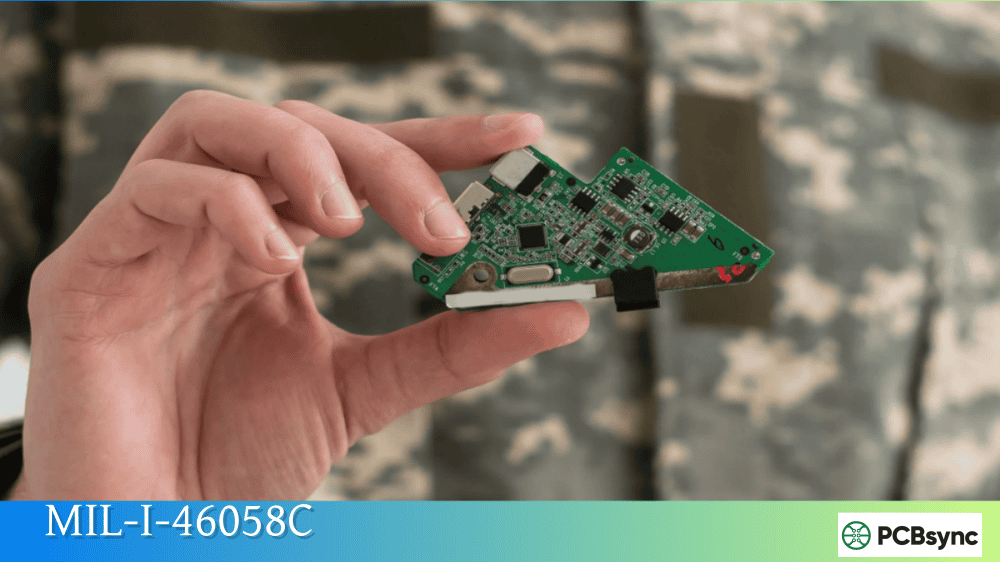
Conformal coating is one of those topics that doesn’t get the attention it deserves until something goes wrong. I’ve seen perfectly good military electronics fail in the field because someone chose the wrong coating type, applied it too thick, or didn’t cure it properly. MIL-I-46058C established the framework for protecting military electronics with conformal coatings, and even though the specification was technically canceled in 1998, its influence shapes how we protect PCBs today.
This guide covers everything engineers need to know about MIL-I-46058C—the coating types it defined, the requirements it established, why it still matters, and how it relates to modern specifications like IPC-CC-830.
MIL-I-46058C was the U.S. Department of Defense specification for insulating compound, electrical, conformal coatings used to protect printed circuit boards and electronic assemblies from moisture, fungus, corrosion, and environmental contamination. The specification defined five types of conformal coatings based on resin chemistry, along with testing requirements and performance criteria.
Although the Defense Logistics Agency (DLA) officially canceled MIL-I-46058C in 1998, replacing it with IPC-CC-830, the military specification remains widely referenced in the industry. Many manufacturers still qualify their coatings to MIL-I-46058C requirements, and countless active military programs continue to call out the specification in their documentation.
Why MIL-I-46058C Still Matters
The specification’s continued relevance stems from several factors:
Legacy programs: Military systems with 20-30 year lifecycles still reference MIL-I-46058C in their technical data packages.
Industry familiarity: Engineers and manufacturers understand the coating type designations (AR, ER, SR, UR, XY) that MIL-I-46058C established.
Proven requirements: The testing methodology and performance criteria defined in MIL-I-46058C remain technically sound.
Specification inertia: Changing qualified materials lists and approved processes requires significant effort, so many programs continue using MIL-I-46058C-qualified coatings.
MIL-I-46058C vs. IPC-CC-830
Aspect
MIL-I-46058C
IPC-CC-830
Status
Canceled (1998)
Active standard
Maintainer
DLA (formerly)
IPC
Coating types
AR, ER, SR, UR, XY
Same designations
Test methods
MIL-I-46058C specific
Updated, expanded
Qualification
QPL system
Manufacturer certification
Industry adoption
Legacy programs
New designs
IPC-CC-830 largely adopted the MIL-I-46058C framework while updating test methods and adding requirements for modern coating technologies. For new designs, IPC-CC-830 is the appropriate specification, but understanding MIL-I-46058C remains essential for anyone working with military electronics.
MIL-I-46058C Conformal Coating Types
The specification defined five coating types based on chemical composition. Each type has distinct properties that make it suitable for specific applications.
Type AR: Acrylic Resin Coatings
Acrylic coatings are among the most widely used conformal coatings due to their ease of application and reworkability.
Property
Type AR Specification
Base chemistry
Acrylic polymer
Cure mechanism
Solvent evaporation
Cure time
30-60 minutes at room temperature
Operating temperature
-65°C to +125°C
Moisture resistance
Good
Chemical resistance
Fair
Dielectric strength
Excellent
Reworkability
Excellent (solvent removable)
Advantages of Type AR coatings:
Fast drying at room temperature
Easy removal for rework using solvents
Good humidity and fungus resistance
Low cost
Excellent dielectric properties
Good optical clarity for inspection
Limitations of Type AR coatings:
Limited chemical resistance
Poor resistance to solvents and fuels
Not suitable for immersion applications
Limited abrasion resistance
Typical applications: General military electronics, ground support equipment, avionics where rework is anticipated, commercial aerospace.
Type ER: Epoxy Resin Coatings
Epoxy coatings provide superior chemical resistance and durability but sacrifice reworkability.
Property
Type ER Specification
Base chemistry
Epoxy resin
Cure mechanism
Chemical reaction (2-part or heat)
Cure time
1-4 hours at elevated temperature
Operating temperature
-65°C to +125°C
Moisture resistance
Excellent
Chemical resistance
Excellent
Dielectric strength
Excellent
Reworkability
Poor (burn-through or grinding)
Advantages of Type ER coatings:
Excellent humidity and chemical resistance
Superior hardness and abrasion resistance
Good adhesion to most substrates
Long pot life available
Resistant to solvents and fuels
Limitations of Type ER coatings:
Difficult or impossible to rework
Longer cure times
Potential for stress cracking
Two-component mixing required (some formulations)
Higher cost than acrylics
Typical applications: Harsh chemical environments, aerospace fuel system electronics, marine electronics, applications where rework is not anticipated.
Type SR: Silicone Resin Coatings
Silicone coatings excel in high-temperature applications and provide excellent flexibility.
Property
Type SR Specification
Base chemistry
Silicone polymer
Cure mechanism
Moisture cure or heat cure
Cure time
24-72 hours (moisture) or 30 min (heat)
Operating temperature
-65°C to +200°C
Moisture resistance
Excellent
Chemical resistance
Good
Dielectric strength
Very good
Reworkability
Moderate (specialized solvents)
Advantages of Type SR coatings:
Widest operating temperature range
Excellent flexibility and stress relief
Vibration damping properties
Good moisture resistance
Corona resistant
Limitations of Type SR coatings:
Lower abrasion resistance
Higher cost
Longer cure times (moisture cure)
Potential adhesion issues without primer
Not resistant to some solvents
Typical applications: High-temperature electronics, engine compartment systems, aerospace applications with thermal cycling, LED lighting, power electronics.
Type UR: Polyurethane Resin Coatings
Polyurethane coatings offer a balance of properties including good chemical resistance and reasonable reworkability.
For new designs, specify IPC-CC-830 rather than the canceled MIL-I-46058C. However, recognize that many coating products are qualified to both standards.
Practical Coating Application Tips
From experience applying and inspecting conformal coatings on military assemblies, here are lessons learned:
Common Application Problems
Problem
Cause
Solution
Pinholes
Contamination, air entrapment
Better cleaning, degas coating
Bubbles
Too thick, solvent entrapment
Multiple thin coats, slower cure
Orange peel
Wrong viscosity, distance
Adjust spray parameters
Dewetting
Surface contamination
Improve cleaning, use primer
Cracking
Too thick, thermal stress
Reduce thickness, flex coating
Poor adhesion
Contamination, incompatibility
Clean surface, verify compatibility
Incomplete coverage
Shadowing, access issues
Multiple angles, selective touch-up
Best Practices
Before coating:
Verify cleanliness with ionic contamination testing
Ensure all flux residues are removed
Pre-bake assemblies to remove moisture
Apply masking carefully with no gaps
Verify coating is within pot life
During coating:
Apply multiple thin coats rather than one thick coat
Allow flash-off time between coats
Maintain consistent spray distance and overlap
Inspect under UV light after each coat (if fluorescent coating)
Document batch, date, and application parameters
After coating:
Follow cure schedule exactly
Don’t handle until fully cured
Inspect under both white light and UV
Measure thickness on coupons or non-critical areas
Original military conformal coating spec (canceled)
IPC-CC-830
Current conformal coating qualification standard
IPC-A-610
Acceptability of electronic assemblies
IPC J-STD-001
Requirements for soldered electrical assemblies
IPC-HDBK-830
Conformal coating handbook
MIL-STD-202
Test methods for electronic components
Coating Manufacturer Resources
Manufacturer
Product Lines
Dow (formerly Dow Corning)
Silicone coatings
Henkel (Loctite)
Multiple coating types
HumiSeal (Chase Corp)
Full range of coatings
MG Chemicals
Acrylic, urethane, silicone
Specialty Coating Systems
Parylene
Electrolube
Full range of coatings
Peters
European coating supplier
MIL-I-46058C FAQs
Is MIL-I-46058C still valid for military contracts?
MIL-I-46058C was officially canceled by the DLA in 1998 and replaced by IPC-CC-830. However, many active military programs still reference MIL-I-46058C in their technical data packages because changing qualified materials requires significant effort. If your contract calls out MIL-I-46058C, you should use coatings qualified to that specification—many manufacturers maintain MIL-I-46058C qualification alongside IPC-CC-830. For new program development, specify IPC-CC-830 to use current standards. If you’re working on a legacy program, check whether a specification update has been issued; some programs have transitioned to IPC-CC-830 through engineering change proposals.
What is the difference between MIL-I-46058C Types AR, ER, SR, UR, and XY?
These designations indicate the coating’s base chemistry: AR is acrylic resin (easy to rework, fast cure, but limited chemical resistance), ER is epoxy resin (excellent chemical resistance but nearly impossible to rework), SR is silicone resin (widest temperature range, excellent flexibility, but higher cost), UR is polyurethane resin (good balance of properties with moderate reworkability), and XY is parylene (vapor deposited, pinhole-free, but requires specialized equipment). Selection depends on your operating environment, rework requirements, and manufacturing constraints. Most general military applications use Type AR for its ease of application and rework capability, while harsh environments requiring chemical resistance typically call for Type ER or UR.
How thick should conformal coating be applied per MIL-I-46058C?
MIL-I-46058C specifies thickness ranges by coating type: Type AR, ER, and UR require 0.03-0.13mm (1.2-5 mils); Type SR requires 0.05-0.21mm (2-8 mils); and Type XY requires 0.01-0.05mm (0.4-2 mils). Too thin provides inadequate protection, while too thick causes cracking, traps solvents, and extends cure time. For most applications, target the middle of the specification range. Apply multiple thin coats rather than one thick coat to avoid bubbles and ensure proper cure. Measure thickness using calibrated gauges on test coupons processed with production boards, or use non-contact measurement methods on actual assemblies.
Can conformal coatings be removed for rework?
Removal capability varies dramatically by coating type. Type AR (acrylic) is the easiest to remove—solvents like isopropyl alcohol or commercial acrylic strippers dissolve the coating quickly. Type UR (urethane) can be softened with specialized solvents but requires more effort. Type SR (silicone) requires specific silicone solvents and mechanical action. Type ER (epoxy) and Type XY (parylene) are essentially non-removable by chemical means—rework requires burning through the coating with a soldering iron or abrasive removal. When selecting coating type for assemblies that may require component replacement, Type AR’s reworkability is a significant advantage despite its lower chemical resistance. Always plan your rework strategy before selecting coating type.
How do I verify conformal coating coverage and quality?
Inspection typically combines visual examination under white light and UV light (for fluorescent coatings). White light inspection identifies obvious defects like bubbles, cracks, and foreign material. UV inspection reveals thin spots, holidays, and coverage boundaries that might be invisible under white light—most MIL-I-46058C-qualified coatings contain UV-fluorescent additives for this purpose. Thickness can be measured destructively by cross-sectioning test coupons, or non-destructively using calibrated coating thickness gauges. For critical applications, perform adhesion testing per tape pull methods and verify insulation resistance meets specification requirements. Document all inspection results and retain samples for reference.
Final Thoughts on MIL-I-46058C Conformal Coatings
Conformal coating seems straightforward until you encounter a field failure caused by inadequate protection or an improper coating selection. MIL-I-46058C established a framework for protecting military electronics that remains technically sound decades after the specification’s cancellation.
Key takeaways for working with conformal coatings:
Match coating to environment. Don’t default to Type AR just because it’s easy. If your application involves chemical exposure or extreme temperatures, invest in the right coating type.
Surface preparation matters. The best coating can’t protect a contaminated surface. Clean thoroughly and verify cleanliness before coating.
Follow thickness specifications. More isn’t better. Excessive thickness causes problems that thin coating won’t.
Plan for rework. If components will need replacement, factor reworkability into your coating selection.
Document everything. Record coating type, batch number, application date, cure schedule, and inspection results. You’ll need this data when questions arise.
Whether you’re working with the original MIL-I-46058C specification on a legacy program or transitioning to IPC-CC-830 for new designs, understanding conformal coating fundamentals ensures your electronics survive the environments they’ll face in service.
Inquire: Call 0086-755-23203480, or reach out via the form below/your sales contact to discuss our design, manufacturing, and assembly capabilities.
Quote: Email your PCB files to Sales@pcbsync.com (Preferred for large files) or submit online. We will contact you promptly. Please ensure your email is correct.
Notes: For PCB fabrication, we require PCB design file in Gerber RS-274X format (most preferred), *.PCB/DDB (Protel, inform your program version) format or *.BRD (Eagle) format. For PCB assembly, we require PCB design file in above mentioned format, drilling file and BOM. Click to download BOM template To avoid file missing, please include all files into one folder and compress it into .zip or .rar format.