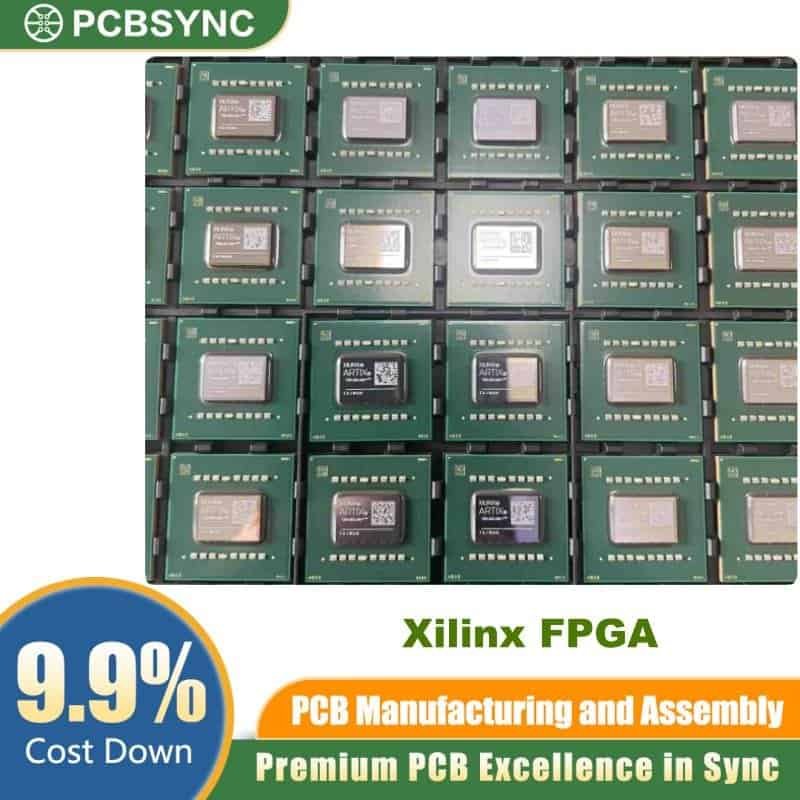
The AMD XC2S200-6FGG635C is a high-performance Field-Programmable Gate Array (FPGA) from the renowned Spartan-II family. This programmable logic device delivers exceptional value for digital design applications, offering 200,000 system gates, advanced I/O capabilities, and robust on-chip memory resources. Engineers and designers worldwide trust this FPGA for cost-effective, high-speed digital implementations.
XC2S200-6FGG635C Key Features and Benefits
The XC2S200-6FGG635C represents AMD’s commitment to delivering superior ASIC replacement technology. This device eliminates the high initial costs, lengthy development cycles, and inherent risks associated with conventional mask-programmed ASICs. The unlimited reprogrammability feature allows design upgrades in the field without hardware replacement.
Advanced Architecture Highlights
The Spartan-II architecture incorporates several cutting-edge features that make the XC2S200-6FGG635C ideal for demanding applications:
- Second-generation ASIC replacement technology with densities up to 200,000 system gates
- 5,292 logic cells providing extensive design flexibility
- Streamlined features based on the proven Virtex FPGA architecture
- Cost-effective 0.18-micron process technology
- Core logic powered at 2.5V with I/Os supporting 1.5V, 2.5V, or 3.3V
XC2S200-6FGG635C Technical Specifications
| Parameter |
Specification |
| Device Family |
Spartan-II |
| System Gates |
200,000 |
| Logic Cells |
5,292 |
| CLB Array |
28 x 42 |
| Total CLBs |
1,176 |
| Maximum User I/O |
284 |
| Distributed RAM |
75,264 bits |
| Block RAM |
56K bits (14 blocks) |
| Speed Grade |
-6 (Higher Performance) |
| Package Type |
FGG (Fine Pitch BGA, Pb-free) |
| Operating Temperature |
Commercial (0°C to +85°C) |
| Process Technology |
0.18 µm |
Memory Resources
The XC2S200-6FGG635C features a hierarchical SelectRAM memory architecture that provides designers with maximum flexibility:
| Memory Type |
Capacity |
Features |
| Distributed RAM |
75,264 bits |
16 bits per LUT |
| Block RAM |
56K bits |
Configurable 4K-bit blocks |
| Block RAM Modules |
14 blocks |
Dual-port synchronous operation |
XC2S200-6FGG635C I/O Standards and Capabilities
This Xilinx FPGA supports 16 high-performance interface standards, making it suitable for diverse system requirements. The versatile I/O architecture includes:
Supported I/O Standards
| Standard |
Reference Voltage (VREF) |
Output Voltage (VCCO) |
| LVTTL (2-24 mA) |
N/A |
3.3V |
| LVCMOS2 |
N/A |
2.5V |
| PCI (3.3V/5V) |
N/A |
3.3V |
| GTL |
0.8V |
N/A |
| GTL+ |
1.0V |
N/A |
| HSTL Class I |
0.75V |
1.5V |
| HSTL Class III |
0.9V |
1.5V |
| HSTL Class IV |
0.9V |
1.5V |
| SSTL3 Class I/II |
1.5V |
3.3V |
| SSTL2 Class I/II |
1.25V |
2.5V |
| CTT |
1.5V |
3.3V |
| AGP-2X |
1.32V |
3.3V |
Clock Management and DLL Features
The XC2S200-6FGG635C incorporates four Delay-Locked Loops (DLLs) for advanced clock control:
DLL Capabilities
- Zero propagation delay for system clocks
- Low clock skew between output signals
- Clock multiplication (2x frequency doubling)
- Clock division by 1.5, 2, 2.5, 3, 4, 5, 8, or 16
- Four quadrature phases of the source clock
- Board-level clock deskewing capability
XC2S200-6FGG635C Configuration Options
The device supports multiple configuration modes for maximum design flexibility:
| Configuration Mode |
Data Width |
CCLK Direction |
| Master Serial |
1-bit |
Output |
| Slave Serial |
1-bit |
Input |
| Slave Parallel |
8-bit |
Input |
| Boundary Scan (JTAG) |
1-bit |
N/A |
Configuration File Size
The XC2S200-6FGG635C requires 1,335,840 bits of configuration data, supporting storage in external serial PROMs or alternative nonvolatile memory solutions.
Application Areas for XC2S200-6FGG635C
The XC2S200-6FGG635C excels in numerous application domains:
- Digital Signal Processing (DSP) implementations
- Communication systems and protocol bridges
- Industrial control and automation systems
- Consumer electronics requiring programmable logic
- Prototyping and development platforms
- Medical equipment digital interfaces
- Automotive electronics applications
Design Support and Development Tools
The XC2S200-6FGG635C is fully supported by AMD’s ISE development system, providing:
- Fully automatic mapping, placement, and routing
- Timing-driven design optimization
- HDL synthesis support for Verilog and VHDL
- Comprehensive simulation and verification tools
- In-circuit debugging capabilities
XC2S200-6FGG635C Package Information
| Package Parameter |
Specification |
| Package Style |
Fine Pitch Ball Grid Array |
| Lead-Free Option |
Yes (Pb-free, “G” designation) |
| Pin Count |
635 |
| Ball Pitch |
1.0 mm |
| Thermal Characteristics |
Optimized for commercial applications |
Boundary Scan and Testing
The XC2S200-6FGG635C includes IEEE 1149.1-compatible boundary scan logic for comprehensive board-level testing:
- EXTEST instruction for external interconnect testing
- SAMPLE/PRELOAD for capturing I/O states
- BYPASS instruction for efficient chain testing
- USERCODE instructions for custom identification
- Full readback capability for configuration verification
Ordering Information
The XC2S200-6FGG635C part number decodes as follows:
- XC2S200: 200K system gate Spartan-II device
- -6: Higher performance speed grade
- FGG: Fine pitch BGA package (Pb-free)
- 635: Pin count
- C: Commercial temperature range (0°C to +85°C)
Why Choose the XC2S200-6FGG635C?
The XC2S200-6FGG635C delivers an optimal balance of performance, features, and cost-effectiveness for volume production applications. Key advantages include:
- Proven reliability from AMD’s industry-leading FPGA technology
- Unlimited reprogrammability for field upgrades and design iterations
- Comprehensive I/O standard support for diverse interface requirements
- Advanced clock management with four integrated DLLs
- Substantial on-chip memory resources for data buffering and processing
- Full development tool support for efficient design implementation
The XC2S200-6FGG635C continues to serve as a trusted solution for engineers requiring a cost-effective, high-performance programmable logic device with comprehensive system-level features and robust design support infrastructure.