Inquire: Call 0086-755-23203480, or reach out via the form below/your sales contact to discuss our design, manufacturing, and assembly capabilities.
Quote: Email your PCB files to Sales@pcbsync.com (Preferred for large files) or submit online. We will contact you promptly. Please ensure your email is correct.
Notes: For PCB fabrication, we require PCB design file in Gerber RS-274X format (most preferred), *.PCB/DDB (Protel, inform your program version) format or *.BRD (Eagle) format. For PCB assembly, we require PCB design file in above mentioned format, drilling file and BOM. Click to download BOM template To avoid file missing, please include all files into one folder and compress it into .zip or .rar format.
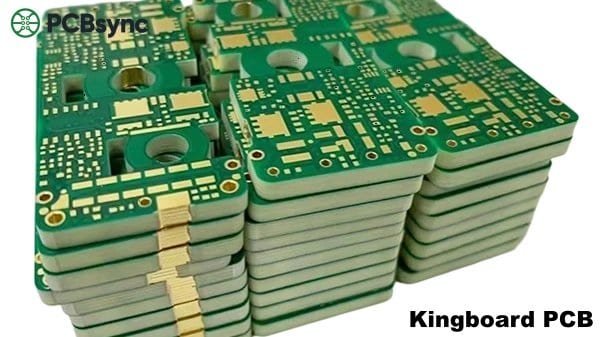
When you’ve been working with PCB laminates for as long as I have, you quickly learn which manufacturers deliver consistent quality and which ones leave you troubleshooting at 2 AM. Kingboard PCB materials have been on my trusted list since I first encountered their KB-6160 series on a high-volume consumer electronics project back in 2015. The boards came off the line with minimal warpage, and the Tg values matched the datasheet specs almost exactly.
If you’re a design engineer selecting materials for your next project, or a procurement specialist evaluating laminate suppliers, understanding Kingboard PCB products can make the difference between a smooth production run and costly rework. The brand has become synonymous with reliable, cost-effective base materials across the global PCB industry.
This guide covers everything you need to know about Kingboard PCB products, from their standard FR-4 offerings to specialized high-Tg and automotive-grade materials. I’ll break down the product lines, explain key specifications, compare against competitors, and share practical insights from years of specifying these materials in real production environments. Whether you’re sourcing for a prototype or scaling to mass production, understanding what Kingboard brings to the table can save you significant headaches down the road.
Kingboard refers to both the company (Kingboard Holdings Limited and its subsidiary Kingboard Laminates Holdings Ltd.) and their range of copper-clad laminates (CCLs) and prepregs used in PCB manufacturing. Founded in 1988 with their first laminate plant in Shenzhen, Kingboard has grown into one of the world’s largest laminate producers, operating over 60 manufacturing facilities across China and Thailand.
The company is publicly traded on the Hong Kong Stock Exchange (SEHK: 148 for Holdings, 1888 for Laminates) and maintains a global workforce of approximately 50,000 employees. Their vertical integration is particularly impressive—they manufacture their own glass fabric, copper foil, epoxy resin, and even the kraft paper used in their CEM products. This level of supply chain control translates to consistent material properties batch after batch.
In 2004, Kingboard acquired Elec & Eltek International Holdings Limited, a strategic move that expanded their capabilities into high-density interconnect (HDI) and advanced multilayer PCB manufacturing. This acquisition positioned them to offer both raw materials and finished PCB fabrication services, though most engineers interact with Kingboard through their laminate products.
The Kingboard Laminates division (spun off for separate listing in 2006) focuses specifically on copper-clad laminates and prepregs. Their manufacturing process starts with upstream materials—glass yarn, fabric weaving, resin synthesis, and copper foil production—giving them control over quality at every stage.
When engineers specify “Kingboard PCB” on a design, they’re typically referring to boards fabricated using Kingboard-branded laminates as the base material. These laminates form the insulating substrate that supports copper traces and components. The brand recognition is strong enough that many fabricators stock Kingboard materials as their default FR-4 option.
Kingboard PCB Material Guide
PCBSync Engineering Tools
Kingboard Laminate Products
FR-4
KB-6160 Series
Standard FR-4 laminate for general purpose PCB applications. Tg 135°C.
FR-4
KB-6164 Series
Medium Tg FR-4 for automotive and industrial. Tg 150°C.
Kingboard laminates are compatible with most commercial solder masks. Recommended surface preparation:
Surface CleaningMechanical brush + chemical clean
Micro-etchSodium persulfate or H2SO4/H2O2
Surface Roughness1.5-2.5 μm Ra
Material Comparison
Property
KB-6160
KB-6165
Glass Transition (Tg)
135°C
170°C
Decomposition Temp (Td)
310°C
340°C
Dielectric Constant (Dk)
4.5
4.3
Loss Tangent (Df)
0.020
0.018
CTI
≥175V
≥175V
T260 (min)
N/A
>30
T288 (min)
N/A
>15
Flammability
UL94 V-0
UL94 V-0
Cost Index
$
$$
Kingboard PCB Laminate Product Categories
Kingboard offers an extensive catalog spanning standard to specialty applications. Here’s how their product lines break down:
Standard FR-4 Laminates
The FR-4 series forms the backbone of Kingboard’s offerings. These glass-reinforced epoxy laminates meet IPC-4101 specifications and work for the vast majority of commercial PCB applications.
Product
Tg (DSC)
Td
Key Features
Typical Applications
KB-6150
130°C
300°C
Cost-effective standard FR-4
Consumer electronics, general purpose
KB-6160
135°C
310°C
AOI/UV compatible, good dimensional stability
Multilayer boards, industrial
KB-6164
140°C
315°C
Enhanced heat resistance, anti-CAF
Lead-free assembly
KB-6165
150°C
340°C
High Td, dicy-free resin system
Automotive, server boards
KB-6167
170°C
340°C
High-Tg, low Z-axis CTE
Complex multilayer, 5G infrastructure
The KB-6160 remains their workhorse product. It handles multiple reflow cycles without delamination and offers excellent compatibility with AOI systems—a factor that’s increasingly important as fabricators push for higher inspection throughput.
High-Performance and Specialized Materials
Beyond standard FR-4, Kingboard produces materials for demanding applications:
High-Tg Materials (KB-6165F, KB-6167F): These variants add inorganic fillers to the resin system, reducing Z-axis expansion during thermal cycling. The “F” designation indicates enhanced filler content for improved dimensional stability. If you’re designing boards that’ll see repeated lead-free reflow cycles or operate in high-temperature environments, these are worth the modest cost premium.
Halogen-Free Options (HF-140, HF-170): Environmental regulations in certain markets require halogen-free flame retardants. Kingboard’s HF series meets these requirements while maintaining comparable electrical and thermal performance to standard FR-4.
Automotive-Grade Laminates: The automotive segment demands materials that pass stringent reliability testing including thermal shock, humidity resistance, and long-term aging. Kingboard’s automotive materials carry IATF 16949 certification.
CEM and Paper-Based Laminates
For single-sided and simple double-sided boards where cost matters more than thermal performance, Kingboard offers composite epoxy materials:
Product
Core Material
Tg
Applications
KB-5150
Paper/epoxy
110°C
Cost-sensitive consumer products
KB-5150H
Paper/epoxy
110°C
High humidity resistance
CEM-1
Paper core, glass surface
120°C
Single-sided, punchable
CEM-3
Nonwoven glass core
125°C
Double-sided, improved stability
I’ve used KB-5150 for LED lighting boards where thermal demands are modest and price sensitivity is high. The punching characteristics make it suitable for high-volume mechanical processing.
Surface Finish Compatibility with Kingboard Materials
One question that comes up frequently: how do Kingboard laminates perform with different surface finishes? In my experience, they work well across the spectrum:
The key is ensuring your fabricator’s process parameters match the laminate grade. Higher-Tg materials like KB-6167 tolerate more aggressive thermal cycles during surface finish application, giving wider process windows.
Understanding Kingboard PCB Specifications
When evaluating Kingboard materials against competitors like Shengyi, Nan Ya, or ITEQ, pay attention to these critical parameters:
Glass Transition Temperature (Tg)
Tg indicates where the laminate transitions from rigid to rubbery. For lead-free assembly with SAC305 solder (peak reflow around 245°C), you want Tg plus reasonable margin—typically 150°C or higher for reliability. Kingboard reports Tg via DSC (Differential Scanning Calorimetry), which tends to read slightly lower than DMA methods. Compare apples to apples when cross-referencing suppliers.
Decomposition Temperature (Td)
Td tells you when the resin starts breaking down chemically. Higher Td means better survival through multiple reflow cycles. The KB-6167 series with Td around 340°C handles aggressive thermal profiles that would stress lower-grade materials.
Coefficient of Thermal Expansion (CTE)
Z-axis CTE matters enormously for plated through-holes and vias. High Z-axis expansion during thermal cycling stresses barrel plating and can cause failures. Kingboard’s filler-enhanced materials (KB-6167F) specifically target low Z-axis CTE for improved via reliability.
Dielectric Constant (Dk) and Loss Tangent (Df)
For controlled impedance designs, you need accurate Dk values. Standard Kingboard FR-4 runs around Dk 4.2-4.5 at 1 GHz. The actual value varies with resin content and glass weave style, so always request the specific prepreg style datasheet for your stackup calculations.
Certifications and Quality Standards
Kingboard maintains comprehensive certifications that matter for regulated industries:
Certification
Purpose
Kingboard Status
UL (E123995)
Flammability and safety
Certified for major products
ISO 9001:2015
Quality management
Certified
IATF 16949
Automotive quality
Certified
ISO 14001
Environmental management
Certified
RoHS
Hazardous substance restriction
Compliant
REACH
Chemical safety (EU)
Compliant
VDE
German electrical safety
Certified
JET
Japanese electrical testing
Certified
CQC
China quality certification
Certified
For medical devices (ISO 13485 compliance) or aerospace (AS9100), you’ll need to verify specific product certifications through your fabricator. Kingboard provides test reports and compliance documentation through their official website.
From a practical design standpoint, here’s what I’ve learned about working with Kingboard materials:
Stackup Planning: Kingboard provides prepreg in standard glass styles (1080, 2116, 7628) with specified resin content. Use their datasheets to calculate dielectric thickness after pressing. Their technical support team has been responsive when I’ve needed Dk/Df data at specific frequencies for high-speed designs.
Drill Optimization: CEM materials drill differently than glass-reinforced FR-4. If you’re using Kingboard CEM-1 or CEM-3, work with your fabricator on drill parameters to minimize hole wall roughness.
HDI Compatibility: For HDI designs with microvias, ensure your fabricator has validated laser drilling parameters for the specific Kingboard material. The KB-6160 series works well with standard CO2 and UV laser processes.
Quality Control and Consistency
One aspect of Kingboard that I appreciate as an engineer is their batch-to-batch consistency. When you’re running impedance-controlled designs, variations in Dk between material lots can throw off your trace widths. Kingboard’s in-house upstream material production helps minimize these variations.
They provide Certificates of Conformance (CoC) and mill test reports upon request, documenting actual measured properties for each production lot. For critical applications, you can specify incoming inspection requirements and hold fabricators to documented material specifications.
Testing and Inspection Processes
Kingboard materials undergo testing at multiple stages:
Incoming material verification (glass fabric, copper foil, resin)
In-process monitoring during lamination
Final product testing for Tg, Td, Dk, Df, and mechanical properties
Flammability testing per UL 94 V-0 requirements
Lot traceability throughout the supply chain
When boards built on Kingboard materials fail in the field (rare, but it happens), the traceability documentation helps root cause analysis. I’ve been able to trace issues back to specific laminate lots when troubleshooting manufacturing anomalies.
Sourcing and Availability
Kingboard materials are widely stocked by PCB fabricators globally, particularly in Asia. Major distributors include:
Matrix USA (North America)
CCI Eurolam (Europe)
Paramount Laminates (North America)
KL Laminates (Europe)
Lead times for standard FR-4 grades typically run 1-2 weeks from stocking distributors. Specialty materials or large quantities may require 4-6 weeks. Plan accordingly for production ramps.
Kingboard PCB vs. Competitors
How does Kingboard stack up against other major laminate manufacturers?
For 90% of commercial PCB work, Kingboard offers the right balance of cost, quality, and availability. When you need ultra-low-loss materials for mmWave frequencies or exotic thermal management, that’s when you step up to specialty suppliers like Rogers or Taconic.
Industry Applications for Kingboard PCB Materials
Different industries gravitate toward specific Kingboard products based on their unique requirements:
Consumer Electronics
Consumer products typically use KB-6150 or KB-6160 for cost optimization. Smartphones, tablets, laptops, and wearables rely on these materials for their motherboards and daughter cards. The consistent dielectric properties ensure reliable signal integrity for wireless connectivity features.
Telecommunications and 5G Infrastructure
Base stations, routers, and networking equipment often specify KB-6165 or KB-6167 for their server-grade reliability. The higher Tg and lower CTE prove valuable when boards must handle continuous operation at elevated temperatures. 5G infrastructure deployments have driven increased demand for these high-performance grades.
Automotive Electronics
ADAS systems, engine control units, infotainment modules, and EV battery management systems require automotive-certified materials. Kingboard’s IATF 16949 certified laminates meet the rigorous qualification requirements of major OEMs and Tier 1 suppliers.
Industrial and Medical Equipment
Industrial controls and medical devices often require boards with extended operating life and environmental resilience. The high-Td variants provide assurance that the laminate won’t degrade over years of continuous operation.
Useful Resources and Downloads
Here are direct links to Kingboard technical resources:
Always download the specific datasheet for your target product grade. Generic “FR-4” properties can vary significantly from product to product.
Frequently Asked Questions
What is the difference between KB-6160 and KB-6167?
KB-6160 is Kingboard’s standard mid-range FR-4 with 135°C Tg, suitable for general-purpose multilayer boards. KB-6167 offers higher Tg (170°C) and lower Z-axis CTE through an enhanced filler system, making it better suited for high-layer-count boards, lead-free assembly with multiple reflow cycles, and applications requiring greater thermal reliability. KB-6167 costs more but provides a wider operating margin for demanding applications.
Is Kingboard PCB suitable for automotive applications?
Yes. Kingboard produces IATF 16949 certified materials specifically for automotive use. Their automotive-grade laminates undergo additional testing for thermal shock resistance, humidity aging, and long-term reliability. If you’re designing for automotive, specify materials from their automotive product line and ensure your fabricator carries appropriate certifications.
What Tg should I choose for lead-free assembly?
For standard lead-free assembly with SAC305 solder (peak reflow around 245°C), a Tg of 150°C or higher provides adequate margin. KB-6165 (Tg 150°C) works well for most lead-free applications. For boards requiring multiple reflow cycles or extended high-temperature exposure, step up to KB-6167 (Tg 170°C) for additional reliability margin.
Can Kingboard materials be used for HDI PCBs?
Yes. Kingboard FR-4 materials are compatible with HDI manufacturing processes including laser-drilled microvias, sequential lamination, and via-in-pad designs. The KB-6160 and KB-6167 series work well with CO2 and UV laser drilling. For HDI designs, confirm laser drilling parameters with your fabricator and consider the filler-enhanced variants (KB-6165F, KB-6167F) if your design requires particularly tight registration or low CTE.
How do I verify if a fabricator is using genuine Kingboard material?
Request material certification or mill test reports with your order. Reputable fabricators provide documentation tracing the laminate to specific Kingboard production lots. You can cross-reference UL file numbers (E123995 for Kingboard) and verify the material grade matches your specification. For critical applications, consider incoming inspection with Tg verification via DSC testing.
Final Thoughts
Kingboard PCB materials have earned their place as an industry standard for good reason. They deliver consistent quality at competitive pricing, backed by comprehensive certifications and wide availability. Whether you’re prototyping your next IoT device or scaling to million-unit production, Kingboard offers a material grade that fits the application.
The key is matching the material to your requirements. Don’t over-specify—a KB-6150 works perfectly fine for a simple consumer product that’ll never see harsh thermals. But when reliability matters, stepping up to KB-6165 or KB-6167 provides meaningful insurance against field failures.
If you’re new to specifying laminates, start with KB-6160 for general multilayer work. It’s the sweet spot of cost and capability that most fabricators know how to process well. As your designs get more demanding, you can explore Kingboard’s broader portfolio with confidence that the materials will perform as specified.
Inquire: Call 0086-755-23203480, or reach out via the form below/your sales contact to discuss our design, manufacturing, and assembly capabilities.
Quote: Email your PCB files to Sales@pcbsync.com (Preferred for large files) or submit online. We will contact you promptly. Please ensure your email is correct.
Notes: For PCB fabrication, we require PCB design file in Gerber RS-274X format (most preferred), *.PCB/DDB (Protel, inform your program version) format or *.BRD (Eagle) format. For PCB assembly, we require PCB design file in above mentioned format, drilling file and BOM. Click to download BOM template To avoid file missing, please include all files into one folder and compress it into .zip or .rar format.