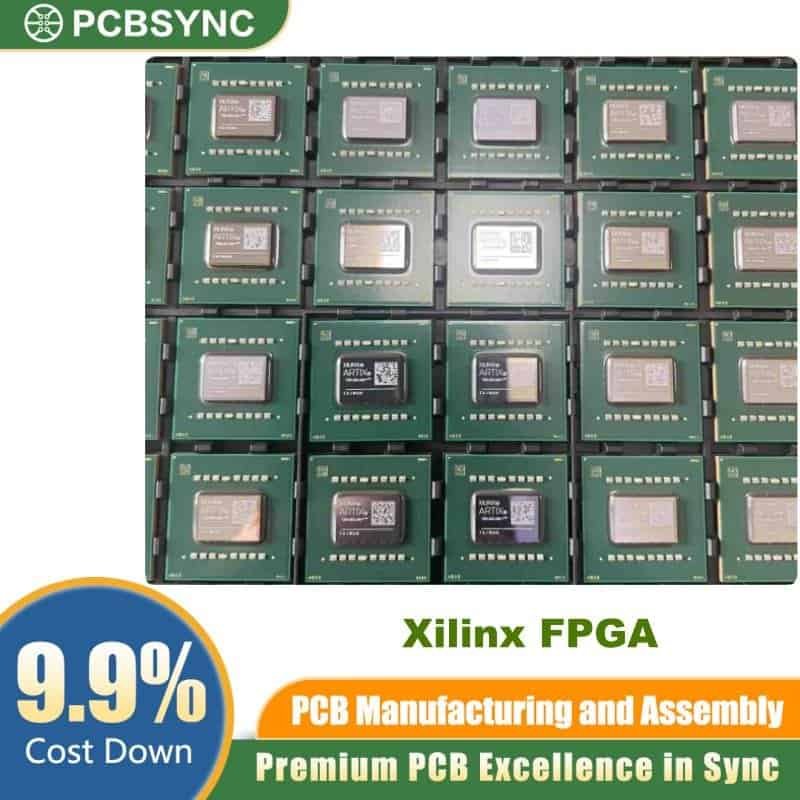
Overview of XC3042-100PQ100C Field Programmable Gate Array
The XC3042-100PQ100C is a high-performance field programmable gate array from the XC3000 Logic Cell Array family, originally manufactured by Xilinx (now part of AMD). This programmable logic device delivers flexible, user-configurable digital integrated circuit capabilities in a compact 100-pin PQFP package, making it ideal for custom VLSI design applications across telecommunications, industrial control, and embedded systems.
Key Technical Specifications
| Specification |
Details |
| Part Number |
XC3042-100PQ100C |
| Manufacturer |
Xilinx Inc. (AMD) |
| Product Family |
XC3000 Series FPGA |
| Logic Capacity |
3,000 Gates (3K) |
| Configurable Logic Blocks |
144 CLBs |
| Total Usable Gates |
30,784 |
| I/O Pins |
82 User I/O |
| Operating Frequency |
100 MHz |
| Supply Voltage |
5V |
| Package Type |
100-Pin PQFP (Plastic Quad Flat Pack) / 100-BQFP |
| Speed Grade |
-100 |
| Temperature Range |
Commercial (0°C to +70°C) |
| Product Status |
Obsolete (No longer manufactured) |
XC3000 Family Architecture and Features
Configurable Logic Architecture
The XC3042-100PQ100C utilizes the proven Logic Cell Array architecture, which consists of three primary configurable elements:
- Configurable Logic Blocks (CLBs): 144 CLBs provide the core logic functionality, enabling complex digital circuit implementation
- Input/Output Blocks (IOBs): Perimeter IOBs offer programmable interface capabilities between internal logic and external signals
- Interconnection Resources: Flexible routing architecture allows customized signal paths throughout the device
Advanced FPGA Capabilities
The device features CMOS technology with a regular, extendable architecture that enables rapid prototyping and deployment of custom digital circuits. Key capabilities include:
- User-programmable configuration stored in static memory cells
- Threshold detection for external signal translation
- Default pull-up resistors on unprogrammed IOBs
- Slew-rate limited outputs by default
- Global reset and clock distribution networks
Physical Package Specifications
100-Pin PQFP Package Details
| Package Parameter |
Specification |
| Package Type |
PQFP (Plastic Quad Flat Pack) |
| Total Pins |
100 |
| User I/O Pins |
82 |
| Power Pins (VCC) |
2-8 (depending on configuration) |
| Ground Pins (GND) |
2-8 (depending on configuration) |
| Dedicated Configuration Pins |
M0, M1, M2, RESET, INIT |
| Mounting |
Surface Mount Technology (SMT) |
Programming and Configuration Options
XACT Development System Support
The XC3042-100PQ100C is supported by Xilinx’s XACT development system, which provides:
- Schematic capture for design entry
- Automated place-and-route tools
- Logic and timing simulation capabilities
- In-circuit emulation for design verification
- Configuration timing calculator for optimization
Configuration Modes
The device supports multiple configuration modes selected via M0, M1, and M2 pins:
- Master Serial Mode
- Slave Serial Mode
- Master Parallel Mode
- Peripheral Mode
Configuration typically requires 290 cycles (approximately 195-580 microseconds depending on clock frequency) for the XC3042 device.
Performance Characteristics
Timing Specifications
| Parameter |
Specification |
| Maximum Operating Frequency |
100 MHz |
| CLB Propagation Delay |
Speed grade -100 dependent |
| IOB Input to Output Delay |
Calculated via XACT timing tools |
| Global Reset Delay |
Based on device-specific calculations |
| Clock High/Low Time |
Minimum specifications maintained |
Power Consumption
The XC3042 family demonstrates efficient power consumption characteristics:
- Standard operation: 0.07-0.25 mW per MHz typical
- Low-power variants available in XC3042L series
- Power consumption scales with clock frequency and utilization
Applications and Use Cases
Primary Applications
The Xilinx FPGA XC3042-100PQ100C excels in numerous applications:
- Digital Signal Processing: Implementing custom DSP algorithms
- Communications Systems: Protocol converters and interface logic
- Industrial Control: Programmable logic controllers and automation
- Instrumentation: Test equipment and measurement systems
- Prototyping: ASIC verification and proof-of-concept development
- Legacy System Support: Replacing discontinued TTL and MSI logic
Design Advantages
Engineers choose the XC3042-100PQ100C for several compelling reasons:
- Eliminates non-recurring engineering costs associated with ASIC development
- Accelerates time-to-market with rapid reconfiguration capabilities
- Integrates complete subsystems into a single package
- Provides field-upgradeable functionality for product improvements
- Offers migration path to XC3300 series HardWire mask-programmed devices for volume production
Replacement and Alternative Options
Product Lifecycle Status
The XC3042-100PQ100C is classified as obsolete and is no longer in production. Design engineers seeking alternatives should consider:
- XC3042A-7PQ100C: Enhanced “A” version with improved specifications (113 MHz operation)
- Modern Xilinx/AMD FPGAs: Current Spartan, Artix, or Kintex series for new designs
- Equivalent Capacity Devices: Alternative FPGA vendors offering similar gate counts
Migration Considerations
When replacing the XC3042-100PQ100C in existing designs:
- Verify pin compatibility with alternative package options
- Review timing requirements against newer device specifications
- Consider voltage level translation for 5V to 3.3V/1.8V migration
- Evaluate modern development tool support and software compatibility
Pin Configuration and Interface
Critical Pin Functions
| Pin Type |
Function |
Notes |
| M0, M1, M2 |
Configuration Mode Selection |
Sampled at configuration start with weak pull-ups |
| RESET |
Global Reset |
Active-low asynchronous reset for all flip-flops |
| INIT |
Initialization Status |
Bidirectional pin indicating configuration status |
| VCC |
Power Supply |
Multiple pins must all be connected |
| GND |
Ground Reference |
Multiple pins for proper grounding |
| I/O |
User Configurable I/O |
82 available for custom logic interfaces |
Interface Standards
The device supports various I/O standards through programmable IOB configuration:
- TTL-compatible input thresholds
- Programmable output drive strength
- Optional pull-up resistor activation
- Configurable output slew rate control
- Bidirectional buffer capabilities
Quality and Reliability
Manufacturing Standards
Xilinx XC3000 family devices, including the XC3042-100PQ100C, were manufactured to rigorous quality standards:
- Commercial, industrial, and military temperature grades available
- High-reliability versions with extended screening
- MIL-STD-883 Class B grade options for critical applications
- Comprehensive test specifications maintained as controlled documents
Reliability Record
The XC3000 series established an excellent reliability record throughout its production lifecycle, with extensive field deployment validation across diverse operating environments and applications.
Ordering and Availability Information
Part Number Breakdown
Understanding the XC3042-100PQ100C part number:
- XC3042: Device family and gate count (3000 series, 42 = 4,200 gates nominal)
- -100: Speed grade (100 MHz maximum frequency)
- PQ100: Package type (Plastic Quad flat pack, 100 pins)
- C: Commercial temperature range (0°C to +70°C)
Current Availability
As an obsolete component, the XC3042-100PQ100C availability is limited to:
- Remaining distributor inventory
- Electronic component brokers specializing in obsolete parts
- Surplus and excess inventory suppliers
- Reclaimed components from legacy equipment
Designers requiring this specific device should consider long-term availability planning and explore modern alternatives for new projects.
Design Support and Resources
Documentation Access
Engineers working with the XC3042-100PQ100C should reference:
- Official Xilinx XC3000 Family Datasheets
- Application notes specific to XC3000 architecture
- XACT Development System documentation
- Timing characterization data for speed grade -100
- Package outline and mechanical drawings
Technical Support
While Xilinx no longer provides direct support for obsolete devices, resources remain available through:
- Legacy documentation archives
- Engineering community forums
- Third-party FPGA development resources
- Authorized distributors with historical technical knowledge
Comparison with Modern FPGA Solutions
Evolution of FPGA Technology
The XC3042-100PQ100C represents early FPGA architecture that has evolved significantly:
| Feature |
XC3042-100PQ100C (Legacy) |
Modern FPGAs |
| Process Technology |
CMOS (larger node) |
Advanced FinFET (7nm-16nm) |
| Supply Voltage |
5V |
1.0V-1.8V core, multi-voltage I/O |
| Logic Capacity |
3K gates |
Up to millions of logic cells |
| Clock Speed |
100 MHz |
Multi-GHz operation |
| Power Efficiency |
Moderate |
Highly optimized low-power modes |
| I/O Standards |
TTL-compatible |
DDR4, LVDS, PCIe, Ethernet, and more |
| Development Tools |
XACT |
Vivado, ISE, advanced synthesis tools |
When to Consider Modern Alternatives
New designs should evaluate current FPGA offerings that provide:
- Significantly higher logic density and performance
- Lower power consumption with advanced power management
- Modern high-speed I/O standards and protocols
- Enhanced DSP blocks and embedded processing cores
- Improved development tool ecosystems with simulation and verification
Conclusion
The XC3042-100PQ100C represents a significant milestone in FPGA development history, offering reliable programmable logic capabilities for countless applications. While now obsolete, this device established architectural foundations that influenced subsequent generations of field programmable gate arrays. Engineers maintaining legacy systems benefit from understanding its comprehensive specifications, while new designs should transition to modern FPGA solutions that build upon the proven concepts pioneered by the XC3000 family.
For current projects requiring programmable logic solutions, explore the latest Xilinx FPGA offerings that deliver enhanced performance, integration, and capabilities far exceeding this legacy device while maintaining the fundamental flexibility that makes FPGAs essential for custom digital design.