Inquire: Call 0086-755-23203480, or reach out via the form below/your sales contact to discuss our design, manufacturing, and assembly capabilities.
Quote: Email your PCB files to Sales@pcbsync.com (Preferred for large files) or submit online. We will contact you promptly. Please ensure your email is correct.
Notes: For PCB fabrication, we require PCB design file in Gerber RS-274X format (most preferred), *.PCB/DDB (Protel, inform your program version) format or *.BRD (Eagle) format. For PCB assembly, we require PCB design file in above mentioned format, drilling file and BOM. Click to download BOM template To avoid file missing, please include all files into one folder and compress it into .zip or .rar format.
IPC-4811: Complete Guide to Embedded Resistor Material Specifications
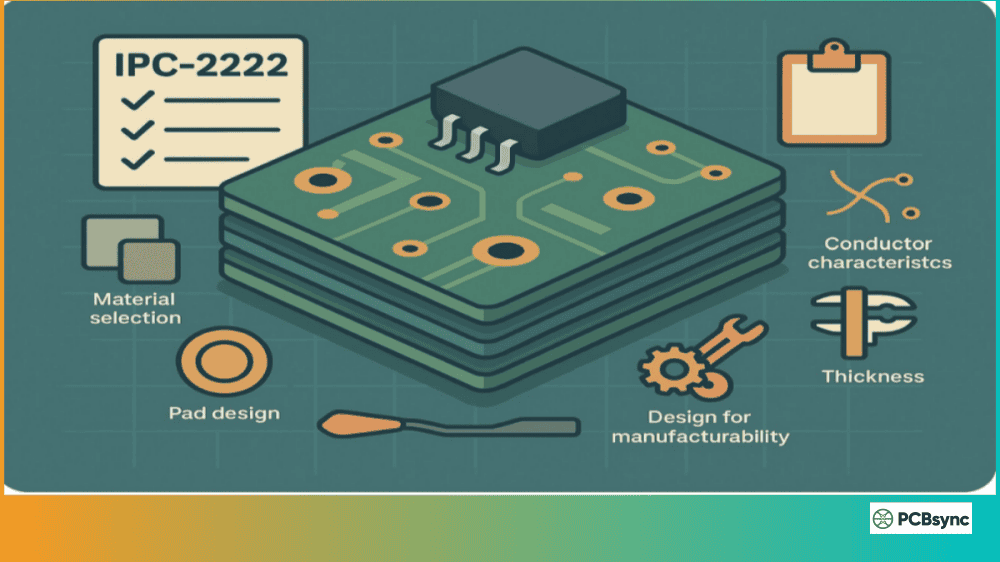
When you’re specifying embedded resistor materials for a PCB design, IPC-4811 is the document that defines what you should expect from your material supplier. I’ve worked with embedded resistors on everything from aerospace applications to MEMS microphone packages, and having a solid understanding of this specification has saved me from accepting substandard materials more than once. This guide covers the key requirements in IPC-4811, from material designations to qualification testing, so you can confidently specify and qualify embedded resistor foils for your applications.
IPC-4811 is the “Specification for Embedded Passive Device Resistor Materials for Rigid and Multilayer Printed Boards,” published by IPC in 2008. This document establishes the requirements for materials used to fabricate embedded resistor devices within PCB substrates. It covers material designation, conformance requirements, qualification (characterization) testing, and quality assurance specifications.
The specification is intended for material suppliers, PCB fabricators, and designers who need standardized criteria for selecting and qualifying embedded resistor materials. IPC-4811 should be used in conjunction with the IPC-2316 design guide, IPC-6017 performance specification, and IPC-TM-650 test methods manual.
What makes IPC-4811 particularly valuable is that it provides a common language between material suppliers and PCB users. When you specify material conforming to IPC-4811, you know what properties have been characterized and what quality controls are in place.
Scope and Purpose of IPC-4811
IPC-4811 provides information on general designations and associated characteristics of embedded passive device (EPD) resistor materials. The document serves as both a qualification standard for material suppliers and a conformance standard for users designing or fabricating PCBs with embedded resistors.
The specification addresses:
Material designation system for identifying resistor alloy types and properties
Conformance requirements that materials must meet for acceptance
Qualification testing to characterize material performance
Quality assurance provisions for ongoing material verification
The document focuses specifically on thin-film resistive materials deposited on copper foil, which are then laminated into PCB stackups. It does not cover thick-film printed resistor pastes or polymer thick-film materials, which follow different manufacturing processes.
Embedded Resistor Material Types per IPC-4811
IPC-4811 recognizes several resistive alloy types, each with distinct electrical and thermal characteristics. Understanding these material options is essential for selecting the right material for your application.
Nickel Phosphorous (NiP)
NiP is the most widely used embedded resistor material, with a five-decade track record in the industry. The nickel-phosphorous alloy is electrodeposited onto copper foil in thicknesses ranging from 0.05 to 1.0 microns. OhmegaPly from Quantic Ohmega is the primary commercial example of NiP resistive foil.
NiP offers excellent stability with a low temperature coefficient of resistance (TCR) typically below 50 ppm/°C. It’s stable over a wide frequency range (tested beyond 20 GHz) and demonstrates superior long-term stability with less than 2% drift after 100,000 hours at 110°C. The material is processed using standard subtractive PCB manufacturing, though it requires a copper sulfate etch for the resistive layer and alkaline etch for copper removal.
Nickel Chromium (NiCr)
NiCr alloys are deposited via vacuum sputtering rather than electroplating. The standard composition is 80% nickel and 20% chromium (often called Nichrome). TCR thin-film resistor foil from Quantic Ticer is the leading commercial NiCr product for embedded resistor applications.
NiCr provides excellent absolute TCR values (typically -20 to +100 ppm/°C) and is not attacked by alkaline solutions, which simplifies processing. The material can be etched in cupric chloride followed by ammoniacal etchant, potentially reducing fabrication steps compared to NiP. NiCr demonstrates excellent resistance to value shift through multiple thermal excursions, which is critical for embedded resistors that must survive PCB lamination and assembly processes.
Nickel Chromium Aluminum Silicon (NCAS)
NCAS is a quaternary alloy that combines the benefits of NiCr with aluminum and silicon additions. This material achieves higher sheet resistivities (up to 1000 Ω/sq) than standard NiCr while maintaining low TCR values. NCAS is particularly useful for high-value resistors where minimizing resistor area is important.
Chromium Silicon Monoxide (CrSiO)
CrSiO offers the highest sheet resistivity of the common embedded resistor materials, enabling very high resistance values in small areas. This material is used in specialized applications requiring resistance values that would be impractical with lower sheet resistivity materials.
IPC-4811 Embedded Resistor Material Comparison:
Material
Deposition
Sheet Resistivity
TCR (ppm/°C)
Commercial Product
NiP
Electroplating
10-377 Ω/sq
<50
OhmegaPly
NiCr
Sputtering
25-250 Ω/sq
-20 to +100
TCR
NCAS
Sputtering
25-1000 Ω/sq
<50
TCR NCAS
CrSiO
Sputtering
Up to 2000+ Ω/sq
Variable
TCR CrSiO
Key Material Properties and Requirements
Sheet Resistivity
Sheet resistivity is the fundamental property that determines what resistance values can be achieved with a given resistor geometry. It’s expressed in ohms per square (Ω/sq), a dimensionless unit where a square of resistive material has the same resistance regardless of its physical size. A 25 Ω/sq material yields 25Ω whether the square is 1 mil × 1 mil or 1 inch × 1 inch.
IPC-4811 specifies tolerances on sheet resistivity that material suppliers must meet. Typical tolerances are ±3% for 10 Ω/sq material, ±5% for 25-100 Ω/sq materials, and ±10% for higher resistivity products. These tolerances directly impact the achievable tolerance of the finished embedded resistors.
Temperature Coefficient of Resistance (TCR)
TCR quantifies how much the resistance changes with temperature, expressed in parts per million per degree Celsius (ppm/°C). Low TCR is critical for embedded resistors because they must survive PCB lamination (typically 180-200°C) and assembly reflow (up to 260°C) without significant resistance drift.
IPC-4811 requires TCR characterization across the operating temperature range. For NiP materials, TCR is typically below 50 ppm/°C. NiCr materials can achieve even lower absolute TCR values, with some products offering near-zero TCR through careful alloy composition control.
Thermal Stability and Drift
Long-term stability is essential for embedded resistors in high-reliability applications. IPC-4811 addresses this through drift testing, where materials are subjected to elevated temperature storage and the resistance change is monitored over time. Quality materials like OhmegaPly demonstrate less than 2% drift after 100,000 hours at 110°C.
Multiple thermal cycle testing is also important because embedded resistors experience repeated thermal excursions during PCB fabrication (lamination cycles) and assembly (reflow cycles). Materials must maintain their resistance values through these processes.
Power Dissipation
IPC-TM-650 Method 2.5.34, which supports IPC-4811, provides testing procedures for power density rating of embedded resistors. Power handling capability depends on the resistor area, resistive film thickness, thermal management, and the glass transition temperature of the surrounding laminate material.
Thicker resistive films generally dissipate more power, and larger resistor areas improve thermal spreading. Heat sinks and thermal vias can increase power handling, while higher Tg laminates allow higher operating temperatures.
Qualification and Conformance Testing
IPC-4811 establishes two levels of testing: qualification testing for initial material characterization and conformance testing for ongoing production verification.
Qualification Testing
Qualification testing characterizes the full range of material properties and performance under various conditions:
Sheet resistivity measurement and uniformity
TCR characterization across the operating temperature range
Thermal stability and drift testing at elevated temperatures
Multiple thermal cycle testing simulating lamination and assembly
Humidity resistance testing
Power handling characterization per IPC-TM-650
Conformance Testing
Conformance testing verifies that production lots meet specification requirements. This typically includes sheet resistivity measurement, visual inspection for uniformity, and statistical sampling to verify consistency lot-to-lot and sheet-to-sheet. Material suppliers providing IPC-4811 conforming products should supply certificates of conformance with each shipment.
Quality Assurance Provisions
IPC-4811 includes quality assurance provisions that material suppliers must implement. This includes documented quality management systems, incoming material inspection, in-process controls, and final inspection procedures.
Traceability is particularly important for embedded resistor materials used in aerospace and defense applications. The specification requires that materials be traceable to specific production lots, enabling root cause analysis if problems occur in the field.
For users qualifying new embedded resistor materials, IPC-4811 recommends working closely with material suppliers to understand the characterization data and establish acceptance criteria appropriate for your specific application requirements.
Commercial Materials Meeting IPC-4811
Product
Supplier
Alloy Type
Available Ω/sq
OhmegaPly RCM
Quantic Ohmega
NiP
10, 25, 50, 100, 250
OhmegaPly MTR
Quantic Ohmega
NiP (enhanced)
10, 25, 50
TCR NiCr
Quantic Ticer
NiCr
25, 50, 100, 250
TCR NCAS
Quantic Ticer
NiCrAlSi
25, 50, 100, 250, 1000
Both Quantic Ohmega and Quantic Ticer provide technical support for designers working with their materials, including resistor calculators, design guidelines, and application engineering assistance. These resources complement the IPC-4811 specification by providing practical design guidance specific to each material system.
Embedded Resistor Material Specification (shop.ipc.org)
IPC-2316
Design Guide for Embedded Passive Device Printed Boards
IPC-6017
Qualification and Performance Specification for Embedded Passives
IPC-TM-650 2.5.34
Power Density Rating Test Method for Embedded Resistors
Quantic Ohmega
OhmegaPly technical library and resistor calculator (quanticohmega.com)
Quantic Ticer
TCR technical resources and design tools (ticertechnologies.com)
Frequently Asked Questions About IPC-4811
What resistance values can be achieved with IPC-4811 materials?
Embedded resistors using IPC-4811 conforming materials typically achieve values from 5Ω to 50kΩ. The achievable range depends on the sheet resistivity selected (10-1000 Ω/sq depending on material type) and the available board area for resistor routing. Higher values are possible with higher sheet resistivity materials like NCAS or CrSiO, while lower values require lower sheet resistivity materials like 10 Ω/sq NiP.
What tolerances can embedded resistors achieve?
As-fabricated tolerances for embedded resistors typically range from ±5% to ±20%, depending on the material, resistor geometry, and process control. Tighter tolerances (±1-2%) can be achieved through laser trimming after fabrication. The base material sheet resistivity tolerance per IPC-4811 (typically ±3% to ±10%) sets the floor for achievable resistor tolerance.
How does IPC-4811 relate to IPC-2316 and IPC-6017?
IPC-4811 specifies the resistor material requirements, IPC-2316 provides design guidance for incorporating embedded passives into PCBs, and IPC-6017 establishes qualification and performance requirements for the finished PCB containing embedded passives. Together, these documents form a complete framework for embedded resistor implementation—from material selection through design to final product qualification.
What’s the difference between NiP and NiCr embedded resistor materials?
NiP (Nickel Phosphorous) is electrodeposited and offers excellent long-term stability with TCR below 50 ppm/°C. It requires a two-step etch process (copper sulfate for NiP, alkaline for copper). NiCr (Nickel Chromium) is sputtered and offers lower absolute TCR (-20 to +100 ppm/°C) with simplified processing since it’s not attacked by alkaline etchants. Choose based on your TCR requirements and fabricator’s process capabilities.
Can embedded resistors handle significant power dissipation?
Yes, but power handling depends on resistor area, film thickness, and thermal management. IPC-TM-650 Method 2.5.34 provides test procedures for characterizing power density rating. Larger resistor areas and thicker films handle more power. Thermal vias and copper pours improve heat spreading. For most termination and pull-up applications, power handling is not a limiting factor, but high-power applications require careful thermal analysis.
Conclusion
IPC-4811 provides the material specification framework that enables reliable embedded resistor implementation in PCBs. Understanding this specification helps you select appropriate materials, set realistic expectations for performance, and work effectively with material suppliers and PCB fabricators.
For most applications, the choice between NiP and NiCr materials comes down to available sheet resistivities, TCR requirements, and your fabricator’s process capabilities. Both material systems have proven track records spanning decades. Start with your performance requirements, consult with material suppliers like Quantic Ohmega or Quantic Ticer, and ensure your PCB fabricator has experience with the material system you select.
Inquire: Call 0086-755-23203480, or reach out via the form below/your sales contact to discuss our design, manufacturing, and assembly capabilities.
Quote: Email your PCB files to Sales@pcbsync.com (Preferred for large files) or submit online. We will contact you promptly. Please ensure your email is correct.
Notes: For PCB fabrication, we require PCB design file in Gerber RS-274X format (most preferred), *.PCB/DDB (Protel, inform your program version) format or *.BRD (Eagle) format. For PCB assembly, we require PCB design file in above mentioned format, drilling file and BOM. Click to download BOM template To avoid file missing, please include all files into one folder and compress it into .zip or .rar format.