Inquire: Call 0086-755-23203480, or reach out via the form below/your sales contact to discuss our design, manufacturing, and assembly capabilities.
Quote: Email your PCB files to Sales@pcbsync.com (Preferred for large files) or submit online. We will contact you promptly. Please ensure your email is correct.
Notes: For PCB fabrication, we require PCB design file in Gerber RS-274X format (most preferred), *.PCB/DDB (Protel, inform your program version) format or *.BRD (Eagle) format. For PCB assembly, we require PCB design file in above mentioned format, drilling file and BOM. Click to download BOM template To avoid file missing, please include all files into one folder and compress it into .zip or .rar format.
If you’ve been working on HDI PCB designs lately, you’ve probably encountered the challenge of specifying materials for microvia build-up layers. Traditional prepreg and copper foil combinations work fine for conventional boards, but once you need microvias smaller than 150µm, you’re stepping into territory where IPC-4563 and resin coated copper (RCC) become essential knowledge.
I’ve spent years working with HDI materials, and I can tell you that understanding RCC specification is one of those things that separates engineers who struggle with microvia reliability from those who get it right the first time. This guide breaks down everything you need to know about IPC-4563, from the designation system to practical material selection.
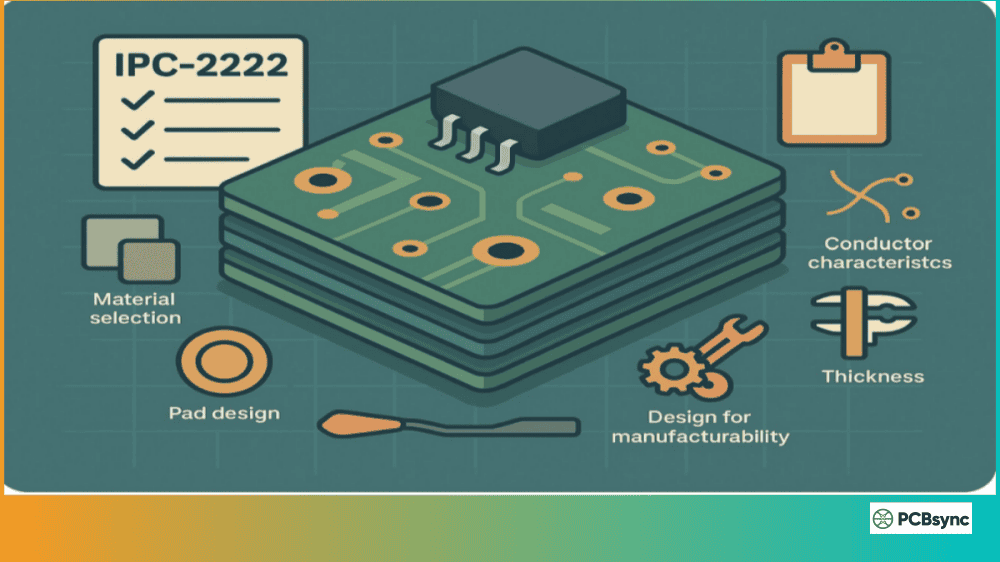
IPC-4563, officially titled “Resin Coated Copper Foil for Printed Boards Guideline,” is the industry standard that defines requirements for resin coated copper foil used in high-density interconnect (HDI) printed circuit boards. Published by IPC (Association Connecting Electronics Industries), this specification superseded the earlier IPC-CF-148A standard in November 2007.
The standard covers RCC materials intended specifically for the formation of surface microvias in sequential build-up (SBU) processes. Unlike traditional copper-clad laminates covered by IPC-4101, RCC materials combine copper foil with unreinforced resin layers that can be easily processed with laser drilling technology.
Why IPC-4563 Matters for HDI Design
HDI boards rely on microvias to achieve the routing density required by modern BGA packages and fine-pitch components. The key advantage of RCC materials is their glass-fiber-free construction, which enables:
Laser drilling compatibility: Without glass fibers, CO2 lasers can efficiently ablate the dielectric to form clean microvias
Ultra-small via formation: Microvia diameters down to 75µm (3 mil) are achievable with RCC
Consistent dielectric thickness: The resin layer provides predictable thickness control between copper layers
Reduced capacitance: Laser-drilled blind vias in RCC have approximately 0.05pF capacitance compared to 1pF for mechanically drilled through-holes
RCC is fundamentally different from traditional prepreg materials. While prepreg uses woven glass fabric impregnated with resin, RCC consists of copper foil directly coated with unreinforced thermosetting resin. This construction eliminates the drilling challenges associated with glass fibers.
B-Stage and C-Stage Resin Layers
IPC-4563 recognizes two types of resin layers that can be applied to copper foil, and understanding their functions is critical for proper material selection.
B-Stage Resin Layer
The B-stage resin is partially cured (semi-polymerized) and remains flowable during lamination. This layer serves two essential functions:
Flows during pressing to fill underlying circuit features and buried vias
Provides adhesion between the RCC and the inner layer circuitry
Think of B-stage resin as the “flow and fill” component. During lamination under heat and pressure, it softens and conforms to the topography of the inner layer before completing its cure.
C-Stage Resin Layer
The C-stage resin is fully cured and does not flow during lamination. Its primary function is to maintain a consistent minimum dielectric thickness between copper layers, regardless of the underlying circuit density.
When both B-stage and C-stage layers are present, the structure works like this: the C-stage acts as a “stop” layer that guarantees minimum dielectric spacing, while the B-stage flows to fill circuit features below.
RCC Configuration Types
Configuration
Structure
Application
Single-Pass (B-stage only)
Copper + B-stage resin
Standard HDI build-up, moderate circuit fill
Dual-Layer (B + C-stage)
Copper + C-stage + B-stage
Controlled dielectric thickness, heavy copper inner layers
Reinforced RCC
Copper + thin glass + resin
Enhanced dimensional stability
IPC-4563 Designation System Explained
One of the most practical aspects of IPC-4563 is its comprehensive designation system. Once you understand the coding structure, you can specify exactly what RCC material you need.
Product Designator Breakdown
The full IPC-4563 designation follows this format:
For HDI applications, copper foil thickness is typically 18µm (1/2 oz), 12µm (1/3 oz), or even 9µm (1/4 oz) to facilitate fine-line etching and reduce laser drilling time.
RCC Material Properties and Requirements
IPC-4563 specifies numerous material properties that affect both manufacturability and end-product reliability. Here are the key parameters to understand.
The dielectric constant of RCC materials is notably lower than glass-reinforced laminates because the resin contains no glass fibers. This lower Dk is advantageous for high-speed signal integrity, as it reduces signal propagation delay and enables tighter impedance control.
Mechanical and Thermal Properties
Property
Test Method
Typical Requirement
Peel Strength (Condition A)
IPC-TM-650
>6.0 lbs/in
Peel Strength (After Solder Float)
IPC-TM-650
>5.5 lbs/in
Peel Strength (Elevated Temp)
IPC-TM-650
>5.0 lbs/in
Glass Transition (Tg)
DSC
135-170°C
Water Absorption
D-24/23
<2.5%
Peel strength is particularly important for RCC because the resin-to-copper bond must survive multiple thermal cycles during assembly. IPC-4563 requires testing under various conditions including after solder float exposure and at elevated temperatures.
HDI PCB Applications for RCC Materials
RCC materials find their primary application in HDI printed circuit boards where traditional prepreg cannot meet the requirements. Let me walk through the main use cases.
Sequential Build-Up (SBU) Process
In SBU construction, RCC layers are laminated onto a core board one at a time, with each layer being imaged, etched, and drilled before the next layer is added. This is fundamentally different from traditional multilayer PCB fabrication where all layers are pressed simultaneously.
The typical SBU process with RCC follows these steps:
Inner core fabrication and surface treatment
RCC lamination onto core (both sides)
Copper window opening (if using conformal mask method)
Laser drilling to form microvias
Desmear and microvia metallization
Pattern plating and etching
Repeat for additional build-up layers
Microvia Formation Methods
RCC materials are optimized for laser drilling, and IPC-4563 materials are compatible with multiple microvia formation techniques:
Method
Laser Type
Via Diameter Range
Notes
Conformal Mask
CO2
75-150 µm
Copper window etched first
Direct Ablation
UV (Nd:YAG)
50-100 µm
Drills through copper and resin
Large Window
CO2
100-200 µm
Oversized copper opening
CO2 lasers are most commonly used with RCC because the glass-free resin absorbs infrared energy efficiently. The typical workflow involves etching a “conformal mask” window in the copper layer, then using the CO2 laser to ablate the resin and stop on the target pad below.
HDI Stackup Configurations
RCC materials enable various HDI stackup configurations designated by the industry as 1+N+1, 2+N+2, and beyond:
Stackup Type
Description
RCC Layers
1+N+1
One build-up layer per side
2 RCC layers total
2+N+2
Two build-up layers per side
4 RCC layers total
Any-Layer HDI
All layers interconnected
Multiple RCC layers
For 2+N+2 and higher configurations, the microvias can be either staggered (offset from each other) or stacked (directly on top of each other). Stacked microvias require copper filling of the first via before the second build-up layer is applied.
One question I get frequently is whether RCC is always better than traditional prepreg for HDI applications. The answer is nuanced and depends on your specific requirements.
Comparison Table: RCC vs Prepreg + Copper Foil
Factor
RCC
Prepreg + Copper
Microvia compatibility
Excellent
Limited (glass impedes laser)
Minimum via diameter
75 µm (3 mil)
100-150 µm (4-6 mil)
Dielectric constant
~3.4
~4.3-4.5
Dimensional stability
Moderate
Better (glass reinforcement)
Material cost
Higher
Lower
Laser drilling speed
Fast
Slower (glass absorption)
Z-axis CTE
Higher
Lower
When to Choose RCC
Select RCC materials when your design requires:
Microvias smaller than 100 µm diameter
Low dielectric constant for high-speed signals
Multiple sequential build-up layers
Via-in-pad with copper filling
Ultra-thin dielectric layers (<60 µm)
When Prepreg May Be Better
Consider traditional prepreg + copper foil when:
Dimensional stability is critical (large boards)
Cost is a primary concern
Microvia diameters exceed 150 µm
Single build-up layer is sufficient
Z-axis CTE matching is important for component reliability
Many fabricators offer a hybrid approach using 1080 or 106 prepreg with thin copper foil as a lower-cost alternative to RCC. This works well for larger microvias (4-6 mil) but doesn’t match RCC performance for ultra-fine features.
Material Selection Guidelines for Engineers
When specifying RCC per IPC-4563, consider these practical factors based on your design requirements.
Resin Thickness Selection
The resin layer thickness must account for two things: filling the underlying circuit features and maintaining adequate dielectric spacing.
Rule of thumb: B-stage resin thickness should be approximately 1.5x the copper thickness of the inner layer being covered, plus the desired minimum dielectric thickness.
For a 35µm inner layer copper with 50µm minimum dielectric requirement:
B-stage thickness ≈ (35 × 1.5) + 50 = 102.5 µm
Specify 100 µm B-stage resin
Copper Foil Selection
For HDI outer layers, thinner copper enables finer line/space capability:
Copper Weight
Line/Space Capability
Best For
1/4 oz (9 µm)
25/25 µm
Ultra-fine pitch BGAs
1/3 oz (12 µm)
40/40 µm
Fine pitch applications
1/2 oz (18 µm)
50/50 µm
Standard HDI
Thermal Considerations
If your board will undergo lead-free assembly (peak temperatures around 260°C), ensure the RCC material has adequate Tg (glass transition temperature). Most modern RCC materials offer Tg values of 150-170°C, which provides sufficient margin for lead-free processing.
Useful Resources for PCB Engineers
For additional information on IPC-4563 and RCC materials, these resources provide valuable reference material.
Official IPC Standards
IPC-4563: Resin Coated Copper Foil for Printed Boards Guideline – available at shop.ipc.org
IPC-4562: Metal Foil for Printed Board Applications (copper foil requirements)
IPC-4101: Specification for Base Materials (laminate slash sheets)
Saturn PCB Toolkit: Impedance and stackup calculators
Frequently Asked Questions About IPC-4563
What is the difference between IPC-4563 and IPC-4562?
IPC-4562 covers bare copper foil used in printed board applications, specifying requirements for electrodeposited and wrought copper foils including grades, profiles, and thickness tolerances. IPC-4563 specifically addresses copper foil that has been coated with resin layers for HDI build-up applications. Think of it this way: IPC-4562 covers the raw copper foil, while IPC-4563 covers that same foil after resin coating has been applied. The two standards work together, with IPC-4563 referencing IPC-4562 for the underlying copper foil properties.
Can RCC materials be used with mechanical drilling?
Technically yes, but it defeats the purpose. RCC materials are specifically designed for non-mechanical via formation methods like laser drilling. The unreinforced resin structure that makes RCC excellent for laser processing also makes it less suitable for mechanical drilling, which can cause resin smear and poor hole quality. If your design only needs mechanically drilled vias, traditional glass-reinforced prepreg is more appropriate and cost-effective.
What microvia diameter should I specify for RCC applications?
For reliable microvia formation and plating, a 100 µm (4 mil) diameter is the industry sweet spot. This size provides good copper coverage on via walls while being small enough for HDI routing advantages. Going smaller (75 µm) is possible but requires tighter process control. The aspect ratio (via depth to diameter) should stay below 0.75:1 for reliable plating, so if your dielectric thickness is 60 µm, your minimum via diameter should be approximately 80 µm.
How does RCC affect impedance calculations compared to prepreg?
RCC materials have a lower dielectric constant (Dk ~3.4) compared to glass-reinforced prepreg (Dk ~4.3-4.5). This means that for the same trace geometry and dielectric thickness, RCC will produce higher characteristic impedance. When transitioning from prepreg to RCC in your stackup calculations, you may need to adjust trace widths or dielectric thickness to maintain target impedance. Most stackup calculators allow you to input the specific Dk value for accurate modeling.
Is RCC suitable for flexible or rigid-flex PCBs?
Standard RCC materials per IPC-4563 are designed for rigid HDI applications. However, flexible resin coated copper (FRCC) products exist for flexible circuit applications, such as Panasonic’s R-FR10. These materials combine thin copper foil with flexible resin systems optimized for bend applications. If you need build-up layers on flexible substrates, look for FRCC products specifically designed for flex applications rather than standard rigid RCC materials.
Conclusion
IPC-4563 provides the framework for specifying resin coated copper materials that enable modern HDI PCB manufacturing. Understanding the distinction between B-stage and C-stage resin layers, knowing how to interpret the designation system, and selecting appropriate material configurations are essential skills for engineers working on high-density designs.
RCC materials offer significant advantages for microvia formation, including excellent laser drilling compatibility, lower dielectric constant for improved signal integrity, and the ability to create ultra-small vias that traditional prepreg cannot match. However, they come with higher material costs and require sequential lamination processes that add complexity to fabrication.
When specifying RCC per IPC-4563, work closely with your fabricator to understand their specific material inventory and process capabilities. Many shops have preferred RCC suppliers and established processes that can influence your material selection. Getting this alignment early in the design phase prevents surprises during fabrication and ensures your HDI board performs as intended.
The trend toward finer-pitch packages and higher-density designs means RCC materials will only become more important in coming years. Engineers who master IPC-4563 requirements position themselves well for the continuing evolution of HDI technology.
Inquire: Call 0086-755-23203480, or reach out via the form below/your sales contact to discuss our design, manufacturing, and assembly capabilities.
Quote: Email your PCB files to Sales@pcbsync.com (Preferred for large files) or submit online. We will contact you promptly. Please ensure your email is correct.
Notes: For PCB fabrication, we require PCB design file in Gerber RS-274X format (most preferred), *.PCB/DDB (Protel, inform your program version) format or *.BRD (Eagle) format. For PCB assembly, we require PCB design file in above mentioned format, drilling file and BOM. Click to download BOM template To avoid file missing, please include all files into one folder and compress it into .zip or .rar format.