Inquire: Call 0086-755-23203480, or reach out via the form below/your sales contact to discuss our design, manufacturing, and assembly capabilities.
Quote: Email your PCB files to Sales@pcbsync.com (Preferred for large files) or submit online. We will contact you promptly. Please ensure your email is correct.
Notes: For PCB fabrication, we require PCB design file in Gerber RS-274X format (most preferred), *.PCB/DDB (Protel, inform your program version) format or *.BRD (Eagle) format. For PCB assembly, we require PCB design file in above mentioned format, drilling file and BOM. Click to download BOM template To avoid file missing, please include all files into one folder and compress it into .zip or .rar format.
If you’ve spent any time managing product data transfers between your design team and contract manufacturers, you know the pain of miscommunicated BOMs, lost revision history, and the endless back-and-forth emails asking “which file is the latest version?” IPC 2571 was created specifically to solve these problems, and after implementing it across multiple projects, I can tell you it’s worth understanding inside and out.
In this comprehensive guide, I’ll explain everything you need to know about IPC 2571—from its core purpose to practical implementation tips that took me years to figure out on my own.
IPC 2571 is the generic requirements specification for Product Data eXchange (PDX), developed and published by IPC (Association Connecting Electronics Industries). This standard defines an XML-based encoding schema that allows electronics manufacturers to describe complete product definitions in a format that any compliant system can read, interpret, and process.
The standard was first published in November 2001 by the Product Data Exchange Task Group (2-15a) under the Supply Chain Communication Subcommittee (2-15) of IPC. It received ANSI (American National Standards Institute) approval as a national standard, giving it significant weight in the industry.
At its foundation, IPC 2571 provides the framework for packaging and exchanging critical product information including Bills of Materials (BOM), Approved Manufacturer Lists (AML), Engineering Change Orders (ECO), Engineering Change Requests (ECR), deviations, and references to supporting documentation like drawings and specifications.
The Problem IPC 2571 Solves
Before PDX standards existed, transferring product data between OEMs and their supply chain partners was chaotic at best. I remember the old days of exporting BOMs to Excel, manually formatting them to match what each CM expected, and praying nothing got lost in translation when they re-keyed the data into their ERP system.
Every handoff introduced errors. Every revision created version control nightmares. And when engineering changes came through—which they always do—tracking what actually changed became nearly impossible.
IPC 2571 addresses this by establishing a common language. When your PLM system exports a PDX package and your CM’s system imports it, they’re speaking the same structured format. The data arrives exactly as you sent it, with full traceability intact.
Understanding the IPC 2570 Series Standards
IPC 2571 doesn’t operate in isolation. It serves as the umbrella specification for a family of related standards, each addressing specific aspects of supply chain data exchange.
Standard
Full Title
Primary Purpose
IPC-2571
Generic Requirements for Electronics Manufacturing Supply Chain Communication
Defines Package element, common elements, DTD structure
Sectional Requirements for BOM and Product Design Configuration
Items, BOMs, AMLs, ASLs, engineering changes
IPC-2577
Sectional Requirements for Manufacturing Quality Assessment
Quality data exchange (proposed, not widely adopted)
IPC 2571 defines the ProductDataeXchangePackage element that wraps every PDX file, plus the common data elements shared across all 2570-series specifications. The sectional standards then build on this foundation with application-specific structures.
How IPC 2571 Relates to IPC 2581
One question I get frequently is about the difference between IPC 2571 and IPC 2581. While they sound similar, they serve distinctly different purposes in the electronics manufacturing workflow.
IPC 2571 (PDX) focuses on supply chain communication—transferring BOMs, manufacturer part information, approved sources, and change documentation between business systems like PLM and ERP.
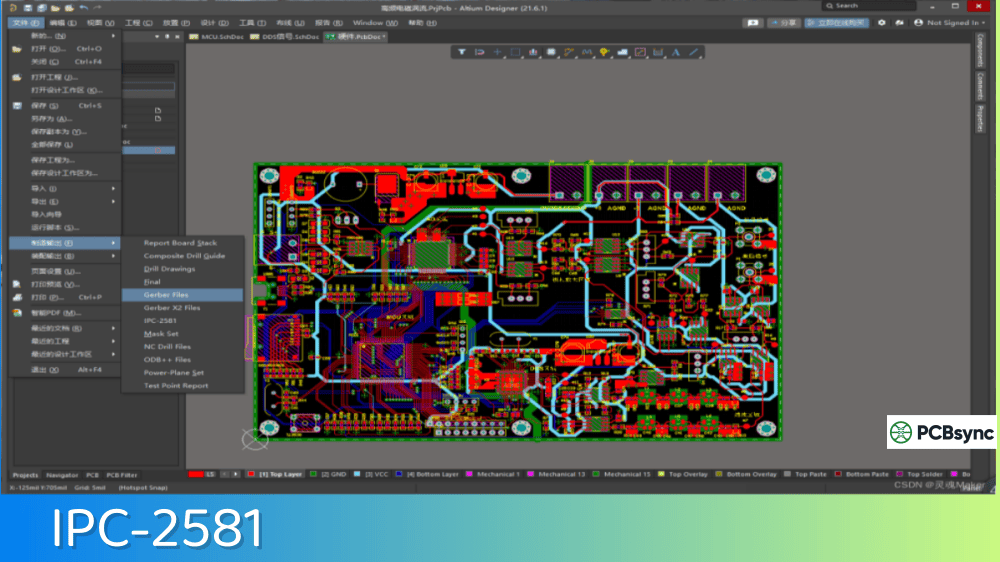
IPC 2581 focuses on PCB fabrication data transfer—sending design data (layer stackup, drill files, netlists, artwork) from CAD tools to board fabrication facilities.
In a typical product development cycle, you might use IPC 2581 to send your bare board design to the fab house, then use IPC 2571 to send the complete product BOM (which includes that PCB as one line item among many) to your assembly contractor.
Key Benefits of Implementing IPC 2571
After working with PDX across multiple organizations, I’ve seen consistent benefits that justify the implementation effort.
Elimination of Manual Data Entry
When your CM receives a PDX package, they can import it directly into their systems. No re-keying part numbers. No transcribing quantities from spreadsheets. The data flows automatically, which means fewer errors and faster turnaround on quotes and production setup.
Complete Engineering Change Traceability
ECOs and ECRs encoded in IPC 2571 format carry full change history—what changed, when it changed, who authorized it, and what revision resulted. This audit trail is invaluable when you need to trace back to understand how a product evolved.
Standardized Approved Manufacturer Lists
The AML structure in IPC 2571 lets you communicate not just what parts are on your BOM, but which manufacturer part numbers are approved for each position. Your CM knows exactly which sources are acceptable without separate correspondence.
Reduced Integration Costs
Instead of building custom integrations for each supply chain partner, you implement one standard. Any PDX-compliant system can exchange data with yours, which simplifies onboarding new partners significantly.
Faster Time-to-Market
When quote requests, BOM transfers, and revision updates happen through automated PDX exchange rather than manual processes, development cycles compress. I’ve seen teams shave weeks off their NPI timelines after implementing proper PDX workflows.
Inside a PDX Package: Technical Structure
A PDX package is a compressed file using GZip compression (RFC 1952) with a .pdx file extension. Inside the archive, you’ll find an XML file conforming to the IPC-2571.dtd Document Type Definition, plus any attached files such as CAD drawings, component datasheets, or assembly instructions.
Core XML Elements Defined by IPC 2571
The XML structure follows a hierarchical model. Understanding these elements is essential for anyone working with PDX at a technical level.
For quick reference, here are the key technical parameters defined in IPC 2571:
Specification
Value
XML Version
1.0
PDX Standard Version
1.0
Compression Algorithm
GZip (RFC 1952 V4.3)
Maximum Package Size
4GB (uncompressed)
File Name Character Set
ISO 8859-1 (Latin-1)
DateTime Format
ISO 8601 (YYYY-MM-DDThh:mm:ssZ)
Definition File
IPC-2571.dtd
ANSI Approved
Yes (November 2001)
IPC 2571 Implementation Best Practices
After implementing PDX across various PLM systems and helping troubleshoot integration issues, I’ve compiled the lessons learned into practical guidance.
Treat Optional Attributes as Required
The IPC 2571 DTD specifies some attributes as #REQUIRED and others as #IMPLIED (optional). In real-world implementations, treat all business-critical attributes as required even if the DTD says otherwise.
Many downstream systems—especially older ones—expect values for optional fields and may fail silently or behave unexpectedly when they’re missing. The originatedByContactName attribute, for example, is technically optional but should always be populated.
Validate DateTime Formats Rigorously
All DateTime values must follow ISO 8601 format exactly: YYYY-MM-DDThh:mm:ssZ. I’ve debugged more than a few integration failures caused by dates formatted as “01/15/2024” or “15-Jan-2024” instead of the required “2024-01-15T00:00:00Z”.
Build format validation into your export process and reject non-compliant data before it leaves your system.
Understand Package-Unique Identifiers
Each element that can be referenced by other elements needs a Package-Unique Identifier (PUID). These identifiers only need to be unique within a single PDX package—they’re not global identifiers and will likely conflict with PUIDs in other packages.
Your PLM system typically generates these automatically, but if you’re building custom tooling, implement reliable PUID generation that avoids collisions within each package.
Handle File Attachments Correctly
The isFileIn attribute controls whether files are embedded or referenced:
isFileIn=”Yes”: The file is physically included in the compressed PDX package. Recipients extract it directly without needing network access.
isFileIn=”No”: The file is referenced by URL in the universalResourceIdentifier attribute but not included in the package.
For secure, reliable data transfers to external partners, always embed files (isFileIn=”Yes”). External URL references assume network access and may break when packages cross organizational boundaries or when referenced locations change.
Normalize File Names to ASCII
IPC 2571 specifies that attachment file names should use ISO 8859-1 (Latin-1) characters only. Unicode characters in file names can cause import failures on receiving systems.
Modern PLM tools often handle this normalization automatically during export, but verify your configuration. If you’re building custom export scripts, implement explicit encoding conversion before adding files to packages.
Even well-implemented PDX workflows encounter issues. Here’s how to address the most common problems.
Vendor DTD Variations
Not all PDX generators follow the IPC-2571.dtd precisely. Oracle Agile PLM, for instance, has historically shipped with modified DTDs that treat some optional attributes as required (or vice versa). Different software versions may also have inconsistent implementations.
Solution: Use resilient XML parsers that don’t fail on minor DTD deviations. PDX viewer tools like PDXplorer are designed to accept varying implementations gracefully. When importing packages from partners, expect and plan for format variations.
Incomplete Manufacturer Part Data
The IPC 2571 data model separates parts into Items (internal parts you own) and ManufacturerParts (external parts from manufacturers). The ManufacturerPart structure is less robust than Item, and you may find packages where manufacturer information is incomplete.
Solution: Establish data quality requirements with supply chain partners upfront. Define which ManufacturerPart attributes your processes require and validate incoming packages against those requirements before processing.
Large Package Size Limitations
The 4GB uncompressed size limit can be restrictive for complex products with thousands of parts and extensive attached documentation.
Solution: Segment large products into multiple packages organized by subassembly, or configure exports to exclude non-essential attachments. Some PLM systems offer filtering options to control which file types are included.
Character Encoding Problems
International organizations sometimes encounter issues with part numbers or file names containing non-Latin characters that don’t convert cleanly to ISO 8859-1.
Solution: Establish naming conventions that use ASCII-compatible characters for part identifiers and file names. Where that’s not possible, implement reliable character normalization in your export process.
PDX Software Tools and Resources
You don’t need enterprise software licenses to work with IPC 2571 files. Several tools are available for viewing, creating, and validating PDX packages.
For electronics supply chain communication specifically, IPC 2571 remains the most widely supported standard. Its PLM vendor adoption and contract manufacturer familiarity make it the pragmatic choice for most organizations.
Future Considerations for IPC 2571
The IPC-2570 series standards have remained stable since 2001, which is both a strength (compatibility) and a limitation (dated technology). Here’s what to watch for going forward.
API-Based Exchange: Cloud PLM adoption is driving interest in REST API approaches that complement or replace file-based PDX transfers. Expect hybrid workflows where PDX packages are transmitted via web services.
Enhanced Security: Some tools now support AES-256 encryption and SHA-256 cryptographic signatures for PDX packages—features not in the original IPC specification but increasingly important for IP protection.
Integration with IPC 1752: Environmental compliance requirements (RoHS, REACH) are driving adoption of IPC 1752 for material declarations. Look for tighter integration between PDX packages and compliance data.
Modern Schema Formats: The original DTD-based definition lacks validation capabilities of modern XSD schemas. Future revisions may address this, though backwards compatibility concerns will likely keep DTD support.
Frequently Asked Questions About IPC 2571
What file extension do PDX packages use?
PDX packages use the .pdx file extension. The file is a GZip-compressed archive containing one XML file (conforming to IPC-2571.dtd) and optionally attached files like drawings, datasheets, or specifications. You can rename .pdx to .gz and decompress with standard archiving tools to examine contents manually.
Can I open IPC 2571 PDX files without purchasing software?
Yes. Free viewers like PDXplorer (www.pdxplorer.com) let you open PDX packages, view BOMs, explore part details, and extract attached files at no cost. For manual inspection, you can also decompress the archive and view the XML in any text editor, though dedicated viewers provide much better usability.
Is IPC 2571 compatible with ERP systems like SAP?
Many ERP systems can import PDX data, but implementation varies by vendor and configuration. SAP, Oracle, and Microsoft Dynamics all offer integration options. You’ll typically need middleware or an adapter to map PDX elements to your ERP’s specific data model. Check with your ERP vendor or integration partner for supported capabilities.
How do I validate that my PDX package is IPC 2571 compliant?
Start by verifying the XML parses correctly against the IPC-2571.dtd definition. PDX viewers like PDXplorer will flag structural problems. For deeper validation, check that required attributes have values, DateTime fields use ISO 8601 format, all PUID cross-references resolve correctly, and file attachments marked isFileIn=”Yes” are actually present in the archive.
What’s the difference between PDX and aXML formats?
aXML is Oracle Agile’s proprietary XML format that predates the PDX standard and influenced its development. While similar in purpose, aXML includes vendor-specific extensions not present in IPC 2571. Oracle Agile PLM can export in both formats. For maximum interoperability with non-Agile systems, use standard PDX rather than aXML.
Step-by-Step: Creating Your First IPC 2571 PDX Package
For teams implementing PDX workflows for the first time, here’s a practical approach to creating and validating your initial package.
Step 1: Prepare Your Source Data
Before generating a PDX file, ensure your source data is complete. At minimum, gather your complete Bill of Materials with all component part numbers, revision levels for all items, Approved Manufacturer List with manufacturer part numbers, and any attached files you need to include.
Step 2: Configure Export Settings
Check your PLM system’s PDX export configuration. Key settings include attachment handling (embed vs. reference), BOM depth (single-level vs. multi-level), and contact information for the originator field.
Step 3: Generate and Validate
Export the package, then validate before distribution. Open in a PDX viewer to verify visual correctness, check that attachments are accessible, and confirm BOM data matches your source.
Conclusion
IPC 2571 addresses a fundamental challenge in electronics manufacturing: getting accurate product data from design through production without losing information or introducing errors along the way. While the standard shows its age in some technical aspects, its widespread adoption across PLM vendors and contract manufacturers makes it the practical choice for supply chain data exchange.
Whether you’re an OEM engineer sending build packages to your CM, a contract manufacturer importing customer BOMs, or a systems integrator building PLM connections, understanding IPC 2571 gives you the foundation to implement reliable data exchange workflows.
The standard isn’t perfect—but it works. And in an industry where proprietary formats could have fragmented supply chain communication entirely, IPC 2571 provides common ground that keeps data flowing between partners who may never have worked together before.
If you’re just getting started with PDX, download a free viewer, open some sample packages, and explore the XML structure. Hands-on experience teaches more than any documentation. When you encounter the inevitable edge cases, remember that the electronics manufacturing community has been working with these standards for over two decades—chances are good that someone has already solved your specific problem.
Inquire: Call 0086-755-23203480, or reach out via the form below/your sales contact to discuss our design, manufacturing, and assembly capabilities.
Quote: Email your PCB files to Sales@pcbsync.com (Preferred for large files) or submit online. We will contact you promptly. Please ensure your email is correct.
Notes: For PCB fabrication, we require PCB design file in Gerber RS-274X format (most preferred), *.PCB/DDB (Protel, inform your program version) format or *.BRD (Eagle) format. For PCB assembly, we require PCB design file in above mentioned format, drilling file and BOM. Click to download BOM template To avoid file missing, please include all files into one folder and compress it into .zip or .rar format.