Inquire: Call 0086-755-23203480, or reach out via the form below/your sales contact to discuss our design, manufacturing, and assembly capabilities.
Quote: Email your PCB files to Sales@pcbsync.com (Preferred for large files) or submit online. We will contact you promptly. Please ensure your email is correct.
Notes: For PCB fabrication, we require PCB design file in Gerber RS-274X format (most preferred), *.PCB/DDB (Protel, inform your program version) format or *.BRD (Eagle) format. For PCB assembly, we require PCB design file in above mentioned format, drilling file and BOM. Click to download BOM template To avoid file missing, please include all files into one folder and compress it into .zip or .rar format.
Every PCB designer knows the anxiety of sending manufacturing files to a new fabricator. You’ve exported your Gerber files, generated drill data, created a pick-and-place file, and assembled a BOM. But here’s the problem: none of those files actually understand your design. They’re disconnected snapshots—images of copper, lists of coordinates, tables of parts—with no inherent knowledge of how they relate to each other or what your design intent actually was.
IPC-2583 addresses this fundamental disconnect. As the design characteristics sectional within the IPC-2581 standard family, it defines how your CAD design data—layer definitions, netlists, component packages, and placement information—should be structured for intelligent manufacturing data exchange. Instead of sending dumb images and hoping the manufacturer reconstructs your intent correctly, IPC-2583 ensures your design intelligence travels intact from CAD to CAM.
IPC-2583 is officially titled “Sectional Requirements for Implementation of Design Characteristics for Manufacturing Data Description.” Released by IPC in March 2007, this standard specifies the XML schema for describing the design-related information within IPC-2581 manufacturing data files.
While IPC-2581 defines the complete intelligent data format for PCB manufacturing, IPC-2583 focuses specifically on the ECAD (Electronic Computer-Aided Design) data that forms the heart of any design package. This includes everything from layer stackup definitions and net connectivity to component packages and placement coordinates.
IPC-2583 Standard Overview
Attribute
Details
Full Title
Sectional Requirements for Implementation of Design Characteristics for Manufacturing Data Description
Standard Number
IPC-2583
Release Date
March 2007
Page Count
13 pages
Parent Standard
IPC-2581 (mandatory companion)
Format
XML Schema
Cost
Free download from IPC
Predecessor
IPC-2513 (GenCAM design data)
The standard evolved from the earlier GenCAM format (IPC-2513) and incorporates concepts from ODB++, creating a unified approach to design data representation that works across different CAD platforms and manufacturing environments.
The IPC-2580 Series: Where IPC-2583 Fits
Understanding IPC-2583 requires seeing it in context. The IPC-2581 parent standard provides generic requirements, while seven sectional standards (IPC-2582 through IPC-2588) detail specific data categories. IPC-2583 handles the design characteristics—arguably the most technically complex section of the entire standard family.
Notice that IPC-2583 (design characteristics) and IPC-2584 (fabrication data) work closely together. The design data in IPC-2583 provides the intelligent context that makes the fabrication data in IPC-2584 meaningful. A copper layer image is just geometry; combined with the design characteristics from IPC-2583, it becomes a signal layer with specific net assignments and impedance requirements.
What Design Data Does IPC-2583 Cover?
The design characteristics defined by IPC-2583 span multiple categories, all centered on capturing and communicating the intelligence behind your PCB layout.
Layer Definitions and Stackup
One of IPC-2583’s core functions is defining how layers are identified and organized. Unlike Gerber files where layer meaning is conveyed through file naming conventions (and frequently misinterpreted), IPC-2583 provides explicit layer type definitions.
Layer Type
Description
Typical Usage
SIGNAL
Conductive layer for signal routing
Top, inner, bottom copper
PLANE
Solid or split power/ground plane
Power distribution, reference planes
MIXED
Combined signal and plane areas
Dense inner layers
SOLDER_MASK
Insulating protective coating
Component and solder protection
SILK_SCREEN
Legend and marking layer
Reference designators, logos
SOLDER_PASTE
Stencil definition layer
SMT assembly
DOCUMENT
Non-manufacturing information
Assembly notes, dimensions
DRILL
Hole location and type
Through, blind, buried vias
Each layer definition includes attributes for physical position in the stackup, material references, and relationships to other layers. This eliminates the ambiguity that plagues traditional Gerber-based workflows where manufacturers must guess at layer order based on file names.
Netlist and Connectivity Data
Perhaps the most valuable aspect of IPC-2583 is its ability to carry complete netlist information. In traditional workflows, the netlist (if provided at all) comes as a separate IPC-D-356 file that must be manually correlated with the artwork. IPC-2583 embeds connectivity directly in the design data.
Netlist Element
Purpose
Information Included
LogicalNet
Net definition
Net name, net class, attributes
PinRef
Pin connections
Component reference, pin number
NetGroup
Net grouping
Differential pairs, bus groups
NetProperty
Net characteristics
Impedance, timing, priority
With embedded netlist data, manufacturers can automatically verify that the physical layout matches the intended connectivity. DFM tools can check for opens and shorts against the authoritative netlist rather than inferring connectivity from copper geometry.
Package and Footprint Definitions
IPC-2583 standardizes how component packages are defined and referenced. This goes beyond simple footprint geometry to include the complete package description needed for assembly.
Package Element
Description
Package
Container for component definition
Outline
Physical component boundary
Pin
Individual lead/pad definition
PickupPoint
SMT nozzle placement location
PinOne
Polarity/orientation indicator
Height
Component Z-dimension
The package definitions in IPC-2583 link directly to the BOM data in IPC-2588 and the placement data used for pick-and-place programming. This linkage ensures that the component your purchasing team orders matches the footprint your designer created and the placement your assembler programs.
Component Placement Data
Component placement in IPC-2583 captures more than X/Y coordinates. Each placement instance includes the complete context needed for accurate assembly.
Placement Attribute
Description
RefDes
Reference designator (R1, C5, U3)
PackageRef
Link to package definition
Location
X, Y coordinates
Rotation
Angular orientation
Side
Top or bottom placement
MountType
SMT, through-hole, mixed
Status
Placed, DNP, alternate
IPC-2583 XML Structure: The Ecad Element
For those implementing IPC-2583 or working with IPC-2581 files programmatically, understanding the XML structure is essential. The design characteristics live within the Ecad element of an IPC-2581 file.
Top-Level Ecad Structure
Element
Purpose
Contains
Ecad
Root design container
CadHeader, CadData
CadHeader
Design metadata
Units, origin, design rules
CadData
Actual design content
Step, Layer, Stackup, Package
Key Child Elements
The CadData element contains the bulk of IPC-2583 design information, organized into logical sections:
Child Element
Function
Key Attributes
Step
Design hierarchy unit
Name, datum, contour
Layer
Layer definition
Name, type, side, polarity
Stackup
Physical layer order
Groups, materials, thicknesses
Package
Component definition
Name, type, height, pins
LogicalNet
Connectivity definition
Name, class, pins
The Step element deserves special attention. In IPC-2583, a Step represents a discrete design unit that can be replicated (stepped) across a panel. A single PCB design is one Step; a panelized array contains multiple Step instances referencing the same Step definition. This elegant approach handles both single-board and panelization scenarios without data duplication.
Layer Feature Data
Within each layer, IPC-2583 defines features using a combination of standard primitives and custom shapes:
Feature Type
Description
Use Case
Line
Straight segment
Traces, outline elements
Arc
Curved segment
Rounded traces, arcs
Polyline
Connected segments
Complex trace paths
Polygon
Filled area
Pours, planes, pads
Circle
Circular element
Round pads, vias
Contour
Closed boundary
Board outline, cutouts
Each feature can carry attributes identifying its function (pad, trace, via, plane) and its net assignment. This attribute system is what makes IPC-2583 data intelligent rather than merely geometric.
Most major EDA platforms support IPC-2581 export, which inherently includes IPC-2583 design characteristics. However, the completeness of implementation varies.
EDA Tool IPC-2583 Support Matrix
CAD Tool
Design Data Export
Notes
Cadence Allegro
Comprehensive
Full Ecad element population
Cadence OrCAD
Comprehensive
Shares Allegro export engine
Mentor Xpedition
Comprehensive
Strong package/footprint support
Mentor PADS
Good
Most design elements supported
Altium Designer
Good
Netlist and layer data complete
Zuken CR-8000
Comprehensive
Enterprise-level implementation
KiCad
Limited
Basic support in development
Export Configuration Tips
When exporting IPC-2581 files from your CAD tool, pay attention to these IPC-2583-related settings:
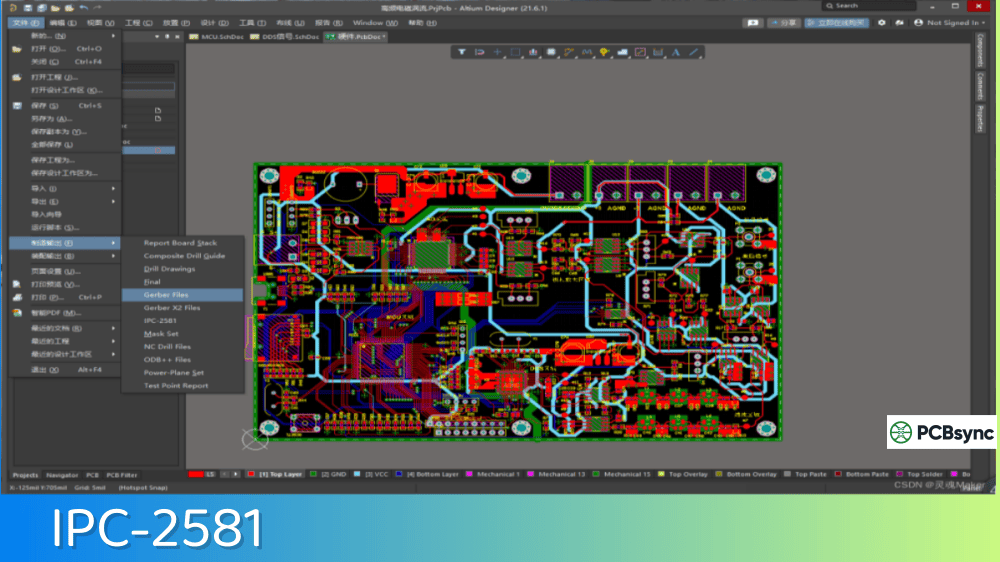
Layer Mapping: Ensure your CAD layers map correctly to IPC-2583 layer types. A “GND” plane layer should export as type PLANE, not SIGNAL.
Net Classes: If your design uses net classes for impedance control or routing rules, verify these export to LogicalNet properties.
Package References: Component footprints should link correctly to their package definitions. Missing links cause assembly data problems downstream.
Placement Status: Components marked DNP (Do Not Populate) should carry that status in the placement data, not just in the BOM.
Implementing IPC-2583 in Your Design Workflow
Moving to intelligent design data exchange requires process adjustments, but the benefits in reduced errors and faster NPI (New Product Introduction) are substantial.
Step 1: Audit Your CAD Library
Your component library is the foundation of good IPC-2583 data. Each component should have complete package definitions including accurate pin numbering and pickup points for SMT placement.
Library Element
Required for IPC-2583
Footprint geometry
Yes – exports to Package element
Pin numbering
Yes – required for netlist mapping
Component height
Yes – needed for assembly
Pickup point
Recommended – improves assembly accuracy
3D model
Optional – not part of IPC-2583
Step 2: Define Layer Stackup Explicitly
Don’t rely on default layer names. Configure your CAD tool with explicit layer types and physical stackup order. This metadata flows directly into IPC-2583 layer definitions.
Step 3: Use Net Classes Consistently
Net classes carry design intent for impedance control, routing rules, and manufacturing requirements. Define them in your CAD tool and they’ll export to IPC-2583 NetProperty elements.
Step 4: Validate Before Export
Most CAD tools offer design rule checks (DRC) that should pass before export. Additionally, verify that all components have valid package references and all nets have complete connectivity.
Step 5: Review the Exported File
Use an IPC-2581 viewer to inspect your exported file before sending to manufacturing. Verify that layer assignments, net names, and component placements appear correctly in the viewer.
Benefits of Proper IPC-2583 Implementation
Organizations that fully implement IPC-2583 design data exchange see improvements across multiple metrics.
Manufacturing Efficiency Gains
Metric
Typical Improvement
CAM setup time
30-50% reduction
Engineering queries
50-70% fewer questions
Netlist verification
90%+ automated
Layer interpretation errors
Near elimination
Design-to-Manufacturing Traceability
With IPC-2583, every feature in the manufacturing data traces back to its design origin. When a manufacturer questions a particular via or trace, the embedded netlist data identifies exactly which net it belongs to and where it connects. This traceability dramatically reduces the back-and-forth communication that slows production.
Tools and Resources for IPC-2583
Official Documentation
Resource
Source
Access
IPC-2583 Standard
shop.ipc.org
Free download
IPC-2581 Standard
shop.ipc.org
Purchase required
IPC-2581 XML Schema
IPC-2581 Consortium
Free download
Implementation Guide
ipc2581.com
Free access
Software Tools
Tool
Provider
IPC-2583 Capability
IPC-2581 Viewer
Cadence
View design elements
Valor NPI
Siemens
Full import/analysis
CAM350
DownStream
Design data import
VisualCAM
ICT
Design verification
Related Standards
Understanding IPC-2583 benefits from familiarity with related specifications:
What is the difference between IPC-2583 and IPC-2584?
IPC-2583 covers design characteristics—the intelligent data that describes what your design is and how it’s connected. This includes layer definitions, netlists, component packages, and placement data. IPC-2584 covers fabrication data—the physical manufacturing instructions including copper artwork, drill specifications, and board outline. Think of IPC-2583 as the “what and why” while IPC-2584 is the “how to make it.” Both are essential parts of a complete IPC-2581 file.
Does IPC-2583 replace IPC-D-356 netlist files?
Yes, IPC-2583 incorporates netlist functionality that traditionally required separate IPC-D-356 files. The LogicalNet elements in IPC-2583 carry complete connectivity information embedded within the manufacturing data package. This eliminates the need to correlate separate netlist files with artwork and ensures the netlist always matches the current design revision.
Can I use IPC-2583 without full IPC-2581 implementation?
No, IPC-2583 is a sectional standard that requires IPC-2581 as its foundation. The design characteristics defined by IPC-2583 exist within the Ecad element of an IPC-2581 file. You cannot generate a standalone IPC-2583 file; instead, you export IPC-2581 files that contain IPC-2583-compliant design data sections.
How do I verify my CAD tool exports correct IPC-2583 data?
Use an independent IPC-2581 viewer to inspect exported files. Check that layer types match your design intent (signal vs. plane), net names appear correctly, component placements show accurate coordinates and rotations, and package definitions include all required elements. Many viewers highlight missing or malformed data that your CAD tool’s export dialog might not catch.
Do contract manufacturers require IPC-2583 design data?
Requirements vary by manufacturer. Large EMS providers and those serving aerospace, automotive, and medical industries often have full IPC-2581 support including IPC-2583 design data. Smaller fabricators may accept IPC-2581 but not fully utilize the design characteristics sections. Always confirm your manufacturer’s capabilities and preferences before relying on embedded design data for critical information.
Moving Forward with Intelligent Design Data
The transition from dumb file formats to intelligent design data exchange represents a fundamental shift in how the electronics industry communicates. IPC-2583 is at the heart of this transformation, defining how your design intelligence—the layers, nets, packages, and placements that you’ve carefully crafted—travels from your CAD tool to the factory floor.
The standard isn’t perfect, and adoption isn’t universal. But for organizations tired of answering manufacturer questions about layer stackups, correlating netlists with artwork manually, or debugging assembly errors caused by disconnected data files, IPC-2583 offers a clear path forward.
Start by auditing your current export process. Examine an IPC-2581 file from your CAD tool and verify the design characteristics are complete and correct. Work with your manufacturing partners to ensure they can receive and utilize the intelligent data you’re sending. The investment in proper IPC-2583 implementation pays dividends in reduced errors, faster time-to-market, and better collaboration across your supply chain.
Your designs deserve to be understood, not just seen. IPC-2583 makes that understanding possible.
Inquire: Call 0086-755-23203480, or reach out via the form below/your sales contact to discuss our design, manufacturing, and assembly capabilities.
Quote: Email your PCB files to Sales@pcbsync.com (Preferred for large files) or submit online. We will contact you promptly. Please ensure your email is correct.
Notes: For PCB fabrication, we require PCB design file in Gerber RS-274X format (most preferred), *.PCB/DDB (Protel, inform your program version) format or *.BRD (Eagle) format. For PCB assembly, we require PCB design file in above mentioned format, drilling file and BOM. Click to download BOM template To avoid file missing, please include all files into one folder and compress it into .zip or .rar format.