Inquire: Call 0086-755-23203480, or reach out via the form below/your sales contact to discuss our design, manufacturing, and assembly capabilities.
Quote: Email your PCB files to Sales@pcbsync.com (Preferred for large files) or submit online. We will contact you promptly. Please ensure your email is correct.
Notes: For PCB fabrication, we require PCB design file in Gerber RS-274X format (most preferred), *.PCB/DDB (Protel, inform your program version) format or *.BRD (Eagle) format. For PCB assembly, we require PCB design file in above mentioned format, drilling file and BOM. Click to download BOM template To avoid file missing, please include all files into one folder and compress it into .zip or .rar format.
If you’ve been designing PCBs for any length of time, you know the drill: export a dozen Gerber files, generate separate drill files, create a pick-and-place file, add a README explaining your layer stackup, and hope your manufacturer interprets everything correctly. It’s a workflow that’s worked for decades, but it’s also a workflow that costs the industry millions in errors, delays, and miscommunication every year.
IPC-2581 represents a fundamental shift in how we transfer PCB design data to manufacturing. Instead of juggling multiple files in different formats, IPC-2581 packages everything—copper artwork, layer stackup, netlist, BOM, drill data, and assembly information—into a single XML-based file. For those of us tired of answering manufacturer questions about which drill file goes with which layer, this is a welcome change.
IPC-2581, officially known as IPC-DPMX (Digital Product Model Exchange), is an open, vendor-neutral standard for exchanging PCB fabrication and assembly data. First released by IPC in March 2004, it was developed to address the fundamental limitations of the Gerber format that had been the industry standard since the 1980s.
The standard defines an XML schema that captures complete PCB manufacturing data in a single file. Unlike Gerber, which is essentially an image format requiring separate files for each layer plus additional documentation, IPC-2581 is an intelligent data format that understands what a PCB actually is—layers, nets, components, and their relationships.
IPC-2581 Version History
Version
Release Date
Key Features
IPC-2581
March 2004
Original specification
IPC-2581A
May 2012
First major revision, improved schema
IPC-2581B
October 2013
Enhanced component and assembly data
IPC-2581C
December 2020
Bidirectional DFX data exchange, differential pair support
The latest revision, IPC-2581C, added capabilities that are essential for modern high-speed designs, including explicit support for differential pairs and impedance-controlled routing. It also introduced bidirectional communication, allowing manufacturers to send DFM feedback in the same format.
Why Gerber Isn’t Enough Anymore
To understand why IPC-2581 matters, you need to understand what’s wrong with the current approach. Gerber files have served the industry well, but they were designed in an era of simpler boards and slower manufacturing cycles.
Every one of these limitations creates opportunities for errors. I’ve seen production delayed because a manufacturer couldn’t figure out which drill file corresponded to which via span. I’ve seen boards built with wrong stackups because the fabrication note didn’t match the layer naming convention. These aren’t rare occurrences—they’re daily challenges in PCB manufacturing.
The Real Cost of File Proliferation
A typical 8-layer board with blind and buried vias might require:
That’s potentially 20+ files that must all be consistent with each other. With IPC-2581, it’s one file containing all the same information in a structured, validated format.
IPC-2581 vs Gerber vs ODB++: A Direct Comparison
The three major PCB data formats each have their place, but they serve very different purposes and have different characteristics.
ODB++ solved many of the same problems as IPC-2581 and actually predates it in the market. However, ODB++ is controlled by Siemens (through their acquisition of Mentor Graphics, which acquired Valor). While the format specification is published, full read/write capability often requires licensed software.
IPC-2581, by contrast, is a truly open standard maintained by IPC, an industry trade association. Any company can implement full support without licensing fees or restrictions. For organizations concerned about vendor lock-in or long-term data accessibility, this distinction matters significantly.
What Data Does IPC-2581 Contain?
The IPC-2581 format captures everything needed to fabricate and assemble a PCB. Here’s what’s included in a typical file:
Fabrication Data
Data Category
Specific Information
Copper Artwork
Traces, pads, planes, pour patterns for all layers
Layer Stackup
Material types, thicknesses, dielectric constants
Drill Data
Hole locations, sizes, plating requirements, via spans
One of IPC-2581’s most valuable features is its ability to capture design intent, not just manufacturing instructions. This includes:
Net names and connectivity: The manufacturer can verify that the physical layout matches the intended circuit
Differential pairs: Explicitly identified for impedance-controlled manufacturing
Component values: Electrical specifications embedded with placement data
Design rules: Minimum spacing, trace widths, and other constraints
This design intent data enables automated DFM analysis that’s simply not possible with Gerber files.
IPC-2581 XML Structure
For those who want to understand what’s actually in an IPC-2581 file, here’s a high-level overview of the XML structure:
Top-Level Elements
Element
Purpose
<Content>
Root container for all data
<Bom>
Bill of materials information
<Ecad>
Electronic CAD data (layout, connectivity)
<Avl>
Approved vendor list
<LogisticHeader>
Administrative and identification data
The <Ecad> section contains the bulk of the manufacturing data, organized into subsections for stackup, layers, steps (panelization), and components. Each layer’s artwork is described using a combination of standard primitives (lines, arcs, pads) and custom shapes.
The XML format means the file is human-readable (albeit verbose) and can be validated against the published schema. This validation capability catches many errors before data ever reaches the manufacturer.
CAD Software Support for IPC-2581
Most major EDA tools now support IPC-2581 export, though the depth of implementation varies.
EDA Tool Support Status
Software
IPC-2581 Export
Version Support
Notes
Altium Designer
Yes
Rev A, B
Native export, extension-based
Cadence OrCAD/Allegro
Yes
Rev A, B, C
Comprehensive implementation
Mentor PADS
Yes
Rev A, B
Part of Siemens ecosystem
Mentor Xpedition
Yes
Rev A, B, C
Full-featured export
Zuken CR-8000
Yes
Rev A, B
Enterprise-level support
KiCad
Limited
Rev A
Community development
Eagle
No
–
Legacy tool, limited updates
How to Export IPC-2581 from Major CAD Tools
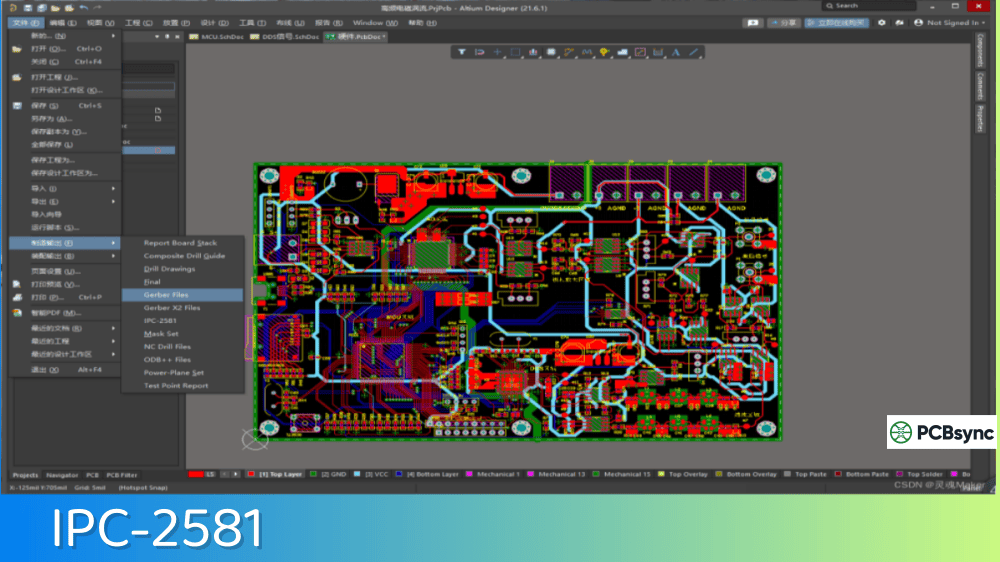
Altium Designer: With a PCB document open, go to File → Fabrication Outputs → IPC-2581. Configure the revision level and precision settings in the dialog.
OrCAD/Allegro: Use the “IPC-2581” option in the Manufacturing outputs menu. The Cadence implementation supports the latest Rev C features including differential pair definitions.
Mentor Xpedition: Export via Fabrication → Outputs → IPC-2581, with options to control what data categories are included.
Regardless of your CAD tool, always verify the exported file using an independent viewer before sending to manufacturing.
The advantages of moving to IPC-2581 extend throughout the manufacturing workflow. Based on industry case studies, organizations implementing IPC-2581 have reported significant improvements in multiple areas.
Quantifiable Improvements
Metric
Typical Improvement
Source
NPI cycle time
25-40% reduction
IPC-2581 Consortium
Engineering questions
50-70% fewer queries
OEM case studies
Data entry errors
80%+ reduction
Automated import vs manual
Quote turnaround
30% faster
Streamlined data processing
For Design Engineers
Single export process: One file instead of managing multiple outputs
Reduced documentation: Stackup, notes, and specs embedded in data
Validation: Schema validation catches errors before submission
Version control: Easier to manage single file in revision systems
For Manufacturers
Faster NPI: Automated data import reduces setup time
Fewer questions: Complete data eliminates clarification requests
Large OEMs with complex boards and high volumes have been the primary drivers, as they see the greatest benefit from reduced NPI cycles and error rates.
Tools and Resources for IPC-2581
Free Viewers and Validators
Tool
Provider
Features
IPC-2581 Viewer
Cadence
Free viewer for Windows
Valor NPI
Siemens
Commercial tool with IPC-2581 import
Ucamco Reference Viewer
Ucamco
Comparison with Gerber
Download free viewers from the IPC-2581 Consortium website: www.ipc2581.com
Official Documentation
Resource
Source
Description
IPC-2581C Standard
shop.ipc.org
Official specification document
IPC-2581 Schema
IPC
XML schema definition files
Implementation Guide
IPC-2581 Consortium
Best practices for implementation
Related Standards
IPC-2571: Generic PDX requirements (supply chain data exchange)
If you’re ready to evaluate IPC-2581 for your organization, here’s a practical approach:
Step 1: Verify CAD Support — Confirm your EDA tool can export IPC-2581 and understand any limitations in the implementation.
Step 2: Talk to Your Manufacturer — Ask your fab and assembly partners if they can accept IPC-2581. Many can, but some may prefer to receive Gerber alongside for validation.
Step 3: Start with a Pilot — Choose a moderately complex board for your first IPC-2581 submission. Avoid your most challenging design until you’ve worked through any process issues.
Step 4: Compare Outputs — Export both IPC-2581 and traditional Gerber files, then use a viewer to verify the IPC-2581 file contains complete and correct data.
Step 5: Iterate — Work with your manufacturer to resolve any import issues and refine your export settings.
Frequently Asked Questions About IPC-2581
What is the file extension for IPC-2581 files?
IPC-2581 files typically use the .cvg extension, though you may also see .xml used. The format is XML-based, so the actual file is a text file that can be opened in any text editor, though specialized viewers provide much better visualization of the data.
Can IPC-2581 completely replace Gerber files?
Yes, IPC-2581 contains all the information present in Gerber files plus additional data that Gerber cannot represent. However, during the transition period, many designers send both formats—IPC-2581 as the primary data and Gerber as a backup for manufacturers whose CAM systems don’t yet support the newer format.
Is IPC-2581 better than ODB++?
Both formats solve similar problems and contain comparable data. The key differences are ownership (IPC-2581 is an open IPC standard; ODB++ is controlled by Siemens) and market adoption (ODB++ has broader current support; IPC-2581 is growing). For organizations prioritizing open standards and long-term data accessibility, IPC-2581 is the better choice.
Which CAD tools support IPC-2581 export?
Most major EDA tools support IPC-2581 export, including Altium Designer, Cadence OrCAD/Allegro, Mentor PADS and Xpedition, and Zuken CR-8000. Support in open-source tools like KiCad is developing but not yet comprehensive. Check your specific tool’s documentation for implementation details.
Do PCB manufacturers accept IPC-2581?
Acceptance is growing but not universal. Large manufacturers and those serving aerospace, defense, and automotive typically support IPC-2581. Smaller or regional fabricators may still prefer Gerber. Always confirm with your specific manufacturer before submitting IPC-2581 as your only data format.
The Future of PCB Data Exchange
The PCB industry is moving toward smarter, more integrated data formats. IPC-2581 represents the current state of that evolution, but development continues. The IPC-2581 Consortium is actively working on enhancements for Industry 4.0 integration, cloud-based collaboration, and AI-driven DFM analysis.
Looking ahead, several trends will shape PCB data exchange:
Digital Thread Integration: IPC-2581 is becoming part of broader digital manufacturing initiatives, connecting design data to MES systems, quality management, and supply chain platforms.
Automated DFM: With intelligent data formats, manufacturers can run comprehensive DFM analysis automatically, providing feedback to designers in minutes rather than days.
Bidirectional Communication: IPC-2581C’s support for DFX feedback enables true collaboration between design and manufacturing, closing the loop on manufacturability issues.
For PCB designers, the message is clear: the days of managing dozens of separate manufacturing files are numbered. Whether IPC-2581 achieves universal adoption or is eventually superseded by something even better, the direction is toward single-file, intelligent data exchange that eliminates the errors and inefficiencies of the Gerber era.
If you haven’t yet evaluated IPC-2581 for your designs, now is the time to start. The tooling is mature, manufacturer support is growing, and the benefits in reduced errors and faster time-to-market are real. Your next board might be the one where you finally stop counting Gerber files.
Inquire: Call 0086-755-23203480, or reach out via the form below/your sales contact to discuss our design, manufacturing, and assembly capabilities.
Quote: Email your PCB files to Sales@pcbsync.com (Preferred for large files) or submit online. We will contact you promptly. Please ensure your email is correct.
Notes: For PCB fabrication, we require PCB design file in Gerber RS-274X format (most preferred), *.PCB/DDB (Protel, inform your program version) format or *.BRD (Eagle) format. For PCB assembly, we require PCB design file in above mentioned format, drilling file and BOM. Click to download BOM template To avoid file missing, please include all files into one folder and compress it into .zip or .rar format.