Inquire: Call 0086-755-23203480, or reach out via the form below/your sales contact to discuss our design, manufacturing, and assembly capabilities.
Quote: Email your PCB files to Sales@pcbsync.com (Preferred for large files) or submit online. We will contact you promptly. Please ensure your email is correct.
Notes: For PCB fabrication, we require PCB design file in Gerber RS-274X format (most preferred), *.PCB/DDB (Protel, inform your program version) format or *.BRD (Eagle) format. For PCB assembly, we require PCB design file in above mentioned format, drilling file and BOM. Click to download BOM template To avoid file missing, please include all files into one folder and compress it into .zip or .rar format.
IPC-2223 Explained: Flex & Rigid-Flex PCB Design Standard
Flex circuits aren’t just thin rigid boards that happen to bend. The moment you start designing flexible or rigid-flex PCBs, you enter a world where bend radius calculations, material selection, and conductor routing rules completely change. Ignore these differences, and you’ll end up with cracked traces, delaminated layers, and field failures that could have been prevented.
IPC-2223 is the sectional design standard that addresses these unique challenges. Officially titled “Sectional Design Standard for Flexible/Rigid-Flexible Printed Boards,” this document provides the specific requirements for designing circuits that bend—whether once during installation or millions of times during operation. If you’re working on wearables, medical devices, aerospace systems, or any application requiring flexible interconnects, IPC-2223 is essential reading.
IPC-2223 establishes the design requirements for flexible printed boards and rigid-flex combinations. It covers everything from material selection to bend radius calculations, conductor routing in flex areas, coverlay design, stiffener requirements, and the critical transition zones where rigid meets flex.
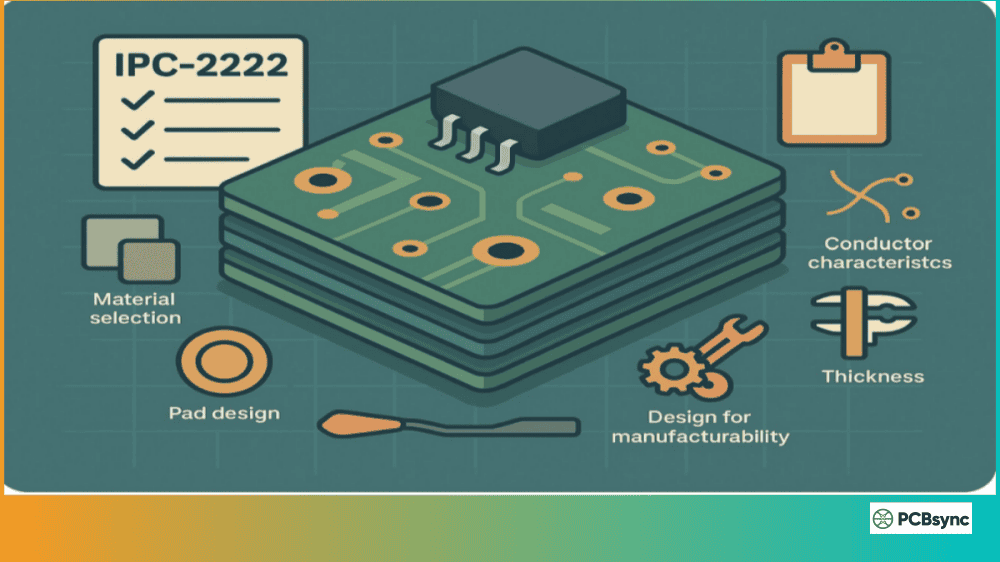
Like other sectional standards in the IPC-2220 family, IPC-2223 works in conjunction with IPC-2221 (the generic design standard). For rigid-flex designs, you’ll also reference IPC-2222 for the rigid portions of your board.
Hole spacing, bend area conductors, ZIF connectors
The current version, IPC-2223E, reflects modern flex circuit manufacturing capabilities and addresses design challenges in high-density rigid-flex applications.
IPC-2223 Standard Overview
Attribute
Details
Full Title
Sectional Design Standard for Flexible/Rigid-Flexible Printed Boards
Designing flex and rigid-flex boards requires juggling multiple IPC standards. Understanding which standard applies where prevents confusion and ensures complete coverage of design requirements.
Standards Relationship for Rigid-Flex Design
Board Section
Primary Standard
Secondary Standard
Generic requirements
IPC-2221
—
Flexible sections
IPC-2223
IPC-2221
Rigid sections
IPC-2222
IPC-2221
Transition zones
IPC-2223
—
Qualification testing
IPC-6013
—
For a rigid-flex board, you need all three design standards: IPC-2221 for generic requirements, IPC-2222 for rigid section specifics, and IPC-2223 for flexible sections and transition zones.
IPC-2223 Flex Board Classifications
IPC-2223 classifies flexible boards by layer count and construction method. The classification determines applicable design rules and manufacturing processes.
Flex Board Types per IPC-2223
Type
Description
Construction
Typical Application
Type 1
Single-sided flex
1 conductive layer, adhesive or adhesiveless
Simple interconnects, membrane switches
Type 2
Double-sided, no PTH
2 layers, surface mount only
Cost-sensitive dual-layer designs
Type 3
Double-sided with PTH
2 layers, plated-through holes
General flex applications
Type 4
Multilayer flex
3+ conductive layers
Complex flex circuits, HDI flex
Rigid-Flex Configurations
Configuration
Description
Application
Single-sided rigid-flex
Type 1 flex + rigid sections
Simple fold-to-install
Double-sided rigid-flex
Type 3 flex + rigid sections
Most common rigid-flex
Multilayer rigid-flex
Type 4 flex + multilayer rigid
Complex military, aerospace
Bookbinder construction
Unbonded flex layers
Tight bend radius requirements
The bookbinder construction—where flex layers remain unbonded in bend areas—allows multilayer flex to achieve bend radii that would otherwise cause layer separation.
Bend Radius Requirements in IPC-2223
Bend radius is the most critical design parameter for flexible circuits. Get it wrong, and copper traces crack, coverlays delaminate, and circuits fail. IPC-2223 defines minimum bend radii based on application type and layer count.
Static vs Dynamic Flex Applications
Application Type
Definition
Bend Cycles
Example
Static (Use A)
Bend-to-install
<100 lifetime
Laptop display cable folded during assembly
Dynamic (Use B)
Repeated bending
100 to millions
Printer head cable, phone hinge
The distinction matters enormously—dynamic applications require bend radii 10-20 times larger than static applications.
IPC-2223 Minimum Bend Radius Ratios
Layer Count
Static (r:h)
Dynamic (r:h)
Single layer
6:1
100:1
Double layer
12:1
150:1
Multilayer
24:1
200:1
Where r = minimum bend radius and h = total thickness of flexible portion.
Bend Radius Calculation Example
For a double-layer dynamic flex circuit with total flex thickness of 0.15mm:
Minimum bend radius = ratio × thicknessMinimum bend radius = 150 × 0.15mm = 22.5mm
For the same construction in a static application: Minimum bend radius = 12 × 0.15mm = 1.8mm
This twelve-fold difference explains why understanding your application type is critical before starting the design.
Bend Radius Best Practices
Practice
Recommendation
Measurement point
Always measure from inside surface of bend
Safety margin
Add 20-30% to calculated minimum
Prototype testing
Validate bend cycles on actual samples
Temperature effects
Materials stiffen at cold temperatures
Material Selection per IPC-2223
Flexible circuit materials differ fundamentally from rigid board materials. IPC-2223 provides guidance on selecting appropriate dielectrics, adhesives, and copper types.
Flexible Dielectric Materials
Material
Dk @ 1MHz
Tg/Max Temp
Characteristics
Polyimide (Kapton)
3.2-3.5
260°C+
Industry standard, excellent flexibility
Polyester (PET)
3.0-3.2
105°C
Lower cost, limited temperature range
LCP
2.9-3.0
280°C+
Low moisture absorption, RF applications
PTFE-based
2.1-2.3
260°C+
Lowest loss, high-frequency designs
Polyimide dominates the flex market due to its balance of flexibility, thermal stability, and cost.
Adhesive vs Adhesiveless Construction
Construction
Advantages
Disadvantages
Adhesive (3-layer)
Lower cost, easier processing
Thicker, adhesive can crack at bends
Adhesiveless (2-layer)
Thinner, better bend performance
Higher cost, limited suppliers
For dynamic flex applications, adhesiveless construction typically provides better reliability because there’s no adhesive layer to crack during repeated bending.
Copper Type Selection
Copper Type
Description
Application
Electrodeposited (ED)
Standard PCB copper
Static flex only
Rolled Annealed (RA)
Wrought copper, grain structure
Dynamic flex—required for repeated bending
This is non-negotiable for dynamic applications: specify RA copper. ED copper will crack under repeated flexing due to its grain structure.
Conductor Routing in Bend Areas
How you route traces through bend zones dramatically affects flex circuit reliability. IPC-2223 provides specific guidance for conductor design in areas that will flex.
Bend Area Routing Rules
Rule
Requirement
Reason
Trace orientation
Perpendicular to bend axis
Minimizes stress on conductors
Trace staggering
Offset traces on opposite layers
Prevents “I-beam” stiffening effect
Via placement
No vias in bend areas
Vias create stress concentration points
Plane design
Crosshatch pattern, not solid
Maintains flexibility
Corner angles
No 90° angles—use curves
Sharp corners concentrate stress
Conductor Width Guidelines for Flex
Location
Recommendation
Bend areas
Maximize width within spacing constraints
Pad transitions
Use teardrop transitions
Small traces (<10 mil)
Place on inside of neutral axis
Wide traces
Consider splitting into multiple narrow traces
Traces on the outside of a bend experience tension; traces on the inside experience compression. Narrow traces tolerate compression better than tension, which is why IPC-2223 recommends placing small traces on the inside of the bend.
Coverlay Design Requirements
Coverlay (cover layer) protects flex circuit conductors and provides the flexible equivalent of solder mask. IPC-2223 addresses coverlay material selection and access hole design.
Coverlay Material Options
Material
Typical Thickness
Characteristics
Polyimide + adhesive
0.025-0.050mm
Standard, good chemical resistance
Flexible solder mask
0.025mm
Lower cost, screen printed
Photoimageable coverlay
Variable
Fine-pitch access holes
Access Hole Requirements
Feature
Requirement
Minimum access hole
Pad + 0.2mm minimum per side
Hole-to-trace clearance
Maintain per conductor spacing rules
Relief holes at corners
Radius >0.75mm to prevent tearing
Coverlay adhesion
Minimum 2mm overlap on conductors
Coverlay access holes expose pads for soldering while protecting surrounding conductors. Undersized access holes cause soldering defects; oversized holes expose conductors to damage.
The transition zone—where rigid meets flex—is the highest-stress area in a rigid-flex board and the most common failure location. IPC-2223 dedicates significant attention to transition zone design.
Transition Zone Requirements
Requirement
Specification
Conductor routing
Perpendicular to flex direction at transition
Via exclusion zone
Minimum 1.25-1.5mm from transition edge
Layer staggering
Stagger flex layer terminations
Adhesive thickness
<10% of total rigid construction
Bend point distance
Keep away from transition by 10× flex thickness
Strain Relief Methods
Method
Description
Application
Strain relief fillet
Adhesive fillet at transition
Standard rigid-flex
Graduated thickness
Taper from rigid to flex
High-reliability applications
Unbonded flex (bookbinder)
Flex layers not bonded in bend zone
Tight radius multilayer flex
The bookbinder technique—leaving flex layers unbonded—allows each layer to slide independently during bending, dramatically reducing stress compared to bonded construction.
Stiffener Requirements
Stiffeners provide mechanical support for components mounted on flex circuits and protect flex areas from damage during assembly.
Stiffener Material Options
Material
Thickness Range
Application
FR-4
0.2-1.6mm
Standard stiffening, SMT support
Polyimide
0.075-0.25mm
Thin stiffening, ZIF contacts
Aluminum
0.25-1.0mm
Heat dissipation, EMI shielding
Stainless steel
0.1-0.5mm
Maximum rigidity, durability
Stiffener Design Guidelines
Guideline
Requirement
Edge clearance
Minimum 0.5mm from flex features
Component support
Extend beyond component footprint
Attachment method
PSA, heat-activated adhesive, or bonded
Transition to flex
Minimum 2mm from bend start point
Common IPC-2223 Design Violations
Understanding common mistakes helps you avoid them. These violations cause the majority of flex and rigid-flex failures.
Frequent Design Errors
Violation
Problem
Solution
Insufficient bend radius
Trace cracking, delamination
Calculate properly, add margin
ED copper for dynamic flex
Copper fatigue failure
Specify RA copper
Vias in bend zones
Barrel cracking
Move vias to stiffened areas
Aligned traces (I-beam)
Stress concentration
Stagger traces between layers
Sharp corners in bend areas
Stress risers
Use curved routing
Components near bends
Solder joint failure
Add stiffeners or relocate
Tools and Resources for IPC-2223
Official Documentation
Resource
Source
Notes
IPC-2223E Standard
shop.ipc.org
Current version (~$120)
IPC-2221C Standard
shop.ipc.org
Required generic companion
IPC-6013
shop.ipc.org
Flex/rigid-flex qualification
IPC-4202/4203/4204
shop.ipc.org
Flex material specifications
Related IPC Standards
Standard
Relationship to IPC-2223
IPC-2221
Generic design (required companion)
IPC-2222
Rigid sections of rigid-flex
IPC-6013
Qualification and performance
IPC-A-600
Acceptability of printed boards
IPC-SM-840
Coverlay materials
Frequently Asked Questions About IPC-2223
What’s the difference between static and dynamic flex?
Static flex (Use A per IPC-2223) bends fewer than 100 times in its lifetime—typically just during installation. Dynamic flex (Use B) bends repeatedly during operation, from hundreds to millions of cycles. The distinction dramatically affects design requirements: dynamic applications need bend radii 10-20 times larger and require rolled annealed copper instead of electrodeposited copper.
Can I place vias in the bend area of a flex circuit?
No—IPC-2223 strongly recommends excluding vias from bend areas. The plated barrel creates a stress concentration point that cracks under repeated bending. If vias must be near bend zones, use teardrop pads and additional plating, but relocating vias to stiffened areas or rigid sections is the preferred solution.
How do I calculate the minimum bend radius for my flex design?
Determine your application type (static or dynamic) and layer count, then find the corresponding ratio in IPC-2223. Multiply the ratio by your total flex thickness. For a double-layer dynamic flex at 0.2mm thickness: 150 × 0.2mm = 30mm minimum bend radius. Add 20-30% margin for manufacturing variation and always measure from the inside surface of the bend.
Do I need all three standards (IPC-2221, 2222, 2223) for rigid-flex?
Yes. IPC-2221 provides generic requirements applicable to all boards. IPC-2222 covers the rigid sections of your rigid-flex. IPC-2223 covers the flexible sections and the critical transition zones where rigid meets flex. Using all three ensures complete coverage with no gaps in your design specification.
What copper type should I specify for flex circuits?
For static flex applications, electrodeposited (ED) copper can work but rolled annealed (RA) is safer. For dynamic flex applications, always specify rolled annealed copper—it’s non-negotiable. RA copper’s grain structure handles repeated bending far better than ED copper, which will crack under dynamic flexing.
Designing Flex Circuits That Last
IPC-2223 distills decades of flex circuit experience into actionable design requirements. The standard exists because flexible circuits fail in predictable ways—ways that proper design prevents.
Start every flex design by classifying your application: static or dynamic. Calculate your minimum bend radius with appropriate margin. Select materials that match your thermal and flexibility requirements—RA copper for dynamic applications, adhesiveless construction for demanding bends. Route conductors perpendicular to bend axes with no vias in flex zones. Design transition zones with proper strain relief and layer staggering.
The combination of IPC-2221 for generic requirements, IPC-2222 for rigid sections, and IPC-2223 for flex sections gives you a complete framework for designing reliable flex and rigid-flex circuits. Follow these standards, and your flex circuits will survive the bending they’re designed for.
Inquire: Call 0086-755-23203480, or reach out via the form below/your sales contact to discuss our design, manufacturing, and assembly capabilities.
Quote: Email your PCB files to Sales@pcbsync.com (Preferred for large files) or submit online. We will contact you promptly. Please ensure your email is correct.
Notes: For PCB fabrication, we require PCB design file in Gerber RS-274X format (most preferred), *.PCB/DDB (Protel, inform your program version) format or *.BRD (Eagle) format. For PCB assembly, we require PCB design file in above mentioned format, drilling file and BOM. Click to download BOM template To avoid file missing, please include all files into one folder and compress it into .zip or .rar format.