Inquire: Call 0086-755-23203480, or reach out via the form below/your sales contact to discuss our design, manufacturing, and assembly capabilities.
Quote: Email your PCB files to Sales@pcbsync.com (Preferred for large files) or submit online. We will contact you promptly. Please ensure your email is correct.
Notes: For PCB fabrication, we require PCB design file in Gerber RS-274X format (most preferred), *.PCB/DDB (Protel, inform your program version) format or *.BRD (Eagle) format. For PCB assembly, we require PCB design file in above mentioned format, drilling file and BOM. Click to download BOM template To avoid file missing, please include all files into one folder and compress it into .zip or .rar format.
IPC-2222 Explained: Design Standard for Rigid Organic PCBs
You’ve got your IPC-2221 down cold—conductor spacing, clearance requirements, material basics. But when it comes to actually designing a rigid multilayer board, you’re finding that the generic standard only gets you so far. Where are the specific rules for PTH aspect ratios? What about scoring depths for panelization? How do you specify laminate requirements for lead-free assembly?
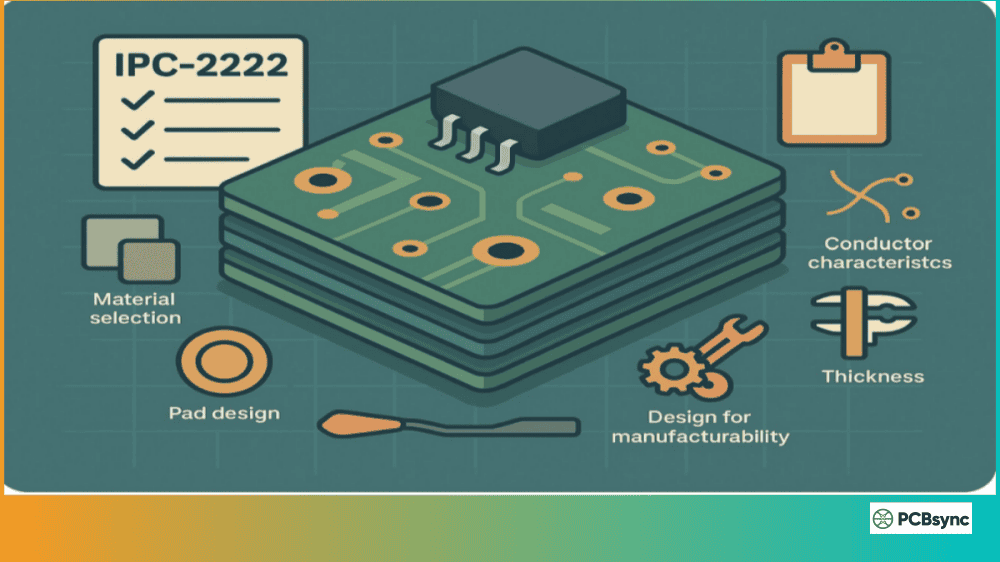
That’s where IPC-2222 comes in. This sectional design standard picks up where IPC-2221 leaves off, providing the rigid board-specific requirements that turn generic design principles into manufacturable products. If you’re designing anything from a simple two-layer board to a complex multilayer stackup on FR-4 or similar rigid materials, IPC-2222 is your companion document.
IPC-2222 is the sectional design standard for rigid organic printed boards, officially titled “Sectional Design Standard for Rigid Organic Printed Boards.” It establishes specific requirements for designing single-sided, double-sided, and multilayer rigid PCBs using organic laminate materials.
The key word here is “sectional”—IPC-2222 doesn’t replace IPC-2221, it supplements it. You need both documents working together: IPC-2221 for generic requirements (conductor spacing, clearance, creepage) and IPC-2222 for rigid board-specific rules (laminate properties, hole requirements, mechanical tolerances).
The current version, IPC-2222B, reflects modern manufacturing capabilities including advanced via structures, tighter tolerances, and materials compatible with lead-free assembly processes.
IPC-2222 Standard Overview
Attribute
Details
Full Title
Sectional Design Standard for Rigid Organic Printed Boards
Understanding the relationship between these two standards is critical. They’re designed as a layered system where IPC-2221 provides the foundation and IPC-2222 adds rigid board-specific details.
IPC-2221 vs IPC-2222: What Each Standard Covers
Topic
IPC-2221 (Generic)
IPC-2222 (Rigid Sectional)
Conductor spacing
✓ Complete tables
References IPC-2221
Clearance/creepage
✓ Detailed requirements
References IPC-2221
Material selection
General guidance
✓ Rigid laminate specifics
Board types
Basic definitions
✓ Type 1-6 classifications
Hole requirements
General principles
✓ Specific aspect ratios
Thickness tolerances
General guidance
✓ Rigid board specifics
Scoring/routing
Not covered
✓ Detailed requirements
Panelization
General concepts
✓ Rigid board rules
When a requirement exists in IPC-2221, IPC-2222 typically references it rather than repeating it. When IPC-2222 provides a requirement, it takes precedence for rigid board designs.
When to Use IPC-2222 vs Other Sectional Standards
Board Type
Primary Sectional Standard
Standard rigid FR-4
IPC-2222
Flexible circuits
IPC-2223
Rigid-flex
IPC-2223 (with IPC-2222 for rigid sections)
HDI with microvias
IPC-2226
RF/Microwave
IPC-2228
Embedded passives
IPC-2227
If your board is rigid and doesn’t fall into a specialized category (HDI, RF, embedded components), IPC-2222 is your sectional standard.
IPC-2222 Board Type Classifications
IPC-2222 defines six distinct board types based on layer count and via complexity. This classification system helps designers select appropriate design rules and helps manufacturers understand fabrication requirements.
Type 1 Through Type 6 Definitions
Type
Description
Via Structure
Typical Application
Type 1
Single-sided
None
Simple LED boards, basic circuits
Type 2
Double-sided, no PTH
None (SMT both sides)
Low-cost consumer products
Type 3
Double-sided with PTH
Through-hole only
General purpose electronics
Type 4
Multilayer, no blind/buried
Through-hole only
Standard multilayer designs
Type 5
Multilayer with blind/buried vias
Blind, buried, through
Complex routing requirements
Type 6
Multilayer with controlled impedance
Any via type
High-speed digital, RF
Selecting the Right Board Type
Design Requirement
Recommended Type
Minimum cost, simple circuits
Type 1 or 2
Standard digital design, moderate complexity
Type 3 or 4
High-density BGA routing
Type 5
Controlled impedance for DDR/SerDes
Type 6
Mixed signal with isolation requirements
Type 4 or 5
The type classification affects not only design rules but also cost and lead time. Type 5 and 6 boards require sequential lamination processes and more complex fabrication, increasing both price and manufacturing time.
Material Selection per IPC-2222
IPC-2222 provides specific guidance on selecting rigid laminate materials based on electrical, thermal, and mechanical requirements. Material selection directly impacts reliability, especially for lead-free assembly processes.
IPC-2222 emphasizes that material selection must consider the entire product lifecycle—not just the operating environment, but assembly processes including reflow temperatures. For lead-free assembly (peak temps around 260°C), high-Tg materials are essentially mandatory.
Lead-Free Material Requirements
Parameter
Lead-Free Requirement
Standard (Leaded)
Minimum Tg
170°C recommended
130°C acceptable
Minimum Td
325°C+
300°C
Z-axis CTE (below Tg)
<60 ppm/°C
<70 ppm/°C
Moisture sensitivity
More critical
Less critical
Mechanical Requirements in IPC-2222
IPC-2222 establishes dimensional and mechanical requirements specific to rigid boards, including thickness tolerances, board dimensions, and fabrication allowances.
Board Thickness Tolerance
Nominal Thickness
Tolerance (Class 2)
Tolerance (Class 3)
≤0.78 mm (0.031″)
±0.13 mm
±0.10 mm
0.79-1.55 mm
±0.15 mm
±0.13 mm
1.56-2.36 mm
±0.18 mm
±0.15 mm
>2.36 mm
±10%
±8%
Thickness tolerance affects impedance control—thicker or thinner dielectric changes the characteristic impedance of your traces. For controlled impedance designs, tighter tolerances or impedance testing may be necessary.
Bow and Twist Requirements
Board Thickness
Maximum Bow/Twist
All thicknesses
0.75% (surface mount)
All thicknesses
1.5% (through-hole only)
Surface mount assemblies require flatter boards because excessive bow or twist can cause solder joint defects during reflow. IPC-2222 specifies tighter requirements for SMT applications.
Higher aspect ratios make plating more difficult. The plating solution struggles to reach the center of deep, narrow holes, potentially creating thin spots or voids that cause reliability issues.
The annular ring is the copper remaining around a hole after drilling. Insufficient annular ring can cause lifted pads or unreliable connections—IPC-2222 specifies minimums based on product class.
Dielectric Spacing Requirements
IPC-2222 provides requirements for dielectric spacing between conductive layers, which affects both electrical performance and manufacturability.
Minimum Dielectric Thickness
Application
Minimum Dielectric
Notes
Standard designs
0.075 mm (3 mil)
Between adjacent signal layers
Impedance controlled
Per calculation
May require specific thickness
High voltage
Per IPC-2221 Table 6-1
Voltage-dependent
Thinner dielectrics enable tighter coupling for impedance control but increase manufacturing difficulty and cost. IPC-2222 balances electrical requirements against practical fabrication constraints.
Clearance Areas in Planes
Feature
Clearance Requirement
PTH to plane
Minimum 0.25 mm (10 mil) typical
Via to plane
Minimum 0.20 mm (8 mil) typical
Thermal relief spoke
Minimum 0.20 mm width
Plane clearances prevent shorts during drilling and provide manufacturing margin for registration tolerances.
Scoring and Routing Guidelines
For panelized boards, IPC-2222 provides specific requirements for scoring (V-groove) and routing (tab-route) separation methods.
V-Score Requirements
Parameter
Requirement
Score depth
1/3 board thickness per side typical
Remaining web
0.25-0.50 mm (varies with thickness)
Score-to-feature clearance
Minimum 0.50 mm
Board edge after break
May have rough edge
V-scoring is cost-effective for straight edges but creates stress during depanelization that can damage nearby components or traces.
Tab Routing Requirements
Parameter
Requirement
Tab width
2.0-3.0 mm typical
Tab quantity
Minimum 3 per board edge
Mouse bites (perforations)
0.5-1.0 mm holes, 0.5 mm spacing
Clearance from components
Minimum 2.0 mm from tab
Tab routing with mouse bites provides cleaner edges and less mechanical stress but costs more than V-scoring.
Assembly Design Considerations
IPC-2222 includes DFM (Design for Manufacturability) guidance specific to rigid board assembly.
Fiducials enable accurate machine vision alignment during automated assembly. IPC-2222 specifies requirements that ensure reliable pick-and-place operation.
Tools and Resources for IPC-2222
Official Documentation
Resource
Source
Notes
IPC-2222B Standard
shop.ipc.org
Current version (~$100)
IPC-2221C Standard
shop.ipc.org
Required companion document
IPC-4101
shop.ipc.org
Base material specifications
IPC-6012
shop.ipc.org
Rigid board qualification
Related IPC Standards
Standard
Relationship to IPC-2222
IPC-2221
Generic design (required companion)
IPC-4101
Laminate material specifications
IPC-6012
Qualification and performance spec
IPC-A-600
Acceptability of printed boards
IPC-2152
Current carrying capacity
Design Software Integration
Tool
IPC-2222 Support
Altium Designer
Design rules can implement requirements
Cadence Allegro
Constraint-driven design
KiCad
Manual DRC rule setup
OrCAD
Design rule checking
Most PCB design software doesn’t directly import IPC-2222 requirements—you need to translate the standard’s requirements into your tool’s design rule format.
Frequently Asked Questions About IPC-2222
Do I need both IPC-2221 and IPC-2222 for rigid board design?
Yes. IPC-2222 is a sectional standard that supplements—not replaces—IPC-2221. You need IPC-2221 for generic requirements like conductor spacing, clearance, and creepage, plus IPC-2222 for rigid board-specific requirements like hole aspect ratios, laminate properties, and mechanical tolerances. Using IPC-2222 alone will leave gaps in your design specification.
What’s the difference between IPC-2222 board Types 4, 5, and 6?
All three are multilayer boards, but they differ in via complexity and design requirements. Type 4 uses only through-hole vias—the simplest multilayer construction. Type 5 adds blind and buried vias for higher routing density. Type 6 includes controlled impedance requirements for high-speed designs. Each successive type adds complexity, cost, and manufacturing lead time.
Which laminate Tg should I specify for lead-free assembly?
For lead-free assembly with peak reflow temperatures around 260°C, specify high-Tg laminate with Tg ≥170°C. Standard FR-4 (Tg 130-140°C) may survive lead-free reflow but offers minimal margin and increased risk of delamination or barrel cracking. Mid-Tg materials (150-160°C) are borderline. High-Tg provides the reliability margin most applications need.
How does IPC-2222 relate to IPC-6012 for board qualification?
IPC-2222 covers design requirements—what you specify in your documentation. IPC-6012 covers qualification and performance—how the fabricated board is tested and accepted. They work together: design per IPC-2222, qualify and accept per IPC-6012. Your fabrication drawing should reference both standards along with the applicable product class.
Can I use IPC-2222 for HDI boards with microvias?
IPC-2222 covers standard rigid boards including those with blind and buried vias (Type 5). However, for true HDI designs with microvias, sequential lamination complexity, and via-in-pad structures, IPC-2226 is the appropriate sectional standard. If your design uses laser-drilled microvias or stacked/staggered microvia structures, reference IPC-2226 instead of or in addition to IPC-2222.
Designing Rigid Boards with Confidence
IPC-2222 fills the gap between generic design principles and manufacturable rigid boards. It answers the specific questions that come up during rigid PCB design—questions that IPC-2221 alone can’t address.
Start your designs by selecting the appropriate board type (1-6) based on your complexity requirements. Choose materials that meet your thermal and electrical needs, paying particular attention to Tg for lead-free compatibility. Apply the hole and via requirements to ensure reliable interconnections. Use the mechanical tolerances to set appropriate expectations with your fabricator.
The standard has evolved through multiple revisions to keep pace with manufacturing technology and assembly processes. IPC-2222B reflects current capabilities for high-density designs, lead-free assembly, and complex via structures. Combined with IPC-2221 for generic requirements, it provides a complete specification framework for rigid organic printed boards.
Remember that IPC-2222 represents minimum requirements and industry consensus—your specific application may demand tighter tolerances or additional requirements. Use the standard as your foundation, then add application-specific requirements as needed to ensure your design meets its performance goals.
Inquire: Call 0086-755-23203480, or reach out via the form below/your sales contact to discuss our design, manufacturing, and assembly capabilities.
Quote: Email your PCB files to Sales@pcbsync.com (Preferred for large files) or submit online. We will contact you promptly. Please ensure your email is correct.
Notes: For PCB fabrication, we require PCB design file in Gerber RS-274X format (most preferred), *.PCB/DDB (Protel, inform your program version) format or *.BRD (Eagle) format. For PCB assembly, we require PCB design file in above mentioned format, drilling file and BOM. Click to download BOM template To avoid file missing, please include all files into one folder and compress it into .zip or .rar format.