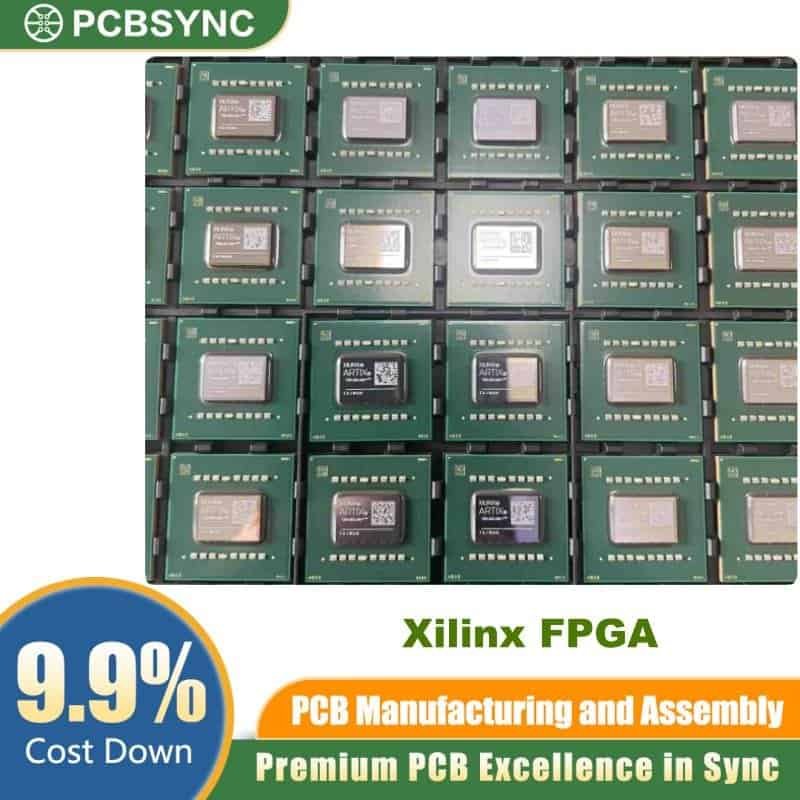
Overview of the XCS30-3PG208C Field Programmable Gate Array
The XCS30-3PG208C is a versatile field-programmable gate array (FPGA) from the renowned Xilinx Spartan family, designed to deliver exceptional performance for high-volume production applications. This FPGA chip represents an ideal ASIC replacement solution, offering 30,000 system gates with advanced configuration capabilities and cost-effective implementation for industrial and embedded systems.
Manufactured by AMD (formerly Xilinx), the XCS30-3PG208C combines reliability with flexibility, making it perfect for applications requiring reconfigurable logic, rapid prototyping, and production-ready designs. The device features a 208-pin plastic quad flat pack (PQFP) package, providing excellent I/O density while maintaining ease of PCB integration.
Key Technical Specifications
Core Performance Features
| Specification |
Value |
| Logic Cells |
1,368 |
| System Gates |
30,000 maximum |
| Typical Gate Range |
10,000 – 30,000 |
| CLB Matrix |
24 x 24 |
| Total CLBs |
576 Configurable Logic Blocks |
| Flip-Flops |
1,536 |
| Speed Grade |
-3 (125 MHz typical) |
| Distributed RAM Bits |
18,432 |
Package and Physical Characteristics
| Parameter |
Specification |
| Package Type |
PG208C – Plastic Quad Flat Pack |
| Pin Count |
208 pins |
| I/O Pins |
Up to 192 user I/O |
| Mounting Type |
Surface Mount |
| Operating Temperature |
Commercial (0°C to +70°C) |
| Package Form |
Gull Wing terminals |
Architecture and Design Features
Configurable Logic Block (CLB) Architecture
The XCS30-3PG208C employs Xilinx’s proven CLB architecture with three look-up tables (LUTs) per block, enabling efficient implementation of complex logic functions. Each CLB contains:
- Three function generators implemented as LUTs
- Two dedicated flip-flops for sequential logic
- Advanced multiplexer networks for signal routing
- Support for functions up to nine inputs
- Distributed RAM capability within each CLB
Memory and Storage Capabilities
This FPGA provides flexible memory options through its distributed RAM architecture, offering 18,432 bits of on-chip RAM that can be configured as:
- Single-port RAM
- Dual-port RAM
- ROM structures
- Shift register implementations
Advanced Features for Professional Applications
IEEE 1149.1 JTAG Boundary-Scan Support
The XCS30-3PG208C includes comprehensive JTAG support for:
- In-system programming and configuration
- Boundary-scan testing capabilities
- Design debugging and verification
- Production testing integration
- Chain-compatible with other JTAG devices
Configuration Options and Flexibility
| Configuration Mode |
Description |
| Master Mode |
Self-configures using external PROM |
| Slave Serial |
Configuration by external controller |
| JTAG |
Programming through boundary-scan interface |
| Peripheral Mode |
Microprocessor-based configuration |
Internal Oscillator and Timing
Built-in 8 MHz oscillator provides:
- Configuration clock generation
- Optional post-configuration clock source
- Four programmable divider taps
- Frequency range: 4-10 MHz dependent on process/temperature
Application Areas and Use Cases
Industrial Control Systems
The XCS30-3PG208C excels in industrial automation applications including:
- Motor control and drive systems
- Process monitoring and control
- Industrial networking protocols
- Sensor interface management
- Real-time data acquisition systems
Communications and Networking
Ideal for communication applications such as:
- Protocol conversion and bridging
- Data encryption and security
- Network packet processing
- Signal conditioning and filtering
- Custom interface implementations
Consumer Electronics
Perfect for high-volume consumer products requiring:
- Video and audio processing
- Display control and management
- User interface implementation
- System control logic
- Cost-sensitive ASIC replacement
Design Advantages and Benefits
Cost-Effective ASIC Alternative
The XCS30-3PG208C delivers ASIC-equivalent pricing in high volumes while eliminating:
- Lengthy NRE (Non-Recurring Engineering) costs
- Extended development timelines
- Inventory risk from fixed-function devices
- Multi-year commitment requirements
Rapid Prototyping and Time-to-Market
Enable faster product development through:
- Immediate design implementation
- In-system reprogrammability
- Iterative design refinement
- Reduced prototype costs
- Shortened development cycles
Proven Reliability and Support
Benefit from Xilinx’s industry-leading support:
- Extensive documentation and datasheets
- Mature development tools
- Large designer community
- Production-proven technology
- Long-term product availability
Compatible Development Tools
| Tool Category |
Software Options |
| Design Entry |
ISE Foundation, Vivado (for newer workflows) |
| Synthesis |
XST (Xilinx Synthesis Technology) |
| Simulation |
ModelSim, ISim |
| Implementation |
PAR (Place and Route) tools |
| Programming |
iMPACT, Vivado Hardware Manager |
Power Specifications
Operating Conditions
| Parameter |
Typical |
Maximum |
Unit |
| Core Voltage (VCCINT) |
5.0 |
5.25 |
V |
| I/O Voltage (VCCO) |
5.0 |
5.25 |
V |
| Standby Current |
5 |
10 |
mA |
| Active Current |
50 |
150 |
mA |
Note: Actual power consumption varies based on design utilization, switching frequency, and operating conditions.
Quality and Compliance Standards
The XCS30-3PG208C meets rigorous quality standards including:
- RoHS compliant manufacturing
- MSL (Moisture Sensitivity Level) rating
- ESD protection on all pins
- Automotive-grade variants available
- ISO 9001 certified production
Engineers working with the XCS30-3PG208C may also consider other devices in the Spartan family for different gate count requirements. The Spartan series offers scalable solutions from 5,000 to 40,000 gates, ensuring you can select the optimal device for your specific application needs.
Ordering Information and Part Number Breakdown
XCS30-3PG208C decodes as:
- XCS30 = Spartan 30,000 gate device
- -3 = Speed grade (-3 indicates 125 MHz typical performance)
- PG208 = Plastic quad flat pack, 208 pins
- C = Commercial temperature range (0°C to +70°C)
Technical Support and Resources
Documentation Available
- Complete datasheet with AC/DC specifications
- Application notes for common implementations
- Reference designs and example code
- PCB layout guidelines and recommendations
- Thermal management considerations
Design Considerations
When implementing the XCS30-3PG208C in your design, consider:
- Adequate decoupling – Place 0.1µF and 0.01µF capacitors near power pins
- Configuration interface – Plan for JTAG or configuration PROM connections
- Clock distribution – Use dedicated clock routing resources
- I/O standards – Match voltage levels with connected devices
- Thermal management – Ensure adequate airflow for sustained operation
Competitive Advantages
Why Choose XCS30-3PG208C?
Performance: 125 MHz system performance with low propagation delays
Flexibility: Fully reconfigurable architecture allows design modifications
Integration: 192 I/O pins support complex system interfaces
Cost: High-volume pricing competitive with mask-programmed devices
Risk Mitigation: Field upgradeable for bug fixes and feature additions
Summary and Conclusion
The XCS30-3PG208C represents a mature, reliable FPGA solution ideal for production applications requiring 30,000 gates of programmable logic. Its combination of proven Spartan architecture, comprehensive I/O capabilities, and cost-effective implementation makes it an excellent choice for industrial control, communications, and consumer electronics applications.
Whether you’re replacing an existing ASIC, developing a new product, or need a flexible logic solution for evolving requirements, the XCS30-3PG208C delivers the performance, reliability, and economic advantages necessary for successful commercial deployment.
With extensive tool support, comprehensive documentation, and the backing of AMD’s engineering expertise, designers can confidently implement complex digital systems while maintaining schedule and budget objectives. The device’s production-proven track record across thousands of applications worldwide demonstrates its capability to meet demanding operational requirements.
For engineers seeking a balance between logic capacity, I/O density, and cost-effectiveness, the XCS30-3PG208C Spartan FPGA continues to be a compelling solution in today’s competitive electronics market.