Inquire: Call 0086-755-23203480, or reach out via the form below/your sales contact to discuss our design, manufacturing, and assembly capabilities.
Quote: Email your PCB files to Sales@pcbsync.com (Preferred for large files) or submit online. We will contact you promptly. Please ensure your email is correct.
Notes: For PCB fabrication, we require PCB design file in Gerber RS-274X format (most preferred), *.PCB/DDB (Protel, inform your program version) format or *.BRD (Eagle) format. For PCB assembly, we require PCB design file in above mentioned format, drilling file and BOM. Click to download BOM template To avoid file missing, please include all files into one folder and compress it into .zip or .rar format.
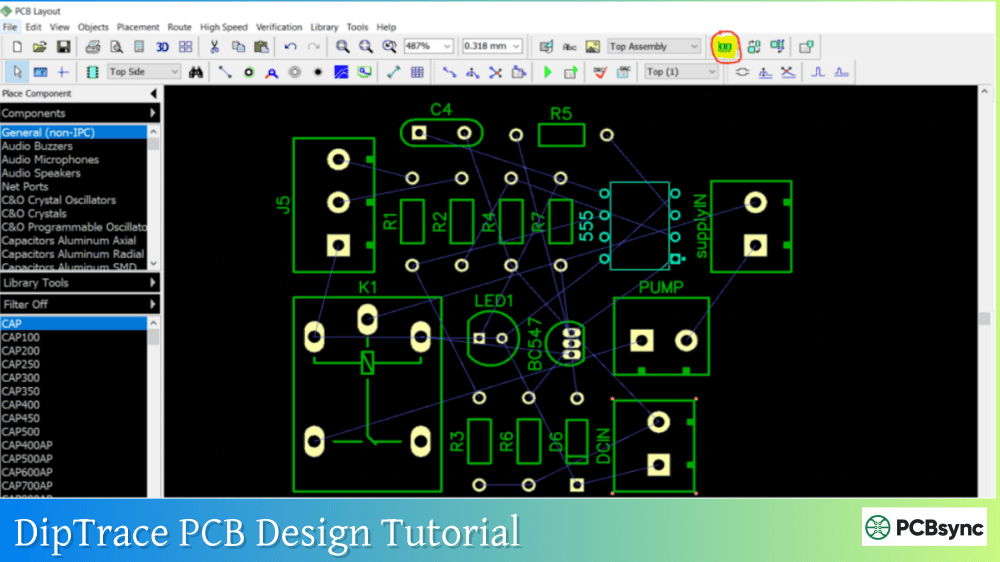
After spending years working with the NE555 and its CMOS variants, I can tell you that getting your 555 timer PCB layout right makes the difference between a circuit that works flawlessly and one that causes endless headaches. This chip has been around since 1972, yet engineers still make the same layout mistakes that Hans Camenzind would shake his head at.
Whether you’re building an LED blinker, a motor speed controller, or a precision delay circuit, the principles of good 555 timer PCB layout remain consistent. Let me walk you through what actually matters when you’re laying out your board.
Before diving into layout specifics, let’s make sure we’re on the same page about what each pin does. The 555 comes in an 8-pin DIP or SOIC package, and every pin placement decision you make affects circuit performance.
Active low reset – tie to Vcc through resistor if unused
5
CTRL
Control voltage – bypass with 10nF to ground
6
THR
Threshold – monitors capacitor voltage
7
DIS
Discharge – internal transistor for RC discharge
8
VCC
Supply voltage (4.5V to 16V for bipolar)
The internal architecture uses three 5kΩ resistors (that’s where the name comes from) to create reference voltages at 1/3 and 2/3 of Vcc. Two comparators monitor these thresholds and control an internal flip-flop, which drives the output stage.
Critical 555 Timer PCB Layout Guidelines
Component Placement Strategy
Here’s where most hobbyists and even some professionals go wrong. Your timing components need to be as close to the IC as physically possible. I’m talking within 1-2 cm of the relevant pins.
The placement priority should be:
Decoupling capacitors (0.1µF ceramic) adjacent to pin 8
Timing resistors near pins 6 and 7
Timing capacitor close to pins 1 and 6
Load components on output traces
When I review failed 555 timer designs, poor component placement is the culprit about 70% of the time. The longer your traces between critical components, the more you’re asking for noise pickup and timing instability.
Decoupling and Power Supply Filtering
This might be the most overlooked aspect of 555 timer PCB layout. The standard bipolar 555 draws significant current spikes during output transitions, and without proper decoupling, you’ll see erratic behavior.
Recommended decoupling configuration:
Capacitor
Value
Placement
Purpose
C bypass
0.1µF ceramic
Between pin 8 and pin 1
High-frequency noise filtering
C bulk
1-10µF electrolytic
Near power input
Low-frequency stabilization
C control
10nF ceramic
Pin 5 to ground
Prevents threshold noise
That capacitor on pin 5 is not optional. I’ve seen countless designs omit it because the datasheet says “optional” in some contexts. Without it, noise on the control voltage pin causes false triggering, especially in electrically noisy environments.
Grounding Techniques for 555 Timer Circuits
Ground loops will absolutely destroy your timing accuracy. For any serious 555 timer PCB layout, you need to think about return current paths.
Single-point grounding works well for most applications:
Connect all ground returns to a single star point
Keep the timing capacitor ground return short
Route high-current output grounds separately from sensitive timing grounds
For production boards, a ground plane is the way to go. It provides low impedance return paths and helps with thermal dissipation (the bipolar 555 does generate some heat at higher frequencies).
Astable Multivibrator PCB Layout Considerations
The astable configuration runs continuously without external triggering, making it ideal for oscillators, PWM generators, and clock sources. Your 555 timer PCB layout for astable mode needs to account for continuous switching noise.
Astable Circuit Component Values
The output frequency depends on your RC network:
Parameter
Formula
Notes
Frequency
f = 1.44 / ((Ra + 2Rb) × C)
Ra and Rb in ohms, C in farads
Duty Cycle
D = (Ra + Rb) / (Ra + 2Rb)
Always greater than 50% in basic config
Time High
Th = 0.693 × (Ra + Rb) × C
Charging through Ra and Rb
Time Low
Tl = 0.693 × Rb × C
Discharging through Rb only
Layout Tips for Astable Mode
The discharge pin (pin 7) carries significant current during capacitor discharge. Route this trace with adequate width, at least 0.3mm for typical applications.
Keep the timing capacitor traces short and away from the output trace. I’ve debugged boards where the output signal coupled back into the RC network, causing frequency jitter. The fix was simply rerouting the traces with better separation.
For high-frequency astable circuits (approaching the 500kHz limit of bipolar 555 or 3MHz for CMOS variants), consider using a ground plane fill between the timing components and output traces as additional shielding.
Monostable mode produces a single output pulse when triggered, with duration determined by your RC time constant. The 555 timer PCB layout for monostable applications requires special attention to trigger input integrity.
Monostable Timing Calculations
Parameter
Formula
Notes
Pulse Width
T = 1.1 × R × C
Time output stays high after trigger
Trigger Threshold
< 1/3 Vcc
Falling edge detection
Max Practical Delay
~10 minutes
Limited by capacitor leakage
Trigger Input Protection
The trigger input (pin 2) is extremely sensitive. On your PCB layout, route this trace away from the output and discharge pins. Any coupling between these signals causes false triggering or missed triggers.
Consider adding a 10kΩ pull-up resistor on the trigger pin and route it with a guard trace connected to ground on either side. This provides shielding in noisy environments.
For switch-based triggering, debouncing becomes important. The monostable naturally provides debouncing since it ignores subsequent triggers during the timing cycle, but clean initial triggering requires either an RC filter or Schmitt trigger buffer on the input.
PWM Generation Circuit Design
Pulse Width Modulation with the 555 is one of its most practical applications. Whether you’re controlling LED brightness or motor speed, your 555 timer PCB layout directly affects PWM quality.
PWM Circuit Topology
The standard approach uses the astable configuration with diodes to achieve independent control of on-time and off-time. Two diodes steer the charging current through one resistor path and discharging through another.
Modified PWM formulas:
Parameter
Formula
Notes
Time On
Ton = 0.693 × R1 × C
Through D1 diode path
Time Off
Toff = 0.693 × R2 × C
Through D2 diode path
Duty Cycle
D = R1 / (R1 + R2)
Adjustable below 50%
PWM Layout Best Practices
For motor control applications, the output stage requires careful layout. Place the MOSFET or driver transistor close to pin 3, with short gate drive traces. Add a flyback diode across inductive loads with the cathode side trace kept as short as possible.
Ground return paths from the load should not share the same trace as the timing circuit ground. This prevents load switching noise from affecting your PWM timing.
If using a potentiometer for duty cycle adjustment, shield the pot terminals with ground pour on adjacent layers. Capacitive coupling to the wiper can introduce noise on the timing circuit.
Common 555 Timer PCB Layout Mistakes
Insufficient Decoupling
Without the 0.1µF ceramic capacitor directly at the power pins, output glitches are inevitable. The bipolar 555 draws current spikes of up to 150mA during output transitions. Your bulk electrolytic capacitor cannot respond fast enough to these transients.
Long Timing Component Traces
Every millimeter of trace between your timing resistors and capacitor adds parasitic inductance and capacitance. In high-frequency applications, this shifts your operating frequency from calculated values.
Output Trace Coupling
The output switches between ground and Vcc at 200mA capability. Routing this trace near sensitive inputs creates capacitive coupling that causes oscillation or false triggering.
Floating Reset Pin
Pin 4 must be tied high through a resistor (typically 10kΩ) or directly to Vcc. A floating reset pin picks up noise and randomly resets your timer. I’ve seen this mistake even on commercial products.
Choosing Between Bipolar and CMOS 555 Variants
Your 555 timer PCB layout requirements change slightly depending on which variant you choose.
Feature
Bipolar (NE555)
CMOS (LMC555/TLC555)
Supply Range
4.5V – 16V
1.5V – 15V
Current Draw
~10mA
~100µA
Max Frequency
~500kHz
~3MHz
Output Current
200mA sink/source
10-50mA typical
ESD Sensitivity
Robust
Requires protection
For battery-powered designs, the CMOS variants are the obvious choice. Their lower power consumption means less thermal stress on your PCB. However, they require more careful ESD protection on input pins, so add series resistors (10-100kΩ) on exposed connections.
Testing and Troubleshooting Your 555 Timer PCB
Before you power up your assembled board, check for solder bridges around the IC. The 8-pin packages have relatively generous pitch, but flux residue can still cause issues on control and timing pins.
Systematic troubleshooting approach:
Verify power supply voltage at pins 1 and 8 with load connected
Check control voltage at pin 5 (should be approximately 2/3 Vcc)
Monitor threshold and trigger voltages during operation
Confirm timing capacitor charges and discharges properly
Examine output waveform for noise or oscillation
If your timing is unstable, first suspect power supply noise. Add additional filtering at the power input and verify your decoupling capacitors are actually ceramic (some look like ceramic but are actually inferior types).
PCBWay Community: 555 Timer Dev Board with KiCAD files
OSHWLab: Discrete transistorized 555 timer project with gerbers
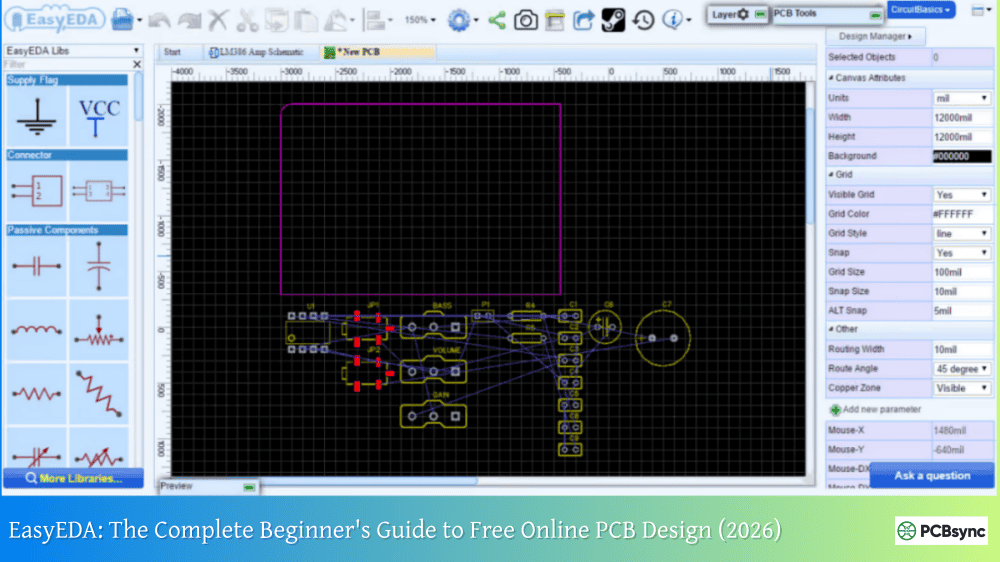
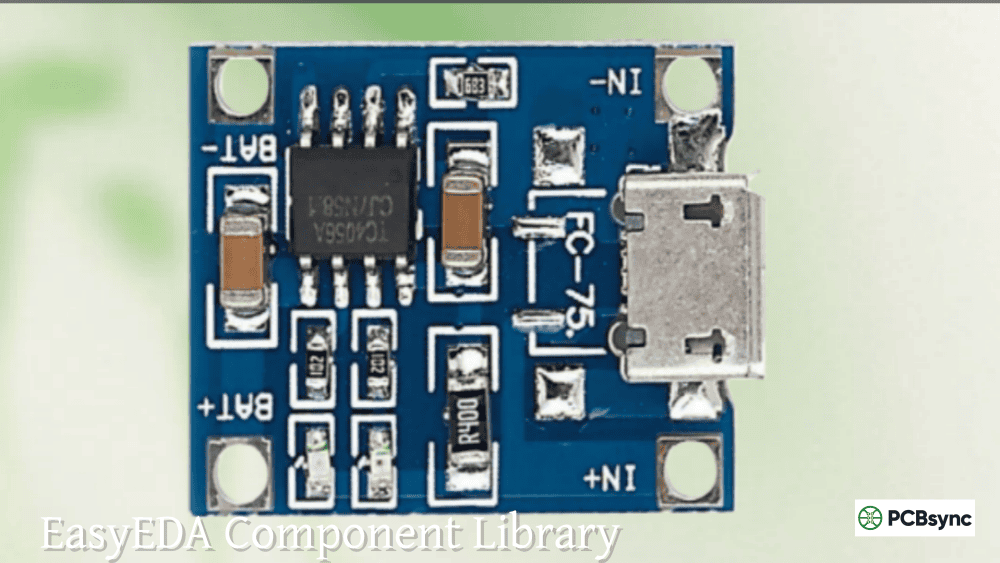
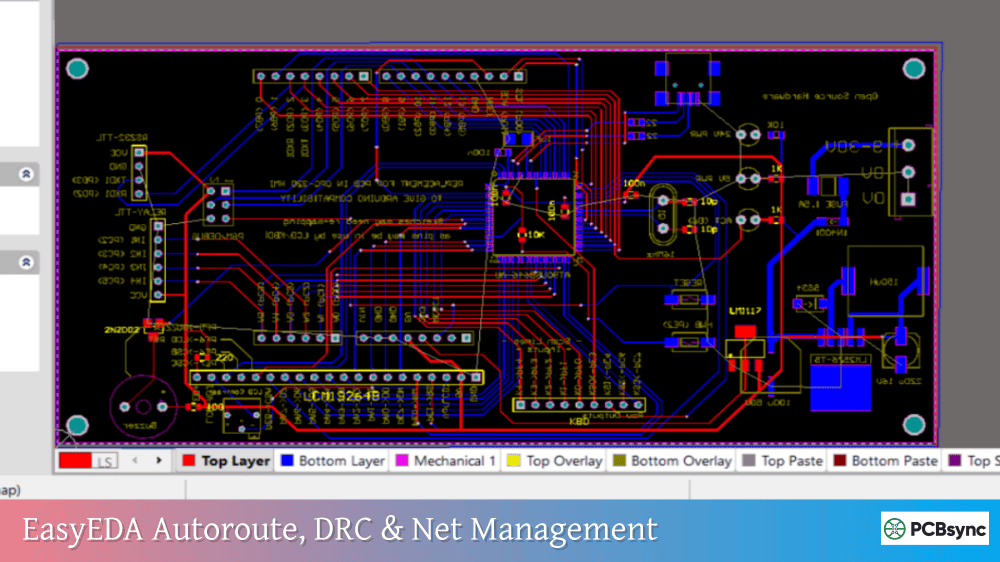
EasyEDA Library: Pre-made 555 timer footprints and schematics
Design Calculators:
Electronics-Tutorials 555 Calculator
DigiKey 555 Timer Calculator Tool
BuildElectronicCircuits 555 Timer Calculator
Community Project Repositories:
GitHub: Various 555-based project repositories with PCB files
Instructables: Step-by-step assembly guides with gerber downloads
Frequently Asked Questions
What is the optimal trace width for 555 timer PCB layouts?
For the power traces (Vcc and GND), use at least 0.5mm width to handle the current spikes during output transitions. Signal traces for timing components can be 0.25mm minimum, but wider is always better for noise immunity. Output traces should be sized based on your load current requirements, using standard current capacity calculators.
Can I use a 555 timer for high-frequency PWM applications?
The standard bipolar 555 reliably operates up to about 500kHz, while CMOS variants like the LMC555 can reach 3MHz. Above these frequencies, your 555 timer PCB layout becomes extremely critical. Trace lengths must be minimized, and ground plane implementation becomes mandatory. For frequencies beyond these limits, dedicated PWM controller ICs are the better choice.
Why does my 555 timer circuit have erratic timing?
Nine times out of ten, the culprit is inadequate power supply decoupling. Verify that your 0.1µF ceramic capacitor sits directly between pins 8 and 1 with minimal trace length. The second most common cause is a missing or improperly valued capacitor on pin 5, allowing noise to modulate the internal threshold voltages.
Should I use through-hole or SMD components for 555 timer circuits?
For prototypes and hobby projects, through-hole DIP packages are easier to work with and allow socket mounting for IC replacement. For production boards where size and cost matter, SOIC or even smaller packages work well. The 555 timer PCB layout principles remain identical regardless of package type, though SMD layouts require more attention to thermal relief patterns.
How do I prevent false triggering in noisy environments?
Start with a proper ground plane and adequate decoupling. Add a 10nF capacitor on pin 5 to stabilize the control voltage threshold. For the trigger input, use a pull-up resistor and consider adding a small ceramic capacitor (100pF to 1nF) to filter high-frequency noise. In extreme cases, add a Schmitt trigger buffer (like the 74HC14) before the trigger input.
Conclusion
Getting your 555 timer PCB layout right isn’t complicated once you understand the fundamentals. Keep timing components close, decouple properly, manage your ground returns, and separate noisy output traces from sensitive inputs. These principles have served me well across hundreds of 555-based designs over the years.
The 555 timer remains one of the most versatile ICs in our toolkit precisely because it’s forgiving enough for beginners yet capable enough for professional applications. Whether you’re building your first LED blinker or a precision industrial timer, proper PCB layout transforms a mediocre design into a reliable one.
Start with the guidelines in this article, prototype on a breadboard first if possible, and don’t skip the decoupling capacitors. Your future self will thank you when the circuit works exactly as calculated on the first spin.
Inquire: Call 0086-755-23203480, or reach out via the form below/your sales contact to discuss our design, manufacturing, and assembly capabilities.
Quote: Email your PCB files to Sales@pcbsync.com (Preferred for large files) or submit online. We will contact you promptly. Please ensure your email is correct.
Notes: For PCB fabrication, we require PCB design file in Gerber RS-274X format (most preferred), *.PCB/DDB (Protel, inform your program version) format or *.BRD (Eagle) format. For PCB assembly, we require PCB design file in above mentioned format, drilling file and BOM. Click to download BOM template To avoid file missing, please include all files into one folder and compress it into .zip or .rar format.