Inquire: Call 0086-755-23203480, or reach out via the form below/your sales contact to discuss our design, manufacturing, and assembly capabilities.
Quote: Email your PCB files to Sales@pcbsync.com (Preferred for large files) or submit online. We will contact you promptly. Please ensure your email is correct.
Notes: For PCB fabrication, we require PCB design file in Gerber RS-274X format (most preferred), *.PCB/DDB (Protel, inform your program version) format or *.BRD (Eagle) format. For PCB assembly, we require PCB design file in above mentioned format, drilling file and BOM. Click to download BOM template To avoid file missing, please include all files into one folder and compress it into .zip or .rar format.
47 Ohm Resistor: Complete Guide to Color Code & Technical Specifications
When you’re breadboarding a new LED circuit at 2 AM and reach for your resistor bin, chances are you’ll grab a 47 ohm resistor. It’s one of those workhorses in electronics that doesn’t get much fanfare, but I’ve probably soldered thousands of these onto PCBs over my career as a design engineer. Let me walk you through everything you need to know about this essential component.
A 47 ohm resistor provides exactly 47 ohms of resistance to current flow in a circuit. Think of it as a controlled bottleneck in your electron highway. The resistance value sits in a sweet spot where it’s low enough to allow moderate current flow while still providing meaningful current limitation and voltage drop control.
In practical terms, when you apply 4.7V across a 47 ohm resistor, you’ll get 100mA of current flowing through it (using Ohm’s Law: I = V/R = 4.7V / 47Ω = 0.1A). This makes it incredibly useful for LED current limiting, where most standard indicator LEDs require around 10-20mA to operate properly.
Why 47 Ohms?
The value 47 appears frequently in the E12 and E24 resistor series, which are industry standards that provide logarithmically spaced values. These series were developed decades ago when resistor manufacturing tolerances were much wider (typically 5-10%), and the spacing between values needed to prevent overlap. The E12 series includes values like 10, 12, 15, 18, 22, 27, 33, 39, 47, 56, 68, and 82 ohms per decade.
Color Code for 47 Ohm Resistor
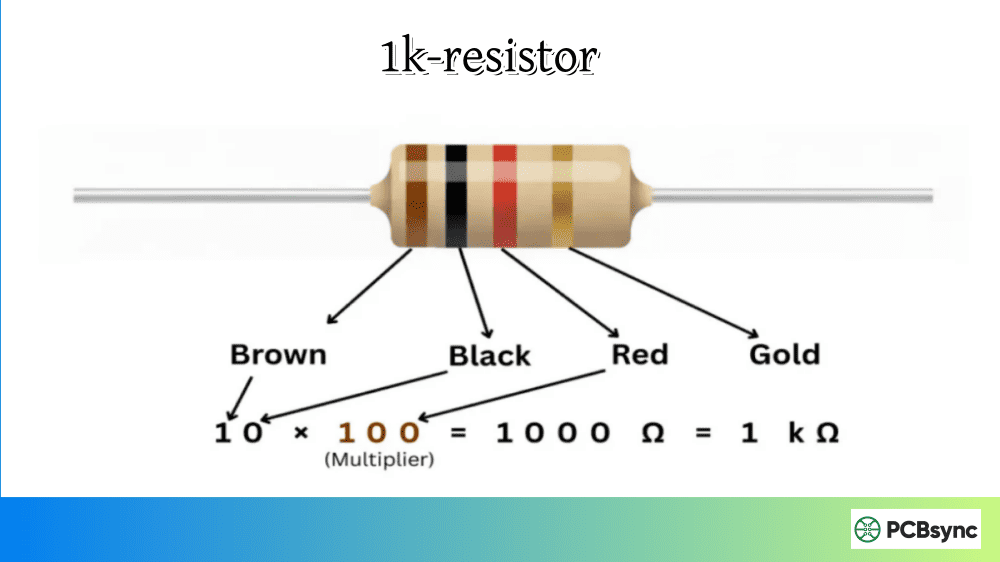
Reading resistor color codes is one of those skills that becomes second nature after you’ve done it a few hundred times. For a 47 ohm resistor, the color bands differ depending on whether you’re looking at a 4-band, 5-band, or 6-band resistor.
4-Band 47 Ohm Resistor Color Code
Band Position
Color
Meaning
Value
1st Band
Yellow
First Digit
4
2nd Band
Violet
Second Digit
7
3rd Band
Black
Multiplier
×1
4th Band
Gold
Tolerance
±5%
The most common configuration you’ll find in hobbyist kits and general electronics is the 4-band resistor with Yellow-Violet-Black-Gold bands. The calculation is straightforward: (4 × 10 + 7) × 1 = 47 ohms, with a tolerance of ±5%.
5-Band 47 Ohm Resistor Color Code
Band Position
Color
Meaning
Value
1st Band
Yellow
First Digit
4
2nd Band
Violet
Second Digit
7
3rd Band
Black
Third Digit
0
4th Band
Gold
Multiplier
×0.1
5th Band
Brown
Tolerance
±1%
For precision applications, you’ll use 5-band resistors. The color sequence Yellow-Violet-Black-Gold-Brown gives you (4 × 100 + 7 × 10 + 0) × 0.1 = 47 ohms with ±1% tolerance. This tighter tolerance matters in sensitive analog circuits, voltage reference designs, or precision measurement equipment.
6-Band 47 Ohm Resistor Color Code
Band Position
Color
Meaning
Value
1st Band
Yellow
First Digit
4
2nd Band
Violet
Second Digit
7
3rd Band
Black
Third Digit
0
4th Band
Gold
Multiplier
×0.1
5th Band
Gold
Tolerance
±5%
6th Band
Black
Temp Coefficient
250 ppm/°C
The 6-band version adds a temperature coefficient specification. The Black band indicates 250 ppm/°C, which tells you how much the resistance will drift as temperature changes. In a 40°C temperature swing, a 47 ohm resistor with 250 ppm/°C would drift by approximately ±0.47 ohms.
Technical Specifications You Need to Know
Power Rating
This is where engineers often run into trouble. The power rating determines how much heat your resistor can safely dissipate. Common power ratings for 47 ohm resistors include:
Power Rating
Package Type
Typical Size
Max Current (Continuous)
1/8W (0.125W)
Through-hole
3.2mm × 1.6mm
~50mA
1/4W (0.25W)
Through-hole
6.3mm × 2.5mm
~75mA
1/2W (0.5W)
Through-hole
9.2mm × 3.5mm
~100mA
1W
Through-hole
11mm × 4.5mm
~145mA
2W
Through-hole
15mm × 5.5mm
~200mA
Here’s a real-world calculation: If you’re running 100mA through a 47 ohm resistor, the power dissipation is P = I² × R = (0.1)² × 47 = 0.47W. You’d need at least a 1W resistor for reliable operation, though I’d personally use a 2W to keep things cool and extend component life.
Tolerance Values
Tolerance
Color Band
Typical Application
±1%
Brown
Precision analog, instrumentation
±2%
Red
High-accuracy circuits
±5%
Gold
General purpose, most common
±10%
Silver
Non-critical applications
For LED current limiting or basic voltage dividers, ±5% tolerance is usually sufficient. But when I’m designing a precision current source or voltage reference, I’ll spec ±1% or even ±0.1% tolerance resistors.
Temperature Coefficient
The temperature coefficient (tempco) specifies how much resistance changes with temperature, measured in parts per million per degree Celsius (ppm/°C):
±50 ppm/°C or better: Precision metal film, used in measurement equipment
±100 ppm/°C: Standard metal film, good for most analog circuits
±250 ppm/°C: Carbon film, acceptable for non-critical applications
±350 ppm/°C or higher: Carbon composition, generally avoided in modern designs
Types of 47 Ohm Resistors
Through-Hole Resistors
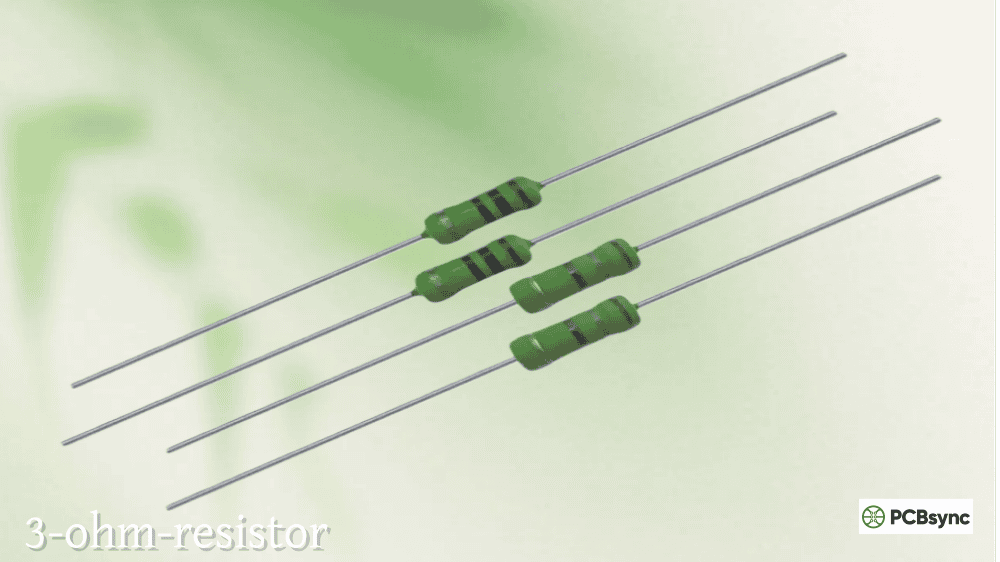
Carbon Film: The most economical option. These have the Yellow-Violet-Black-Gold bands you’re familiar with. They’re fine for breadboarding and non-critical circuits, but they generate more noise and have poorer temperature stability than metal film alternatives.
Metal Film: My go-to for production designs. They offer tighter tolerances (typically ±1%), lower noise, and better temperature coefficient (typically ±100 ppm/°C). They cost a bit more, but the improved performance is worth it in any circuit where stability matters.
Wire-Wound: For high-power applications (5W and above), wire-wound resistors are the way to go. They’re constructed by winding resistive wire around a ceramic core. The downside is that they have significant inductance, making them unsuitable for RF or high-frequency applications.
Metal Oxide: These offer excellent pulse handling and overload capabilities. I use them in power supply circuits where transient protection is important.
Surface Mount (SMD) Resistors
Package Size
Dimensions
Power Rating
Common Applications
0402
1.0mm × 0.5mm
1/16W
Smartphones, dense PCBs
0603
1.6mm × 0.8mm
1/10W
General purpose SMD
0805
2.0mm × 1.25mm
1/8W
Easy hand soldering
1206
3.2mm × 1.6mm
1/4W
Moderate power, hobbyist friendly
2512
6.3mm × 3.2mm
1W – 2W
Power applications
SMD resistors don’t use color codes. Instead, they’re marked with numerical codes. A 47 ohm SMD resistor might be marked “47R0” or “470” (the zero indicates the multiplier). On smaller packages like 0402 or 0603, markings might be absent entirely.
Practical Applications in Circuit Design
LED Current Limiting
This is probably the most common application I’ve encountered. Let’s work through a real example:
Scenario: You want to drive a standard red LED from a 5V supply. The LED has a forward voltage (Vf) of 2V and requires 20mA of current.
Calculation:
Voltage across resistor: Vr = Vsupply – Vf = 5V – 2V = 3V
Required resistance: R = Vr / I = 3V / 0.020A = 150Ω
Nearest standard value: 150Ω
But what if you only have 47 ohm resistors? With 47Ω, the current would be: I = 3V / 47Ω = 63.8mA. That’s way too much for a standard LED and would likely damage it. This demonstrates why having the right resistor value matters.
However, 47 ohm works perfectly for driving LEDs from 3.3V supplies where you need higher current, or for parallel LED strings where current sharing is desired.
Voltage Divider Networks
In voltage divider applications, 47 ohm resistors create specific voltage ratios. For instance, pairing a 47Ω with a 100Ω resistor gives you:
Vout = Vin × (100 / (47 + 100)) = Vin × 0.68
This configuration is useful for level shifting signals or creating reference voltages for comparators and ADC inputs.
Impedance Matching
In audio circuits and RF applications, 47 ohm resistors help with impedance matching. While not a standard impedance (50Ω or 75Ω are more common in RF), 47Ω resistors are useful in audio amplifier feedback networks and speaker protection circuits.
Pull-up and Pull-down Resistors
While 47 ohms is quite low for typical pull-up/pull-down applications (which usually use 4.7kΩ to 10kΩ), it’s occasionally used in high-speed digital circuits where fast rise/fall times are critical and the circuit can tolerate the higher power consumption.
Current Sensing
In low-voltage, high-current applications, a 47 ohm resistor can serve as a current sense element. The voltage drop across the resistor is proportional to the current flowing through it. At 100mA, you’d see 4.7V across the resistor, which is easy to measure with standard analog-to-digital converters.
Component datasheets typically specify power ratings at 70°C ambient temperature with free air convection. In enclosed designs or high-temperature environments, you need to derate the power handling capability.
A good rule of thumb: Never run a resistor above 50-70% of its rated power in continuous operation. This extends component life and maintains reliability. For critical applications, I derate to 40% or even 30%.
Voltage Rating
Physical size matters for voltage rating. A tiny 0402 SMD resistor might only handle 50V maximum, while larger through-hole resistors can handle several hundred volts before arcing occurs between the leads.
For a 47 ohm, 1/4W resistor, the maximum safe voltage is: V = √(P × R) = √(0.25W × 47Ω) = 3.43V under full power conditions.
Parallel and Series Combinations
Don’t have a 47 ohm resistor? You can create one:
Series: 22Ω + 22Ω + 3Ω = 47Ω Parallel: Two 94Ω resistors in parallel = 47Ω
The parallel formula is: Rtotal = (R1 × R2) / (R1 + R2)
Mouser Electronics: Comparable to Digi-Key, slightly different inventory
Newark/Farnell: Good for international shipping
LCSC: Cost-effective for high volumes, especially SMD components
For prototyping, Amazon assortments work fine, but quality varies. I’ve had mixed results with no-name resistor kits where actual values measured significantly outside the stated tolerance.
Quality Indicators
When selecting resistors for production:
Check the datasheet for full specifications
Verify manufacturer is reputable (Vishay, Yageo, KOA, Panasonic, etc.)
Confirm the temperature coefficient for your application
Verify power rating includes derating curves
Check for RoHS compliance if required
Frequently Asked Questions
What current can a 47 ohm resistor handle?
The maximum current depends on the power rating. Use I = √(P/R). For a 1/4W resistor: I = √(0.25W / 47Ω) = 73mA continuous. For pulse applications, resistors can handle 2-10x rated power for short durations (microseconds to milliseconds), but check the specific datasheet.
Can I use a 47 ohm resistor in place of a 50 ohm for impedance matching?
For most RF applications, 47Ω is too far from 50Ω standard impedance, creating a 3Ω mismatch. This results in a VSWR of about 1.13:1, which might be acceptable for non-critical applications but would cause problems in precision RF designs or high-frequency circuits where impedance matching is critical.
What’s the difference between a 1/4W carbon film and metal film 47 ohm resistor?
Metal film resistors have lower temperature coefficients (±50 to ±100 ppm/°C vs ±350 ppm/°C for carbon film), lower noise, and tighter tolerances (±1% vs ±5%). Carbon film resistors are cheaper but less stable. For most modern designs, metal film is the better choice unless you’re extremely cost-sensitive.
How do I measure if my 47 ohm resistor is still good?
Use a multimeter in resistance mode. A 47Ω resistor with ±5% tolerance should read between 44.65Ω and 49.35Ω. If it reads significantly outside this range, it’s damaged. Also check for physical signs: discoloration, burning, cracks, or deformation indicate thermal damage or overcurrent events.
Can I use higher wattage resistor than calculated?
Absolutely, and I recommend it. Using a 1W resistor where calculations show you need 0.5W is good engineering practice. The resistor runs cooler, lasts longer, and provides a safety margin for unexpected conditions. The only downsides are increased cost and larger board footprint, which are usually negligible.
Useful Resources and Databases
To make your design work easier, I’ve compiled essential resources that I use regularly:
IPC-2221 – Generic Standard on Printed Board Design (includes power dissipation guidelines)
MIL-PRF-55342 – Military resistor specifications (useful for understanding quality grades)
Conclusion
The 47 ohm resistor might seem like a simple component, but understanding its specifications, color codes, and proper application is fundamental to reliable circuit design. Whether you’re limiting current to an LED, creating a voltage divider, or building a complex analog circuit, choosing the right 47 ohm resistor with appropriate power rating, tolerance, and package type makes the difference between a circuit that works reliably for years and one that fails in the field.
After two decades of designing electronics, I still double-check my resistor calculations and verify color codes before soldering. It’s this attention to detail with “simple” components like the 47 ohm resistor that separates robust, professional designs from problematic prototypes.
Inquire: Call 0086-755-23203480, or reach out via the form below/your sales contact to discuss our design, manufacturing, and assembly capabilities.
Quote: Email your PCB files to Sales@pcbsync.com (Preferred for large files) or submit online. We will contact you promptly. Please ensure your email is correct.
Notes: For PCB fabrication, we require PCB design file in Gerber RS-274X format (most preferred), *.PCB/DDB (Protel, inform your program version) format or *.BRD (Eagle) format. For PCB assembly, we require PCB design file in above mentioned format, drilling file and BOM. Click to download BOM template To avoid file missing, please include all files into one folder and compress it into .zip or .rar format.