Inquire: Call 0086-755-23203480, or reach out via the form below/your sales contact to discuss our design, manufacturing, and assembly capabilities.
Quote: Email your PCB files to Sales@pcbsync.com (Preferred for large files) or submit online. We will contact you promptly. Please ensure your email is correct.
Notes: For PCB fabrication, we require PCB design file in Gerber RS-274X format (most preferred), *.PCB/DDB (Protel, inform your program version) format or *.BRD (Eagle) format. For PCB assembly, we require PCB design file in above mentioned format, drilling file and BOM. Click to download BOM template To avoid file missing, please include all files into one folder and compress it into .zip or .rar format.
As a PCB engineer who has spent over a decade working with high-layer-count boards, I can tell you that 44 layer PCB technology represents the cutting edge of circuit board manufacturing. When clients first hear “44 layers,” their eyes often widen. But in today’s world of AI servers, 5G infrastructure, and advanced computing systems, these ultra-high-density boards have become essential rather than exotic.
In this guide, I’ll walk you through everything you need to know about 44 layer PCB design, manufacturing processes, and real-world applications. Whether you’re an engineer evaluating options for your next project or a procurement specialist trying to understand what you’re sourcing, this article will give you the technical foundation you need.
A 44 layer PCB is an ultra-high layer count printed circuit board containing 44 conductive copper layers separated by insulating dielectric materials. These boards fall into the category of high layer count (HLC) PCBs, typically defined as boards with 12 or more layers.
To put this in perspective, your average consumer electronics device uses a 4-layer or 6-layer board. A smartphone motherboard might use 10-12 layers. High-end server motherboards commonly range from 16-24 layers. A 44 layer PCB sits at the upper extreme of current manufacturing capabilities, with only a handful of manufacturers worldwide capable of consistently producing boards at this layer count.
Why 44 Layers?
The simple answer is routing density and signal integrity. When you have processors with thousands of pins, multiple high-speed memory interfaces running at gigabits per second, and stringent EMI requirements, you need layers for:
Signal routing: High-speed differential pairs for PCIe 5.0/6.0, DDR5, and 400G Ethernet
Ground planes: Adjacent ground planes for every signal layer to control impedance
Power distribution: Multiple voltage rails with low-inductance delivery
Shielding: Isolation between noisy digital and sensitive analog sections
A typical 44 layer PCB might dedicate 20+ layers to signals, 12-16 layers to ground planes, and 6-10 layers to power distribution. The exact allocation depends on the specific application requirements.
Technical Specifications of 44 Layer PCBs
Understanding the specifications helps you evaluate whether a 44 layer PCB is right for your application. Here are the typical parameters you’ll encounter:
Specification
Typical Range
Notes
Total Thickness
4.0 – 6.0 mm
Thicker than standard boards
Aspect Ratio
15:1 to 20:1
Hole depth to diameter ratio
Minimum Trace Width
50 – 75 µm
Depends on copper weight
Minimum Trace Spacing
50 – 75 µm
Critical for high-speed signals
Via Diameter
0.15 – 0.25 mm
Mechanical drilling
Microvia Diameter
0.075 – 0.1 mm
Laser drilling
Copper Weight
0.5 – 2 oz inner, 1-2 oz outer
Application dependent
Impedance Tolerance
±5% to ±10%
Controlled impedance
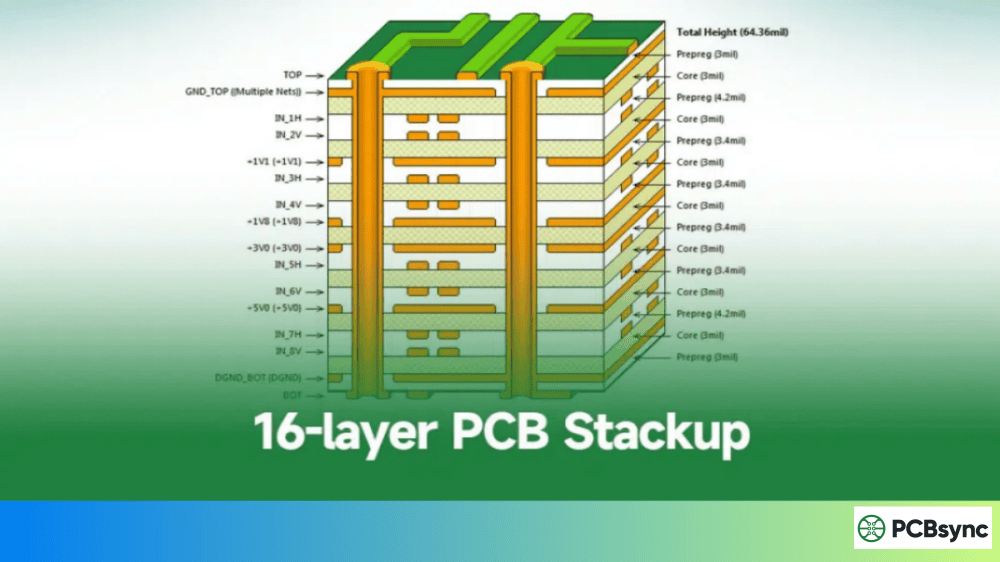
Layer Stack-Up Considerations
The stack-up design for a 44 layer PCB requires careful planning. You cannot simply stack 44 layers randomly and expect good results. Key principles include:
Symmetry: The stack-up must be symmetrical around the center to prevent warping during lamination. An asymmetrical design will bow and twist, making assembly impossible.
Signal-Ground Pairing: Every high-speed signal layer should have an adjacent ground plane. This provides a controlled impedance return path and reduces EMI.
Core and Prepreg Selection: With 44 layers, you’re working with multiple lamination cycles. Typical builds use sequential lamination with 3-4 press cycles, each adding layers to a core structure.
Material Consistency: Using the same dielectric material family throughout the stack-up maintains consistent electrical properties. Mixing materials can cause Dk variations that affect impedance.
Materials Used in 44 Layer PCB Manufacturing
Material selection dramatically impacts performance in high layer count boards. Standard FR-4 often isn’t adequate for 44 layer designs due to higher dielectric loss at elevated frequencies, inconsistent Dk values across the board, and thermal limitations during multiple lamination cycles.
Most 44 layer PCB designs use mid-loss or low-loss materials like Panasonic MEGTRON 6 or Isola FR408HR. These materials balance performance with cost and have proven manufacturing track records at high layer counts.
Copper Foil Types
For 44 layer boards operating at multi-gigabit speeds, copper foil selection matters significantly:
Standard ED copper: Higher surface roughness, more loss
RTF (Reverse Treated Foil): Reduced roughness, better for 10-28 Gbps
HVLP (Hyper Very Low Profile): Ultra-smooth, essential for 50+ Gbps
The copper-dielectric interface contributes substantially to insertion loss at high frequencies. Using HVLP foil with low-loss laminates can reduce total loss by 30-40% compared to standard materials.
Manufacturing a 44 layer PCB is significantly more complex than producing a standard multilayer board. The process requires specialized equipment, tight process controls, and extensive experience.
Sequential Lamination
A 44 layer board cannot be built in a single lamination press cycle. Instead, manufacturers use sequential lamination:
Registration errors compound through multiple lamination cycles. What starts as a 25 µm error in cycle one can become 100+ µm by the final cycle if not carefully controlled.
Via Structures in 44 Layer PCBs
The via structure significantly impacts 44 layer PCB design flexibility:
Via Type
Description
Application
Through-hole
Spans all 44 layers
Power, ground, low-speed signals
Blind via
Surface to inner layer
BGA fanout, HDI routing
Buried via
Inner layer to inner layer
Internal routing density
Stacked microvia
Multiple microvias aligned
High-density BGA escape
Staggered microvia
Offset microvias
Reliability in thermal cycling
Many 44 layer designs use HDI (High Density Interconnect) technology with 2+N+2 or higher configurations, meaning 2 or more HDI buildup layers on each side of an N-layer core.
For professional PCB manufacturing of high layer count boards, working with an experienced manufacturer who understands these complexities is essential.
Design Considerations for 44 Layer PCBs
Designing a 44 layer PCB requires careful attention to several critical factors that don’t apply to simpler boards.
Signal Integrity Planning
At the data rates common in 44 layer PCB applications (PCIe 5.0, 112G PAM4, 400G Ethernet), signal integrity isn’t optional. Key considerations include:
Impedance Control: Single-ended typically 50 ohms ±5%, differential pairs typically 85-100 ohms ±10%. Design must account for via stub effects, and back-drilling is often required for through-hole vias.
Loss Budget: Calculate total channel loss (conductor + dielectric + via), stay within receiver sensitivity specifications, and consider using equalization if loss exceeds targets.
Crosstalk: Maintain minimum 3x trace spacing for high-speed signals, use ground stitching vias between differential pairs, and avoid parallel routing on adjacent layers.
Power Integrity
Power distribution in a 44 layer board serving high-performance processors requires careful design:
PDN impedance: Target < 1 milliohm for low-frequency response
Decoupling strategy: Multi-tier approach from bulk to ceramic
44 layer PCBs are premium products with costs reflecting their manufacturing complexity. Understanding cost drivers helps optimize your design and budget.
Cost Factor
Impact
Mitigation Strategies
Layer count
Major
Optimize routing to minimize layers
Material selection
Significant
Use low-loss only where needed
Board size
Significant
Minimize panel utilization
Via structures
Moderate
Balance HDI with standard vias
Tolerances
Moderate
Specify only necessary precision
Volume
Major
Higher volumes reduce per-unit cost
Lead time
Moderate
Plan ahead, avoid expedite fees
Typical pricing for 44 layer prototype boards can range from several hundred to several thousand dollars per board, depending on size and specifications. Production volumes significantly reduce per-unit cost through panel optimization and process efficiency.
Working with manufacturers who specialize in Multilayer PCB production ensures you get competitive pricing with reliable quality.
Quality and Testing Requirements
44 layer PCBs require comprehensive testing to ensure reliability:
Electrical Testing
Flying probe or bed-of-nails: 100% continuity verification
Impedance testing: TDR measurements on controlled impedance lines
Solder float: Multiple cycles at peak reflow temperature
Industry Standards and Certifications
44 layer PCB manufacturers should comply with relevant industry standards:
IPC-6012: Qualification and performance for rigid PCBs (Class 3 for high-reliability)
IPC-A-600: Acceptability of printed boards
AS9100: Aerospace quality management
ISO 9001: General quality management
UL certification: Safety listing
RoHS/REACH: Environmental compliance
Future Trends in High Layer Count PCBs
The demand for 44 layer and higher layer count PCBs continues growing driven by:
AI and Machine Learning: Training and inference hardware requiring extreme memory bandwidth drives layer counts higher. Next-generation AI accelerators may push beyond 50 layers.
Data Rates: 224G PAM4 and beyond will require even more sophisticated materials and via structures, potentially increasing layer counts for adequate signal isolation.
Chiplet Integration: Advanced packaging with chiplet architectures requires high-density interconnects that drive motherboard complexity.
Miniaturization: As systems shrink, the same functionality must fit in smaller form factors, requiring more layers in less space.
FAQs About 44 Layer PCBs
What is the maximum layer count possible in PCB manufacturing?
While 44 layers represents a high-end production capability, some manufacturers can produce boards with 60+ layers. The theoretical maximum exceeds 100 layers, though commercial production at such counts is extremely rare. The practical limit depends on manufacturer capability, cost constraints, and actual design requirements.
How long does it take to manufacture a 44 layer PCB?
Prototype lead times typically range from 3-6 weeks depending on specifications and manufacturer workload. Production lead times may extend to 6-10 weeks for first articles, with subsequent orders potentially faster. Complex HDI structures or exotic materials may add additional time.
Can any PCB design software handle 44 layer designs?
Professional EDA tools like Cadence Allegro, Siemens Xpedition, and Altium Designer all support 44+ layer designs. The challenge isn’t the tool capability but rather managing the design complexity, simulation requirements, and file sizes that accompany such designs.
What’s the typical yield rate for 44 layer PCB production?
Yield rates vary significantly based on design complexity and manufacturer capability. Experienced manufacturers with appropriate equipment achieve 85-95% yields on mature 44 layer designs. First-article builds or aggressive designs may see lower initial yields that improve through process optimization.
When should I consider a 44 layer PCB versus lower layer counts?
Consider 44 layers when your design requires: routing for high-pin-count BGAs (2000+ pins), multiple high-speed interfaces (PCIe 5.0, DDR5, 100G+ Ethernet), stringent signal integrity requirements that need dedicated ground planes per signal layer, or when lower layer counts fail to achieve acceptable routing density. Always optimize the design before increasing layer count, as 44 layers significantly increases cost and lead time.
Selecting a 44 Layer PCB Manufacturer
Not all PCB manufacturers can produce 44 layer boards. When selecting a supplier, evaluate their technical capabilities, quality systems, and experience carefully.
Technical Capability Assessment
Demonstrated 44+ layer production history with customer references
Appropriate equipment including LDI, X-ray drill, and sequential lamination systems
Engineering support for stack-up optimization and DFM review
Quality Systems Evaluation
IPC Class 3 capability certification for high-reliability applications
Industry certifications such as AS9100 for aerospace projects
Statistical process control data and traceability systems
Experience and Communication
Customer references in your specific industry vertical
Responsive engineering support throughout the design and production cycle
Design for manufacturing (DFM) feedback before production commitment
Transparent lead time commitments and proactive communication
Conclusion
44 layer PCB technology enables the most demanding electronic systems in existence today. From AI servers processing petabytes of data to aerospace systems operating in extreme environments, these ultra-high layer count boards provide the routing density, signal integrity, and reliability that advanced applications demand.
Success with 44 layer PCBs requires understanding the entire ecosystem: materials selection, stack-up design, manufacturing processes, and quality requirements all interconnect. Working with experienced manufacturers and investing in proper design validation ensures your 44 layer board meets its performance targets.
As data rates continue climbing and system complexity grows, 44 layer and higher layer count PCBs will become increasingly common in high-performance computing, telecommunications, and aerospace applications. Understanding this technology today prepares you for the electronics challenges of tomorrow.
Useful Resources
For engineers and designers working with high layer count PCBs, the following resources provide valuable reference information:
Standards and Specifications
IPC-2221B: Generic Standard on Printed Board Design
IPC-6012E: Qualification and Performance Specification for Rigid PCBs
IPC-4101E: Specification for Base Materials for Rigid Boards
Material Datasheets
Panasonic MEGTRON Series: Technical documentation for high-speed laminates
Isola Group Materials Database: Comprehensive material property data
Rogers Corporation High-Frequency Materials: RF/microwave material specifications
Inquire: Call 0086-755-23203480, or reach out via the form below/your sales contact to discuss our design, manufacturing, and assembly capabilities.
Quote: Email your PCB files to Sales@pcbsync.com (Preferred for large files) or submit online. We will contact you promptly. Please ensure your email is correct.
Notes: For PCB fabrication, we require PCB design file in Gerber RS-274X format (most preferred), *.PCB/DDB (Protel, inform your program version) format or *.BRD (Eagle) format. For PCB assembly, we require PCB design file in above mentioned format, drilling file and BOM. Click to download BOM template To avoid file missing, please include all files into one folder and compress it into .zip or .rar format.