Inquire: Call 0086-755-23203480, or reach out via the form below/your sales contact to discuss our design, manufacturing, and assembly capabilities.
Quote: Email your PCB files to Sales@pcbsync.com (Preferred for large files) or submit online. We will contact you promptly. Please ensure your email is correct.
Notes: For PCB fabrication, we require PCB design file in Gerber RS-274X format (most preferred), *.PCB/DDB (Protel, inform your program version) format or *.BRD (Eagle) format. For PCB assembly, we require PCB design file in above mentioned format, drilling file and BOM. Click to download BOM template To avoid file missing, please include all files into one folder and compress it into .zip or .rar format.
Designing a 433 MHz PCB antenna presents challenges you don’t encounter at higher frequencies. The first time I tried scaling down a 2.4 GHz antenna design to 433 MHz, I ended up with something absurdly large—a quarter wavelength at 433 MHz is 173mm, nearly seven inches. That’s bigger than most IoT devices. The solution is meander antennas, helical structures, and clever folding techniques that compress that electrical length into a practical PCB footprint.
This guide covers practical 433 MHz PCB antenna design for ISM band applications. Whether you’re building a CC1101-based remote control, a LoRa sensor node, or an alarm system transmitter, these dimensions and matching network values will get you working hardware. I’ll focus on what actually works—meander antennas that fit on reasonably sized boards, matching networks that tune properly, and layout rules that don’t kill your range.
The 433 MHz ISM band sits between the easy-to-design 2.4 GHz range and the truly challenging sub-200 MHz frequencies. It’s manageable, but the wavelength demands respect.
433 MHz Wavelength Calculations
Parameter
Value
Notes
Center frequency
433.92 MHz
European ISM band
Wavelength (λ)
691 mm
Free space
Half wavelength (λ/2)
346 mm
Dipole length
Quarter wavelength (λ/4)
173 mm
Monopole length
λ/4 on FR4 (εr = 4.4)
82–95 mm
Effective length on PCB
Typical meander length
40–80 mm
Physical PCB footprint
At 2.4 GHz, a quarter-wave antenna fits in about 31mm. At 433 MHz, you need 173mm—over five times larger. This fundamental difference drives everything about 433 MHz PCB antenna design.
433 MHz ISM Band Specifications
Region
Frequency Range
Bandwidth
Max Power
Europe (ETSI)
433.05–434.79 MHz
1.74 MHz
10 mW ERP
Americas
433.92 MHz (unlicensed)
Limited
10 mW
Asia
Varies by country
—
Varies
LoRa 433
433.05–434.79 MHz
125–500 kHz
Per region
The relatively narrow bandwidth (1.74 MHz) is actually good news for antenna design—you don’t need wideband performance, which allows higher Q antennas with better efficiency.
433 MHz PCB Antenna Types Compared
Several antenna topologies work at 433 MHz. Your choice depends on available PCB space and performance requirements.
Antenna Type Selection for 433 MHz
Antenna Type
PCB Size Required
Gain
Complexity
Best For
Meander monopole
40–80 × 20–40 mm
0 to +2 dBi
Medium
Most applications
Helical (wire)
15–25 mm diameter
+2 to +3 dBi
Medium
Compact devices
IFA (Inverted-F)
60–100 × 15–25 mm
+1 to +2 dBi
Medium
Edge-mounted
Chip antenna
10–20 × 3–5 mm
-2 to +1 dBi
Low
Very small devices
Whip (wire)
173 mm length
+2 to +3 dBi
Very low
Maximum range
Loop antenna
50–80 mm diameter
-1 to +1 dBi
High
PCB perimeter
When to Use Each Antenna Type
Project Type
Recommended Antenna
Reason
Key fob / remote
Helical wire or chip
Compact size
IoT sensor node
Meander PCB
Low cost, integrated
Alarm panel
Meander or IFA
Good range, flat profile
LoRa gateway
External whip
Maximum range
AMR / smart meter
Meander PCB
Cost-effective
Prototype
Wire monopole (173mm)
Simple, best performance
For most 433 MHz PCB antenna applications, the meander monopole provides the best balance of size, performance, and ease of integration.
Meander Antenna Design for 433 MHz
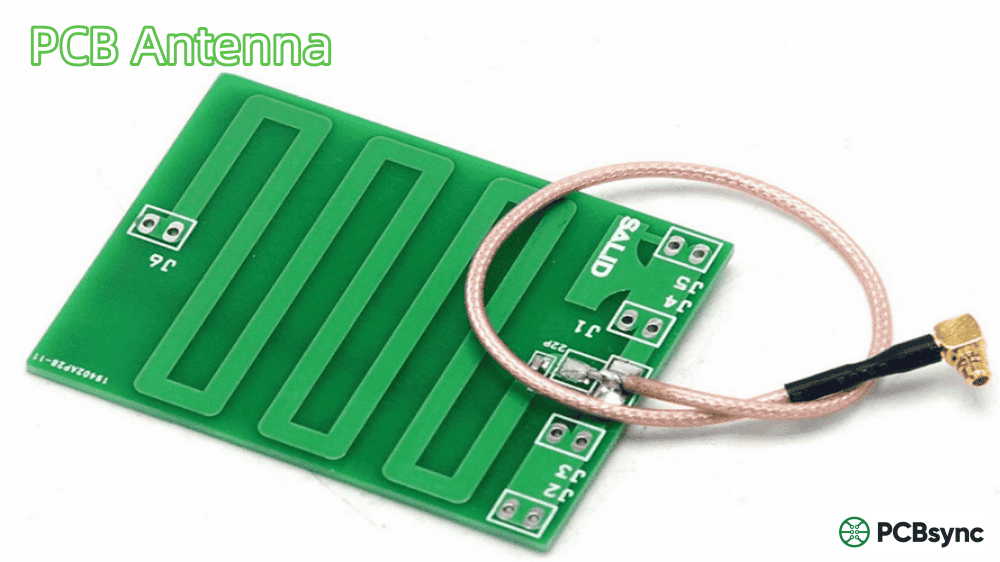
Meander antennas fold the required electrical length back and forth to fit a shorter physical footprint. This is the most common approach for 433 MHz PCB antenna designs.
How Meander Antennas Work
A meander antenna is essentially a quarter-wave monopole that’s been folded multiple times. The total trace length still needs to approximate λ/4 (accounting for the effective dielectric constant), but the physical footprint shrinks dramatically.
Key relationships:
Total trace length ≈ 80–120 mm (depends on trace width, spacing)
Physical length: 30–60% of straight monopole
Bandwidth: Narrower than straight monopole (but adequate for 433 MHz)
Efficiency: 60–85% (lower than straight monopole)
Meander Antenna Dimension Tables
Small Meander (40 × 20 mm footprint):
Parameter
Dimension
Notes
Physical footprint
40 × 20 mm
Compact design
Trace width
1.0 mm
Balance of Q and size
Trace spacing
1.0 mm
Minimize coupling
Number of meanders
8–10
Folds back and forth
Total trace length
~95 mm
Effective λ/4
Ground clearance
15 mm minimum
From trace to ground
Keep-out zone
45 × 25 mm
No copper
Medium Meander (60 × 30 mm footprint):
Parameter
Dimension
Notes
Physical footprint
60 × 30 mm
Good performance
Trace width
1.5 mm
Lower resistance
Trace spacing
1.5 mm
Reduced mutual coupling
Number of meanders
6–8
Fewer folds
Total trace length
~105 mm
Effective λ/4
Ground clearance
20 mm minimum
Better radiation
Keep-out zone
65 × 35 mm
No copper
Large Meander (80 × 40 mm footprint):
Parameter
Dimension
Notes
Physical footprint
80 × 40 mm
Best PCB antenna performance
Trace width
2.0 mm
Lowest loss
Trace spacing
2.0 mm
Minimal coupling
Number of meanders
4–6
Closest to straight monopole
Total trace length
~115 mm
Effective λ/4
Ground clearance
25 mm minimum
Optimal
Keep-out zone
85 × 45 mm
No copper
Meander Design Rules
Rule
Guideline
Impact
Trace width
1.0–2.0 mm
Wider = lower loss, lower Q
Trace spacing
≥ trace width
Prevents unwanted coupling
Corner style
Curved or 45°
Reduces discontinuities
Feed point
End of meander
Standard monopole feed
Ground clearance
≥ 15 mm
Critical for efficiency
Keep-out
No copper on any layer
Prevents detuning
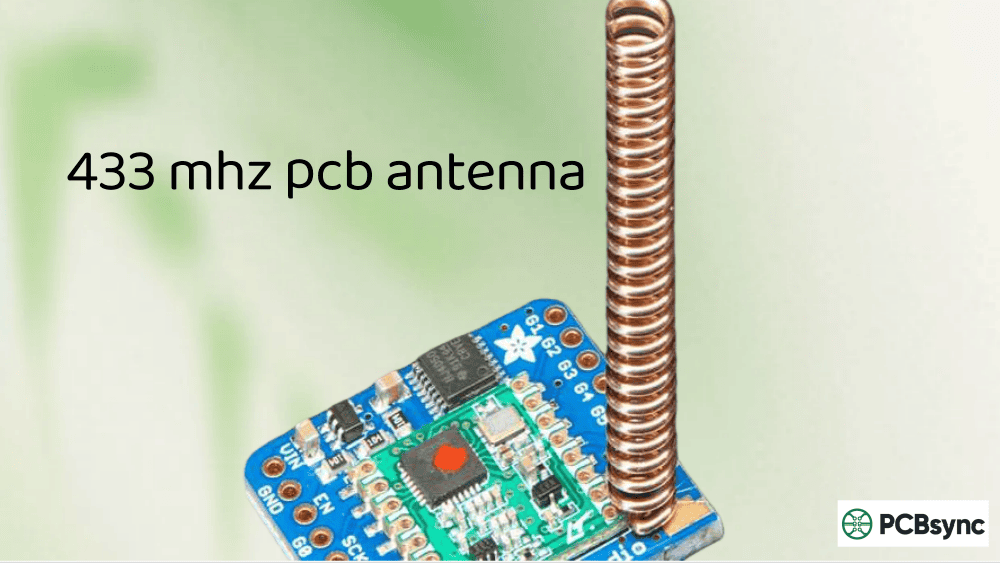
Helical Antenna Alternative
When PCB space is extremely limited, a helical wire antenna offers better performance in a smaller footprint than a PCB meander.
Helical Antenna Specifications for 433 MHz
Parameter
Value
Notes
Wire length
~165–175 mm
Quarter wavelength
Coil diameter
5–8 mm
Wound on form or self-supporting
Number of turns
15–25
Depends on pitch
Coil height
15–25 mm
Physical height
Wire gauge
0.5–1.0 mm
Enameled copper
Gain
+2 to +3 dBi
Better than small meander
PCB vs Helical Comparison
Factor
Meander PCB
Helical Wire
Cost
Free (PCB trace)
Wire + assembly
Size (footprint)
40–80 mm
5–8 mm diameter
Size (height)
~1.6 mm (PCB)
15–25 mm
Performance
Good
Better
Consistency
Excellent
Varies with assembly
Matching
Often needed
Often needed
Helical antennas are popular in key fobs and small remotes where vertical space is available but PCB area is limited.
Ground Plane Requirements for 433 MHz
The ground plane is half your antenna system. At 433 MHz, ground plane requirements are significantly larger than at 2.4 GHz.
Minimum Ground Plane Dimensions
Application
Minimum Size
Recommended Size
Key fob
30 × 50 mm
40 × 60 mm
IoT sensor
40 × 60 mm
50 × 80 mm
Remote control
35 × 70 mm
45 × 90 mm
Alarm sensor
50 × 80 mm
60 × 100 mm
Gateway/hub
60 × 100 mm
80 × 120 mm
Ground Plane Design Rules
Rule
Requirement
Why It Matters
No copper under antenna
ALL layers clear
Prevents severe detuning
Ground edge position
Perpendicular to antenna
Affects radiation pattern
Via stitching
< 10 mm spacing at 433 MHz
Prevents slot resonance
Minimum dimension
≥ λ/8 (86 mm) ideal
Adequate counterpoise
Cable/wire routing
Keep away from antenna
Cables become part of antenna
At 433 MHz, cables connected to your device (USB, power, sensors) can significantly affect antenna performance because their lengths are comparable to the wavelength. Consider this during system design.
Problem: USB/power cables near antenna. Effect: Cables radiate, pattern distortion, detuning. Solution: Route cables away from antenna, use ferrites.
Mistake 5: No Matching Network Provision
Problem: No footprints for tuning components. Effect: Can’t adjust for manufacturing variation or enclosure. Solution: Always include Pi network footprints.
Mistake 6: Using Wrong Inductor Type
Problem: Multilayer ceramic inductors in matching network. Effect: High loss, poor Q, wasted power. Solution: Use thin film or wirewound inductors.
Useful Resources for 433 MHz Antenna Design
Application Notes and Datasheets
Document
Source
Content
SWRA730
Texas Instruments
433–930 MHz tunable PCB antenna
AN849
Silicon Labs
434 MHz antenna selection guide
AN850
Silicon Labs
434 MHz antenna measurement reports
CC1101 Datasheet
Texas Instruments
Transceiver RF specifications
SX1278 Datasheet
Semtech
LoRa transceiver specifications
WP008
Radiocrafts
ISM band antenna selection
Design Tools
Tool
Purpose
Cost
NanoVNA
Antenna measurement
$50–100
AppCAD
Matching network
Free
Saturn PCB Toolkit
Trace impedance
Free
MMANA-GAL
Antenna simulation
Free
4NEC2
Antenna modeling
Free
Reference Designs
Design
Source
Features
CC1101EMK-433
TI
Reference with meander
LAUNCHXL-CC1352P
TI
Multi-band reference
RFM95W
HopeRF
LoRa 433 MHz module
Si4463 reference
Silicon Labs
ISM transceiver
Frequently Asked Questions
What’s the minimum PCB size for a 433 MHz antenna?
The minimum practical PCB size for a 433 MHz PCB antenna is approximately 40mm × 60mm. This provides enough space for a compact meander antenna (40mm × 20mm) plus the minimum ground plane (40mm × 40mm) needed for the antenna to function properly. Smaller boards are possible but require compromises—either using a helical wire antenna that extends off the board, using a chip antenna with reduced performance, or accepting significantly reduced range. For best results with a meander PCB antenna, target 60mm × 80mm or larger.
How do I match a 433 MHz antenna to a CC1101?
The CC1101 has a differential RF output, so you first need a balun to convert to single-ended. Use the reference balun values from TI’s application notes (27nH inductors, 6.8pF capacitors). After the balun, add a Pi matching network between the balun output and your antenna. Start with the matching footprints populated with a 0Ω series resistor and no shunt capacitors. Measure S11 with a NanoVNA, identify the antenna’s impedance at 433 MHz, then add shunt capacitors and series inductors as needed to bring the resonance to 433.92 MHz with S11 < -10 dB.
Why is my 433 MHz range much shorter than expected?
Poor range at 433 MHz typically results from: (1) Insufficient ground plane—at 433 MHz you need at least 40×60mm, larger is better; (2) Ground copper under the antenna on any layer—check inner layers carefully; (3) Missing or incorrect matching network—verify S11 < -10 dB at 433 MHz; (4) Nearby metal objects or cables acting as parasitic elements; (5) Enclosure effects detuning the antenna. Start by measuring S11 with a VNA. If resonance is off 433 MHz, adjust matching. If resonance is correct but range is still poor, examine ground plane size and nearby metal/cable interference.
Can I use a chip antenna at 433 MHz?
Yes, but chip antennas at 433 MHz have significant limitations. Due to the long wavelength, 433 MHz chip antennas are larger than 2.4 GHz versions (typically 10-20mm long), have lower efficiency, and are more sensitive to ground plane size and nearby objects. They require careful matching and extensive tuning. Chip antennas make sense when board space is extremely limited and some performance reduction is acceptable. For most applications, a meander PCB antenna or helical wire antenna provides better performance. If you must use a chip antenna, follow the manufacturer’s layout guidelines exactly and expect to spend time tuning.
How does a meander antenna compare to a straight wire antenna?
A straight quarter-wave wire (173mm at 433 MHz) always outperforms a meander PCB antenna because it has the full electrical length without the losses introduced by folding. Expect 2-4 dB better performance from a wire monopole versus a compact meander. However, meander antennas offer practical advantages: they’re integrated into the PCB (no assembly), consistent (no variation from wire placement), lower profile, and often adequate for short-to-medium range applications. Use a wire monopole when maximum range is critical and space permits; use a meander when size constraints or production considerations favor an integrated solution.
Conclusion
Designing a working 433 MHz PCB antenna requires respecting the long wavelength—173mm for a quarter wave versus 31mm at 2.4 GHz. Meander antennas let you compress that length into a practical 40-80mm footprint, but you need adequate ground plane (minimum 40×60mm), proper clearance (15mm from antenna to ground), and usually a matching network to tune the final design.
My recommendation for new 433 MHz designs: start with a medium-sized meander (60×30mm) on a board with at least 60×80mm of ground plane. Include Pi matching network footprints even if you don’t expect to use them. Copy the meander dimensions from a reference design (TI’s SWRA730 is excellent) before trying to optimize.
Test with a NanoVNA before production. S11 should be below -10 dB at 433.92 MHz with at least 5 MHz of bandwidth. Compare range against a known reference like a 173mm wire monopole—your meander should achieve 60-80% of the wire’s range in a fraction of the space.
The 433 MHz band remains popular for IoT and remote control applications because it penetrates obstacles better than 2.4 GHz and requires simpler circuitry. With proper antenna design, you can achieve reliable communication over hundreds of meters with milliwatt power levels—exactly what low-power IoT applications require.
Inquire: Call 0086-755-23203480, or reach out via the form below/your sales contact to discuss our design, manufacturing, and assembly capabilities.
Quote: Email your PCB files to Sales@pcbsync.com (Preferred for large files) or submit online. We will contact you promptly. Please ensure your email is correct.
Notes: For PCB fabrication, we require PCB design file in Gerber RS-274X format (most preferred), *.PCB/DDB (Protel, inform your program version) format or *.BRD (Eagle) format. For PCB assembly, we require PCB design file in above mentioned format, drilling file and BOM. Click to download BOM template To avoid file missing, please include all files into one folder and compress it into .zip or .rar format.