Inquire: Call 0086-755-23203480, or reach out via the form below/your sales contact to discuss our design, manufacturing, and assembly capabilities.
Quote: Email your PCB files to Sales@pcbsync.com (Preferred for large files) or submit online. We will contact you promptly. Please ensure your email is correct.
Notes: For PCB fabrication, we require PCB design file in Gerber RS-274X format (most preferred), *.PCB/DDB (Protel, inform your program version) format or *.BRD (Eagle) format. For PCB assembly, we require PCB design file in above mentioned format, drilling file and BOM. Click to download BOM template To avoid file missing, please include all files into one folder and compress it into .zip or .rar format.
As a PCB engineer who has worked on high-layer count designs for aerospace and telecom applications, I can tell you that 42 layer PCB technology represents the cutting edge of circuit board manufacturing. When standard 4-layer or even 16-layer boards cannot accommodate the routing density, signal integrity requirements, or power distribution needs of your design, ultra-high layer count PCBs become essential.
This guide covers everything you need to know about 42 layer PCB design, manufacturing, materials, and applications—written from practical experience rather than theoretical concepts.
A 42 layer PCB is a multilayer printed circuit board featuring 42 conductive copper layers separated by dielectric insulation materials. Unlike standard multilayer boards that typically range from 4 to 16 layers, these ultra-high-density circuit boards are engineered for applications where extreme routing complexity, superior signal integrity, and dense component integration are non-negotiable requirements.
The basic structure consists of signal layers for data transmission, ground planes for EMI shielding and signal return paths, power planes for stable voltage distribution, and multiple prepreg/core layers that bind everything together through sequential lamination processes.
Understanding the architecture of a 42 layer PCB requires visualizing it as a carefully orchestrated sandwich of copper and dielectric materials. Each copper layer serves a specific purpose—whether carrying high-speed differential signals, providing low-impedance power distribution, or acting as reference planes for controlled impedance traces. The insulating prepreg and core materials between layers are selected based on their dielectric properties, thermal characteristics, and compatibility with high-frequency signals.
What makes 42 layer PCBs particularly challenging is not just the sheer number of layers, but the precision required to maintain alignment, impedance control, and reliability across all layers through multiple manufacturing cycles.
Why 42 Layers? Understanding the Design Rationale
The decision to use a 42 layer PCB typically stems from several converging requirements. High-speed digital designs operating at frequencies above 25 Gbps demand multiple dedicated ground reference planes adjacent to signal layers. Dense BGA packages with over 2,000 pins need extensive routing escape channels across multiple layers. Power integrity requirements for modern processors may necessitate 8-12 power plane pairs for different voltage rails. Additionally, controlled impedance requirements for differential pairs often mandate specific stackup configurations that consume layers quickly.
In practical terms, if your design requires fanout from multiple high-pin-count BGAs while maintaining 100-ohm differential impedance for PCIe 5.0 signals, you will consume layers faster than you might expect.
42 Layer PCB Stackup Design
The stackup is the foundation of any successful 42 layer PCB design. Getting it wrong means signal integrity problems that cannot be fixed through routing changes.
Stackup Configuration Principles
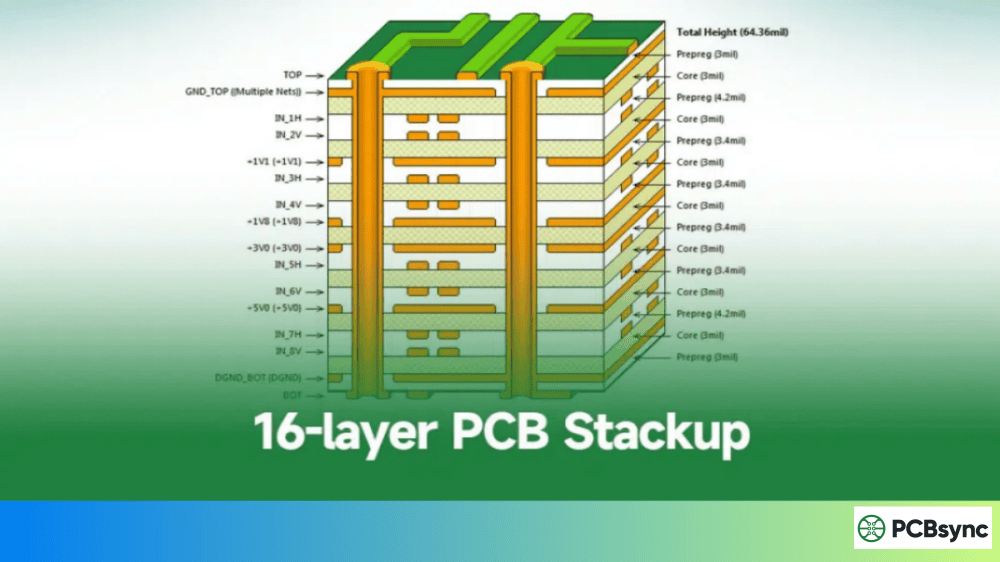
A typical 42 layer PCB stackup follows a symmetrical arrangement around a center core. This symmetry is critical for preventing warpage during the lamination process and thermal cycling. Signal layers are placed adjacent to solid ground or power planes to provide controlled impedance and short return paths.
Here is a simplified representation of a common 42 layer stackup structure:
Layer Type
Function
Typical Copper Weight
Signal (Top)
Component placement, high-speed routing
0.5-1 oz
Ground
Reference plane, EMI shielding
1-2 oz
Signal
Internal routing
0.5 oz
Ground
Reference plane
1-2 oz
Power
VDD distribution
1-2 oz
Signal
Internal routing
0.5 oz
Ground
Reference plane
1-2 oz
Continue pattern…
Core
Center mechanical support
N/A
Mirror pattern to bottom
For high-speed designs, I recommend keeping signal layers sandwiched between ground planes whenever possible. This stripline configuration provides better EMI containment compared to microstrip traces on outer layers.
Impedance Control in High Layer Count Boards
Maintaining consistent impedance across 42 layers requires tight control over dielectric thickness, trace width, and copper roughness. For differential pairs running at 25+ Gbps, even minor variations in dielectric constant (Dk) can cause impedance discontinuities that degrade signal quality.
Target specifications for high-speed 42 layer PCBs include impedance tolerance of ±5-7% (±3-5% for critical nets), dielectric thickness tolerance of ±0.5 mil or better, and registration accuracy below 3 mils between layers.
Signal Integrity and EMC Considerations
In 42 layer PCB design, signal integrity is not an afterthought—it is the primary design constraint. With data rates exceeding 25 Gbps becoming standard in data center applications, designers must account for transmission line effects, crosstalk, power delivery network impedance, and electromagnetic compatibility from the earliest design stages.
The stackup architecture directly influences EMC performance. Ground planes act as shields, containing electromagnetic emissions from high-speed traces and providing low-impedance return paths that minimize loop area. In a well-designed 42 layer stackup, every signal layer has an adjacent reference plane, typically within 3-4 mils distance.
Power integrity represents another critical aspect. With modern processors drawing 200-400W in transient conditions, the power delivery network must maintain sub-milliohm impedance from DC to several hundred MHz. This requirement drives the use of multiple thin power-ground plane pairs distributed throughout the stackup, rather than thick power planes concentrated in one area.
Material choice becomes significantly more critical as layer counts increase. The wrong laminate selection can result in excessive signal loss, reliability failures, or manufacturing yield problems.
High-Performance Laminate Options
For 42 layer PCB applications, several laminate categories are commonly specified:
Material Type
Dk @ 10GHz
Df @ 10GHz
Tg (°C)
Applications
Standard High-Tg FR-4
4.2-4.5
0.020-0.025
170-180
General purpose, cost-sensitive
Mid-Loss FR-4 (IS620)
3.8-4.0
0.008-0.012
200+
PCIe Gen4, moderate speed
Low-Loss (Megtron 6)
3.4-3.6
0.002-0.004
200+
25+ Gbps, backplanes
Very Low Loss (Tachyon)
3.0-3.2
0.002
200+
56+ Gbps, highest performance
Rogers PTFE
3.0-3.5
0.001-0.002
280+
RF/microwave, hybrid stackups
For most data center and telecom backplane applications requiring 42 layers, Panasonic Megtron 6 or Isola Tachyon provide an excellent balance of electrical performance and manufacturability. Rogers materials, while offering superior high-frequency performance, present challenges in high-layer-count sequential lamination and typically cost 2-3x more than comparable epoxy-based laminates.
Critical Material Properties
Beyond Dk and Df values, 42 layer PCB materials must exhibit low Z-axis coefficient of thermal expansion (CTE) below 50 ppm/°C to prevent via reliability issues during thermal cycling. High glass transition temperature (Tg) above 180°C ensures dimensional stability during multiple lamination cycles. CAF (Conductive Anodic Filament) resistance is critical for fine-pitch vias in humid environments. Low moisture absorption below 0.15% prevents Dk variation and delamination.
Via Technologies in 42 Layer PCBs
Interconnecting 42 copper layers requires sophisticated via strategies. Relying solely on through-hole vias would consume excessive routing real estate and create unacceptable stub lengths for high-speed signals.
Via Types and Their Applications
Through-hole vias connect all 42 layers but create stubs that cause signal reflections above 5-10 Gbps. They are best suited for power distribution and low-speed signals.
Blind vias connect outer layers to internal layers and are essential for BGA fanout. Typical configurations include L1-L2 or L1-L4 connections using laser drilling for smaller diameters.
Buried vias connect internal layers only and are invisible from the surface. They free up routing space on outer layers but require sequential lamination.
Microvias are laser-drilled vias with diameters below 150µm (typically 75-100µm). They are essential for HDI sections under fine-pitch BGAs. The IPC defines microvias as having a maximum aspect ratio of 1:1.
Stacked microvias consist of multiple microvias aligned vertically and filled with copper to create connections spanning several layers. This approach maximizes routing density in HDI regions.
Via Design Guidelines for 42 Layer PCBs
Via Type
Typical Diameter
Aspect Ratio
Drill Method
Through-hole
8-12 mil
10:1 to 15:1
Mechanical
Blind
6-10 mil
0.75:1 to 1:1
Laser or mechanical
Buried
8-12 mil
8:1 to 12:1
Mechanical
Microvia
3-4 mil
0.75:1 to 1:1
Laser
Stacked
3-4 mil per level
1:1 per level
Laser with fill
For high-speed signals in 42 layer boards, back-drilling through-hole vias is often mandatory. By removing the unused via stub, back-drilling can reduce signal reflections by 60-70% at 25 Gbps data rates. Target stub lengths should be below 10 mils for optimal performance.
42 Layer PCB Manufacturing Process
Manufacturing a 42 layer PCB requires multiple sequential lamination cycles, precise registration, and rigorous process control. Not all PCB fabricators possess the capability to produce boards with this layer count reliably.
Sequential Lamination Process
Unlike standard multilayer PCBs manufactured in a single lamination cycle, 42 layer boards require 3-5 sequential lamination steps. Each cycle introduces potential registration errors and thermal stress.
The process begins with core fabrication, where individual cores (typically 2-layer or 4-layer subunits) are processed with their circuit patterns. These cores undergo inner layer processing through imaging, etching, and inspection. The first lamination bonds the initial core stack together with prepreg layers under controlled heat and pressure. Blind via formation follows, using laser drilling to create blind vias, with subsequent plating and filling. Multiple buildup cycles repeat the lamination and via formation process for each additional layer group. Through-hole processing creates through-hole vias after all layers are laminated. Final processing includes outer layer imaging, plating, solder mask application, and surface finishing.
Manufacturing Challenges and Solutions
Fabricating 42 layer PCBs presents several significant challenges. Layer-to-layer registration must maintain accuracy below 3-5 mils across all 42 layers despite multiple thermal cycles. Solutions include laser direct imaging (LDI) and X-ray registration systems. Thickness control must manage overall board thickness (typically 4-6mm for 42 layers) while maintaining uniform dielectric spacing. Careful prepreg selection and lamination pressure optimization address this challenge. Via reliability requires ensuring plated through-hole integrity with aspect ratios up to 15:1, addressed through optimized electroless and electrolytic plating processes. Warpage control minimizes bow and twist in thick, multi-lamination boards through symmetrical stackup design and stress-relief annealing.
Applications of 42 Layer PCBs
The extreme complexity and cost of 42 layer PCBs limit their use to applications where no alternative exists. However, within these specialized domains, they have become indispensable components enabling technological advancement.
Data Center and Server Infrastructure
Modern AI server motherboards now average 18-22 layers, with some high-performance computing applications pushing toward 40+ layers. The explosive growth in artificial intelligence workloads has driven unprecedented demand for high-layer-count boards capable of supporting massive parallel processing architectures.
The 42 layer PCB finds its home in enterprise server backplanes interconnecting multiple processor cards over high-speed serial links, network switch line cards handling 400G Ethernet ports, storage controllers managing NVMe connections to dense drive arrays, and AI accelerator carrier boards supporting multiple GPU or TPU modules.
In data center environments, these boards must maintain signal integrity across hundreds of high-speed channels while operating continuously in thermally challenging conditions. The reliability requirements are stringent—system downtime translates directly to revenue loss measured in thousands of dollars per minute.
Telecommunications Infrastructure
5G base station equipment relies on 42 layer PCBs for massive MIMO antenna arrays requiring complex RF distribution networks, baseband processing units handling multiple frequency bands, backhaul equipment supporting 100G+ optical interfaces, and router line cards for carrier-grade networking equipment.
The telecommunications industry’s transition to 5G and preparation for 6G has created demand for boards that can handle both high-frequency RF signals and high-speed digital processing on the same substrate. This mixed-signal requirement often pushes layer counts beyond what standard manufacturing can accommodate, making 42 layer PCBs essential for next-generation network infrastructure.
Aerospace and Defense
Military and aerospace applications demand 42 layer PCBs for avionics systems requiring extreme reliability, radar signal processing with mixed RF and digital sections, satellite communication payloads, and electronic warfare systems.
These applications add additional requirements beyond civilian use cases. Boards must withstand extreme temperature ranges from -55°C to +125°C, resist vibration and mechanical shock, and operate reliably for 15-20 year service lives without field replacement options. The AS9100D certification requirements for aerospace applications mandate extensive documentation, traceability, and testing protocols that further complicate manufacturing.
Medical Equipment
High-end medical imaging systems including MRI, CT, and PET scanners use ultra-high layer count boards for image processing subsystems and high-density sensor interfaces. The precision required for medical diagnostics demands exceptional signal integrity to prevent imaging artifacts.
Medical applications also impose unique regulatory requirements. Boards used in life-critical equipment must meet IEC 60601 standards for electromagnetic compatibility and patient safety. The extended qualification cycles for medical devices mean that once a 42 layer design is qualified, changes become extremely expensive and time-consuming.
Cost Factors and Lead Time
The cost and timeline for 42 layer PCB projects differ substantially from standard Multilayer PCB production.
Cost Considerations
42 layer PCBs typically cost 10-20x more than equivalent-sized 8-layer boards. Key cost drivers include materials (30-40% of total cost) where specialized low-loss laminates add significant expense. Multiple lamination cycles (25-35%) increase fabrication time. Via processing (15-20%) involves laser drilling, back-drilling, and copper filling. Testing and inspection (10-15%) require extensive electrical testing and cross-section analysis. Low yield rates introduce additional cost factors, with yield rates for 42 layer boards running 60-80% compared to 95%+ for standard multilayer boards.
Layer Count
Relative Cost
Typical Lead Time
4 layer
1x
5-7 days
8 layer
2-3x
7-10 days
16 layer
4-6x
2-3 weeks
32 layer
12-18x
4-6 weeks
42 layer
18-25x
6-10 weeks
Lead Time Expectations
Standard production lead times for 42 layer PCBs range from 6-10 weeks. Prototype quantities may extend to 8-12 weeks depending on material availability. Expedited services are rarely available due to process complexity.
For projects requiring 42 layer PCBs, engaging with your PCB manufacturing partner early in the design phase is essential to validate stackup feasibility and material lead times.
Quality Standards and Testing
IPC Classification for High-Layer Count PCBs
42 layer PCBs intended for critical applications typically require IPC-6012 Class 3 qualification. Key Class 3 requirements include minimum copper plating thickness of 25µm in holes, tighter annular ring requirements (minimum 50µm), enhanced thermal stress testing, and more stringent visual and dimensional requirements.
Testing Requirements
Test Type
Method
Acceptance Criteria
Electrical
Flying probe or bed-of-nails
100% netlist verification
Impedance
TDR
±5-7% of target
Via integrity
Microsection
Per IPC-6012 Class 3
Thermal stress
Solder float
No delamination
IST/HATS
Accelerated cycling
>1000 cycles
Design Tips from the Field
After working on numerous high-layer-count projects, here are practical recommendations. Start stackup discussions early—engage your fabricator before finalizing the layer count. Their input on material availability and process capabilities can save weeks of redesign. Plan for back-drilling—design through-hole vias with back-drill in mind, ensuring adequate clearance from adjacent features. Budget for respins—first-article 42 layer boards rarely achieve 100% yield, so plan for at least one design iteration. Use simulation—with 42 layers, fixing signal integrity problems post-fabrication is prohibitively expensive. Invest in pre-layout simulation. Document extensively—detailed stackup documentation, impedance requirements, and via specifications are critical for manufacturer communication.
FAQs About 42 Layer PCB Technology
What is the maximum layer count possible for PCBs?
While most manufacturers cap practical production at 40-50 layers, specialized fabricators can produce boards exceeding 60 layers. However, beyond 50 layers, yield rates drop significantly, and costs increase exponentially. Most high-performance applications can be addressed with 30-40 layer designs through careful optimization.
How thick is a typical 42 layer PCB?
A standard 42 layer PCB ranges from 4.0mm to 6.5mm total thickness, depending on dielectric materials and copper weights used. Thicker boards (approaching 8mm) are possible but create challenges for plated through-hole aspect ratios.
What is the typical turnaround time for 42 layer PCB prototypes?
Expect 6-10 weeks for prototype quantities. This timeline includes material procurement (2-3 weeks), fabrication (3-5 weeks), and testing/inspection (1-2 weeks). Expedited production below 6 weeks is rarely available for layer counts above 30.
Can 42 layer PCBs be manufactured with flex sections?
Yes, rigid-flex construction is possible but adds substantial complexity. The flex sections typically contain 4-8 layers, while rigid sections can extend to 40+ layers. This construction requires specialized materials like polyimide for flex sections and careful transition zone design.
What software tools support 42 layer PCB design?
Professional tools like Cadence Allegro, Siemens Xpedition, and Altium Designer all support high-layer-count designs. Key requirements include robust layer stack management, field solver integration for impedance calculation, and comprehensive DFM checking capabilities.
Useful Resources
For deeper learning on high-layer-count PCB design and manufacturing, these resources provide valuable information:
Industry Standards:
IPC-2221B: Generic Standard on Printed Board Design
IPC-6012: Qualification and Performance Specification for Rigid Printed Boards
IPC-2226: HDI Design Standard
Design Tools:
Saturn PCB Toolkit: Free impedance and via calculator
Polar Instruments SI9000: Professional impedance planning software
Ansys SIwave: Signal integrity simulation
Technical References:
High Speed Digital Design by Howard Johnson
Signal Integrity Simplified by Eric Bogatin
Conclusion
42 layer PCB technology enables the most demanding electronic designs in telecommunications, data centers, aerospace, and high-performance computing. Success with these ultra-high-density boards requires careful attention to stackup design, material selection, via strategy, and manufacturing partnership.
While the complexity and cost are substantial, for applications requiring extreme routing density, superior signal integrity at 25+ Gbps, and complex power distribution—42 layer PCBs remain the enabling technology that makes modern high-performance electronics possible.
The evolution of 42 layer PCB technology continues to advance in parallel with semiconductor progress. As chip interfaces push toward 112 Gbps per lane and beyond, board-level interconnects must keep pace. This drives ongoing innovation in materials science, manufacturing processes, and design methodologies.
For engineers considering a 42 layer design, the key success factors remain consistent: engage with experienced fabricators before finalizing your layer count, validate stackup assumptions through pre-layout simulation, and build sufficient schedule margin for the extended manufacturing cycle. Working with a manufacturing partner who has demonstrated capability in high-layer-count production is worth any premium over less experienced alternatives—the cost of failed prototypes far exceeds any savings from competitive bidding.
The future of 42 layer PCB technology points toward even greater integration. Advanced packaging techniques like 2.5D and 3D integration, chiplets, and embedded components will change how we think about board-level interconnect. Yet the fundamental principles of stackup design, signal integrity, and manufacturing process control will remain relevant regardless of how the technology evolves.
Start your high-layer-count project by engaging with experienced fabricators early, validating your stackup assumptions through simulation, and building sufficient schedule margin for the extended manufacturing cycle these sophisticated boards require. The investment in proper planning and partnership pays dividends in successful first-article builds and reliable production outcomes.
Inquire: Call 0086-755-23203480, or reach out via the form below/your sales contact to discuss our design, manufacturing, and assembly capabilities.
Quote: Email your PCB files to Sales@pcbsync.com (Preferred for large files) or submit online. We will contact you promptly. Please ensure your email is correct.
Notes: For PCB fabrication, we require PCB design file in Gerber RS-274X format (most preferred), *.PCB/DDB (Protel, inform your program version) format or *.BRD (Eagle) format. For PCB assembly, we require PCB design file in above mentioned format, drilling file and BOM. Click to download BOM template To avoid file missing, please include all files into one folder and compress it into .zip or .rar format.