Inquire: Call 0086-755-23203480, or reach out via the form below/your sales contact to discuss our design, manufacturing, and assembly capabilities.
Quote: Email your PCB files to Sales@pcbsync.com (Preferred for large files) or submit online. We will contact you promptly. Please ensure your email is correct.
Notes: For PCB fabrication, we require PCB design file in Gerber RS-274X format (most preferred), *.PCB/DDB (Protel, inform your program version) format or *.BRD (Eagle) format. For PCB assembly, we require PCB design file in above mentioned format, drilling file and BOM. Click to download BOM template To avoid file missing, please include all files into one folder and compress it into .zip or .rar format.
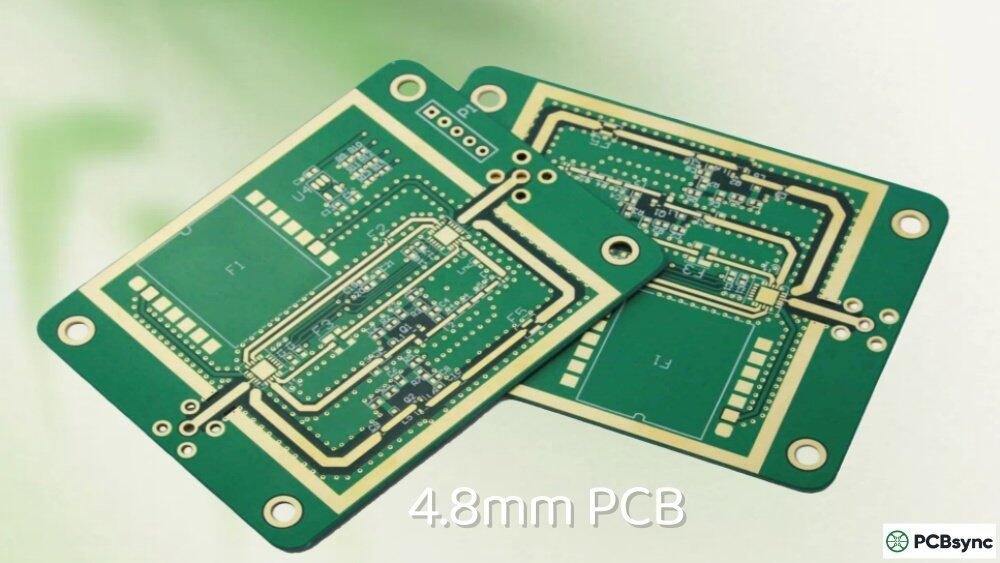
When your backplane design pushes beyond 4.5mm but you’re hesitant about the significant cost jump to 5.0mm, a 4.8mm PCB becomes an engineer’s strategic choice. I’ve specified this thickness on several high-layer telecom and data center projects, and it consistently delivers the performance margin needed without premium pricing.
A 4.8mm PCB (189 mil or 0.189″) sits firmly in heavy-duty backplane territory – thick enough to support 30-38 layer designs with heavy copper integration, yet positioned just below where manufacturing complexity steps up considerably. According to industry standards, boards exceeding 4.0mm with typical crimp hole designs qualify as PCB backplanes, and the 4.8mm thickness represents serious capability within this category.
Why 4.8mm PCB Represents the Heavy-Duty Sweet Spot
The jump from 4.5mm to 5.0mm isn’t linear in terms of cost and complexity. At 5.0mm, many fabricators require different equipment setups, extended processing cycles, and more stringent quality controls. A 4.8mm PCB captures most of the benefits while staying within the manufacturing envelope of sub-5.0mm processing.
4.8mm PCB Position in the Backplane Thickness Spectrum
Thickness
Classification
Typical Layer Count
Heavy Copper
Relative Cost
4.0mm
Backplane entry
20-28 layers
4-6oz
Baseline
4.5mm
Mid-backplane
26-32 layers
5-8oz
+15-20%
4.8mm
Heavy-duty
30-38 layers
6-10oz
+25-35%
5.0mm
Major threshold
32-40 layers
8-12oz
+45-60%
6.0mm
Extreme
36-48 layers
10-15oz
+80-120%
Typical backplane thickness ranges from 4mm-6mm according to manufacturing literature, with the 4.8mm PCB sitting comfortably in this established range.
When Your Design Demands a 4.8mm PCB
Based on project experience and industry research, engineers typically specify 4.8mm PCB thickness in these situations:
High Layer Count Requirements (30+ Layers)
When your design requires 30-38 layers with proper dielectric spacing for impedance control, a 4.8mm PCB provides the stack-up depth needed without compromises.
Layer Count
At 4.5mm
At 4.8mm
At 5.0mm
30 layers
Tight dielectrics
Comfortable spacing
Extra margin
34 layers
Very challenging
Achievable
Comfortable
38 layers
Not feasible
Challenging but doable
Achievable
Heavy Copper Power Distribution
High-current backplanes often require 6oz or heavier copper on power layers. Heavy copper PCBs with weights from 3oz to 6oz are commonly used for high power distribution and heat dissipation. A 4.8mm PCB accommodates this copper weight while maintaining signal layer spacing.
Copper Weight
Current Capacity (5mm trace)
Thermal Improvement
1oz standard
~30A maximum
Baseline
4oz heavy
~80A maximum
+30-40% better
6oz heavy
~100A maximum
+40-50% better
10oz extreme
~150A maximum
+50-60% better
Press-Fit Connector Reliability
The additional board thickness of a 4.8mm PCB provides enhanced mechanical support and longer copper sleeve engagement for press-fit connections. Press-fit technology requires tight hole tolerance (±0.05mm compared to standard ±0.10mm) and works best with thicker boards where copper barrel length increases pin retention force.
4.8mm PCB Stack-Up Design Principles
Designing a stack-up for a 4.8mm PCB requires balancing layer count, copper weights, and manufacturing feasibility.
34-Layer 4.8mm PCB Stack-Up Configuration
Layer
Function
Material
Thickness (mm)
Copper
L1
Signal (Top)
Copper
0.035
1oz
PP
Prepreg 2116
FR-4 Tg170
0.114
–
L2
Ground
Copper
0.035
1oz
Core
Laminate
FR-4
0.100
–
L3
Signal
Copper
0.018
0.5oz
PP
Prepreg 1080×2
FR-4
0.127
–
L4
Power
Copper
0.070
2oz
L5-L31
Mixed Signal/Power/GND
Various
~4.05
Mixed
L32
Signal
Copper
0.018
0.5oz
L33
Ground
Copper
0.035
1oz
PP
Prepreg 2116
FR-4
0.114
–
L34
Signal (Bottom)
Copper
0.035
1oz
Total
~4.8mm
Heavy Copper 4.8mm PCB Configuration Options
Configuration
Power Layer Copper
Signal Layer Copper
Practical Layer Count
Standard
2oz (70μm)
1oz (35μm)
34-38 layers
Enhanced Power
3oz (105μm)
1oz (35μm)
30-34 layers
High Current
4oz (140μm)
1oz (35μm)
26-32 layers
Extreme Power
6oz (210μm)
2oz (70μm)
22-28 layers
Aspect Ratio Management for 4.8mm PCB
At 4.8mm thickness, aspect ratio becomes a primary design constraint. The industry-standard maximum for mechanically drilled vias is 10:1.
4.8mm PCB Via Design Guidelines
Via Type
Minimum Diameter
Aspect Ratio
Plating Challenge
Aggressive
0.48mm (19 mil)
10:1
High – requires pulse plating
Recommended
0.50mm (20 mil)
9.6:1
Moderate – reliable process
Conservative
0.55mm (22 mil)
8.7:1
Standard – easy plating
Relaxed
0.60mm (24 mil)
8:1
Low – highest reliability
My recommendation for 4.8mm PCB designs: use 0.50mm minimum via diameter as your baseline. This provides a workable 9.6:1 aspect ratio with margin for manufacturing tolerance.
Via Strategy Options for 4.8mm PCB
Strategy
Implementation
Benefit
Cost Impact
Through-hole only
Standard PTH
Simplest process
Baseline
Blind vias (outer)
L1-L4 connections
Better BGA fanout
+30-40%
Buried vias
Inner layer connections
Internal routing density
+35-45%
Sequential lamination
Multiple build cycles
Maximum flexibility
+50-70%
Back-drilling
Stub removal
High-speed signal integrity
+15-25%
Back-Drilling Requirements for 4.8mm PCB High-Speed Design
In thick backplanes like a 4.8mm PCB, via stubs create significant signal integrity problems at high frequencies. Back-drilling is essential for designs operating above 10 Gbps.
Via Stub Impact on Signal Integrity
Signal Speed
Maximum Stub Length
Back-Drill Required?
3-5 Gbps
2.5mm tolerable
Optional
10-15 Gbps
0.8mm maximum
Required
25-56 Gbps
0.4mm maximum
Mandatory
56+ Gbps (PAM4)
0.25mm maximum
Mandatory
For a 4.8mm PCB, an undrilled via stub can exceed 3-4mm – far above acceptable limits for modern high-speed protocols. Industry guidelines recommend stub length be controlled within 0.25mm to minimize effects on signal transmission quality.
Back-Drilling Specifications for 4.8mm PCB
Parameter
Specification
Notes
Back-drill diameter
Via diameter + 0.20-0.25mm
Ensures complete stub removal
Depth tolerance
±0.05mm (2 mil)
Critical for avoiding layer damage
Minimum back-drill size
0.45mm (18 mil)
Smaller drills prone to breakage
Target stub length
0.15-0.20mm (6-8 mil)
Per IPC-6012 recommendations
Manufacturing Challenges for 4.8mm PCB
Working with 4.8mm PCB thickness means engaging with specialized manufacturing processes.
Diamond Drilling for 4.8mm PCB
Standard mechanical drilling struggles with the depth of a 4.8mm PCB. The solution is diamond drilling (two-pass drilling), where holes are drilled from both sides to meet in the middle.
Drilling Method
Application
Achievable Tolerance
Cost Impact
Single-pass mechanical
Larger holes (>0.6mm)
±0.05mm
Standard
Diamond drilling
Precision PTH holes
±0.03mm
+20-30%
Controlled-depth
Blind vias, back-drill
±0.05mm
+25-35%
Electroplating at High Aspect Ratios
Achieving uniform copper plating in deep holes requires advanced processes:
Plating Process
Aspect Ratio Capability
Application
Conventional DC
Up to 8:1
Standard holes
Pulse plating
Up to 10:1
Standard boards
Pulse-reverse plating
Up to 12:1
Thick boards, small vias
Specify fabricators with pulse-reverse plating capability for 4.8mm PCB projects requiring high aspect ratios.
A 4.8mm PCB typically supports 30-38 layers depending on copper weights. With 0.5oz inner copper and optimized thin cores, you can achieve 36-38 layers. With heavy copper (3-4oz) on power layers, expect 28-32 layers maximum while maintaining proper impedance control.
How does 4.8mm PCB compare to 5.0mm for cost?
A 4.8mm PCB typically costs 15-25% less than an equivalent 5.0mm board. Savings come from reduced material costs, shorter processing cycles, and avoiding the manufacturing complexity threshold at 5.0mm.
What via size should I use for 4.8mm PCB?
Use 0.50mm (20 mil) minimum finished hole diameter to achieve a manageable 9.6:1 aspect ratio. For smaller vias needed for BGA fanout, use blind via structures from outer layers.
Is back-drilling required for all 4.8mm PCB designs?
Back-drilling is strongly recommended for signals above 10 Gbps and mandatory above 25 Gbps. The deep via stubs (3-4mm) create significant degradation at high frequencies. Budget 15-25% additional cost for back-drilling.
Can quick-turn shops produce 4.8mm boards?
Most standard quick-turn fabricators cannot reliably produce 4.8mm boards. This thickness requires specialized lamination, diamond drilling, and pulse-reverse plating equipment. Expect 5-6 weeks lead time from experienced backplane fabricators.
Fabricator Selection for 4.8mm PCB Projects
Not all PCB manufacturers can reliably produce 4.8mm boards. Here’s what to verify before committing to a design:
Essential Fabricator Capabilities for 4.8mm PCB
Capability
Minimum Requirement
Preferred Capability
Maximum board thickness
5.0mm+
6.0mm+
Aspect ratio capability
10:1
12:1
Back-drilling
Available
In-house with depth control
Diamond drilling
Available
Routine production process
Pulse-reverse plating
Available
Standard for thick boards
Press-fit experience
Demonstrated
Backplane production history
Key Questions for Potential 4.8mm PCB Fabricators
Before selecting a fabricator for your 4.8mm PCB project, ask these questions: What is your standard aspect ratio capability for through-hole vias? Do you perform diamond drilling in-house? What back-drilling depth tolerance can you achieve? Can you provide pulse-reverse plating for high aspect ratio holes? What is your typical lead time for 4.8mm, 34-layer backplanes? Do you have experience with press-fit connector holes requiring ±0.05mm tolerance?
Design Best Practices for 4.8mm PCB Success
Based on multiple 4.8mm PCB projects, these practices lead to successful outcomes:
Pre-Design Checklist for 4.8mm PCB
Before committing to a 4.8mm PCB design, confirm fabricator capability and verify they regularly produce boards at this thickness. Request stack-up consultation to get fabricator input on achievable material combinations. Define via strategy early including blind/buried vias and back-drilling requirements. Establish signal integrity budget by simulating via stubs and planning mitigation. Budget for extended lead time by adding 1-2 weeks buffer to standard schedules.
Layout Guidelines for 4.8mm PCB
Design Practice
Specification
Reasoning
Minimum via diameter
0.50mm (20 mil)
Safe 9.6:1 aspect ratio
Via-to-via spacing
0.65mm minimum
Manufacturing margin for drilling
Copper balance
Symmetric distribution
Prevents warpage during lamination
Power plane splits
Minimize
Maintains thermal distribution
Test coupon inclusion
Impedance and micro-section
Verify fabrication quality
Conclusion: Is a 4.8mm PCB Right for Your Project?
Specifying a 4.8mm PCB makes engineering and economic sense when your design has outgrown 4.5mm but doesn’t justify the substantial cost increase of 5.0mm. This heavy-duty thickness delivers the performance needed for demanding backplane applications at a more accessible price point.
The 4.8mm PCB is the right choice when your design requires 30-36 layers with comfortable dielectric spacing, heavy copper needs (6-8oz) strain thinner options, and you need nearly 5.0mm capability without the premium pricing. This thickness supports high-speed protocols up to 56 Gbps with proper back-drilling, accommodates extensive press-fit connector arrays, and provides the thermal mass needed for high-power data center and telecom equipment.
Work closely with your fabricator from the earliest design stages – decisions made during schematic capture impact producibility months later. Request stack-up consultation, verify aspect ratio and back-drilling capabilities, and build appropriate schedule buffer for this thickness class. When you need heavy-duty backplane performance without crossing into 5.0mm territory, the 4.8mm PCB delivers exactly what demanding applications require.
Suggested Meta Descriptions for 4.8mm PCB Article
Option 1 (159 characters): 4.8mm PCB guide for heavy-duty backplanes: layer count capabilities, aspect ratio management, back-drilling requirements, and cost comparison vs 5.0mm thickness.
Option 2 (156 characters): Complete 4.8mm PCB design guide covering stack-up configurations, via strategies, manufacturing challenges, and when to choose this heavy-duty PCB thickness.
Option 3 (160 characters): Engineer’s guide to 4.8mm PCB backplane design: 30-38 layer capability, 6-10oz heavy copper, back-drilling for high-speed signals. Save 15-25% versus 5.0mm.
Option 5 (155 characters): Heavy-duty 4.8mm PCB thickness guide: backplane applications, stack-up design, via management, signal integrity, and cost-effective alternative to 5.0mm.
Inquire: Call 0086-755-23203480, or reach out via the form below/your sales contact to discuss our design, manufacturing, and assembly capabilities.
Quote: Email your PCB files to Sales@pcbsync.com (Preferred for large files) or submit online. We will contact you promptly. Please ensure your email is correct.
Notes: For PCB fabrication, we require PCB design file in Gerber RS-274X format (most preferred), *.PCB/DDB (Protel, inform your program version) format or *.BRD (Eagle) format. For PCB assembly, we require PCB design file in above mentioned format, drilling file and BOM. Click to download BOM template To avoid file missing, please include all files into one folder and compress it into .zip or .rar format.