Inquire: Call 0086-755-23203480, or reach out via the form below/your sales contact to discuss our design, manufacturing, and assembly capabilities.
Quote: Email your PCB files to Sales@pcbsync.com (Preferred for large files) or submit online. We will contact you promptly. Please ensure your email is correct.
Notes: For PCB fabrication, we require PCB design file in Gerber RS-274X format (most preferred), *.PCB/DDB (Protel, inform your program version) format or *.BRD (Eagle) format. For PCB assembly, we require PCB design file in above mentioned format, drilling file and BOM. Click to download BOM template To avoid file missing, please include all files into one folder and compress it into .zip or .rar format.
330 Ohm Resistor: Color Code, LED Circuits & Practical Applications
If you’ve ever lit up an LED on a breadboard, chances are you’ve used a 330 ohm resistor without giving it much thought. It’s probably the most-grabbed component in any beginner’s kit, and for good reason. This particular resistance value hits a sweet spot for protecting LEDs across common voltage supplies while keeping things bright enough to actually see.
I’ve placed thousands of these on prototype boards over the years, and the 330 ohm value consistently proves itself as the go-to current limiter for basic LED work. Let’s break down everything you need to know about identifying and using this essential component.
A 330 ohm resistor provides exactly 330 ohms of electrical resistance. That “ohm” unit measures how strongly the component opposes current flow through your circuit. In practical terms, when you connect a 330 ohm resistor in series with an LED and a 5V supply, you’re limiting current to roughly 9-10 milliamps, which is safe operating territory for most standard LEDs.
The 330 ohm value belongs to the E12 and E24 standard resistor series, meaning it’s a universally stocked value that you’ll find at any electronics supplier. This standardization keeps costs low and availability high.
Key Specifications of 330 Ohm Resistors
Parameter
Typical Value
Notes
Resistance
330 Ω
E12/E24 standard value
Common Tolerances
±5%, ±1%, ±10%
Gold, Brown, or Silver band
Power Ratings
1/8W, 1/4W, 1/2W, 1W
1/4W most common
Temperature Coefficient
100-250 ppm/K
Depends on construction
Maximum Voltage
150-350V
Varies by package
330 Ohm Resistor Color Code
Identifying a 330 ohm resistor by its color bands is straightforward once you know the pattern. The distinctive double-orange start makes this value easy to spot, even in a pile of mixed resistors.
4-Band 330 Ohm Resistor Color Code
The standard 4-band configuration for a 330 ohm resistor uses these colors:
Band Position
Color
Value
Meaning
1st Band
Orange
3
First significant digit
2nd Band
Orange
3
Second significant digit
3rd Band
Brown
×10
Multiplier
4th Band
Gold
±5%
Tolerance
Reading it: Orange-Orange-Brown-Gold gives you 33 × 10 = 330Ω with ±5% tolerance.
That gold tolerance band means your actual resistance falls somewhere between 313.5Ω and 346.5Ω. For LED work and most general applications, this variance doesn’t matter.
5-Band 330 Ohm Resistor Color Code
For precision applications, you’ll encounter 5-band resistors with tighter tolerances:
Band Position
Color
Value
Meaning
1st Band
Orange
3
First significant digit
2nd Band
Orange
3
Second significant digit
3rd Band
Black
0
Third significant digit
4th Band
Black
×1
Multiplier
5th Band
Brown
±1%
Tolerance
The 5-band code Orange-Orange-Black-Black-Brown represents 330 × 1 = 330Ω with ±1% tolerance.
6-Band 330 Ohm Resistor Color Code
When temperature stability matters, look for 6-band resistors:
Band Position
Color
Value
Meaning
1st Band
Orange
3
First significant digit
2nd Band
Orange
3
Second significant digit
3rd Band
Black
0
Third significant digit
4th Band
Black
×1
Multiplier
5th Band
Brown
±1%
Tolerance
6th Band
Brown
100 ppm/K
Temperature coefficient
The sixth band tells you how much the resistance drifts with temperature changes.
Resistor Color Code Reference Chart
Color
Digit
Multiplier
Tolerance
Black
0
×1
–
Brown
1
×10
±1%
Red
2
×100
±2%
Orange
3
×1,000
–
Yellow
4
×10,000
–
Green
5
×100,000
±0.5%
Blue
6
×1,000,000
±0.25%
Violet
7
–
±0.1%
Gray
8
–
±0.05%
White
9
–
–
Gold
–
×0.1
±5%
Silver
–
×0.01
±10%
SMD 330 Ohm Resistor Markings
Surface mount 330 ohm resistors use numerical codes instead of color bands. Here’s how to identify them:
3-Digit SMD Code
A 330 ohm resistor in 3-digit format is marked 331.
Breaking it down:
First two digits (33) = significant figures
Third digit (1) = number of zeros to add = one zero
Result: 33 + one zero = 330Ω
Don’t confuse this with 330 marked on an SMD, which actually means 33Ω (33 with zero additional zeros).
4-Digit SMD Code
Precision SMD resistors use 3300 for 330 ohms:
First three digits (330) = significant figures
Fourth digit (0) = multiplier = ×1
Result: 330 × 1 = 330Ω
EIA-96 Code
For 1% tolerance SMDs, the EIA-96 system marks 330Ω as 33A:
33 = code for 330 (from lookup table)
A = multiplier of ×1
SMD Marking System
Code for 330Ω
Typical Tolerance
3-Digit
331
±5%
4-Digit
3300
±1%
EIA-96
33A
±1%
Circuit Applications for 330 Ohm Resistors
The 330 ohm resistor shines brightest in LED circuits, but its usefulness extends far beyond that single application.
LED Current Limiting
This is the primary use case, and it’s worth understanding the math behind it. LEDs require current limiting because they’ll happily draw as much current as your power supply can deliver, then promptly burn out.
The calculation:
R = (Vsupply – Vforward) / I
For a typical red LED (2V forward voltage) on a 5V Arduino pin at 10mA:
R = (5V – 2V) / 0.010A = 300Ω
The nearest standard value? 330 ohm. This gives you approximately 9.1mA, which keeps most LEDs happy and visible.
Supply Voltage
LED Forward Voltage
Current with 330Ω
3.3V
2.0V (Red)
3.9 mA
5V
2.0V (Red)
9.1 mA
5V
3.2V (Blue/White)
5.5 mA
9V
2.0V (Red)
21.2 mA
12V
2.0V (Red)
30.3 mA
Notice how the current jumps significantly at 9V and 12V. For those higher voltages, you might want a larger resistor value, or the 330 ohm still works but runs the LED brighter (and hotter).
Arduino and Microcontroller Projects
The 330 ohm resistor appears constantly in Arduino tutorials for good reason. It’s the standard recommendation for:
GPIO pin LED indicators
Status light circuits
Learning projects and breadboard experiments
Basic sensor indicator circuits
When you see a circuit diagram calling for “220-330 ohm” for an LED, either value works fine. The 330 ohm runs slightly dimmer but with better thermal margin.
Pull-Up and Pull-Down Resistors
While not the most common value for pull-ups (10K is more typical), a 330 ohm resistor works well as a strong pull-up when you need fast rise times or when driving longer cable runs where capacitance becomes a factor.
Transistor Base Biasing
In switching circuits, a 330 ohm resistor limits base current to transistors like the 2N2222 or BC547. With 5V drive:
Ibase = (5V – 0.7V) / 330Ω = 13mA
That’s enough base drive to saturate the transistor for loads up to about 1.3A (assuming hFE of 100).
Optocoupler Input Circuits
The input LED of optocouplers like the PC817 typically runs at 10-20mA. A 330 ohm resistor from a 5V logic signal provides appropriate current without stressing the internal LED.
Voltage Divider Circuits
Pair a 330 ohm resistor with another value to create specific voltage ratios:
R1
R2
Vout (from 5V input)
330Ω
330Ω
2.5V
330Ω
1kΩ
3.76V
330Ω
680Ω
3.37V
1kΩ
330Ω
1.24V
Power Rating Selection
Before using a 330 ohm resistor, verify the power dissipation won’t exceed the component’s rating.
Power formula: P = I² × R or P = V² / R
For a 330 ohm resistor with 10mA flowing through it:
P = (0.010)² × 330 = 0.033W = 33mW
A standard 1/4W (250mW) resistor handles this easily with plenty of headroom.
Current Through 330Ω
Power Dissipated
Minimum Rating
5 mA
8.25 mW
1/8W fine
10 mA
33 mW
1/8W fine
20 mA
132 mW
1/4W fine
27 mA
240 mW
1/4W marginal
40 mA
528 mW
1W needed
Package Sizes for SMD 330 Ohm Resistors
Package
Size (mm)
Typical Power
0201
0.6 × 0.3
1/20W (50mW)
0402
1.0 × 0.5
1/16W (62.5mW)
0603
1.6 × 0.8
1/10W (100mW)
0805
2.0 × 1.25
1/8W (125mW)
1206
3.2 × 1.6
1/4W (250mW)
For typical LED current limiting, 0603 or 0805 packages work perfectly with 330 ohm values.
Color code mix-ups happen, especially under poor lighting:
Value
Color Code
Easy Identifier
33Ω
Orange-Orange-Black
Black multiplier
330Ω
Orange-Orange-Brown
Brown multiplier
3.3kΩ
Orange-Orange-Red
Red multiplier
When in doubt, use your multimeter. A quick resistance check takes seconds and prevents smoking components.
Using 330Ω with High Voltage Sources
At 12V with a standard 2V LED, a 330 ohm resistor passes over 30mA. Many indicator LEDs are rated for 20mA maximum. Consider using 470Ω or 560Ω for 12V applications.
Ignoring Temperature in Precision Circuits
A standard 330 ohm carbon film resistor can drift by several percent over temperature. For circuits where the exact resistance matters, use metal film resistors with tighter temperature coefficients.
How to Measure a 330 Ohm Resistor
Verifying resistance takes just a moment with a digital multimeter:
Set your meter to resistance mode (Ω)
Select a range including 330Ω (usually 2kΩ range or auto-range)
Remove the resistor from any circuit
Touch the probes to each lead
Read the display and confirm it falls within tolerance
A ±5% 330 ohm resistor should measure between 313.5Ω and 346.5Ω. If your reading falls outside this range, the resistor may be damaged or incorrectly marked.
330 Ohm vs. Other Common Resistor Values
Value
Color Code
Typical Use
100Ω
Brown-Black-Brown
Higher current LEDs, motor control
220Ω
Red-Red-Brown
LED limiting (brighter than 330Ω)
330Ω
Orange-Orange-Brown
Standard LED limiting, GPIO protection
470Ω
Yellow-Violet-Brown
LED limiting at higher voltages
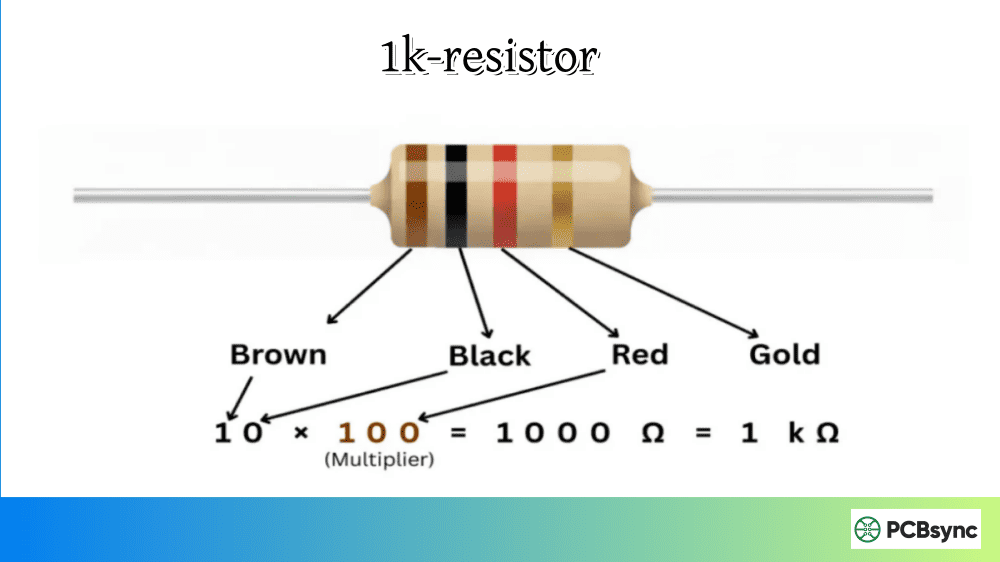
1kΩ
Brown-Black-Red
Pull-ups, general purpose
The 330 ohm sits in a useful middle ground for 5V LED work, providing good brightness without pushing components too hard.
A 4-band 330 ohm resistor has the color code Orange-Orange-Brown-Gold. The first orange band represents 3, the second orange band represents 3, the brown band is a ×10 multiplier, and the gold band indicates ±5% tolerance. Multiply 33 by 10 to get 330 ohms. For 5-band precision resistors, the code is Orange-Orange-Black-Black-Brown.
Why is 330 ohm commonly used with LEDs?
The 330 ohm value provides safe current limiting for standard LEDs across common voltage supplies. With a 5V source and a typical 2V red LED, 330Ω limits current to about 9mA, which is within the safe operating range for most indicator LEDs while still producing good visible brightness. It’s become a default recommendation in Arduino and hobbyist electronics because it works reliably across many LED types without calculation.
Can I use 220 ohm instead of 330 ohm for an LED?
Yes, in most cases you can substitute a 220Ω resistor for a 330 ohm in LED circuits. The LED will run brighter (about 13.6mA instead of 9.1mA at 5V with a 2V LED) but still within safe limits for most standard LEDs rated at 20mA. If you’re concerned about LED lifespan or heat, stick with 330 ohm. If you want maximum brightness, 220Ω works fine.
What is the SMD marking for a 330 ohm resistor?
For standard tolerance SMD resistors, a 330 ohm value is marked 331 using the 3-digit code (33 with one zero added). For precision 1% resistors using the 4-digit code, look for 3300. Don’t confuse 330 marked on an SMD with 330Ω. The code 330 actually represents 33Ω (33 with zero additional zeros).
How much current does a 330 ohm resistor allow at 5V?
Using Ohm’s Law (I = V/R), a 330 ohm resistor with 5V across it allows 15.15mA to flow. However, in LED circuits, you subtract the LED’s forward voltage first. For a typical red LED with 2V forward drop: I = (5V – 2V) / 330Ω = 9.1mA. For blue or white LEDs with 3.2V forward voltage: I = (5V – 3.2V) / 330Ω = 5.5mA.
Summary
The 330 ohm resistor earns its reputation as the default LED current limiter through simple practicality. It’s safe across common voltage supplies, widely available, and requires zero calculation for basic projects. The Orange-Orange-Brown color pattern becomes instantly recognizable once you’ve built a few circuits.
For SMD work, remember that 331 is your target marking. And always keep a strip of these in your parts drawer because you’ll reach for them constantly.
Whether you’re blinking your first Arduino LED or designing a production prototype, the 330 ohm resistor remains an essential building block of practical electronics.
Suggested Meta Descriptions
Primary (154 characters): Learn the 330 ohm resistor color code (Orange-Orange-Brown-Gold), LED circuit calculations, and SMD markings. Complete guide with tables and practical examples.
Alternative (148 characters): 330 ohm resistor guide: decode the color code, calculate LED circuits, and understand SMD markings (331). Practical tips for Arduino and breadboard projects.
Inquire: Call 0086-755-23203480, or reach out via the form below/your sales contact to discuss our design, manufacturing, and assembly capabilities.
Quote: Email your PCB files to Sales@pcbsync.com (Preferred for large files) or submit online. We will contact you promptly. Please ensure your email is correct.
Notes: For PCB fabrication, we require PCB design file in Gerber RS-274X format (most preferred), *.PCB/DDB (Protel, inform your program version) format or *.BRD (Eagle) format. For PCB assembly, we require PCB design file in above mentioned format, drilling file and BOM. Click to download BOM template To avoid file missing, please include all files into one folder and compress it into .zip or .rar format.