Inquire: Call 0086-755-23203480, or reach out via the form below/your sales contact to discuss our design, manufacturing, and assembly capabilities.
Quote: Email your PCB files to Sales@pcbsync.com (Preferred for large files) or submit online. We will contact you promptly. Please ensure your email is correct.
Notes: For PCB fabrication, we require PCB design file in Gerber RS-274X format (most preferred), *.PCB/DDB (Protel, inform your program version) format or *.BRD (Eagle) format. For PCB assembly, we require PCB design file in above mentioned format, drilling file and BOM. Click to download BOM template To avoid file missing, please include all files into one folder and compress it into .zip or .rar format.
When I first worked on a 30 layer PCB project for a high-frequency radar system, I quickly realized this wasn’t just “more layers.” The complexity scales exponentially once you move beyond 20 layers. A 30 layer PCB represents the upper tier of high-density interconnect technology, reserved for applications where component density, signal integrity, and thermal performance are non-negotiable. This guide covers everything you need to know about designing, manufacturing, and sourcing 30 layer PCBs based on real-world engineering experience.
A 30 layer PCB is a printed circuit board containing 30 individual conductive copper layers separated by dielectric materials, all laminated together under heat and pressure. This high layer count enables extremely complex routing, dedicated power distribution networks, comprehensive shielding, and high-density component integration that simpler boards cannot achieve.
To put this in perspective, a standard consumer electronics board might use 4-6 layers. Industrial equipment typically runs 8-12 layers. Once you hit 20+ layers, you’re in specialized territory: aerospace avionics, medical imaging systems, supercomputers, and advanced telecommunications infrastructure.
The key differentiator with a 30 layer PCB isn’t just the layer count—it’s the engineering precision required at every stage. Registration tolerances tighten. Material selection becomes critical. And the cost of design errors multiplies significantly.
30 Layer PCB Basic Specifications
Parameter
Typical Specification
Layer Count
30 layers
Total Thickness
3.0mm – 6.0mm
Minimum Trace Width
3 mil (75μm)
Minimum Spacing
3 mil (75μm)
Minimum Via Diameter
0.15mm – 0.2mm
Aspect Ratio
Up to 12:1
Copper Weight
0.5oz – 2oz per layer
Dielectric Material
FR-4, High-Tg FR-4, Rogers, Megtron
Surface Finish
ENIG, Immersion Silver, OSP, Hard Gold
Why Choose a 30 Layer PCB?
Not every project needs 30 layers. In fact, most don’t. But when you’re facing specific technical challenges, nothing else will do.
High-Density Component Integration
Modern BGA packages with 1500+ pins require substantial routing escape channels. With a 30 layer PCB, you can break out dense BGA patterns across multiple signal layers while maintaining clean power delivery. I’ve seen projects where engineers tried to squeeze a high-pin-count FPGA onto a 16-layer board—the result was routing nightmares and compromised signal integrity.
Signal Integrity Requirements
High-speed designs (10+ Gbps) demand controlled impedance, proper reference planes, and adequate isolation between signal groups. A 30 layer stackup provides room for dedicated ground reference layers adjacent to every signal layer, which dramatically reduces crosstalk and maintains impedance consistency.
Power Distribution Networks
Complex mixed-signal designs often require multiple isolated power domains. A 30 layer PCB allows you to dedicate entire planes to different voltage rails (1.0V core, 1.8V I/O, 3.3V analog, 5V legacy, etc.) without compromising signal routing capacity.
EMI/EMC Compliance
Achieving electromagnetic compliance certification gets harder as frequencies increase. Additional shielding layers in a 30 layer PCB can contain emissions and reduce susceptibility, often making the difference between passing and failing EMC testing.
30 Layer PCB Stackup Design
The stackup is arguably the most critical design decision for any Multilayer PCB. Get it wrong, and you’ll face signal integrity issues, thermal problems, or manufacturing defects. With 30 layers, the stakes are higher.
Typical 30 Layer PCB Stackup Structure
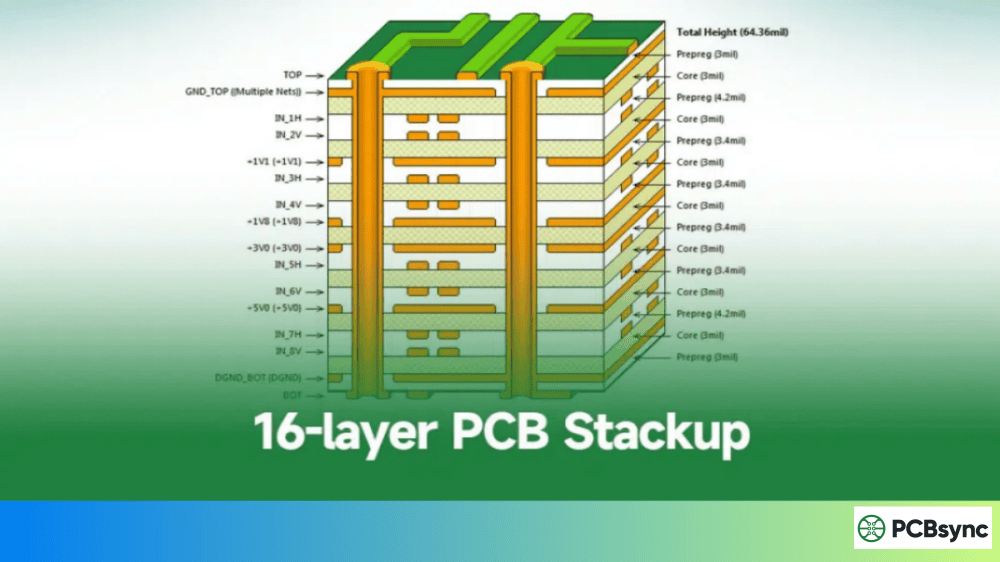
A well-designed 30 layer stackup follows a symmetrical arrangement to prevent warpage during lamination. Here’s an example structure I’ve used successfully:
Layer
Function
Material
Thickness
L1
Signal (TOP)
Copper 1oz
35μm
PP
Prepreg
1080
65μm
L2
Ground
Copper 0.5oz
17.5μm
Core
Core
FR-4
100μm
L3
Signal
Copper 0.5oz
17.5μm
PP
Prepreg
2116
120μm
L4
Power (VCC)
Copper 1oz
35μm
Core
Core
FR-4
100μm
L5
Signal
Copper 0.5oz
17.5μm
PP
Prepreg
1080
65μm
L6
Ground
Copper 0.5oz
17.5μm
…
Pattern repeats…
…
…
L25
Ground
Copper 0.5oz
17.5μm
PP
Prepreg
1080
65μm
L26
Signal
Copper 0.5oz
17.5μm
Core
Core
FR-4
100μm
L27
Power
Copper 1oz
35μm
PP
Prepreg
2116
120μm
L28
Signal
Copper 0.5oz
17.5μm
Core
Core
FR-4
100μm
L29
Ground
Copper 0.5oz
17.5μm
PP
Prepreg
1080
65μm
L30
Signal (BOT)
Copper 1oz
35μm
Stackup Design Principles for 30 Layer PCB
Symmetry is mandatory. An asymmetric stackup will warp during cooling after lamination. With 30 layers, even small asymmetries compound into significant bow and twist.
Signal layers need adjacent reference planes. Every high-speed signal layer should have a solid ground or power plane immediately adjacent. This establishes controlled impedance and provides a return path for high-frequency currents.
Power and ground plane pairs should be closely coupled. Tight spacing (2-4 mils) between power and ground planes creates interplane capacitance, which helps with power delivery decoupling.
Separate analog and digital domains. If your design mixes analog and digital signals, assign them to different layer groups with separate reference planes.
Material choice directly impacts signal integrity, thermal performance, and long-term reliability. Standard FR-4 works for many applications, but 30 layer designs often push into territory where it falls short.
Stick with standard FR-4 when signal frequencies stay below 5 GHz and the design doesn’t face extreme thermal cycling. Move to high-performance materials when:
Signal data rates exceed 10 Gbps
Operating temperatures regularly exceed 100°C
The application requires extended operational life (aerospace, medical implants)
Impedance tolerance requirements are tighter than ±10%
For a 30 layer PCB, I typically recommend at least High-Tg FR-4 as a baseline. The lamination process for 30 layers generates significant thermal stress, and standard FR-4 can delaminate or crack under these conditions.
30 Layer PCB Manufacturing Process
The PCB manufacturing process for 30 layer boards follows the same general steps as lower layer counts, but tolerances tighten and process control becomes exponentially more important.
Layer-by-Layer Manufacturing Steps
Inner Layer Processing (L2-L29)
Each inner layer starts as a copper-clad laminate. The process includes:
Photoresist application via dry film lamination
UV exposure through artwork film or LDI (Laser Direct Imaging)
Developing to remove unexposed photoresist
Etching to remove unwanted copper
Stripping remaining photoresist
AOI (Automated Optical Inspection) for defect detection
For 30 layers, you’re processing 28 inner layers. Each requires perfect registration and zero defects. A single scratched layer means scrapping the entire board.
Lamination
This is where 30 layer PCBs get challenging. The process involves:
Layer stackup assembly with prepreg between each layer
Registration pin alignment (mechanical or optical)
Vacuum pressing to remove air
Heated press cycle (typically 180°C for 60-90 minutes)
Controlled cooling to prevent warpage
With 30 layers, the lamination press cycle must be precisely controlled. Temperature gradients across the stack can cause internal stress and delamination.
Drilling
30 layer PCBs typically require multiple drill operations:
Drill Type
Purpose
Typical Diameter
Through-hole
Component leads, vias
0.2mm – 0.5mm
Blind via
Surface-to-inner connections
0.1mm – 0.15mm
Buried via
Inner-to-inner connections
0.1mm – 0.15mm
Back-drill
Stub removal for high-speed
0.3mm – 0.5mm
For high-speed 30 layer designs, back-drilling is almost always required. Via stubs create impedance discontinuities and resonances that degrade signal integrity above 5 GHz.
Plating and Surface Finishing
After drilling, boards go through electroless copper deposition followed by electrolytic plating to build up via walls. Surface finish options include:
ENIG (Electroless Nickel Immersion Gold): Best for fine-pitch BGAs, good shelf life
Immersion Silver: Excellent for high-frequency applications, shorter shelf life
OSP: Cost-effective, limited reflow cycles
Hard Gold: Required for edge connectors and high-wear contacts
Manufacturing Tolerances for 30 Layer PCB
Parameter
Standard Tolerance
Tight Tolerance
Layer-to-layer registration
±3 mil
±2 mil
Trace width
±20%
±10%
Impedance
±10%
±5%
Board thickness
±10%
±5%
Hole position
±3 mil
±2 mil
Annular ring
4 mil minimum
3 mil minimum
30 Layer PCB Applications
Thirty-layer boards appear in applications where technical requirements simply cannot be met with fewer layers.
Aerospace and Defense
Radar systems, satellite communications, and avionics commonly use 30 layer PCBs. These applications demand:
High reliability under thermal cycling (-55°C to +125°C)
Resistance to vibration and mechanical shock
Long operational life (20+ years)
EMI shielding for sensitive receivers
I’ve worked on airborne radar processor boards where the 30-layer stackup was driven entirely by power distribution requirements. The DSP array needed 12 different voltage rails with tight regulation.
Medical Imaging Equipment
CT scanners, MRI systems, and ultrasound machines rely on 30 layer PCBs for data acquisition and image processing. These designs require:
Low-noise analog front ends
High-speed digital processing
Strict EMC compliance for medical certification
High reliability for patient safety
High-Performance Computing
Server processors, network switches, and AI accelerators push the boundaries of what’s possible with PCB technology. A modern server board might run:
56 Gbps PAM4 signaling
DDR5 memory interfaces
PCIe Gen5 links
500W+ power delivery
All of this requires the routing density and power distribution that only a 30 layer PCB can provide.
Telecommunications Infrastructure
5G base stations, optical transport systems, and core network routers use 30 layer designs for:
Multi-gigabit serial links
RF front-end integration
High-current power amplifier support
Dense connector interfaces
30 Layer PCB Design Guidelines
Having designed several 30 layer boards, here are the practical guidelines that save time and money.
Via Strategy
Use blind and buried vias strategically. They add cost but recover routing real estate. On a dense 30 layer design, blind vias can reduce via count by 30-40%.
Plan via stacks carefully. Stacked microvias (via-on-via) are possible but require careful copper filling and plating control. Staggered vias are safer but consume more space.
Back-drill high-speed vias. Any via carrying signals above 5 GHz should be back-drilled to remove stubs. Specify back-drill depth based on your actual stackup.
Power Integrity
Perform PDN analysis early. Use tools like Ansys SIwave or Cadence Sigrity to simulate power delivery impedance. A 30 layer board gives you room for proper decoupling, but only if planned correctly.
Size power planes for current density. Calculate worst-case current flow and ensure copper weight is adequate. Hot spots near high-current ICs can cause long-term reliability issues.
Place decoupling capacitors by frequency. Bulk caps (100μF+) near power entry, mid-range (1-10μF) distributed across the board, and high-frequency (10-100nF) immediately adjacent to IC power pins.
Signal Integrity
Maintain consistent impedance. Define impedance requirements per signal class and verify with field solver calculations. Typical targets:
Signal Type
Impedance Target
Tolerance
Single-ended digital
50Ω
±10%
Differential pairs
100Ω
±10%
DDR memory
40Ω
±10%
High-speed serial
85Ω differential
±5%
Route differential pairs symmetrically. Length matching within 5 mils is typically adequate for signals below 10 Gbps. Tighter matching for faster signals.
Minimize layer transitions. Each via is an impedance discontinuity. Plan routing to minimize signal layer changes, especially for high-speed nets.
30 Layer PCB Cost Factors
A 30 layer PCB costs significantly more than simpler boards. Understanding the cost drivers helps optimize designs.
Right-size the layer count. Before committing to 30 layers, verify that 28 or 26 won’t work. Sometimes creative routing or relaxed trace widths can reduce layer count.
Panel utilization. Work with your fabricator to optimize panel usage. A few millimeters of board dimension change can significantly improve yield.
Material selection. Use high-performance materials only where needed. Hybrid stackups with standard FR-4 cores and low-loss signal layers can reduce cost.
Consolidate orders. Prototypes of 30 layer boards are expensive. Combine prototype and first production runs if schedule permits.
IPC-6012E: Qualification and Performance Specification for Rigid PCBs
IPC-A-600K: Acceptability of Printed Boards (visual standards)
JEDEC JESD22-A104: Thermal Cycling test methodology
IPC-TM-650: Test Methods Manual (includes microsection analysis)
Online Calculators
Most PCB design tools include built-in impedance calculators. For quick estimates, Saturn PCB Toolkit and the Polar Instruments Si9000 are industry standards.
FAQs About 30 Layer PCB
What is the typical lead time for a 30 layer PCB?
Standard lead time ranges from 4-6 weeks for prototypes and 6-8 weeks for production quantities. Quick-turn options exist at premium pricing (2-3 weeks), but quality may be compromised. For aerospace or medical applications requiring full qualification, expect 8-12 weeks minimum.
How much does a 30 layer PCB cost compared to a 10 layer board?
Pricing varies significantly based on specifications, but as a rough guideline, a 30 layer PCB costs 4-6 times more than a comparable 10 layer board. The non-linear scaling comes from increased lamination cycles, tighter process controls, lower yield rates, and specialized equipment requirements. A prototype run of five 30-layer boards (100mm x 100mm) might cost $2,000-$5,000.
Can any PCB manufacturer produce 30 layer boards?
No. Thirty-layer fabrication requires specialized equipment, experienced process engineers, and rigorous quality systems. Only a subset of PCB manufacturers have validated 30+ layer capability. Always verify manufacturer certifications (AS9100 for aerospace, ISO 13485 for medical) and request references for similar projects. Ask to see process capability data for layer count, registration tolerance, and aspect ratio.
What are common failure modes in 30 layer PCB manufacturing?
The most frequent issues include: delamination between layers (caused by moisture absorption, contamination, or thermal stress), registration errors (layers shifting during lamination), barrel cracking in plated through-holes (thermal cycling stress), and impedance variations (prepreg thickness inconsistency). Good fabricators use statistical process control to monitor these parameters and maintain capability.
Is it possible to repair a 30 layer PCB?
Limited repair is possible. Surface component issues (solder bridges, lifted pads) can often be fixed. Internal defects like broken traces or shorts between layers cannot be repaired and require board replacement. For production, focus on design-for-manufacturing practices and thorough testing rather than relying on repair capability. Some aerospace programs allow wire repairs per MIL-STD-2000, but this requires special certification.
Conclusion
A 30 layer PCB represents serious engineering commitment. The design complexity, manufacturing challenges, and cost premium all demand careful justification. But when your application requires extreme component density, pristine signal integrity, robust power delivery, or comprehensive EMI containment, nothing else delivers equivalent performance.
Success with 30 layer designs comes from understanding the entire ecosystem: materials science, manufacturing processes, design tools, and test methodologies. Work closely with your fabricator from day one. Share your stackup intentions early. Get DFM feedback before finalizing design. The money spent on front-end collaboration saves exponentially more in production.
Whether you’re designing radar systems for defense applications or next-generation server platforms, the principles remain consistent: respect the physics, understand the manufacturing constraints, and never underestimate the value of experienced partners throughout the process.
Inquire: Call 0086-755-23203480, or reach out via the form below/your sales contact to discuss our design, manufacturing, and assembly capabilities.
Quote: Email your PCB files to Sales@pcbsync.com (Preferred for large files) or submit online. We will contact you promptly. Please ensure your email is correct.
Notes: For PCB fabrication, we require PCB design file in Gerber RS-274X format (most preferred), *.PCB/DDB (Protel, inform your program version) format or *.BRD (Eagle) format. For PCB assembly, we require PCB design file in above mentioned format, drilling file and BOM. Click to download BOM template To avoid file missing, please include all files into one folder and compress it into .zip or .rar format.