Inquire: Call 0086-755-23203480, or reach out via the form below/your sales contact to discuss our design, manufacturing, and assembly capabilities.
Quote: Email your PCB files to Sales@pcbsync.com (Preferred for large files) or submit online. We will contact you promptly. Please ensure your email is correct.
Notes: For PCB fabrication, we require PCB design file in Gerber RS-274X format (most preferred), *.PCB/DDB (Protel, inform your program version) format or *.BRD (Eagle) format. For PCB assembly, we require PCB design file in above mentioned format, drilling file and BOM. Click to download BOM template To avoid file missing, please include all files into one folder and compress it into .zip or .rar format.
There’s a moment in every complex design project when you realize standard options won’t cut it. You’ve pushed your layer count to 26 layers, added 6oz copper on the power planes, calculated your stack-up—and the math lands at 3.5mm or more. The standard 3.2mm (125 mil) maximum won’t work. Welcome to 3.6mm PCB territory, where custom engineering begins and standard specifications end.
The 3.6mm PCB thickness (approximately 142 mils or 0.142 inches) occupies a unique position in the PCB spectrum. It’s the first meaningful step beyond the traditional 3.2mm maximum—thick enough to accommodate ultra-high layer counts and heavy copper combinations that can’t fit in standard constructions, yet not so extreme that it requires the specialized infrastructure of 4mm+ backplane manufacturing. For engineers designing advanced test equipment, high-layer-count server boards, or custom power electronics, this thickness often represents the optimal solution.
In this guide, I’ll explain when 3.6mm makes engineering sense, how to design effectively at this custom thickness, and what to expect when working with fabricators on non-standard constructions. If you’ve hit the limits of 3.2mm and need to step up, this is your roadmap.
Understanding 3.6mm PCB as Custom Thickness Territory
A 3.6mm PCB measures approximately 0.142 inches (142 mils) in finished thickness—roughly 12% thicker than the traditional 3.2mm (125 mil) maximum. This might seem like a modest increase, but that additional 0.4mm opens significant design possibilities that simply aren’t achievable within standard thickness constraints.
Where 3.6mm Fits in the Thickness Spectrum
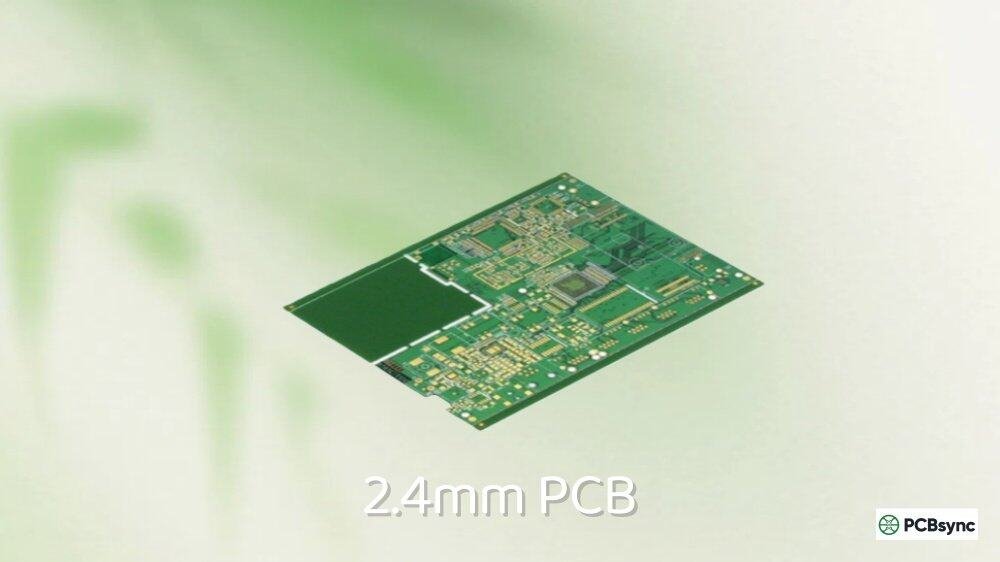
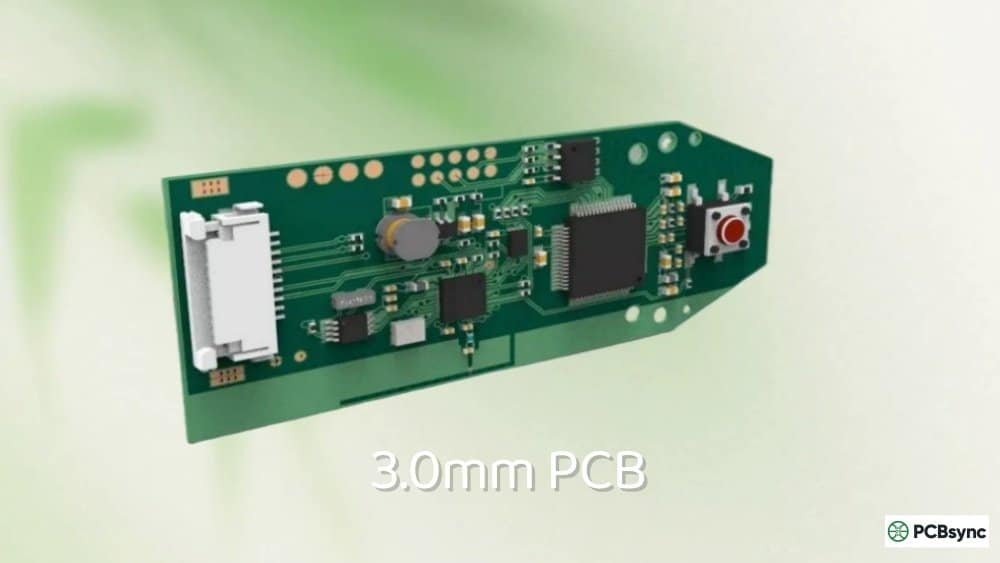
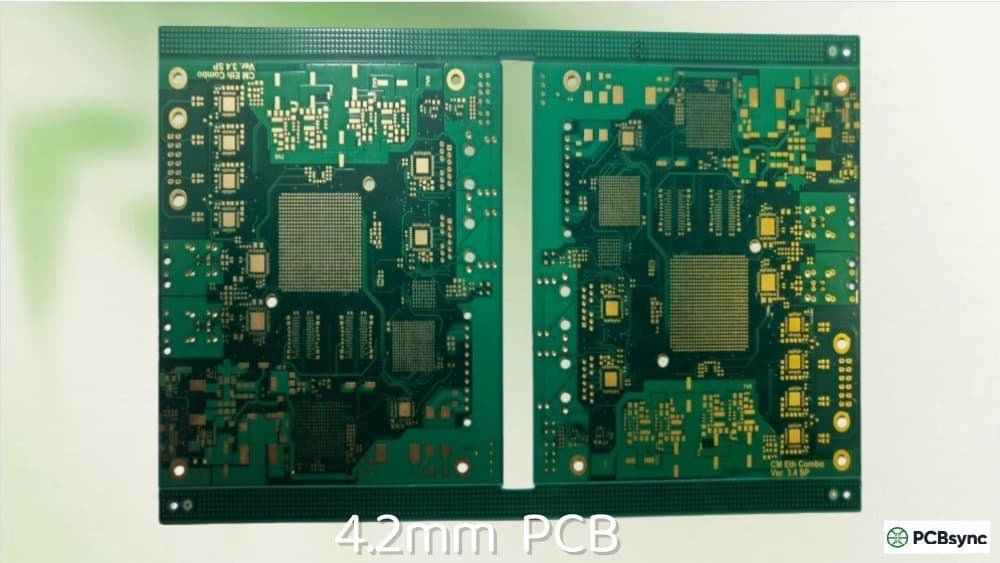
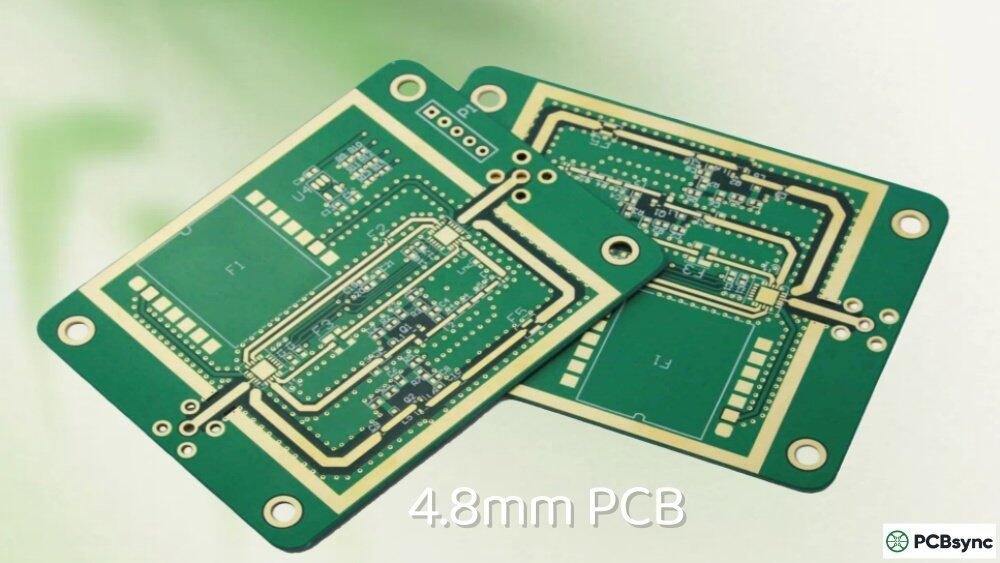
The 3.6mm thickness bridges the gap between standard heavy-duty boards and extreme backplane constructions:
Thickness
Category
Typical Layer Count
Manufacturing Status
2.4mm
Heavy-duty
8-14 layers
Standard stock
3.0mm
Heavy-duty+
12-18 layers
Semi-standard
3.2mm
Maximum standard
16-24 layers
Standard stock
3.6mm
Custom
24-32 layers
Custom order
4.0mm
Extreme
28-36 layers
Specialty fabricators
5.0mm+
Backplane
32-60 layers
Backplane specialists
The 3.6mm PCB sits at the threshold of custom manufacturing. Most standard PCB fabricators list 3.2mm as their maximum standard thickness—anything beyond requires custom quotation, non-standard materials, and potentially longer lead times. But unlike 4mm+ constructions that may require backplane-specialist fabricators, 3.6mm remains within reach of many advanced PCB manufacturers.
Why 3.6mm Instead of Forcing 3.2mm or Jumping to 4.0mm
The decision to specify 3.6mm PCB thickness typically emerges from stack-up calculations that don’t fit neatly into standard options:
When 3.2mm falls short:
Layer count reaches 24-28 with proper dielectric spacing
Heavy copper (5oz-6oz) on multiple layers
Controlled impedance requirements need specific dielectric thicknesses
Combination of high layer count AND heavy copper
When 4.0mm is overkill:
Layer count is under 32
Total copper weight doesn’t demand extreme thickness
Cost optimization matters
Standard (non-backplane) fabricators preferred
The 3.6mm thickness provides exactly the additional space needed for many demanding designs without triggering the cost premiums and lead time extensions associated with true backplane-class manufacturing.
Primary Applications for 3.6mm PCB Designs
Not every thick board needs to jump to custom territory. Here’s where 3.6mm PCB thickness delivers genuine engineering value.
Ultra-High Layer Count Boards (24-32 Layers)
As layer count increases beyond 24, maintaining proper dielectric thickness between layers becomes impossible within 3.2mm constraints. The 3.6mm PCB thickness allows:
Layer Count
Min Dielectric per Layer
Fits in 3.2mm?
Fits in 3.6mm?
20 layers
0.10mm average
Yes
Yes
24 layers
0.09mm average
Marginal
Yes
26 layers
0.08mm average
No
Yes
28 layers
0.075mm average
No
Yes
30 layers
0.07mm average
No
Marginal
32 layers
0.065mm average
No
No (need 4.0mm)
For boards in the 24-28 layer range, 3.6mm PCB construction provides the space needed for manufacturable dielectric thicknesses without jumping to extreme thickness categories.
Heavy Copper Combined with High Layer Counts
The most common driver for 3.6mm thickness is the combination of heavy copper AND high layer counts. Consider a 20-layer design with:
4oz copper on two power planes
3oz copper on two ground planes
1oz copper on 16 signal layers
This configuration adds approximately 0.5mm of copper alone. Combined with necessary dielectric spacing, 3.2mm becomes impossible—but 3.6mm handles it comfortably.
Copper Configuration
Added Thickness
Minimum Board Thickness
20L with 1oz all layers
~0.7mm
2.4-3.0mm
20L with 2oz power planes
~0.8mm
2.8-3.2mm
24L with 3oz power planes
~1.1mm
3.2-3.6mm
24L with 4oz+ power planes
~1.3mm
3.6mm+
Automatic Test Equipment (ATE) and Probe Cards
Test equipment represents a significant market for 3.6mm PCB construction. ATE boards and probe cards require:
Exceptional dimensional stability over temperature
Maximum flatness across large board areas
Heavy copper for power distribution to device-under-test
High layer counts for complex routing to thousands of test points
The additional thermal mass and mechanical rigidity of 3.6mm construction provides measurably better dimensional stability than thinner alternatives—critical when probe alignment tolerances are measured in microns.
Custom Card Cage and Mechanical Interface Requirements
Some applications specify 3.6mm PCB thickness due to mechanical interface requirements:
Legacy card cage systems designed for non-standard slot dimensions
Retrofit applications requiring specific board thickness
Custom connector systems optimized for 142-mil boards
Thermal management systems designed around specific board thickness
When the mechanical system dictates thickness, the PCB must comply—making custom thickness capability essential.
High-Power Industrial and Military Systems
Industrial motor drives, military power systems, and aerospace power distribution often combine:
Achieving exactly 3.6mm requires intentional stack-up planning with non-standard material combinations.
24-Layer 3.6mm PCB Stack-Up Example
This configuration supports high-speed digital designs with enhanced power distribution:
Layer
Type
Material
Copper
Thickness
L1
Signal
1oz
35μm
Prepreg
2116
0.12mm
L2
Ground
1oz
35μm
Core
FR-4
0.15mm
L3
Signal
1oz
35μm
Prepreg
1080
0.08mm
L4
Power
2oz
70μm
Core
FR-4
0.15mm
L5-L8
Signal/Ground
1oz each
140μm total
Core/Prepreg
Various
0.48mm
L9-L12
Signal/Power
1-2oz
175μm total
Core/Prepreg
Various
0.48mm
L13-L16
Signal/Ground
1oz each
140μm total
Core/Prepreg
Various
0.48mm
L17-L20
Signal/Power
1-2oz
175μm total
Core/Prepreg
Various
0.48mm
L21
Power
2oz
70μm
Prepreg
1080
0.08mm
L22
Signal
1oz
35μm
Core
FR-4
0.15mm
L23
Ground
1oz
35μm
Prepreg
2116
0.12mm
L24
Signal
1oz
35μm
Total
~3.6mm
Heavy Copper 3.6mm PCB Configuration
For power applications requiring extreme copper weights:
Layer
Copper Weight
Thickness
Purpose
L1 (Top)
4oz
140μm
High-current bus
L2
2oz
70μm
Ground return
L3-L4
1oz each
70μm
Signal routing
L5
3oz
105μm
Power plane
L6
2oz
70μm
Ground plane
L7-L10
1oz each
140μm
Signal routing
L11
2oz
70μm
Ground plane
L12
3oz
105μm
Power plane
L13-L14
1oz each
70μm
Signal routing
L15
2oz
70μm
Ground return
L16 (Bottom)
4oz
140μm
High-current bus
Total copper
~1.12mm
With dielectrics, this 16-layer heavy-copper configuration reaches approximately 3.6mm—impossible to achieve at 3.2mm with proper dielectric spacing.
Manufacturing Considerations for 3.6mm PCB
The 3.6mm PCB thickness introduces manufacturing challenges that require careful design consideration and fabricator coordination.
Via Aspect Ratio Challenges
Via aspect ratio—the relationship between board thickness and hole diameter—becomes critical at 3.6mm:
Via Diameter
Aspect Ratio at 3.6mm
Plating Quality
Recommendation
0.30mm (12 mil)
12:1
Poor
Not recommended
0.35mm (14 mil)
10.3:1
Marginal
Use with caution
0.40mm (16 mil)
9:1
Acceptable
Minimum recommended
0.45mm (18 mil)
8:1
Good
Preferred
0.50mm (20 mil)
7.2:1
Excellent
Best reliability
For 3.6mm PCB designs, I recommend minimum 0.40mm (16 mil) vias for signal connections and 0.50mm (20 mil) for power and thermal vias. Smaller vias are achievable but require HDI techniques with blind/buried structures.
Drilling and Plating Specifications
Parameter
Standard (3.2mm)
Custom (3.6mm)
Notes
Min mechanical via
0.32mm
0.40mm
Aspect ratio limited
Plating uniformity
±15%
±20%
Longer holes = more variation
Drill tolerance
±0.05mm
±0.075mm
Deeper holes = more drift
Back-drilling depth
Up to 3.0mm
Up to 3.4mm
Equipment dependent
Tolerance Expectations
Parameter
Standard Tolerance
Tight Tolerance
Overall thickness
±10% (±0.36mm)
±5% (±0.18mm)
Dielectric spacing
±10%
±8%
Layer registration
±0.15mm
±0.10mm
Bow and twist
≤1.0%
≤0.75%
For applications where board thickness critically affects mechanical fit, always specify tighter tolerances and confirm fabricator capability before finalizing designs.
Working with Fabricators on 3.6mm PCB Orders
Since 3.6mm falls outside standard offerings, effective fabricator communication is essential.
Pre-Design Consultation Checklist
Before finalizing your 3.6mm PCB design, confirm with potential fabricators:
Question
Why It Matters
Maximum board thickness capability?
Not all shops can do 3.6mm
Available core thicknesses?
Determines achievable stack-ups
Available prepreg options?
Affects dielectric flexibility
Minimum via diameter at 3.6mm?
Constrains routing density
Lead time for custom thickness?
Typically +1-2 weeks
Minimum order quantity?
May require MOQ for custom
Tolerance capability?
Verify achievable precision
Documentation Requirements
For 3.6mm PCB orders, provide:
Complete stack-up specification with material callouts
Explicit thickness tolerance requirements
Impedance targets if controlled impedance required
Via structure details (through-hole, blind, buried)
Cross-section inspection requirements
IPC class specification (Class 2 or Class 3)
Don’t leave any specification to fabricator interpretation—explicitly define everything for custom constructions.
Cost Analysis for 3.6mm PCB Production
Custom thickness commands premium pricing. Understanding the cost structure helps justify specifications to project stakeholders.
Cost Premium Breakdown
Cost Factor
3.6mm vs 3.2mm
3.6mm vs 1.6mm
Material cost
+15-20%
+120-140%
Drilling cost
+20-25%
+80-100%
Plating cost
+15-20%
+60-80%
Lamination cost
+10-15%
+50-70%
NRE/setup
+$500-2000
Same
Typical total premium
+20-30%
+100-130%
Volume Impact on Pricing
Volume
Cost Premium vs Standard
Notes
Prototype (1-5 pcs)
+40-60%
High setup cost impact
Small batch (10-50)
+30-40%
Moderate economies
Medium (100-500)
+20-30%
Good economies
Production (1000+)
+15-25%
Best pricing
The premium for 3.6mm PCB construction is significant but often justified when the alternative is compromising design integrity or splitting functionality across multiple boards.
Useful Resources for 3.6mm PCB Design
Design Calculation Tools
Tool
Purpose
Access
Saturn PCB Toolkit
Stack-up planning, impedance
saturnpcb.com (Free)
Polar Si9000
Professional impedance modeling
polarinstruments.com
Altium Stack-up Planner
Integrated design environment
altium.com
IPC-2141 Calculator
Controlled impedance design
ipc.org
Industry Standards
Standard
Application
IPC-6012E
Rigid PCB qualification and performance
IPC-2221B
Generic PCB design standard
IPC-4101
Base materials specification
IPC-2152
Current carrying capacity
IPC-A-600
Acceptability of printed boards
Material Resources
Resource
Description
Isola Laminate Selector
Online material selection with Dk/Df data
Panasonic Megtron Series
Low-loss laminate specifications
Ventec Material Database
High-performance laminate options
Rogers Corporation
High-frequency material datasheets
Frequently Asked Questions About 3.6mm PCB
Is 3.6mm considered a standard PCB thickness?
No, 3.6mm PCB is a custom thickness that falls outside standard manufacturing specifications. Most PCB fabricators list 3.2mm (125 mil) as their maximum standard thickness. Ordering 3.6mm requires custom quotation, potentially non-standard material combinations, and typically results in longer lead times and higher costs. However, many advanced fabricators can produce 3.6mm boards—it’s custom but not exotic. The key is confirming capability before design finalization and allowing adequate lead time in your project schedule.
What’s the maximum practical layer count for 3.6mm PCB?
With standard FR-4 materials, 3.6mm PCB thickness practically supports 28-30 layers with manufacturable dielectric spacing. The exact limit depends on copper weights used—all 1oz copper allows more layers than designs with heavy copper planes. For layer counts above 30, consider stepping up to 4.0mm or using HDI techniques with thinner dielectrics. The sweet spot for 3.6mm is 24-28 layers, where it provides adequate dielectric thickness without the cost premium of extreme-thickness constructions.
How does 3.6mm affect via design compared to 3.2mm?
The additional 0.4mm thickness directly impacts via aspect ratios. At 3.6mm, achieving the industry-standard 10:1 maximum aspect ratio requires minimum 0.36mm via diameter—compared to 0.32mm at 3.2mm. For reliable plating, I recommend 0.40mm minimum vias for 3.6mm PCB designs. If your routing density requires smaller vias, consider HDI construction with blind and buried vias, which allows smaller diameters in sequential lamination layers while maintaining acceptable aspect ratios for through-holes.
What lead time should I expect for 3.6mm PCB orders?
Expect 3.6mm PCB orders to require 1-2 weeks additional lead time compared to standard thickness boards from the same fabricator. Prototype quantities typically run 3-4 weeks total (vs. 2-3 weeks for standard), while production quantities may add 1 week to normal schedules. The extra time accounts for custom material procurement, non-standard process setup, and potentially multiple lamination cycles for high layer counts. Build this extended timeline into your project schedule from the beginning.
Can any PCB fabricator produce 3.6mm boards?
Not all fabricators can produce 3.6mm PCB thickness. Many budget-oriented or quick-turn shops are optimized for standard constructions and cannot accommodate custom thickness orders. When evaluating fabricators for 3.6mm projects, specifically ask about maximum thickness capability, available core/prepreg options at that thickness, and experience with similar constructions. Request references or examples of previous 3.6mm+ builds. Fabricators specializing in high-layer-count, military, or aerospace boards are most likely to have the equipment and expertise for custom-thickness manufacturing.
Making the Custom Thickness Decision
The 3.6mm PCB represents a deliberate step beyond standard manufacturing into custom territory. It’s not a thickness you choose casually—it’s the solution you specify when your stack-up calculations, layer count requirements, and copper weight needs genuinely exceed what 3.2mm can accommodate, but don’t yet demand the extreme infrastructure of 4mm+ backplane construction.
Before committing to 3.6mm, verify that your requirements truly exceed 3.2mm capability. Sometimes creative stack-up engineering—thinner dielectrics, optimized copper distribution, or HDI techniques—can achieve your goals within standard thickness constraints. But when the math clearly demands more space, the 3.6mm PCB provides exactly that additional margin without excessive overkill.
The key to successful 3.6mm projects is early fabricator engagement. Identify capable suppliers, confirm material availability, understand lead time impacts, and budget for the cost premium from the start. With proper planning, custom-thickness manufacturing becomes a manageable extension of standard PCB procurement rather than an exotic specialty process.
When your design demands what only 3.6mm PCB construction can deliver—the layer count capacity, the heavy copper accommodation, the mechanical robustness—don’t hesitate to specify it. Custom thickness exists precisely for applications where standard options fall short. And sometimes, the engineering-correct solution is the one that steps beyond conventional boundaries.
Inquire: Call 0086-755-23203480, or reach out via the form below/your sales contact to discuss our design, manufacturing, and assembly capabilities.
Quote: Email your PCB files to Sales@pcbsync.com (Preferred for large files) or submit online. We will contact you promptly. Please ensure your email is correct.
Notes: For PCB fabrication, we require PCB design file in Gerber RS-274X format (most preferred), *.PCB/DDB (Protel, inform your program version) format or *.BRD (Eagle) format. For PCB assembly, we require PCB design file in above mentioned format, drilling file and BOM. Click to download BOM template To avoid file missing, please include all files into one folder and compress it into .zip or .rar format.