Inquire: Call 0086-755-23203480, or reach out via the form below/your sales contact to discuss our design, manufacturing, and assembly capabilities.
Quote: Email your PCB files to Sales@pcbsync.com (Preferred for large files) or submit online. We will contact you promptly. Please ensure your email is correct.
Notes: For PCB fabrication, we require PCB design file in Gerber RS-274X format (most preferred), *.PCB/DDB (Protel, inform your program version) format or *.BRD (Eagle) format. For PCB assembly, we require PCB design file in above mentioned format, drilling file and BOM. Click to download BOM template To avoid file missing, please include all files into one folder and compress it into .zip or .rar format.
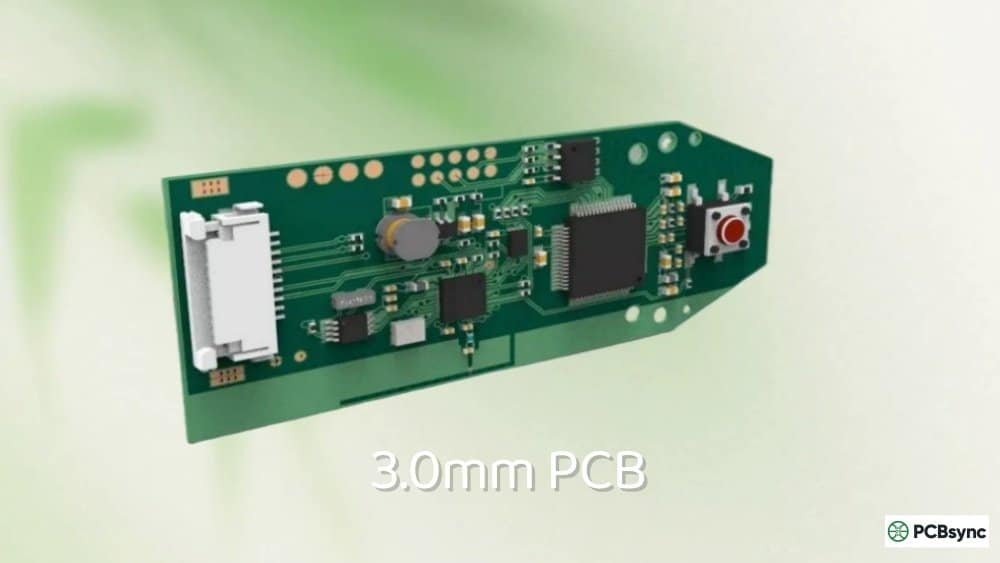
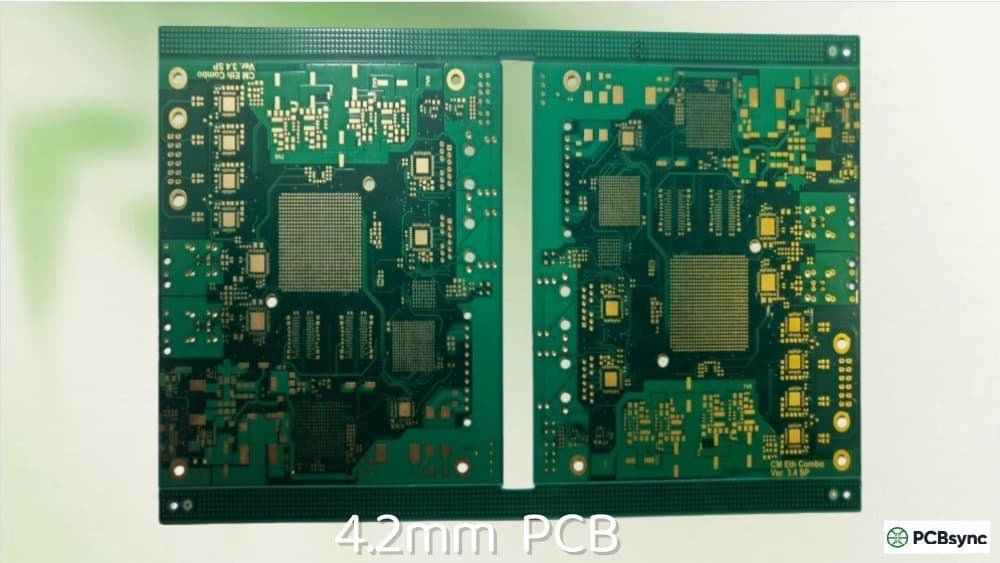
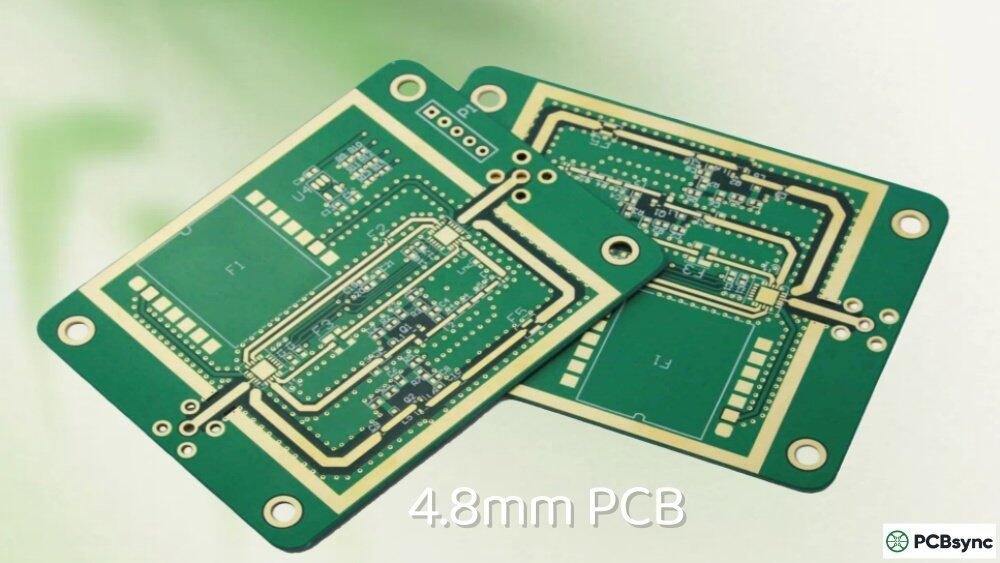
Every thick-board design I’ve worked on eventually lands on the same question: do we really need 3.2mm, or are we just defaulting to it because that’s what everyone does? After years of designing backplanes, power distribution boards, and high-layer-count assemblies, I’ve found that 3.0mm PCB thickness often hits the engineering sweet spot—delivering the mechanical strength and electrical performance you need without the extra material, weight, and cost of going all the way to 3.2mm.
The 3.2mm thickness (0.125 inches or 125 mils) became the de facto standard for heavy-duty boards decades ago, largely because it’s a clean imperial measurement. But engineering decisions shouldn’t be based on historical convention alone. When you actually run the numbers—aspect ratios, thermal mass, via reliability, manufacturing tolerances—the 3.0mm PCB frequently outperforms its thicker sibling while saving 6% on material and improving manufacturability.
This guide walks through when 3.0mm makes sense, how to design effectively at this thickness, and what to expect from your fabricator. If you’re tired of over-engineering your thick boards, keep reading.
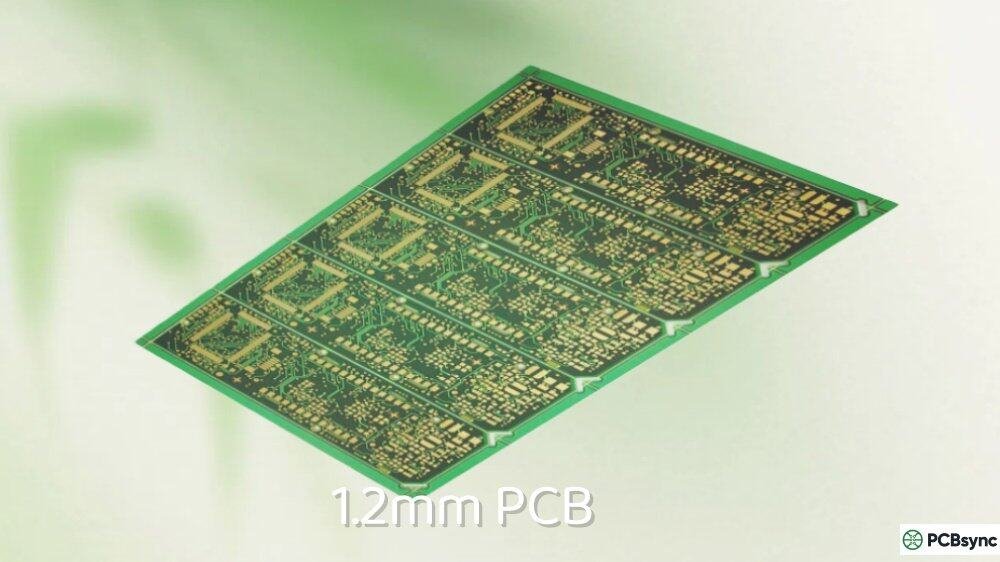
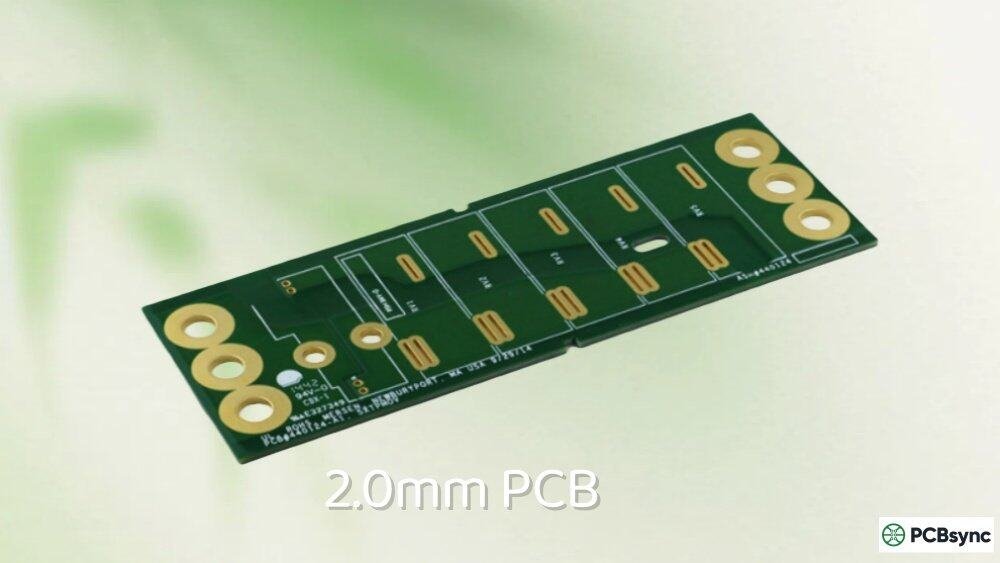
A 3.0mm PCB measures approximately 0.118 inches (118 mils) in finished thickness, including all laminate layers, copper, solder mask, and surface finish. This positions it squarely between the common 2.4mm heavy-duty boards and the traditional 3.2mm maximum-thickness option.
3.0mm PCB Thickness in the Standard Spectrum
Understanding where 3.0mm fits helps clarify when it’s the right choice:
Thickness
Inches
Metric Status
Common Applications
1.6mm
0.063″
Industry standard
Consumer electronics, general purpose
2.0mm
0.079″
Enhanced standard
Industrial, automotive electronics
2.4mm
0.094″
Heavy-duty
Servers, motor drives, high-power
3.0mm
0.118″
Semi-standard
Backplanes, multi-layer, power distribution
3.2mm
0.126″
Traditional thick
Maximum mechanical requirements
The 3.0mm PCB occupies unique territory. It’s thick enough to support serious mechanical loads, high layer counts (12-20 layers), and heavy copper configurations. But it stays lean enough to maintain better via aspect ratios and easier manufacturing than 3.2mm boards.
Why 3.0mm Instead of Defaulting to 3.2mm
The 0.2mm difference between 3.0mm and 3.2mm doesn’t sound significant until you examine the cascading effects across your design.
Via Aspect Ratio Improvements
Via aspect ratio—the relationship between board thickness and drilled hole diameter—directly impacts plating quality and long-term reliability. Industry standard limits this ratio to 10:1 for mechanically drilled through-hole vias.
Board Thickness
Min Via at 10:1
Min Via at 8:1
Plating Reliability
2.4mm
0.24mm (9.4 mil)
0.30mm (11.8 mil)
Excellent
3.0mm
0.30mm (11.8 mil)
0.375mm (14.8 mil)
Very Good
3.2mm
0.32mm (12.6 mil)
0.40mm (15.7 mil)
Good
At 3.0mm PCB thickness, you can achieve the same 10:1 aspect ratio with slightly smaller vias than 3.2mm allows. Alternatively, using the same via size gives you a more conservative ratio with better plating coverage—your choice based on design priorities.
Weight and Material Savings
For a typical 300mm x 400mm backplane, the 3.0mm PCB saves approximately 6% in board weight compared to 3.2mm. That translates to:
Lower FR-4 material costs (6% less laminate)
Reduced shipping weight for high-volume production
Lower mechanical stress on connectors and mounting hardware
Better thermal cycling performance (less thermal mass to manage)
Primary Applications for 3.0mm PCB Designs
Not every application needs maximum thickness. Here’s where the 3.0mm PCB delivers optimal value without compromise.
Backplane and Midplane Systems
Backplanes connect multiple daughter cards in servers, telecom equipment, and industrial computing systems. They require rigidity, multiple connector support, and often high layer counts for signal routing.
Traditional wisdom defaulted to 3.2mm for backplanes, but modern designs have evolved. Improved materials with better dimensional stability and advanced press-fit connector technology mean many backplane applications perform excellently at 3.0mm PCB thickness.
The 3.0mm option works particularly well when:
Board dimensions stay under 500mm in the longest direction
Connector density is moderate (not maximum slot capacity)
The design uses high-Tg laminates (Tg ≥ 170°C)
Operating temperatures remain within industrial ranges (-40°C to +85°C)
Backplane Parameter
3.0mm Capability
3.2mm Capability
Max recommended length
500mm
600mm+
Typical layer count
12-20 layers
16-24 layers
Connector slots
6-12 slots
8-16 slots
Via aspect ratio
10:1 standard
10:1 (larger vias)
High Layer Count Multilayer Boards (12-20 Layers)
As layer count increases, achieving specific thickness targets requires careful stack-up planning. Many designers find that 3.0mm PCB aligns naturally with their dielectric requirements better than forcing designs into exactly 3.2mm.
Consider a 16-layer controlled impedance design. The dielectric thicknesses required for target impedance values might sum to 2.9mm or 3.1mm naturally. Forcing the stack-up to exactly 3.2mm means adjusting dielectrics away from optimal values—potentially compromising signal integrity to hit an arbitrary thickness target.
Power Distribution and Heavy Copper Applications
Power distribution boards for industrial equipment, solar inverters, UPS systems, and motor drives need thickness for current handling and thermal mass. The 3.0mm PCB thickness supports:
Heavy copper from 3oz to 5oz on multiple layers
Large thermal via arrays for heat spreading
Substantial bus bar structures for high-current paths
Adequate creepage and clearance for high-voltage isolation
Power Specification
3.0mm PCB Capability
Maximum copper weight
5oz (175μm) per layer
Current handling
Up to 100A continuous
Thermal mass
Excellent heat absorption
High-voltage isolation
Supports 1000V+ designs
For applications under 100A continuous and operating below 1000V, the 3.0mm PCB provides everything needed without the extra material of 3.2mm.
Industrial Control and Automation Equipment
PLCs, motor controllers, CNC systems, and process automation equipment often land in the 3.0mm range due to combined requirements:
Moderate layer counts (8-12 layers)
Mixed signal routing (analog, digital, power)
Harsh environment durability (vibration, temperature cycling)
Heavy connector loading (terminal blocks, ribbon cables, D-sub connectors)
Stack-Up Design Strategies for 3.0mm PCB
Achieving exactly 3.0mm requires intentional stack-up planning. Unlike standard 1.6mm boards where fabricators have pre-qualified configurations, the 3.0mm PCB thickness often requires specifying the exact layer structure.
8-Layer 3.0mm PCB Stack-Up Example
This configuration balances signal integrity with power distribution:
Layer
Type
Material
Thickness
Function
L1
Signal/Power
2oz Cu
70μm
Top routing
Prepreg
2116 x2
0.24mm
Dielectric
L2
Ground
1oz Cu
35μm
Reference plane
Core
FR-4
0.71mm
Structural
L3
Signal
1oz Cu
35μm
Inner routing
Prepreg
7628
0.20mm
Dielectric
L4
Signal
1oz Cu
35μm
Inner routing
Core
FR-4
0.71mm
Structural
L5
Power
1oz Cu
35μm
Power distribution
Prepreg
7628
0.20mm
Dielectric
L6
Signal
1oz Cu
35μm
Inner routing
Core
FR-4
0.71mm
Structural
L7
Ground
1oz Cu
35μm
Reference plane
Prepreg
2116 x2
0.24mm
Dielectric
L8
Signal/Power
2oz Cu
70μm
Bottom routing
Total
~3.0mm
12-Layer 3.0mm PCB Stack-Up Example
For higher layer counts, individual dielectric layers become thinner:
Layer
Material
Thickness
Purpose
L1
1oz Cu
35μm
Signal
Prepreg
2116
0.12mm
L2
1oz Cu
35μm
Ground
Core
FR-4
0.30mm
L3
1oz Cu
35μm
Signal
Prepreg
2116
0.12mm
L4
1oz Cu
35μm
Power
Core
FR-4
0.30mm
L5
1oz Cu
35μm
Signal
Prepreg
1080 x2
0.14mm
L6
1oz Cu
35μm
Ground
Core
FR-4
0.30mm
L7
1oz Cu
35μm
Ground
Prepreg
1080 x2
0.14mm
L8
1oz Cu
35μm
Signal
Core
FR-4
0.30mm
L9
1oz Cu
35μm
Power
Prepreg
2116
0.12mm
L10
1oz Cu
35μm
Signal
Core
FR-4
0.30mm
L11
1oz Cu
35μm
Ground
Prepreg
2116
0.12mm
L12
1oz Cu
35μm
Signal
Total
~3.0mm
Always confirm material availability with your fabricator and verify that proposed stack-ups achieve both thickness targets and impedance requirements.
Manufacturing Considerations for 3.0mm PCB Production
The 3.0mm PCB sits in a manufacturing-friendly zone—thick enough to be robust during processing but not so thick that it creates major challenges.
Drilling and Via Parameters
At 3.0mm, standard mechanical drilling handles most requirements:
Via Type
Minimum Diameter
Aspect Ratio
Notes
Signal via
0.30mm (12 mil)
10:1
Standard process
Thermal via
0.40mm (16 mil)
7.5:1
Enhanced reliability
Mounting hole
0.50mm+ (20 mil)
6:1
Best plating coverage
For finer vias, sequential lamination with blind/buried structures can achieve 0.15mm vias in individual sub-laminates while maintaining 3.0mm finished thickness.
Tolerance Specifications
Parameter
Standard Tolerance
Tight Tolerance
Overall thickness
±10% (±0.30mm)
±5% (±0.15mm)
Dielectric thickness
±10%
±8%
Layer registration
±0.15mm
±0.10mm
Bow and twist
≤1.0%
≤0.7%
For card cage applications where board thickness critically affects slot fit, specify tighter tolerances and discuss feasibility with your manufacturer early in the design process.
Manufacturing Cost Analysis
Cost Factor
3.0mm vs 1.6mm
3.0mm vs 3.2mm
Material cost
+18-22%
-5-6%
Drilling cost
+10-15%
-3-5%
Plating cost
+12-18%
-4-6%
Typical total premium
+15-20%
-4-6%
The 3.0mm PCB typically costs 4-6% less than equivalent 3.2mm designs. On production runs of 1,000+ units, these savings compound significantly.
When to Choose 3.0mm vs 2.4mm or 3.2mm
Choose 3.0mm PCB When:
Layer count is 10-18 layers
Board dimensions are 200-500mm
Copper weight is 2oz-4oz
Mechanical loads are moderate to heavy
Cost optimization matters
Via aspect ratio is a concern
Step Up to 3.2mm When:
Layer count exceeds 20 layers
Board dimensions exceed 500mm
Maximum mechanical rigidity is required
Extreme vibration environments
Military/aerospace specifications mandate it
Stay with 2.4mm When:
Layer count is under 10 layers
Board dimensions are under 200mm
Standard copper weights (1oz-2oz)
Cost is the primary driver
Useful Resources for 3.0mm PCB Design
Design Calculation Tools
Tool
Purpose
Access
Saturn PCB Toolkit
Trace width, via current, impedance
saturnpcb.com (Free)
Polar Si9000
Professional impedance modeling
polarinstruments.com
JLCPCB Impedance Calculator
Quick online calculations
jlcpcb.com/pcb-impedance-calculator
Altium Stack-up Manager
Integrated design environment
altium.com
Industry Standards References
Standard
Coverage
IPC-6012E
Qualification and Performance Specification for Rigid PCBs
IPC-2221B
Generic Standard on Printed Board Design
IPC-4101
Specification for Base Materials
IPC-2152
Standard for Determining Current Carrying Capacity
Material Databases
Resource
Description
Isola Material Selector
Laminate selection tool with Dk/Df data
Rogers Corporation Library
High-frequency material specifications
Panasonic Megtron Series
Low-loss material datasheets
Frequently Asked Questions About 3.0mm PCB
Is 3.0mm considered a standard PCB thickness?
The 3.0mm PCB falls into the semi-standard category. While most fabricators list 3.2mm (125 mils) as their standard thick-board option due to historical imperial measurements, nearly all capable manufacturers can produce 3.0mm boards without issue. It’s technically a custom thickness but common enough that material combinations are readily available. Confirm lead time impact with your specific supplier before finalizing designs.
What’s the maximum practical layer count for 3.0mm PCB?
With standard FR-4 materials and conventional manufacturing, 16-20 layers is practical at 3.0mm. Beyond 20 layers, individual dielectric thicknesses become very thin, potentially creating impedance control challenges. For layer counts above 20, consider whether 3.2mm or thicker provides better design margin. The exact limit depends on your copper weights, impedance requirements, and fabricator capabilities.
How does 3.0mm affect thermal performance compared to thicker boards?
The 3.0mm PCB provides substantial thermal mass for absorbing transient heat events. The 6% reduction compared to 3.2mm has minimal impact on steady-state thermal performance. Where you gain is in thermal cycling reliability—less thermal mass means faster temperature equalization and reduced stress on solder joints and via barrels. For power applications, copper weight and via density matter far more than the 0.2mm thickness difference.
Can press-fit connectors designed for 3.2mm work with 3.0mm boards?
Most press-fit connectors specify an acceptable thickness range rather than a single value—commonly 2.4mm to 3.2mm. A 3.0mm PCB typically falls within these ranges. However, connectors optimized specifically for 125-mil (3.2mm) boards may provide marginally lower retention force at 3.0mm. Always verify connector specifications and request samples for fit testing before production commitment.
Does 3.0mm thickness support controlled impedance designs?
Absolutely. The 3.0mm PCB provides excellent flexibility for controlled impedance structures. The additional thickness compared to standard boards allows comfortable dielectric spacing between signal layers and reference planes. You can achieve standard impedance targets (50Ω single-ended, 100Ω differential) with reasonable trace widths that don’t push manufacturing limits. Work with your fabricator to define stack-ups that achieve both thickness and impedance requirements simultaneously.
Making the Engineering-Driven Thickness Decision
The 3.0mm PCB represents pragmatic engineering over tradition-driven defaults. It delivers the mechanical strength, thermal capacity, and layer-count support that demanding applications require—without the material waste, cost premium, and via constraints of defaulting to 3.2mm.
When evaluating your next heavy-duty board design, challenge the assumption that maximum thickness equals optimal performance. Consider what your application actually requires, not what convention suggests. For backplanes under 500mm, power boards handling moderate currents, and multi-layer designs in the 12-18 layer range, 3.0mm provides everything you need with nothing you don’t.
The best engineering decisions optimize for actual requirements. If 3.0mm PCB thickness meets your mechanical, electrical, and thermal specifications, there’s no engineering benefit in adding that extra 0.2mm—just extra cost, weight, and manufacturing complexity. Sometimes the smartest choice is knowing when enough is enough.
Inquire: Call 0086-755-23203480, or reach out via the form below/your sales contact to discuss our design, manufacturing, and assembly capabilities.
Quote: Email your PCB files to Sales@pcbsync.com (Preferred for large files) or submit online. We will contact you promptly. Please ensure your email is correct.
Notes: For PCB fabrication, we require PCB design file in Gerber RS-274X format (most preferred), *.PCB/DDB (Protel, inform your program version) format or *.BRD (Eagle) format. For PCB assembly, we require PCB design file in above mentioned format, drilling file and BOM. Click to download BOM template To avoid file missing, please include all files into one folder and compress it into .zip or .rar format.