Inquire: Call 0086-755-23203480, or reach out via the form below/your sales contact to discuss our design, manufacturing, and assembly capabilities.
Quote: Email your PCB files to Sales@pcbsync.com (Preferred for large files) or submit online. We will contact you promptly. Please ensure your email is correct.
Notes: For PCB fabrication, we require PCB design file in Gerber RS-274X format (most preferred), *.PCB/DDB (Protel, inform your program version) format or *.BRD (Eagle) format. For PCB assembly, we require PCB design file in above mentioned format, drilling file and BOM. Click to download BOM template To avoid file missing, please include all files into one folder and compress it into .zip or .rar format.
When your design demands maximum routing density, uncompromising signal integrity, and the ability to handle dozens of high-speed interfaces simultaneously, you’re looking at 26 layer PCB territory. After spending over a decade designing boards for aerospace avionics and high-performance computing systems, I can tell you that 26 layer boards represent a sweet spot for many complex applications where 20 layers fall short but 32 feels like overkill.
This guide walks you through everything you need to know about 26 layer PCB design, from stack-up planning to manufacturing challenges and cost optimization. Whether you’re specifying your first ultra-high-layer-count board or looking to refine your existing design approach, you’ll find practical insights here that took me years of trial and error to learn.
A 26 layer PCB is an advanced multilayer PCB containing 26 individual copper layers separated by dielectric materials and bonded together through lamination. These boards typically range from 3.0mm to 4.5mm in total thickness, depending on copper weights and dielectric requirements.
Unlike standard 4-8 layer boards that most engineers work with daily, 26 layer PCBs provide massive routing capacity for complex system designs. You’re essentially working with a three-dimensional routing space that allows complete separation of digital domains, analog circuits, power delivery networks, and high-speed differential pairs.
The construction typically involves multiple sequential lamination cycles, extensive use of blind and buried vias, and materials specifically chosen for high-frequency performance. Every additional layer adds manufacturing complexity, but it also gives you another routing channel and potentially another reference plane.
Key Specifications for 26 Layer PCB
Parameter
Typical Value
Notes
Total Thickness
3.0mm – 4.5mm
Varies with copper weight and dielectric selection
Minimum Trace Width
3 mil (0.076mm)
Inner layers allow tighter geometries
Minimum Trace Spacing
3 mil (0.076mm)
Depends on manufacturer capability
Minimum Via Diameter
0.15mm (laser) / 0.2mm (mechanical)
Blind vias often use laser drilling
Copper Weight Options
0.5oz – 2oz per layer
Heavy copper available for power layers
Aspect Ratio
10:1 to 12:1
Critical for plated through holes
Impedance Tolerance
±7% to ±10%
Tighter tolerances increase cost
Why Choose 26 Layer PCB for Your Design?
The decision to go with 26 layers should never be taken lightly. Each additional layer adds roughly 8-12% to your fabrication cost, and the design complexity increases non-linearly. Here’s when 26 layers makes sense:
Complex BGA Breakout Requirements
Modern FPGAs and processors with 1500+ pins in fine-pitch BGA packages simply cannot be routed on lower layer counts. A Xilinx Virtex UltraScale+ with 2577 balls needs dedicated routing layers just for the high-speed transceivers, memory interfaces, and general I/O. With 26 layers, you can dedicate specific layers to each interface type without compromising signal integrity.
High-Speed Serial Interface Density
Designs incorporating multiple 25Gbps+ interfaces like PCIe Gen5, 400G Ethernet, or DDR5 memory require careful impedance control and isolation. 26 layers gives you the luxury of running each high-speed domain on dedicated layer pairs with solid reference planes above and below.
Power Delivery Complexity
When your design has 15+ voltage rails with tight ripple requirements, you need multiple power plane pairs with proper decoupling strategies. 26 layer boards can accommodate several power/ground plane pairs while maintaining adequate signal routing capacity.
EMI/EMC Requirements
Military and aerospace applications often require exceptional EMI performance. Extra shielding layers and dedicated ground planes throughout the stack-up significantly reduce radiated emissions and improve susceptibility performance.
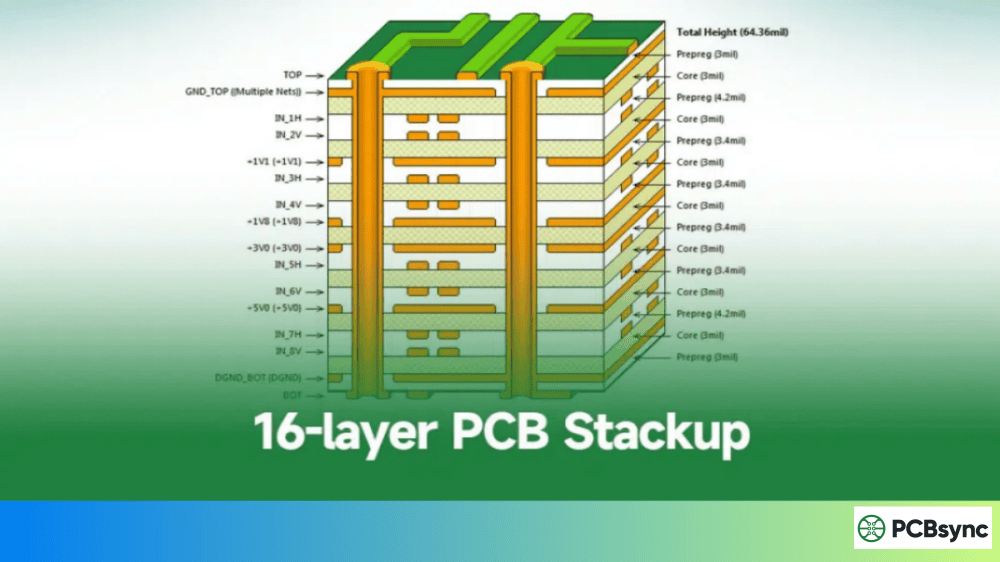
Stack-up design for 26 layer boards is where projects succeed or fail. Get this wrong, and you’ll face signal integrity nightmares, manufacturing yield issues, or boards that simply don’t work.
Fundamental Stack-Up Principles
Before diving into specific configurations, understand these principles that govern every high-layer-count design:
Symmetry is mandatory. An asymmetrical stack-up will warp during lamination. Your fab house will either reject the design or modify it, potentially changing your impedance calculations.
Every signal layer needs an adjacent reference plane. Running signals between two signal layers is asking for crosstalk problems. High-speed signals absolutely require a solid plane directly above or below.
Power and ground planes should be distributed evenly. Clustering all your power planes on one side creates thermal imbalance and complicates via transitions.
Here’s a proven stack-up that I’ve used successfully across multiple high-speed designs:
Layer
Type
Function
Copper Weight
L1
Signal
High-speed signals, components
1oz
L2
Ground
Reference plane for L1
1oz
L3
Signal
High-speed routing
0.5oz
L4
Ground
Reference/shielding
1oz
L5
Signal
General routing
0.5oz
L6
Power
VCC Core
1oz
L7
Signal
General routing
0.5oz
L8
Ground
Reference plane
1oz
L9
Signal
High-speed differential
0.5oz
L10
Ground
Reference plane
1oz
L11
Signal
General routing
0.5oz
L12
Power
3.3V / 1.8V
1oz
L13
Ground
Central reference
1oz
L14
Power
Additional voltage rails
1oz
L15
Signal
General routing
0.5oz
L16
Ground
Reference plane
1oz
L17
Signal
High-speed differential
0.5oz
L18
Ground
Reference plane
1oz
L19
Signal
General routing
0.5oz
L20
Power
I/O voltages
1oz
L21
Signal
General routing
0.5oz
L22
Ground
Reference/shielding
1oz
L23
Signal
High-speed routing
0.5oz
L24
Ground
Reference plane for L25
1oz
L25
Signal
High-speed signals
1oz
L26
Ground
Bottom reference/shielding
1oz
This configuration provides eight dedicated signal layers with adjacent ground references, four power distribution layers, and maintains excellent symmetry about the center.
Material Selection for 26 Layer PCB
Material choice directly impacts signal performance, especially above 10GHz. Here’s what works:
Material
Dk
Df (@ 10GHz)
Best For
Standard FR-4
4.2-4.5
0.020-0.025
Non-critical layers, cost optimization
High-Tg FR-4
4.2-4.4
0.018-0.022
Lead-free assembly, thermal reliability
Megtron 4
3.8
0.008
10-15 Gbps applications
Megtron 6
3.4
0.004
25+ Gbps applications
Megtron 7
3.3
0.002
56+ Gbps PAM4 applications
Tachyon 100G
3.02
0.0021
Ultra-low-loss backplanes
Rogers 4350B
3.48
0.0037
RF/microwave applications
For cost optimization, consider hybrid stack-ups using premium materials only for critical high-speed layers and standard FR-4 for general routing.
Design Considerations for 26 Layer PCB
Impedance Control Strategy
With 26 layers, you’ll typically need multiple impedance configurations:
Single-ended signals: 50Ω standard for most digital I/O Differential pairs: 85Ω or 100Ω depending on interface specification Controlled impedance ranges: Calculate each signal layer separately based on dielectric thickness
Work with your fab house early. They’ll provide actual achievable trace widths and spacings based on their process capabilities. Most 26 layer manufacturers target ±7% impedance tolerance, though ±5% is achievable at premium pricing.
Via Strategy and Planning
Via planning for 26 layer boards demands careful attention:
Through-hole vias penetrate all 26 layers. They’re simple but create stub issues for signals not using all layers. The aspect ratio (board thickness to hole diameter) becomes challenging at ~4mm thickness.
Blind vias connect outer layers to inner layers without penetrating the entire board. Critical for high-density BGA breakout. Laser drilling allows 0.15mm holes, enabling tighter via spacing.
Buried vias connect only inner layers. Essential for routing escape from inner BGA rows without consuming outer layer real estate.
Microvias are laser-drilled vias typically 0.1mm or smaller, usually spanning only 1-2 layers. Used extensively in HDI designs.
Via Type
Typical Size
Layers Connected
Manufacturing Impact
Through-hole
0.25-0.35mm
All layers
Standard process
Blind (Laser)
0.15mm
L1-L4 or L23-L26
Sequential lamination
Buried
0.2mm
Any internal subset
Requires sub-lamination
Stacked Microvia
0.1mm
Sequential layer pairs
Most expensive
Signal Integrity for High-Speed Design
At 26 layers, signal integrity isn’t optional—it’s the foundation of your design success.
Return path continuity: Every signal needs a clear return path on the adjacent reference plane. When signals change layers, place stitching vias near the transition to provide return current continuity.
Crosstalk management: Maintain 3W spacing (three times the trace width) between parallel traces for single-ended signals. For critical differential pairs, increase to 5W.
Via stub mitigation: For signals above 5GHz, via stubs cause significant reflections. Use back-drilling to remove unused via barrel sections, or design with blind/buried vias that don’t create stubs.
Length matching: High-speed parallel buses require tight length matching. DDR4/DDR5 typically needs ±5mil matching within byte lanes.
26 Layer PCB Manufacturing Process
Understanding the PCB manufacturing process helps you design boards that fabricators can actually build reliably.
Core Process Steps
1. Inner Layer Fabrication Each of the 24 inner copper layers gets imaged and etched individually. Registration accuracy is critical—misalignment accumulates across layers. Modern facilities achieve ±2 mil registration layer-to-layer.
First cycle: Create core sub-assemblies (groups of 4-6 layers)
Subsequent cycles: Bond sub-assemblies with additional prepreg layers
Each cycle adds thermal stress and potential for dimensional instability
3. Drilling Operations Multiple drilling stages for different via types:
Mechanical drilling for through-holes (0.2mm minimum practical)
Laser drilling for blind vias and microvias
Controlled depth drilling for buried vias
4. Plating and Finishing Through-hole plating must achieve adequate wall coverage across the full 3-4mm board thickness. Aspect ratios above 10:1 become increasingly difficult.
Manufacturing Challenges Specific to 26 Layer PCB
Challenge
Impact
Mitigation Strategy
Layer Registration
Misaligned annular rings, opens/shorts
Use reputable manufacturers with modern equipment
Aspect Ratio Drilling
Poor hole wall coverage, reliability issues
Keep aspect ratio ≤10:1, use HDI techniques
Lamination Warpage
Board flatness issues, assembly problems
Symmetrical stack-up, balanced copper distribution
Impedance Variation
Signal integrity failures
±7% tolerance specification, test coupons
Resin Starvation
Delamination, reliability failures
Proper prepreg selection, adequate resin content
Quality Inspection Requirements
26 layer boards demand comprehensive testing:
Automated Optical Inspection (AOI): Every layer inspected before lamination
X-Ray Inspection: Validates via registration and internal plane connections
Electrical Testing: 100% netlist verification through flying probe or fixture testing
Cross-Section Analysis: Sample boards sectioned to verify layer thickness, registration, and plating quality
Impedance Testing: TDR measurement on impedance coupons
Cost Factors for 26 Layer PCB
Let’s talk numbers. 26 layer boards are expensive, but understanding cost drivers helps optimize your design.
Primary Cost Drivers
Factor
Cost Impact
Optimization Approach
Layer Count
High
Verify you truly need 26 layers
Board Size
High
Minimize panel size through efficient layout
Material Selection
Medium-High
Hybrid stack-up with premium materials only where needed
Via Complexity
Medium-High
Minimize buried via use if possible
Quantity
High
Volume pricing starts around 50-100 pieces
Lead Time
Medium
Standard lead times are 4-6 weeks
Impedance Tolerance
Low-Medium
±7% is standard; tighter tolerances add cost
Typical Pricing Ranges
For reference, expect these approximate cost ranges (2025-2026 pricing):
Quantity
Per-Board Cost (100×150mm)
Prototype (5 pcs)
$800 – $1,500 each
Small batch (25 pcs)
$400 – $700 each
Medium volume (100 pcs)
$200 – $400 each
Production (500+ pcs)
$100 – $250 each
Pricing varies significantly based on specifications, materials, and manufacturer. Always get quotes from 3-4 qualified suppliers.
How to Choose a 26 Layer PCB Manufacturer
Not every PCB manufacturer can handle 26 layers reliably. Here’s what to evaluate:
Critical Capabilities
Maximum layer count capability: They should routinely build boards with your layer count plus margin. If 26 is their absolute maximum, consider alternatives.
Lamination equipment: Sequential lamination requires specialized presses. Ask about press capacity and lamination cycle experience.
Registration accuracy: Require ±2 mil or better layer-to-layer registration for 26 layer builds.
Via technologies: Confirm capabilities for blind, buried, and microvias if your design requires them.
Material partnerships: Manufacturers should have established relationships with high-frequency laminate suppliers (Isola, Panasonic, Rogers).
Certifications to Look For
Certification
What It Means
ISO 9001
Quality management system in place
AS9100
Aerospace quality standards
IATF 16949
Automotive quality standards
IPC Class 3
Highest reliability manufacturing class
ITAR Registered
Required for defense applications
UL Listed
Safety agency recognition
Questions to Ask Potential Manufacturers
What is your standard lead time for 26 layer boards?
What layer registration accuracy do you guarantee?
Which high-frequency materials do you stock?
Can you provide microsection reports?
What is your typical first-pass yield on 26+ layer boards?
Do you offer DFM review as part of your quote process?
Useful Resources for 26 Layer PCB Design
Design Tools and Calculators
Saturn PCB Design Toolkit – Free impedance and via calculators
Sierra Circuits Stackup Designer – Online stack-up planning tool
Having reviewed hundreds of 26 layer designs over the years, certain mistakes appear repeatedly. Learning from others’ failures saves you time and budget.
Inadequate Power Plane Splitting
Splitting power planes for multiple voltage rails seems efficient, but narrow plane sections create high-impedance paths. For rails requiring significant current, dedicate entire layers rather than splitting. The small layer count savings isn’t worth the power integrity headaches.
Ignoring Via Stub Effects
Through-hole vias on a 4mm board create substantial stubs when signals don’t use all layers. A via from L1 to L8 leaves an 18-layer stub that acts as an antenna at high frequencies. Either back-drill these vias or use blind vias from the start.
Insufficient Prepreg Between High-Speed Layers
Tight coupling between signal layers and reference planes improves impedance control but requires thin prepreg. Going too thin (under 3 mils) risks resin starvation during lamination. Work with your fabricator to find the optimal balance for their process.
Missing Stitching Vias at Layer Transitions
When high-speed signals change routing layers, the return current must also transition. Without nearby stitching vias connecting reference planes, return currents take long detour paths, creating loops that radiate EMI and disrupt signal integrity.
Overlooking Thermal Considerations
26 layer boards have significant thermal mass, which affects both assembly and operation. Heavy copper planes can act as heat spreaders, but they also make rework difficult. Plan thermal relief patterns and consider component placement impacts on thermal paths.
Testing and Validation Strategies
Pre-Production Validation
Before committing to production quantities, perform comprehensive validation:
Signal Integrity Measurements: Use TDR (Time Domain Reflectometry) to verify impedance across critical nets. Expect ±10% variation as acceptable for most applications.
Power Integrity Analysis: Measure PDN impedance using a VNA (Vector Network Analyzer). Target impedance should be below the specification across the operating frequency range.
Thermal Imaging: During initial power-on, capture thermal images to identify unexpected hot spots or current concentrations.
Production Testing Requirements
Test Type
What It Catches
When to Use
Flying Probe
Opens, shorts, missing vias
Low-volume, prototypes
Fixture Test
Opens, shorts (faster)
Medium-high volume
Boundary Scan
Digital connectivity
Assembled boards
Functional Test
System-level failures
Final validation
Reliability Testing for Critical Applications
Aerospace and medical applications often require additional qualification testing:
Thermal Cycling: -55°C to +125°C for 500-1000 cycles
Successful 26 layer designs consider manufacturability from day one. Here are practical DFM guidelines that improve yield and reduce cost:
Layer-Specific Routing Guidelines
Outer Layers (L1, L26): Keep trace widths at 4 mil minimum for reliable imaging. These layers see the most process variation due to plating thickness.
Inner Signal Layers: Can use tighter geometries (3 mil) since copper thickness is more consistent. Best location for impedance-critical traces.
Power Planes: Include proper thermal relief patterns around vias. Solid connections to plane vias cause heat sinking during soldering.
Via and Pad Guidelines
Minimum annular ring: 4 mil for inner layers, 5 mil for outer layers
Via-to-trace clearance: 8 mil minimum
Via-to-via clearance: 10 mil minimum
Pad-to-trace clearance: 6 mil minimum
Panelization Considerations
26 layer boards require specific panelization approaches:
Allow 15mm minimum rail width for handling
Include tooling holes at consistent locations
Add fiducials on each PCB unit and panel level
Consider breakaway tab placement relative to heavy components
FAQs About 26 Layer PCB
What is the typical thickness of a 26 layer PCB?
Most 26 layer PCBs fall between 3.0mm and 4.5mm total thickness. The exact thickness depends on copper weights (typically 0.5oz to 1oz per inner layer), dielectric thicknesses (ranging from 3 to 10 mils between layers), and whether hybrid material constructions are used. Standard builds using FR-4 with 1oz copper typically result in approximately 3.5mm to 4.0mm finished thickness.
How much does a 26 layer PCB cost?
Prototype quantities (5-10 pieces) typically cost $800-$1,500 per board for a standard 100×150mm panel. Production volumes of 500+ pieces can reduce costs to $100-$250 per board. Major cost factors include board dimensions, material selection, via complexity, and impedance requirements. Premium materials like Megtron 6 can add 30-50% to base pricing. Always obtain quotes from multiple qualified manufacturers.
What is the lead time for 26 layer PCB manufacturing?
Standard lead times range from 4-6 weeks for production quantities. Prototype services may offer 3-week expedited options at premium pricing. Rush services (under 2 weeks) are rarely available due to the multiple lamination cycles required. Plan your project timeline accordingly and factor in potential revision cycles.
Can any PCB manufacturer produce 26 layer boards?
No. 26 layer manufacturing requires specialized equipment including high-accuracy registration systems, multiple lamination presses, and laser drilling capability. Many regional fabricators cap out at 12-16 layers. For reliable 26 layer production, work with manufacturers who routinely produce boards with 24+ layers and have documented experience with your required technologies.
What materials are best for 26 layer PCB high-speed design?
Material selection depends on signal frequencies. For signals up to 5GHz, standard high-Tg FR-4 works adequately. For 10-15GHz applications, Megtron 4 or I-Speed provide good performance. Above 25GHz, specify Megtron 6 or Tachyon 100G for critical layers. Hybrid constructions using premium materials only for high-speed layers offer cost optimization while maintaining performance where it matters.
Conclusion
26 layer PCB design sits at the intersection of cutting-edge technology and practical engineering constraints. These boards enable systems that simply couldn’t exist on lower layer counts—from next-generation servers processing hundreds of high-speed lanes to aerospace systems requiring extreme reliability and EMI performance.
Success with 26 layer designs comes down to three factors: thorough stack-up planning that respects signal integrity fundamentals, partnership with a capable manufacturer who understands your requirements, and realistic budgeting that accounts for the genuine complexity involved.
Start your stack-up design early, engage your fabrication partner before finalizing your layer assignments, and don’t hesitate to iterate. The upfront engineering investment pays dividends in manufacturing yield and system performance.
Ready to move forward with your 26 layer PCB project? Gather your design requirements, reach out to qualified manufacturers for DFM consultation, and build your stack-up around proven configurations rather than starting from scratch.
Inquire: Call 0086-755-23203480, or reach out via the form below/your sales contact to discuss our design, manufacturing, and assembly capabilities.
Quote: Email your PCB files to Sales@pcbsync.com (Preferred for large files) or submit online. We will contact you promptly. Please ensure your email is correct.
Notes: For PCB fabrication, we require PCB design file in Gerber RS-274X format (most preferred), *.PCB/DDB (Protel, inform your program version) format or *.BRD (Eagle) format. For PCB assembly, we require PCB design file in above mentioned format, drilling file and BOM. Click to download BOM template To avoid file missing, please include all files into one folder and compress it into .zip or .rar format.