Inquire: Call 0086-755-23203480, or reach out via the form below/your sales contact to discuss our design, manufacturing, and assembly capabilities.
Quote: Email your PCB files to Sales@pcbsync.com (Preferred for large files) or submit online. We will contact you promptly. Please ensure your email is correct.
Notes: For PCB fabrication, we require PCB design file in Gerber RS-274X format (most preferred), *.PCB/DDB (Protel, inform your program version) format or *.BRD (Eagle) format. For PCB assembly, we require PCB design file in above mentioned format, drilling file and BOM. Click to download BOM template To avoid file missing, please include all files into one folder and compress it into .zip or .rar format.
Having worked with complex multilayer boards for over a decade, I can tell you that a 24 layer PCB represents one of the most challenging yet rewarding designs in high-density electronics. When your project demands maximum routing density, impeccable signal integrity, and robust power distribution, a 24 layer PCB becomes your go-to solution.
This guide walks you through everything you need to know about designing, specifying, and manufacturing 24 layer PCBs. Whether you’re working on server backplanes, advanced telecommunications equipment, or aerospace systems, understanding the nuances of high-layer-count design will save you time, money, and headaches.
24-Layer PCB Stackup Selector
24-Layer PCB Stackup Selector 24LEXTREME
Configure layer thicknesses for extreme-density 24-layer datacenter, HPC, AI/ML accelerator, 800G networking, and advanced backplane PCB designs
Quick Presets
Layer Assignment (12 Signal + 6 GND + 6 PWR)
L1 SIG
L2 GND
L3 SIG
L4 PWR
L5 SIG
L6 GND
L7 SIG
L8 PWR
L9 SIG
L10 GND
L11 SIG
L12 PWR
L13 GND
L14 SIG
L15 PWR
L16 SIG
L17 GND
L18 SIG
L19 PWR
L20 SIG
L21 GND
L22 SIG
L23 PWR
L24 SIG
Copper Layers (24)
Prepreg Layers (12)
Core Layers (11)
Total Board Thickness
4.000mm
4000 µm
vs 4.0mm
+0 µm
Copper (24L)
840 µm
Prepreg (12L)
1482 µm
Core (11L)
2000 µm
12
Signal
6
GND
6
PWR
10
Stripline
2
Microstrip
Stackup Visualization
SOLDER MASK (TOP)
Outer SIG
Inner SIG
GND
PWR
Prepreg
Core
💡 24L Targets
3.5mm: High-density HDI 4.0mm: Standard 24L 4.5-5.0mm: Server/HPC 5.5-6.0mm: Backplane
📐 Impedance
Microstrip: L1→L2, L24→L23 Stripline: All inner SIG Center: L12↔L13 PWR/GND pair
⚡ Power Integrity
6 GND: Every 4 layers 6 PWR: Multi-rail splits L12-L13: Ultra-low Z pair
12 Signal Layers: L1, L3, L5, L7, L9, L11, L14, L16, L18, L20, L22, L24 — Maximum routing density for ultra-fine-pitch BGA (0.25mm), HBM3/HBM3E, 224G PAM4 SerDes, PCIe Gen6, CXL 3.0, and UCIe interfaces. 6 GND Planes: L2, L6, L10, L13, L17, L21 — Ground reference within 3-4 layers of every signal; symmetric distribution minimizes return path inductance and EMI. 6 PWR Planes: L4, L8, L12, L15, L19, L23 — Support 8+ voltage rails with island splits; L12-L13 form ultra-low-inductance decoupling capacitor structure. Sequential Lamination: Requires 3+ lamination cycles with blind/buried vias, stacked/staggered microvias, and potentially ELIC (Every Layer Interconnect). Materials: Ultra-low-loss required (Megtron 7, Tachyon 100G, I-Speed, EM-890K) for 56Gbps+ channels. Dk ~3.0-3.3, Df <0.002. Symmetry: Structure symmetric about L12-L13 center for optimal CTE matching, <0.4% warpage, and reliable assembly of large BGAs/LGAs.
What Is a 24 Layer PCB?
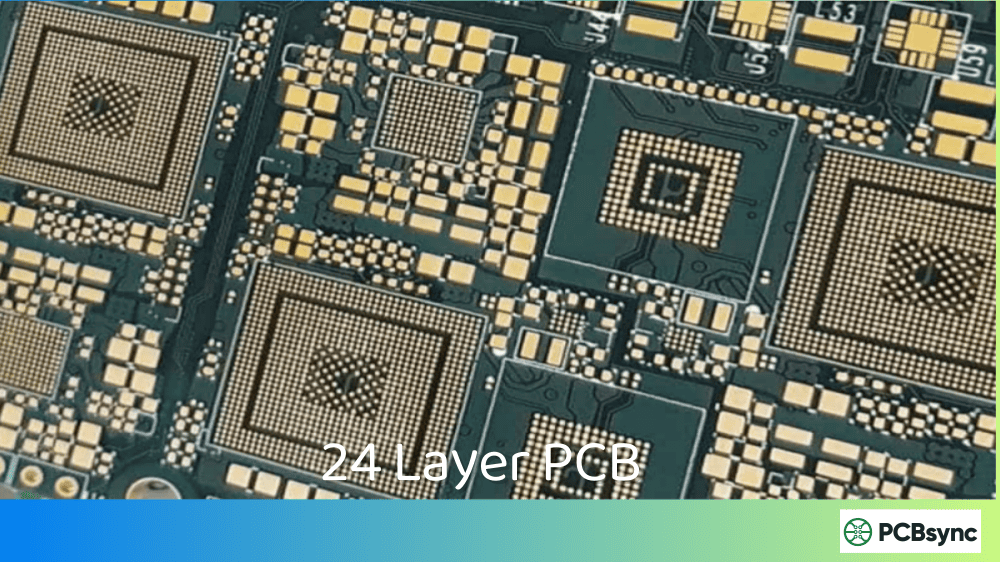
A 24 layer PCB is an advanced multilayer printed circuit board consisting of 24 conductive copper layers laminated together with insulating dielectric materials. These layers include signal routing layers, ground planes, and power planes, all bonded using prepreg and core materials under high temperature and pressure.
The typical 24 layer PCB thickness ranges from 3.0mm to 5.0mm, depending on the copper weights and dielectric materials used. This substantial layer count allows designers to achieve high-density interconnection (HDI) capabilities while maintaining excellent signal integrity for high-speed applications.
The stackup is arguably the most critical aspect of any 24 layer PCB design. A well-planned stackup determines your signal integrity performance, EMI characteristics, power distribution efficiency, and manufacturability. I’ve seen countless projects fail or require costly respins simply because the stackup wasn’t properly considered upfront.
Recommended 24 Layer PCB Stackup Configuration
For most high-speed applications, I recommend a symmetrical stackup that alternates signal layers with reference planes. Here’s a proven configuration that balances signal integrity with manufacturability:
Layer
Type
Function
Dielectric
L1
Signal (Top)
Component/Routing
Prepreg 1080 (3 mil)
L2
Ground
Reference Plane
Core (4 mil)
L3
Signal
High-Speed Routing
Prepreg 2116 (4 mil)
L4
Power
VCC 3.3V
Core (4 mil)
L5-L6
Signal
General Routing
Prepreg/Core alternating
L7
Ground
Reference Plane
Core (4 mil)
L8-L11
Signal/Power
Mixed routing/power
Symmetrical construction
L12-L13
Ground/Power
Core center planes
Thick core (8-10 mil)
L14-L24
Mirror of L1-L11
Symmetrical stackup
Matching top half
Critical Stackup Design Rules
When designing your 24 layer PCB stackup, keep these essential rules in mind:
Maintain symmetry: A symmetrical stackup prevents warping during lamination and thermal cycling. The layer arrangement above and below the center should mirror each other.
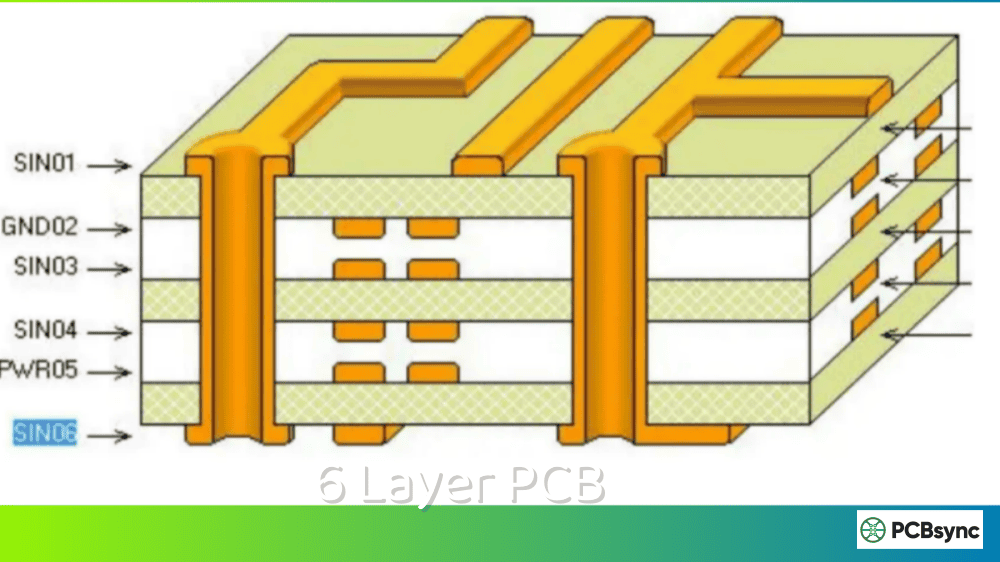
Adjacent reference planes: Every signal layer should have an adjacent ground or power plane. Never place two signal layers next to each other without a reference plane between them.
Tight coupling for high-speed signals: Use thin dielectric (3-4 mil) between high-speed signal layers and their reference planes to minimize crosstalk and improve impedance control.
Ground plane continuity: Avoid splitting ground planes whenever possible. Signal return paths need continuous reference planes to maintain integrity.
Power plane placement: Place power planes in the inner layers, sandwiched between ground planes, to create effective power distribution networks with low loop inductance.
24 Layer PCB Materials: Choosing the Right Substrate
Material selection significantly impacts the performance of your 24 layer PCB. The dielectric properties, thermal characteristics, and mechanical stability all play crucial roles in determining whether your design will meet its performance targets.
For most 24 layer PCB applications running signals below 5 Gbps, high-Tg FR4 provides excellent value. However, when your design includes high-speed serial interfaces like PCIe Gen 4/5, 25G Ethernet, or DDR5 memory, investing in low-loss materials like Isola I-Speed or Panasonic Megtron becomes essential. The signal integrity benefits far outweigh the additional material cost.
Manufacturing a 24 layer PCB pushes the limits of modern PCB manufacturing processes. Understanding these challenges helps you design boards that are manufacturable while meeting performance requirements.
Layer Registration and Alignment
With 24 layers, maintaining proper registration becomes exponentially more difficult. Each lamination cycle introduces potential for misalignment, and the cumulative effect can result in layer-to-layer registration errors exceeding acceptable tolerances. Advanced manufacturers use optical alignment systems and pin-less lamination techniques to achieve registration accuracy within ±2 mils across all layers.
Lamination Process Control
The lamination process bonds multiple inner layer cores together with prepreg materials under high temperature (350°F+) and pressure (300+ PSI). For 24 layer boards, this process presents several critical challenges:
Resin flow control: Insufficient resin leads to voids and delamination, while excessive flow causes resin starvation in tight-pitch areas
Pressure uniformity: Uneven pressure distribution results in thickness variations affecting impedance control
Thermal management: Heat distribution must be uniform to ensure proper resin cure throughout the stackup
Via Formation and Plating
Drilling and plating vias in thick 24 layer boards requires specialized techniques. The high aspect ratio (board thickness divided by hole diameter) creates challenges for achieving uniform copper plating throughout the barrel. Most manufacturers can reliably achieve aspect ratios up to 10:1 for through-holes, with some advanced facilities capable of 12:1 or higher.
Back-drilling (also called controlled-depth drilling) is often necessary to remove via stubs that would otherwise degrade high-speed signal integrity. This secondary drilling operation requires precise depth control to remove the stub while leaving enough copper for reliable electrical connection.
Bow and Twist Control
Board warpage is a common issue with high-layer-count PCBs due to differential thermal expansion between copper and dielectric materials. The IPC standard allows maximum bow and twist of 0.75% for surface mount boards, but achieving this on 24 layer designs requires careful attention to copper balancing across layers and symmetrical stackup construction.
24 Layer PCB Applications
The complexity and capability of 24 layer PCB technology makes it ideal for demanding applications across multiple industries. Let’s explore where these advanced Multilayer PCB designs deliver the most value.
Server and Data Center Infrastructure
Modern server motherboards and backplanes commonly utilize 24 layer designs to route high-speed memory interfaces, multiple PCIe lanes, and complex power distribution networks. The dense routing requirements of multi-socket server platforms, combined with strict signal integrity demands of DDR5 and PCIe Gen 5, make 24 layer boards essential for data center applications.
Telecommunications Equipment
5G base stations, network switches, and optical transport equipment rely on 24 layer PCBs to handle high-frequency signals and complex digital processing requirements. The combination of RF sections requiring controlled impedance and digital sections needing dense routing makes these designs particularly challenging and well-suited for 24 layer technology.
Aerospace and Defense
Avionics systems, radar equipment, and military communications platforms demand the reliability and performance that 24 layer PCB designs provide. These applications often require specialized materials for high-temperature operation and strict quality standards per MIL-PRF-31032 or similar specifications.
Medical Imaging Systems
CT scanners, MRI machines, and advanced diagnostic equipment use 24 layer boards for their complex signal processing and data acquisition circuits. The high channel count and strict noise immunity requirements of medical imaging systems benefit significantly from the routing flexibility and signal isolation capabilities of high-layer-count designs.
Advantages of 24 Layer PCB Design
Choosing a 24 layer PCB over lower layer-count alternatives offers several significant benefits:
Superior signal integrity: Dedicated reference planes for every signal layer ensure clean return paths and minimize crosstalk
Excellent power distribution: Multiple power and ground planes create low-impedance power delivery networks essential for high-speed ICs
Compact form factor: High routing density enables smaller board sizes while maintaining functionality
The cost of a 24 layer PCB varies significantly based on board size, material selection, and quantity. For prototype quantities (1-10 pieces), expect to pay $800-2,500 per board depending on complexity. Production volumes typically see costs of $150-400 per board for standard FR4 constructions. High-performance materials like Megtron 6 can increase costs by 40-60%.
What is the minimum hole size for a 24 layer PCB?
For mechanical drilling in 24 layer PCBs, the minimum finished hole size is typically 0.15mm (6 mils) with an aspect ratio limit of 10:1 to 12:1. Laser-drilled microvias can achieve 0.075-0.1mm (3-4 mils) diameter but are limited to connecting one or two layers at a time. Your manufacturer’s capabilities will determine the exact minimums for your specific stackup.
How long does it take to manufacture a 24 layer PCB?
Standard lead time for 24 layer PCB prototypes ranges from 15-25 working days, depending on the manufacturer and complexity. Quick-turn services can reduce this to 10-15 days at premium pricing. Production orders typically require 20-30 days for first article and ongoing delivery schedules. Complex HDI designs with sequential lamination may require additional time.
Can I use blind and buried vias in a 24 layer PCB?
Yes, blind and buried vias are commonly used in 24 layer PCB designs to improve routing density and signal integrity. Blind vias connect outer layers to inner layers, while buried vias connect only inner layers. However, using these via types requires sequential lamination, which increases cost and complexity. Plan your via structure carefully during the design phase to minimize lamination cycles while achieving your routing goals.
What impedance tolerance can I expect on a 24 layer PCB?
Most qualified manufacturers can achieve ±10% impedance tolerance on 24 layer PCBs as standard capability, with ±7% or ±5% available at premium pricing. Achieving tight tolerance requires consistent dielectric thickness control, precise trace geometry, and proper material selection. For controlled impedance traces, always specify your target impedance and tolerance in the fabrication notes and request impedance coupons for verification testing.
Conclusion
Designing a successful 24 layer PCB requires careful attention to stackup design, material selection, and manufacturing constraints. By following the guidelines outlined in this article and working closely with your fabrication partner, you can create high-performance multilayer boards that meet even the most demanding application requirements.
Remember that every 24 layer PCB design is unique, and the best results come from early collaboration between design and manufacturing teams. Take the time to validate your stackup, simulate critical signal paths, and review your design with your manufacturer before committing to production. The investment in proper planning pays dividends in reduced iterations and faster time-to-market.
Whether you’re working on next-generation servers, telecommunications infrastructure, or advanced medical equipment, the 24 layer PCB platform provides the routing density, signal integrity, and power distribution capabilities needed to bring your most complex designs to life.
Inquire: Call 0086-755-23203480, or reach out via the form below/your sales contact to discuss our design, manufacturing, and assembly capabilities.
Quote: Email your PCB files to Sales@pcbsync.com (Preferred for large files) or submit online. We will contact you promptly. Please ensure your email is correct.
Notes: For PCB fabrication, we require PCB design file in Gerber RS-274X format (most preferred), *.PCB/DDB (Protel, inform your program version) format or *.BRD (Eagle) format. For PCB assembly, we require PCB design file in above mentioned format, drilling file and BOM. Click to download BOM template To avoid file missing, please include all files into one folder and compress it into .zip or .rar format.