Inquire: Call 0086-755-23203480, or reach out via the form below/your sales contact to discuss our design, manufacturing, and assembly capabilities.
Quote: Email your PCB files to Sales@pcbsync.com (Preferred for large files) or submit online. We will contact you promptly. Please ensure your email is correct.
Notes: For PCB fabrication, we require PCB design file in Gerber RS-274X format (most preferred), *.PCB/DDB (Protel, inform your program version) format or *.BRD (Eagle) format. For PCB assembly, we require PCB design file in above mentioned format, drilling file and BOM. Click to download BOM template To avoid file missing, please include all files into one folder and compress it into .zip or .rar format.
After spending years designing PCBs for everything from Arduino-based projects to industrial control systems, I can tell you that certain resistor values appear so frequently that they become second nature. The 22 ohm resistor is definitely one of those components, showing up consistently in USB interfaces, LED circuits, and signal conditioning applications. This guide covers everything you need to know about this essential E-series value.
A 22 ohm resistor is a passive electronic component providing exactly 22 ohms of electrical resistance. This value belongs to the E6, E12, and E24 preferred number series, making it one of the most fundamental standard values in electronics.
The “22” designation indicates resistance measured in ohms (Ω). Within the E24 progression, this value sits between 20Ω and 24Ω. If you have ever looked at an Arduino schematic or any USB-enabled microcontroller board, you have probably noticed the 22 ohm resistor on the USB data lines without realizing its importance.
The E-Series and Why 22 Ohms Is Universal
The E-series system provides logarithmically spaced resistance values. Each series corresponds to specific tolerance ranges, and 22Ω appears across multiple series due to its fundamental utility.
E-Series
Values Per Decade
Typical Tolerance
Notes
E6
6
±20%
Includes 22Ω
E12
12
±10%
Includes 22Ω
E24
24
±5%
Includes 22Ω
E48
48
±2%
Higher precision
E96
96
±1%
Precision applications
The presence of 22Ω across E6, E12, and E24 series ensures this value is stocked by every electronics distributor worldwide in every conceivable package type.
22 Ohm Resistor Color Code
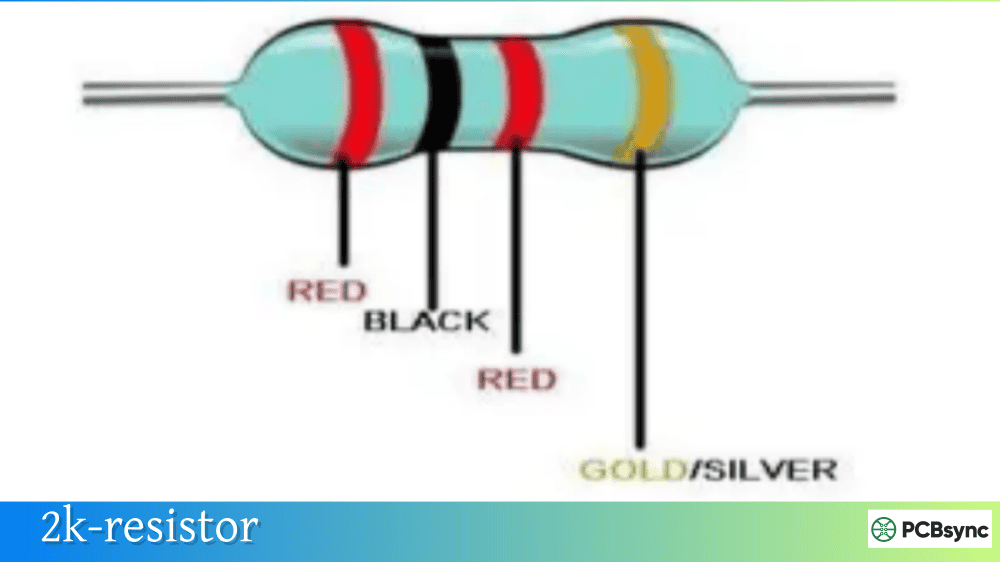
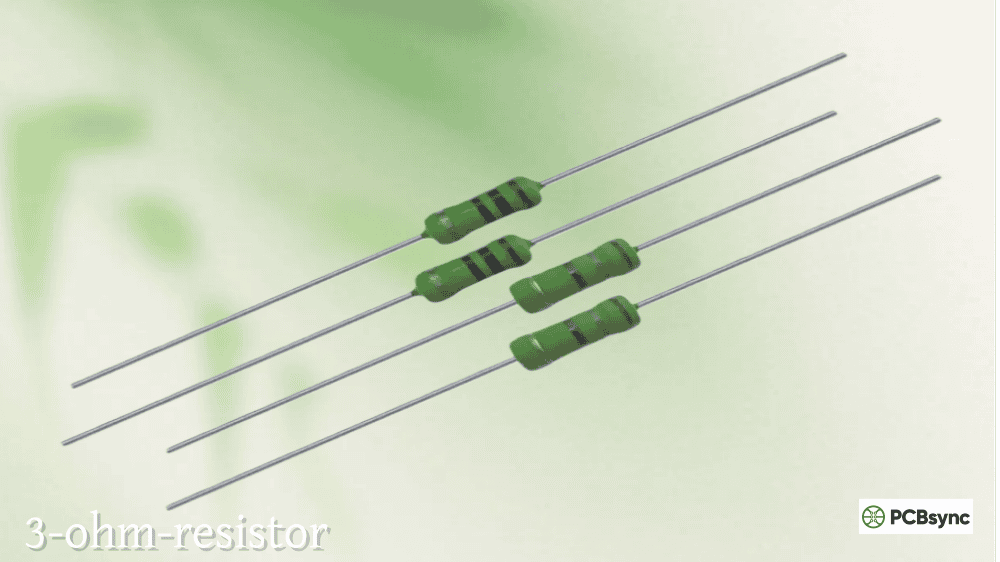
Identifying a 22 ohm resistor by its color bands becomes straightforward once you understand that 22 = 22 × 10^0. The color sequence uses Red for each digit 2 and Black for the ×1 multiplier.
4-Band Color Code (Standard)
The most common through-hole resistors display four color bands:
Band Position
Color
Meaning
1st Band (First Digit)
Red
2
2nd Band (Second Digit)
Red
2
3rd Band (Multiplier)
Black
×1 (10^0)
4th Band (Tolerance)
Gold
±5%
A standard 22 ohm resistor displays Red-Red-Black-Gold for 5% tolerance.
5-Band Color Code (Precision)
For 1% tolerance precision resistors, a five-band code adds an extra significant digit:
Band Position
Color
Meaning
1st Band
Red
2
2nd Band
Red
2
3rd Band
Black
0
4th Band (Multiplier)
Gold
×0.1
5th Band (Tolerance)
Brown
±1%
The sequence reads Red-Red-Black-Gold-Brown. The gold multiplier indicates ×0.1, giving 220 × 0.1 = 22Ω.
6-Band Color Code (High Precision with TCR)
High-precision applications sometimes require temperature coefficient specification:
Band Position
Color
Meaning
1st–3rd Bands
Red-Red-Black
220
4th Band (Multiplier)
Gold
×0.1
5th Band (Tolerance)
Gold
±5%
6th Band (TCR)
Brown
100 ppm/K
SMD Marking Codes for 22 Ohm Resistors
Surface mount resistors use numerical markings:
Marking System
Code
Interpretation
3-Digit EIA
220
22 × 10^0 = 22Ω
4-Digit EIA
22R0
22.0Ω exactly
EIA-96
68X
Lookup table: 22Ω
Critical point: An SMD marked “220” equals 22Ω, not 220Ω. The third digit indicates the multiplier exponent (10^0 = 1).
Common Uses for 22 Ohm Resistors
Through years of design work, I have encountered the 22 ohm resistor in numerous critical applications that justify keeping this value well-stocked.
USB Data Line Series Resistors
This is the most widespread application for 22 ohm resistors in modern electronics. If you examine virtually any Arduino board (UNO, Leonardo, Micro), USB hub, or microcontroller with USB connectivity, you will find 22Ω resistors in series with the D+ and D- data lines.
According to the ATMEL Mega32 design guide and similar USB chip specifications, these series resistors serve multiple purposes:
Match the USB transceiver’s output impedance to the differential pair characteristic impedance
Protect the USB transceiver from electrostatic discharge (ESD) events
Reduce signal reflections and ringing on the data lines
Limit peak currents during hot-plug connection events
The USB 2.0 specification defines driver output impedance between 28-44Ω. Combined with internal driver impedance, the external 22Ω resistor achieves approximately 45Ω output impedance, matching the standard 90Ω differential impedance requirement.
LED Current Limiting
For specific LED configurations, a 22 ohm resistor provides appropriate current limitation. Consider driving a high-brightness red LED at approximately 140mA from a 5V supply with a typical 1.9V forward voltage:
R = (5V – 1.9V) / 0.14A = 22.1Ω
The calculation works out almost perfectly for higher-current LED applications and power indicators.
Snubber Circuits for Transient Suppression
When switching inductive loads like relays or motors, transient voltage spikes can damage semiconductors and generate electromagnetic interference (EMI). Snubber circuits using a 22 ohm resistor in series with a capacitor effectively suppress these transients.
The 22Ω value provides sufficient resistance to damp oscillations without excessive power dissipation while allowing the capacitor to absorb inductive kick energy.
Audio Signal Conditioning
In audio circuits, 22 ohm resistors appear in several roles:
Zobel network damping resistors for amplifier stability
Input protection for sensitive preamplifier stages
Isolation resistors in audio mixing networks
Transistor Base and Emitter Circuits
Many transistor amplifier designs use 22Ω resistors for emitter degeneration, providing negative feedback for stability without excessive signal loss in small-signal applications.
Specifications and Package Options
Power Ratings by Package Type
Selecting the correct power rating prevents overheating:
Package Type
Power Rating
Typical Size
0402 SMD
1/16W (0.063W)
1.0mm × 0.5mm
0603 SMD
1/10W (0.1W)
1.6mm × 0.8mm
0805 SMD
1/8W (0.125W)
2.0mm × 1.25mm
1206 SMD
1/4W (0.25W)
3.2mm × 1.6mm
2512 SMD
1W
6.3mm × 3.2mm
1/4W Axial
0.25W
~6.3mm body
1/2W Axial
0.5W
~9.2mm body
1W Axial
1W
~12mm body
For USB data line applications, 0402 or 0603 packages typically suffice since power dissipation is minimal (under 10mW).
Resistor Construction Types
Type
Temp Coefficient
Best For
Carbon Film
200-500 ppm/°C
General purpose, hobbyist
Metal Film
50-100 ppm/°C
Precision, low noise
Thick Film SMD
100-200 ppm/°C
Digital circuits, USB
Thin Film SMD
25-50 ppm/°C
High precision
Wirewound
Variable
High power (avoid RF)
For USB applications, metal film or thick film SMD resistors work excellently. Avoid wirewound types due to their parasitic inductance.
Ohm’s Law Calculations with 22 Ohm Resistors
Every circuit calculation starts with V = I × R:
Known Values
Formula
Example with 22Ω
Voltage and Resistance
I = V/R
I = 5V/22Ω = 227mA
Current and Resistance
V = I × R
V = 0.1A × 22Ω = 2.2V
Voltage and Current
R = V/I
R = 2.2V/0.1A = 22Ω
Power Dissipation Calculations
Understanding power dissipation prevents component failures:
Voltage Across 22Ω
Current
Power Dissipated
1.1V
50mA
55mW
2.2V
100mA
220mW
3.3V
150mA
495mW
5V
227mA
1.14W
Notice that 5V across a 22 ohm resistor requires over 1W dissipation capability, exceeding standard 1/4W ratings.
Creating 22 Ohms from Other Values
When your parts bin lacks a 22 ohm resistor:
Series Combinations (~22Ω)
Configuration
Result
10Ω + 12Ω
22.0Ω
15Ω + 6.8Ω
21.8Ω
18Ω + 3.9Ω
21.9Ω
20Ω + 2.2Ω
22.2Ω
Parallel Combinations (~22Ω)
Configuration
Result
44Ω ∥ 44Ω
22.0Ω
33Ω ∥ 68Ω
22.2Ω
27Ω ∥ 120Ω
22.0Ω
47Ω ∥ 39Ω
21.3Ω
Tolerance Impact on Applications
Tolerance determines actual resistance variation:
Tolerance
22Ω Actual Range
Band Color
±1%
21.78Ω to 22.22Ω
Brown
±2%
21.56Ω to 22.44Ω
Red
±5%
20.9Ω to 23.1Ω
Gold
±10%
19.8Ω to 24.2Ω
Silver
For USB data line applications, 5% tolerance (gold band) is typically adequate. The USB specification accounts for component variations.
A standard 4-band 22 ohm resistor with 5% tolerance displays Red-Red-Black-Gold. The first Red represents 2, the second Red represents 2, Black is the multiplier (×1), and Gold indicates ±5% tolerance. For precision 1% resistors, a 5-band code shows Red-Red-Black-Gold-Brown.
Why are 22 ohm resistors used on USB data lines?
The 22 ohm resistor on USB D+ and D- lines provides impedance matching and protection. USB 2.0 specifies driver output impedance of 28-44Ω. The 22Ω series resistor combines with internal driver impedance to achieve proper termination, reducing signal reflections and protecting against ESD damage during hot-plug events.
How do I identify a 22 ohm SMD resistor?
Surface mount 22 ohm resistors display “220” using the 3-digit EIA marking system. This means 22 × 10^0 = 22Ω (not 220Ω). The first two digits are significant figures, and the third digit indicates the multiplier exponent. Some precision resistors may use “22R0” notation where R indicates the decimal position.
What wattage 22 ohm resistor do I need?
Calculate power using P = V²/R or P = I²R. For a 22Ω resistor with 3V across it, power equals 9/22 = 0.41W. Select a resistor rated at 1.5 to 2 times your calculated dissipation for reliability. In this example, choose at least a 1/2W resistor rather than a marginal 1/4W part.
Is 22 ohms a standard resistor value?
Yes, 22 ohms is a foundational standard value appearing in E6, E12, and E24 series. This makes it universally available from all electronics distributors in every package type and power rating. Any basic resistor assortment kit includes 22Ω, and you will find it in virtually every Arduino or USB-enabled device.
Final Thoughts
The 22 ohm resistor is one of those components that exemplifies how certain values become industry standards through practical engineering requirements. Its ubiquitous presence on USB data lines alone ensures this value appears on billions of circuit boards manufactured annually.
Whether you are building an Arduino project, designing a USB interface, creating LED driver circuits, or implementing snubber networks for relay contacts, understanding the characteristics and proper application of 22 ohm resistors will serve you well. Remember the color code (Red-Red-Black-Gold for 5% tolerance), verify your power calculations match your selected package, and for USB applications, always consult your microcontroller’s datasheet for specific series resistor recommendations.
Keep a good stock of 22Ω resistors in both through-hole and SMD packages, and you will find yourself reaching for them regularly in projects ranging from simple prototypes to production designs.
Inquire: Call 0086-755-23203480, or reach out via the form below/your sales contact to discuss our design, manufacturing, and assembly capabilities.
Quote: Email your PCB files to Sales@pcbsync.com (Preferred for large files) or submit online. We will contact you promptly. Please ensure your email is correct.
Notes: For PCB fabrication, we require PCB design file in Gerber RS-274X format (most preferred), *.PCB/DDB (Protel, inform your program version) format or *.BRD (Eagle) format. For PCB assembly, we require PCB design file in above mentioned format, drilling file and BOM. Click to download BOM template To avoid file missing, please include all files into one folder and compress it into .zip or .rar format.