Inquire: Call 0086-755-23203480, or reach out via the form below/your sales contact to discuss our design, manufacturing, and assembly capabilities.
Quote: Email your PCB files to Sales@pcbsync.com (Preferred for large files) or submit online. We will contact you promptly. Please ensure your email is correct.
Notes: For PCB fabrication, we require PCB design file in Gerber RS-274X format (most preferred), *.PCB/DDB (Protel, inform your program version) format or *.BRD (Eagle) format. For PCB assembly, we require PCB design file in above mentioned format, drilling file and BOM. Click to download BOM template To avoid file missing, please include all files into one folder and compress it into .zip or .rar format.
When I first encountered a 22 layer PCB project for an AI server motherboard, I’ll admit the complexity was intimidating. After spending over a decade in PCB design and fabrication, working with high layer count boards still demands respect. These aren’t your typical consumer electronics boards—they’re the backbone of cutting-edge technology that powers everything from data centers to satellite systems.
In this guide, I’ll walk you through everything you need to know about 22 layer PCBs, from stackup design principles to manufacturing challenges and real-world applications. Whether you’re an engineer evaluating high layer count options or a procurement specialist sourcing complex boards, this comprehensive guide has you covered.
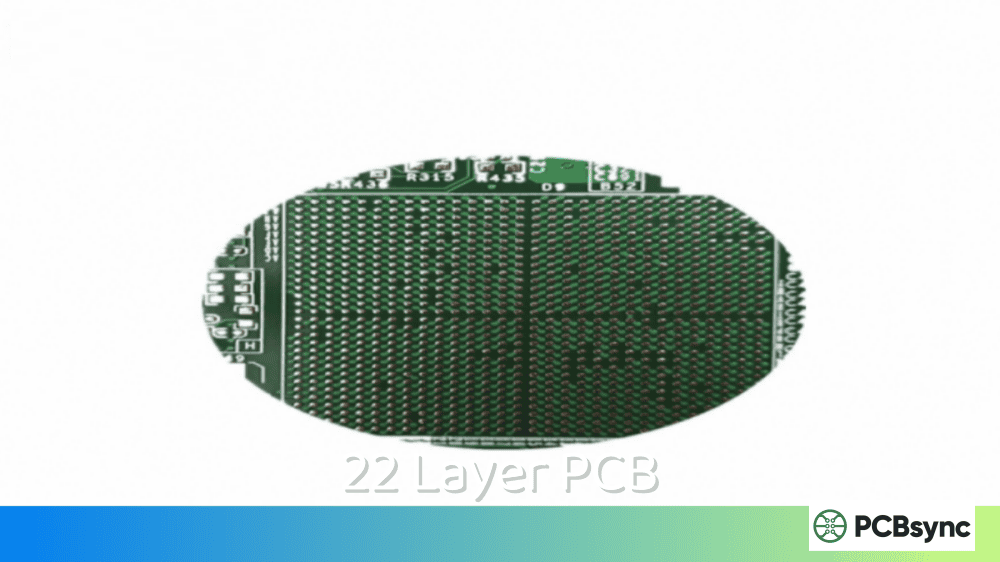
A 22 layer PCB is a highly complex multilayer PCB that contains 22 individual conductive copper layers separated by dielectric insulating materials. These layers are precisely stacked, laminated, and interconnected through various via structures to create an integrated circuit platform capable of handling extremely dense routing and complex signal requirements.
To put this in perspective, while most consumer electronics use 4 to 8 layer boards, a 22 layer PCB represents professional-grade complexity typically reserved for:
AI server motherboards and GPU backplanes
High-performance computing systems
Telecommunications infrastructure (5G base stations)
Aerospace avionics and satellite systems
Advanced medical imaging equipment
Military and defense electronics
The primary driver for using a 22 layer PCB is routing density. When you’re dealing with high pin-count BGA packages (think 2000+ pins), multiple high-speed interfaces running at 112 Gbps, and strict signal integrity requirements, sometimes 16 or 18 layers simply aren’t enough.
Why Choose a 22 Layer PCB Over Other Layer Counts?
The decision to use a 22 layer PCB shouldn’t be taken lightly—it significantly impacts cost, lead time, and manufacturing complexity. Here’s when it makes sense:
Routing Density Requirements
High-density BGA components with 0.4mm pitch or finer require multiple routing layers just for breakout. A typical high-performance FPGA or processor might need 4-6 layers just to fan out from the package. Add memory interfaces, power delivery networks, and peripheral connectivity, and you quickly exceed what 16 or 18 layers can accommodate.
Consider a modern AI accelerator package with 4,000+ pins. The first two rows of BGA balls can typically route on the surface layer. The next rows require inner signal layers for escape routing. With multiple such packages on a single board, plus memory modules, power management ICs, and I/O connectivity, layer count escalates quickly.
Signal Integrity Considerations
A 22 layer PCB provides more dedicated ground and power planes, which translates to:
Better return path continuity for high-speed signals
Lower power distribution network (PDN) impedance
Improved EMI shielding between sensitive interfaces
More flexibility in controlled impedance routing
When signals transition between layers via vias, they need a continuous return path on an adjacent reference plane. With more ground planes distributed throughout the stackup, you can ensure every signal layer has a nearby reference, minimizing return path discontinuities that cause signal integrity issues.
Power Delivery Architecture
Modern processors and GPUs can draw 500W or more. Distributing this power efficiently requires multiple power planes with sufficient copper weight. A 22 layer stackup can allocate 6-8 layers purely for power distribution while maintaining enough signal layers for complex routing.
The power distribution network (PDN) for high-performance processors requires multiple voltage rails—core voltage, I/O voltage, analog supplies, and various auxiliary rails. Each rail benefits from dedicated plane areas, and with 22 layers, you have the flexibility to implement robust power distribution without compromising signal routing resources.
Layer Count Comparison
To understand when a 22 layer PCB makes sense, compare it with other common layer counts:
Layer Count
Typical Applications
Routing Density
Cost Index
8 layers
Consumer electronics, IoT
Low-Medium
1x
12 layers
Industrial controls, networking
Medium
2x
16 layers
Servers, telecom equipment
Medium-High
3x
20 layers
High-performance computing
High
4-5x
22 layers
AI servers, aerospace, 5G
Very High
5-6x
24+ layers
Specialized applications
Extreme
7x+
The jump from 16 to 22 layers represents a significant increase in capability but also complexity. Make sure your design truly requires this level of sophistication before committing to it.
22 Layer PCB Stackup Design Fundamentals
Designing a stackup for a 22 layer PCB requires balancing multiple competing requirements. Here’s the approach I recommend based on years of practical experience:
Understanding Stackup Architecture
Before diving into specific layer arrangements, it’s important to understand the building blocks of a 22 layer PCB stackup:
Core Materials: These are fully cured laminate sheets with copper foil bonded to both sides. Standard core thicknesses range from 0.1mm to 0.3mm. Cores provide structural rigidity and dimensional stability.
Prepreg Materials: Pre-impregnated glass fabric with partially cured resin that bonds layers together during lamination. Prepreg thickness is less predictable than core because it flows during pressing, typically ranging from 0.05mm to 0.15mm post-lamination.
Copper Foils: Standard weights include 0.5oz (17.5μm), 1oz (35μm), and 2oz (70μm). Heavier copper is used for power distribution; lighter copper for fine-pitch signal routing.
Symmetrical Layer Distribution
Always maintain symmetry in your 22 layer PCB stackup. This prevents warpage during manufacturing and ensures consistent thermal expansion characteristics. A typical distribution might look like:
Layer Type
Count
Purpose
Signal Layers
10-12
High-speed routing, controlled impedance traces
Ground Planes
5-6
Return paths, EMI shielding
Power Planes
4-6
Power distribution, decoupling
Layer Arrangement Principles
For a 22 layer PCB, I typically recommend this arrangement pattern:
Top Section (Layers 1-11)
Layer 1: Top signal (components)
Layer 2: Ground plane
Layer 3: Signal
Layer 4: Power plane
Layer 5: Signal
Layer 6: Ground plane
Continuing alternating pattern…
Bottom Section (Layers 12-22)
Mirror image of top section for symmetry
Sample 22 Layer PCB Stackup Configuration
Here’s a detailed example stackup for a high-speed 22 layer PCB:
Layer
Type
Function
Copper Weight
1
Signal
Component side, high-speed
1 oz
2
Plane
Ground reference
1 oz
3
Signal
High-speed routing
0.5 oz
4
Plane
Power (VCC)
1 oz
5
Signal
General routing
0.5 oz
6
Plane
Ground
1 oz
7
Signal
High-speed routing
0.5 oz
8
Plane
Power (3.3V)
1 oz
9
Signal
General routing
0.5 oz
10
Plane
Ground
1 oz
11
Signal
High-speed routing
0.5 oz
12
Signal
High-speed routing
0.5 oz
13
Plane
Ground
1 oz
14
Signal
General routing
0.5 oz
15
Plane
Power (1.2V)
1 oz
16
Signal
High-speed routing
0.5 oz
17
Plane
Ground
1 oz
18
Signal
General routing
0.5 oz
19
Plane
Power (VCC)
1 oz
20
Signal
High-speed routing
0.5 oz
21
Plane
Ground reference
1 oz
22
Signal
Bottom side, components
1 oz
This configuration provides 12 signal layers, 6 ground planes, and 4 power planes—an excellent balance for high-speed digital designs.
The choice of dielectric material directly impacts your 22 layer PCB’s performance:
Material Type
Dk Value
Df Value
Best For
Standard FR-4
4.2-4.5
0.02
Low-cost, moderate speed
High Tg FR-4
4.0-4.3
0.018
Better thermal performance
Megtron 6
3.4-3.7
0.002-0.004
High-speed digital (25+ Gbps)
Rogers 4350B
3.48
0.004
RF and microwave
Megtron 7
3.3
0.001-0.002
Ultra high-speed (112 Gbps)
For AI server applications running PCIe 5.0 or 6.0, I recommend low-loss materials like Megtron 6 or 7 with Dk values below 3.5 and Df below 0.004 at 10 GHz.
22 Layer PCB Manufacturing Process
The PCB manufacturing process for a 22 layer board is significantly more complex than standard multilayer boards. Here’s what happens in a capable fabrication facility:
Sequential Lamination
A 22 layer PCB cannot be manufactured in a single lamination cycle. Most fabricators use a 3-4 cycle sequential lamination approach:
First Lamination: Core layers 9-14 (center section)
Second Lamination: Add layers 5-8 and 15-18
Third Lamination: Add layers 1-4 and 19-22
Final Pressing: Complete stack with outer copper foil
Each lamination cycle introduces potential for layer misregistration, which is why alignment accuracy (typically ±2-3 mils) is critical.
Via Formation Technology
A 22 layer PCB typically uses multiple via types:
Via Type
Diameter
Application
Through-hole vias
8-12 mil
Layer 1 to Layer 22 connections
Buried vias
6-8 mil
Internal layer connections
Blind vias
4-6 mil
Surface to internal connections
Microvias
3-4 mil
HDI layers, laser drilled
Stacked microvias
3-4 mil
Multiple HDI layers
For HDI 22 layer PCB designs, you’ll often see structures like 2+N+2 or 3+N+3, where the outer sections contain sequentially laminated HDI layers with microvias.
Critical Manufacturing Tolerances
Here are the manufacturing tolerances you should expect from a capable 22 layer PCB manufacturer:
Manufacturing a 22 layer PCB presents unique challenges:
Resin Flow Control: During lamination, the prepreg resin must flow uniformly to fill gaps and voids. Too little resin causes voids; too much can cause resin starvation in other areas.
Interlayer Alignment: With 22 layers requiring precise alignment across multiple lamination cycles, maintaining ±5 μm layer-to-layer registration is essential. Deviations exceeding 10 μm can increase signal reflection by 15%.
Thermal Management: High layer count boards retain more heat during lamination. Uneven temperature distribution can cause localized warpage or delamination.
Copper Balance: Uneven copper distribution across layers creates differential thermal expansion, leading to bow and twist. Smart copper balancing and thieving patterns help mitigate this.
22 Layer PCB Thickness and Specifications
Total board thickness for a 22 layer PCB depends on your stackup choices:
Typical Thickness Ranges
Configuration
Approximate Thickness
Standard 22 layer (1oz copper)
2.8-3.2 mm
Standard 22 layer (2oz copper)
3.4-3.8 mm
High-density HDI 22 layer
2.0-2.5 mm
Heavy copper 22 layer
4.0-5.0 mm
Dielectric Thickness Considerations
For impedance-controlled designs, dielectric thickness between signal and reference planes is critical. Common options include:
Core materials: 0.1mm to 0.3mm
Prepreg materials: 0.05mm to 0.2mm (post-lamination)
Ultra-thin dielectrics: 25-50 μm for HDI sections
Thinner dielectrics enable tighter impedance control and reduce via stub lengths, but they’re more expensive and harder to manufacture consistently.
22 Layer PCB Applications
The applications for 22 layer PCBs span the most demanding sectors of the electronics industry. Let me walk you through the key markets where these complex boards are essential.
AI and High-Performance Computing
The average layer count for AI server motherboards has increased from 14 layers in 2019 to 18-22 layers in 2024. This trend reflects the increasing complexity of AI workloads:
NVIDIA DGX systems use 20+ layer motherboards
Dell PowerEdge AI servers feature 20-22 layer designs
According to industry research firm Prismark, the high-end server PCB market reached $18 billion in 2023, with 18-24 layer PCBs accounting for over 60% of that total. The demand continues to grow at 20%+ annually as AI workloads proliferate.
The complexity of modern AI accelerators is staggering. A single NVIDIA H100 GPU requires routing for thousands of signals, multiple power rails delivering hundreds of amps, and thermal management for 700W of heat dissipation. Only a 22 layer PCB or higher can accommodate these requirements while maintaining the signal integrity needed for reliable operation.
Telecommunications Infrastructure
5G base stations and network switches rely on 22 layer PCBs for:
Massive MIMO antenna arrays
High-speed backhaul connections
Power amplifier modules
Signal processing units
The transition from 4G to 5G has driven significant increases in PCB complexity. 5G base stations operate at higher frequencies (sub-6 GHz and mmWave), require more antenna elements, and process vastly more data. These factors combine to demand higher layer count PCBs.
A typical 5G Massive MIMO radio unit might include:
Component
Layer Requirements
Digital beamforming ASIC
4-6 layers for breakout
FPGA/DSP array
4-6 layers
Power distribution
4-6 layers
RF signal routing
4-6 layers
Control/monitoring
2-4 layers
This adds up to 18-28 layers depending on integration level, putting 22 layer PCBs squarely in the sweet spot.
Aerospace and Defense
Avionics systems, satellite communications, and radar systems use 22 layer PCBs that must meet MIL-STD-883G standards:
1000+ thermal cycles (-55°C to 125°C)
High altitude pressure tolerance
Radiation hardening requirements
Extended operating temperature ranges
Defense electronics present unique challenges beyond commercial applications. These systems must operate in extreme environments while maintaining absolute reliability—failure is not an option when lives depend on the equipment.
22 layer PCBs in aerospace applications often use specialized constructions:
Polyimide-based materials for extended temperature range (-65°C to +260°C)
Low-outgassing materials for space applications where volatile compounds can contaminate sensitive optics
Radiation-tolerant designs with dedicated shielding planes and redundant signal routing
Conformal coating compatibility for protection against humidity and contaminants
Medical Equipment
High-end medical imaging equipment including MRI machines, CT scanners, and advanced ultrasound systems utilize 22 layer PCBs for:
High-resolution image processing
Real-time data acquisition
Precision motor control
RF signal processing
Medical device manufacturers face stringent regulatory requirements (FDA, CE marking, ISO 13485) that demand exceptional reliability. A 22 layer PCB in a CT scanner might process data from 128 or more detector channels simultaneously, requiring massive parallel processing capability and precise timing synchronization.
Data Center and Cloud Infrastructure
Beyond AI servers, general cloud infrastructure increasingly relies on 22 layer PCBs:
Network switches handling 51.2 Tbps throughput
Storage controllers managing petabytes of data
Rack management and power distribution systems
The hyperscale data centers operated by Amazon, Google, Microsoft, and others deploy hundreds of thousands of servers. The economics of scale mean even small efficiency improvements in PCB design translate to massive cost savings and reduced environmental impact.
Design Considerations for 22 Layer PCBs
Signal Integrity Planning
When routing high-speed signals on a 22 layer PCB:
Reference Plane Continuity: Every high-speed signal needs an adjacent reference plane. Never route signals over split planes or gaps.
Return Path Management: Current returns through the nearest reference plane. Plan your layer stack so signals have consistent return paths.
Crosstalk Mitigation: Maintain 3x trace width spacing between adjacent signals on the same layer. Use ground shields between sensitive traces.
Via Optimization: Minimize via stubs by using back-drilling or via-in-pad with via filling. Stubs longer than λ/10 at your operating frequency will cause reflections.
Power Integrity Considerations
A proper power distribution network (PDN) on a 22 layer PCB requires:
Multiple power plane pairs for low impedance
Embedded capacitance materials where applicable
Strategic decoupling capacitor placement
Via stitching between ground planes
Target PDN impedance for modern processors is typically below 1 milliohm at frequencies up to 100 MHz.
Thermal Management
High layer count boards present thermal challenges:
Use thermal vias (0.3mm diameter, 1.2mm pitch) under hot components
Consider 2oz or heavier copper on power planes
Allocate dedicated thermal relief layers if needed
Plan for thermal vias to transfer heat to both surfaces
Cost Factors for 22 Layer PCBs
Understanding cost drivers helps optimize your 22 layer PCB design:
Cost Factor
Impact
Optimization Strategy
Layer count
Very High
Verify you actually need 22 layers
Board size
High
Panelize efficiently
Material selection
High
Use standard FR-4 where possible
Via types
Medium-High
Limit blind/buried vias
Trace/space
Medium
Stay above 3.5/3.5 mil if possible
Impedance control
Medium
Limit to necessary nets
Lead time
Medium
Plan ahead for 4-6 week builds
Typical Pricing Ranges
As a rough guideline (prices vary significantly by manufacturer and specifications):
Prototype (5-10 pcs): $2,000-$8,000 per board
Low volume (50-100 pcs): $800-$2,500 per board
Production (1000+ pcs): $200-$800 per board
Selecting a 22 Layer PCB Manufacturer
Not every PCB fabricator can produce quality 22 layer boards. Here’s what to look for:
Essential Capabilities
Layer count experience: Verify they regularly produce 20+ layer boards
Registration accuracy: Should demonstrate ±2-3 mil capability
Sequential lamination: Multiple lamination cycles with alignment verification
Via technology: Laser drilling, buried vias, via-in-pad capability
Testing equipment: X-ray inspection, flying probe, time domain reflectometry
Certifications to Look For
Certification
Application
ISO 9001:2015
Quality management
AS9100D
Aerospace applications
IATF 16949
Automotive applications
ISO 13485
Medical device PCBs
IPC Class 3/3A
High reliability
ITAR registered
Defense applications
Due Diligence Checklist
Before committing to a manufacturer:
Request sample boards or visit facility
Review their DFM guidelines for high layer counts
Confirm material sourcing for low-loss laminates
Verify testing and inspection capabilities
Check lead times for your layer count
Understand their warranty and failure analysis process
Useful Resources for 22 Layer PCB Design
Design Tools and Calculators
Here are some tools I regularly use for high layer count designs:
IPC-6012E: Rigid board qualification and performance
IPC-4101: Laminate and prepreg specifications
IPC-TM-650: Test methods manual
Material Datasheets
Request detailed datasheets from your laminate supplier. Key manufacturers include:
Isola (Tachyon, I-Tera, Astra)
Panasonic (Megtron series)
Rogers Corporation (RO4000, RO3000 series)
Shengyi Technology (S-series)
Nan Ya Plastics (NPG series)
Frequently Asked Questions About 22 Layer PCBs
What is the typical lead time for a 22 layer PCB prototype?
Most capable manufacturers quote 4-6 weeks for a 22 layer PCB prototype, compared to 1-2 weeks for standard 4-layer boards. The extended time accounts for multiple lamination cycles, additional drilling operations, and more extensive testing. Expedited services may reduce this to 3-4 weeks at premium pricing. For production quantities, expect 6-8 weeks from order to delivery.
What is the maximum board size for a 22 layer PCB?
Maximum panel sizes vary by manufacturer, but typically range from 18″ x 24″ to 21″ x 24″. However, practical limits for 22 layer PCBs are often smaller (around 16″ x 20″) due to registration and warpage concerns during multiple lamination cycles. As layer count increases, maximum achievable board size generally decreases. Consult your manufacturer for their specific capabilities.
Can a 22 layer PCB use flex or rigid-flex construction?
Yes, but it’s extremely complex and expensive. Rigid-flex designs with 22 total layers are possible but typically use 18-20 rigid layers with 2-4 flex layers. These designs are used in aerospace and military applications where space constraints demand three-dimensional routing. Expect significantly higher costs (3-5x) and longer lead times (8-12 weeks) compared to all-rigid constructions.
How do I reduce the cost of a 22 layer PCB design?
Several strategies can reduce costs without sacrificing performance: First, verify you actually need 22 layers—sometimes creative routing can reduce layer count. Use standard FR-4 for inner layers where high-speed materials aren’t required (hybrid stackups). Stay above 3.5/3.5 mil trace/space to improve yields. Minimize blind and buried vias to essential connections. Consider via-in-pad only where absolutely necessary. Finally, work with your manufacturer during design review to identify DFM optimizations specific to their process.
What testing is performed on 22 layer PCBs?
Comprehensive testing for 22 layer PCBs typically includes: Automated Optical Inspection (AOI) after each imaging step; electrical testing via flying probe or fixture for continuity and isolation; controlled impedance testing using Time Domain Reflectometry (TDR); X-ray inspection for internal via quality and layer alignment; microsection analysis for lamination quality verification; and Ionic contamination testing. For Class 3 applications, additional testing may include thermal stress testing, peel strength verification, and accelerated aging.
Conclusion
A 22 layer PCB represents the high end of mainstream PCB manufacturing complexity. While not every project needs this level of sophistication, understanding when and how to use 22 layer designs is essential knowledge for engineers working on advanced electronics.
The key takeaways from this guide:
A 22 layer PCB is justified when routing density, signal integrity, or power distribution requirements exceed what lower layer counts can achieve
Symmetrical stackup design prevents manufacturing issues and ensures consistent performance
Material selection directly impacts signal integrity at high frequencies
Manufacturing requires specialized processes including sequential lamination and advanced via technology
Cost optimization requires careful attention to design rules and material choices
As AI, 5G, and high-performance computing continue to advance, demand for 22 layer PCBs will only increase. The engineers and companies who master these complex designs will be well-positioned to deliver the next generation of electronic products.
If you’re planning a 22 layer PCB project, start the conversation with your manufacturer early. The decisions made during stackup planning ripple through the entire design process, and getting expert input upfront saves time, money, and headaches down the road.
Inquire: Call 0086-755-23203480, or reach out via the form below/your sales contact to discuss our design, manufacturing, and assembly capabilities.
Quote: Email your PCB files to Sales@pcbsync.com (Preferred for large files) or submit online. We will contact you promptly. Please ensure your email is correct.
Notes: For PCB fabrication, we require PCB design file in Gerber RS-274X format (most preferred), *.PCB/DDB (Protel, inform your program version) format or *.BRD (Eagle) format. For PCB assembly, we require PCB design file in above mentioned format, drilling file and BOM. Click to download BOM template To avoid file missing, please include all files into one folder and compress it into .zip or .rar format.