Inquire: Call 0086-755-23203480, or reach out via the form below/your sales contact to discuss our design, manufacturing, and assembly capabilities.
Quote: Email your PCB files to Sales@pcbsync.com (Preferred for large files) or submit online. We will contact you promptly. Please ensure your email is correct.
Notes: For PCB fabrication, we require PCB design file in Gerber RS-274X format (most preferred), *.PCB/DDB (Protel, inform your program version) format or *.BRD (Eagle) format. For PCB assembly, we require PCB design file in above mentioned format, drilling file and BOM. Click to download BOM template To avoid file missing, please include all files into one folder and compress it into .zip or .rar format.
After designing hundreds of PCBs over the years, I have learned that certain resistor values appear repeatedly across different projects. The 20 ohm resistor is one such workhorse component that shows up in power circuits, LED applications, and automotive electronics with surprising regularity. This guide covers everything engineers and hobbyists need to know about this E24 series standard value.
A 20 ohm resistor is a passive electronic component providing exactly 20 ohms of electrical resistance. This value belongs to the E24 preferred number series, making it a standard value available from every major electronics distributor worldwide.
The “20” designation indicates resistance measured in ohms (Ω). In the E24 progression, this value sits between 18Ω and 22Ω. When your calculations call for moderate resistance with low-to-medium voltage supplies, you will frequently find that a 20 ohm resistor fits the bill perfectly.
Why 20 Ohms Is a Standard E24 Value
The E-series system provides logarithmically distributed resistance values that cover practical requirements while keeping manufacturing efficient. Each series corresponds to a specific tolerance range.
E-Series
Values Per Decade
Typical Tolerance
Application
E6
6
±20%
Non-critical circuits
E12
12
±10%
General purpose
E24
24
±5%
Standard precision
E48
48
±2%
Higher precision
E96
96
±1%
Precision circuits
The value 20 appears in E24 and higher series, ensuring the 20 ohm resistor remains readily available in both through-hole and surface mount packages across all common power ratings.
20 Ohm Resistor Color Code
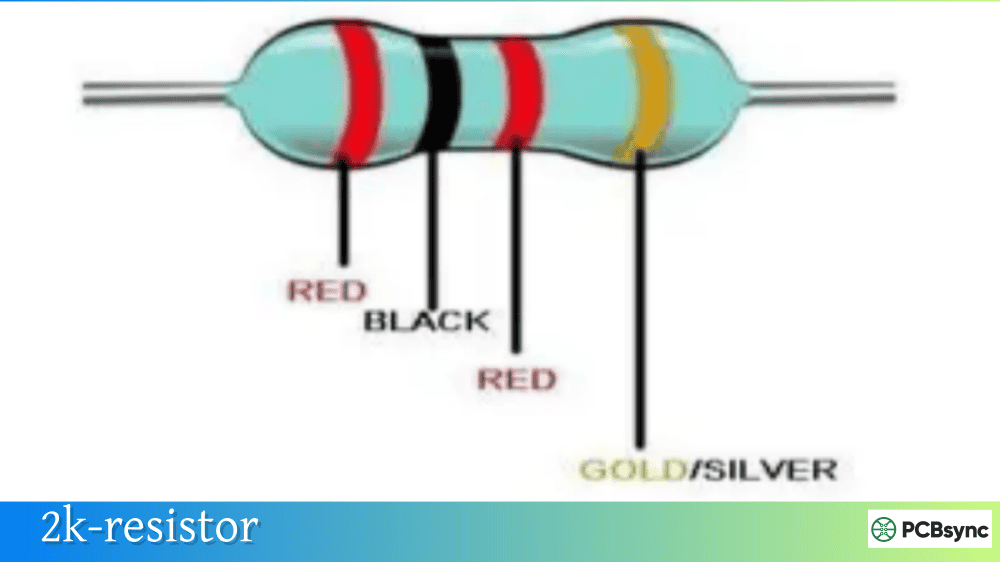
Identifying a 20 ohm resistor by its color bands becomes second nature once you understand the coding system defined by IEC 60062. The key is recognizing that 20 = 2 × 10^1, which translates to specific color combinations.
4-Band Color Code for 20 Ohm Resistors
Standard through-hole resistors with 5% or 10% tolerance display four color bands:
Band Position
Color
Meaning
1st Band (First Digit)
Red
2
2nd Band (Second Digit)
Black
0
3rd Band (Multiplier)
Black
×1
4th Band (Tolerance)
Gold or Silver
±5% or ±10%
A 20 ohm resistor with 5% tolerance displays Red-Black-Black-Gold.
5-Band Color Code for Precision Resistors
For 1% tolerance precision resistors, the five-band code adds an extra significant digit:
Band Position
Color
Meaning
1st Band
Red
2
2nd Band
Black
0
3rd Band
Black
0
4th Band (Multiplier)
Gold
×0.1
5th Band (Tolerance)
Brown
±1%
The sequence reads Red-Black-Black-Gold-Brown. The gold multiplier indicates division by 10, giving us 200 × 0.1 = 20Ω.
6-Band Color Code with Temperature Coefficient
High-precision applications sometimes require resistors with a sixth band indicating temperature coefficient:
Band Position
Color
Meaning
1st–3rd Bands
Red-Black-Black
200
4th Band (Multiplier)
Gold
×0.1
5th Band (Tolerance)
Gold
±5%
6th Band (TCR)
Black
250 ppm/K
SMD Marking Codes for 20 Ohm Resistors
Surface mount resistors use numerical markings due to space constraints:
Marking System
Code
Interpretation
3-Digit Code
200
20 × 10^0 = 20Ω
4-Digit Code
20R0
20.0Ω
EIA-96 Code
20X
Requires lookup table
The “200” marking is most common on standard SMD packages. The “R” notation indicates the decimal position, so “20R0” means exactly 20.0 ohms.
Common Applications for 20 Ohm Resistors
Through my experience working on everything from consumer electronics to industrial controls, I have encountered 20 ohm resistors in numerous practical applications.
Automotive LED Load Resistors
This is probably the most common application I see for higher-wattage 20 ohm resistors. When replacing 10W incandescent turn signal bulbs with LEDs on a 12V automotive system, the vehicle’s flasher module expects a specific current draw.
Using Ohm’s Law: P = V²/R = 144/20 = 7.2W
A 20 ohm resistor rated at 10W simulates approximately 7W of load, which matches many original 10W turn signal bulbs closely enough to prevent hyperflash. This makes 20Ω load resistors popular for motorcycle and automotive LED conversions.
LED Current Limiting Circuits
Lower-wattage 20 ohm resistors work well for current limiting in specific LED configurations. Consider driving a high-brightness LED at 150mA from a 5V supply with a 2V forward voltage drop:
R = (5V – 2V) / 0.15A = 20Ω
The math works out cleanly, making this resistor value practical for certain LED driver designs.
Audio Amplifier Circuits
In audio applications, 20 ohm resistors appear in several roles:
Zobel networks for high-frequency stability
Speaker crossover impedance matching
Output stage biasing in certain amplifier topologies
Load simulation during amplifier testing
The value provides useful impedance levels when working with 4Ω and 8Ω speaker loads.
Current Sensing Applications
For moderate-current sensing where you want a measurable voltage drop, a 20 ohm resistor provides good signal levels. At 100mA, you get a clean 2V signal that most ADCs handle easily without amplification.
Voltage Divider Networks
When combined with other E24 values, 20 ohm resistors create useful voltage division ratios. Paired with a 10Ω resistor, you get a 2:1 divider. Combined with 80Ω (or four 20Ω in series), you achieve a 4:1 ratio.
Specifications and Available Types
Power Ratings by Package
Selecting the correct power rating prevents overheating and premature failure. Here are typical ratings for common packages:
Package Type
Power Rating
Typical Dimensions
0402 SMD
1/16W (0.063W)
1.0mm × 0.5mm
0603 SMD
1/10W (0.1W)
1.6mm × 0.8mm
0805 SMD
1/8W (0.125W)
2.0mm × 1.25mm
1206 SMD
1/4W (0.25W)
3.2mm × 1.6mm
2512 SMD
1W
6.3mm × 3.2mm
1/4W Axial
0.25W
~6mm × 2mm body
1/2W Axial
0.5W
~9mm × 3mm body
1W Axial
1W
~12mm × 4mm body
5W Wirewound
5W
~22mm × 8mm body
10W Ceramic
10W
Varies by manufacturer
For automotive load resistor applications, always choose components rated well above your calculated dissipation. Those 10W and 20W ceramic or aluminum-housed resistors exist for good reason.
Resistor Construction Types
Different construction methods suit different applications:
Carbon Film: Economical choice for general-purpose work. Temperature coefficient typically 200-500 ppm/°C. Adequate for most hobbyist projects.
Metal Film: Superior stability and lower noise. Temperature coefficient around 50-100 ppm/°C. My default choice for analog signal paths.
Metal Oxide Film: Excellent pulse handling and high-temperature operation. Good for power supply circuits and automotive environments.
Wirewound: Best power handling but introduces inductance. Avoid in RF or high-frequency switching applications. Perfect for load resistors and power circuits below 100kHz.
Thick Film SMD: Standard surface mount construction. Works well for digital circuits and general analog work where extreme precision is not required.
Thin Film SMD: Superior precision and temperature stability. Choose these when your design demands tight tolerances.
Ohm’s Law Calculations with 20 Ohm Resistors
Every circuit calculation involving resistors begins with the fundamental relationship: V = I × R
Known Values
Formula
Example with 20Ω
Voltage and Resistance
I = V/R
I = 12V/20Ω = 0.6A
Current and Resistance
V = I × R
V = 0.25A × 20Ω = 5V
Voltage and Current
R = V/I
Confirms R = 5V/0.25A = 20Ω
Power Dissipation Calculations
Understanding power dissipation prevents component failures:
Voltage Across 20Ω
Current
Power Dissipated
2V
100mA
0.2W
4V
200mA
0.8W
6V
300mA
1.8W
12V
600mA
7.2W
Notice how a 12V supply across a 20 ohm resistor demands over 7W dissipation. This is exactly why automotive LED load resistors come in 10W and 25W ratings with aluminum heatsink housings.
Sometimes your parts bin lacks a 20 ohm resistor. Here are combination strategies:
Series Combinations for ~20Ω
Configuration
Calculation
Result
10Ω + 10Ω
10 + 10
20.0Ω
18Ω + 2.2Ω
18 + 2.2
20.2Ω
15Ω + 4.7Ω
15 + 4.7
19.7Ω
12Ω + 8.2Ω
12 + 8.2
20.2Ω
Parallel Combinations for ~20Ω
Configuration
Calculation
Result
40Ω ∥ 40Ω
40/2
20.0Ω
30Ω ∥ 60Ω
(30×60)/(30+60)
20.0Ω
22Ω ∥ 220Ω
(22×220)/(22+220)
20.0Ω
27Ω ∥ 75Ω
(27×75)/(27+75)
19.85Ω
Tolerance and Its Impact on Circuits
The tolerance specification determines actual resistance variation from the marked value:
Tolerance
20Ω Actual Range
Color Code Band
±1%
19.8Ω to 20.2Ω
Brown
±2%
19.6Ω to 20.4Ω
Red
±5%
19.0Ω to 21.0Ω
Gold
±10%
18.0Ω to 22.0Ω
Silver
For current sensing or precision voltage dividers, stick with 1% tolerance components. The price difference is minimal for small quantities, and circuit predictability improves significantly.
PCB Design Considerations
From years of layout work, here are practical recommendations for working with 20 ohm resistors:
Thermal Management for Power Resistors
Higher-power 20 ohm resistors need careful thermal design:
Provide adequate copper area around pads for heat spreading
Add thermal vias under SMD power resistors
Maintain spacing between power resistors and temperature-sensitive components
Consider forced airflow for dissipations exceeding 1W per resistor
Aluminum-housed resistors need proper mounting to heatsinks or chassis
Footprint Selection Guidelines
Match your footprint to power requirements, not just resistance value. An 0805 SMD resistor handles only 1/8W under ideal conditions. Derate by 50% at elevated ambient temperatures, leaving you with just 62.5mW continuous capacity.
High-Frequency Considerations
Wirewound 20 ohm resistors can exhibit several microhenries of inductance. This causes problems in:
Switching regulator feedback networks
High-frequency filter circuits
Fast edge-rate digital signal termination
Use carbon film, metal film, or thin-film SMD resistors for applications above a few hundred kilohertz.
A standard 4-band 20 ohm resistor with 5% tolerance displays the color code Red-Black-Black-Gold. Red represents the digit 2, the first Black represents 0, the second Black is the multiplier (×1), and Gold indicates ±5% tolerance. For 10% tolerance versions, the fourth band is Silver instead of Gold.
Can I use a 20 ohm resistor for automotive LED turn signals?
Yes, 20 ohm resistors rated at 10W are commonly used as load resistors when converting 10W incandescent turn signal bulbs to LEDs. The resistor must be wired in parallel with the LED and mounted on a heat-resistant surface since it will dissipate significant heat. Always use a resistor rated for at least 10W to handle the power safely.
How do I identify a 20 ohm SMD resistor?
Surface mount 20 ohm resistors typically display “200” on their surface, meaning 20 × 10^0 = 20Ω. The first two digits are significant figures (20), and the third digit indicates how many zeros to add (zero zeros). Some precision resistors may show “20R0” where the R indicates the decimal position.
What wattage 20 ohm resistor do I need?
Calculate power dissipation using P = V²/R where V is the voltage across the resistor. For a 20 ohm resistor with 6V across it, power equals 36/20 = 1.8W. Always select a resistor rated at least 1.5 to 2 times your calculated dissipation for reliable long-term operation. In this example, choose a 3W or higher rated resistor.
Is 20 ohms a standard resistor value?
Yes, 20 ohms is a standard E24 series value, making it widely available from all major electronics distributors. You will find this value in through-hole packages ranging from 1/8W to 10W and beyond, as well as SMD packages from tiny 0402 to larger power-handling 2512 sizes. Any well-stocked parts inventory includes 20 ohm resistors in multiple configurations.
Final Thoughts
The 20 ohm resistor exemplifies the practical utility of standard E24 values. Whether you are building an LED load resistor for your motorcycle, designing a current sensing circuit, or working on audio equipment, this value appears with surprising frequency.
Understanding the color code (Red-Black-Black-Gold for 5% tolerance), power rating requirements, and appropriate construction types ensures you select the right component for each application. Keep an assortment of 20 ohm resistors in various packages and power ratings in your inventory, and you will reach for them more often than you might expect.
For high-power automotive applications, remember that heat dissipation is critical. Those aluminum-housed 10W and 25W resistors exist because a 20 ohm load on a 12V system generates serious thermal energy. Plan your mounting accordingly, and your LED conversion projects will work reliably for years.
Inquire: Call 0086-755-23203480, or reach out via the form below/your sales contact to discuss our design, manufacturing, and assembly capabilities.
Quote: Email your PCB files to Sales@pcbsync.com (Preferred for large files) or submit online. We will contact you promptly. Please ensure your email is correct.
Notes: For PCB fabrication, we require PCB design file in Gerber RS-274X format (most preferred), *.PCB/DDB (Protel, inform your program version) format or *.BRD (Eagle) format. For PCB assembly, we require PCB design file in above mentioned format, drilling file and BOM. Click to download BOM template To avoid file missing, please include all files into one folder and compress it into .zip or .rar format.