Inquire: Call 0086-755-23203480, or reach out via the form below/your sales contact to discuss our design, manufacturing, and assembly capabilities.
Quote: Email your PCB files to Sales@pcbsync.com (Preferred for large files) or submit online. We will contact you promptly. Please ensure your email is correct.
Notes: For PCB fabrication, we require PCB design file in Gerber RS-274X format (most preferred), *.PCB/DDB (Protel, inform your program version) format or *.BRD (Eagle) format. For PCB assembly, we require PCB design file in above mentioned format, drilling file and BOM. Click to download BOM template To avoid file missing, please include all files into one folder and compress it into .zip or .rar format.
1M Ohm Resistor: Complete Guide to Color Code & High Impedance Uses
Last month, I spent three hours debugging a capacitive touch sensor that wouldn’t detect touches reliably. The Arduino sketch was perfect, the sensor pad was sized correctly, but sensitivity was terrible. The problem? Someone had substituted a 100kΩ resistor for the specified 1M ohm resistor in the RC timing circuit. That 10× resistance difference meant the RC time constant dropped from 10 microseconds to just 1 microsecond—too fast for the microcontroller to detect the subtle capacitance changes from a finger touch. After swapping in the correct 1M ohm resistor, the sensor worked beautifully. High impedance applications are unforgiving about resistance values.
A 1M ohm resistor provides exactly 1,000,000Ω (one megaohm) of resistance. This is genuine high-impedance territory where circuit behavior shifts dramatically from the low-value resistors most hobbyists encounter. At 1MΩ, you’re intentionally restricting current flow to microampere levels while maintaining usable voltages across the resistor.
The “M” designation means “mega,” representing one million. In electronics shorthand, you’ll see it written as 1MΩ, 1M, or sometimes 1MEG. These all mean the same thing: 1,000,000 ohms.
Why 1M Ohm Matters in Circuit Design
At 1 megaohm resistance, you enter a different electrical domain:
Ultra-low current operation: Apply 5V across a 1M ohm resistor and you get I = V/R = 5V / 1,000,000Ω = 5µA (microamps). That’s five millionths of an ampere—essentially nothing by normal circuit standards. This makes 1MΩ resistors perfect for bias networks, timing circuits, and sensor interfaces where you specifically don’t want current flow.
High input impedance: In measurement and instrumentation circuits, high impedance minimizes circuit loading. When you probe a circuit with a 1MΩ input impedance (like an oscilloscope on 1× mode), you’re drawing minimal current from the circuit under test, preserving the original signal characteristics.
Sensitive RC timing: Combined with even tiny capacitances (10-100pF), 1M ohm resistors create RC time constants in the microsecond to millisecond range. This is ideal for capacitive touch sensing, delay circuits, and timing applications where you need measurable delays without wasting power.
The 1M ohm value sits in the E12 standard series, making it widely available and cost-effective despite its specialized applications.
Decoding 1M Ohm Resistor Color Codes
Reading megaohm-range resistors requires careful attention to the color bands, particularly the multiplier band.
4-Band 1M Ohm Color Code
Band Position
Color
Meaning
Value
1st Band
Brown
First Digit
1
2nd Band
Black
Second Digit
0
3rd Band
Green
Multiplier
×100,000
4th Band
Gold
Tolerance
±5%
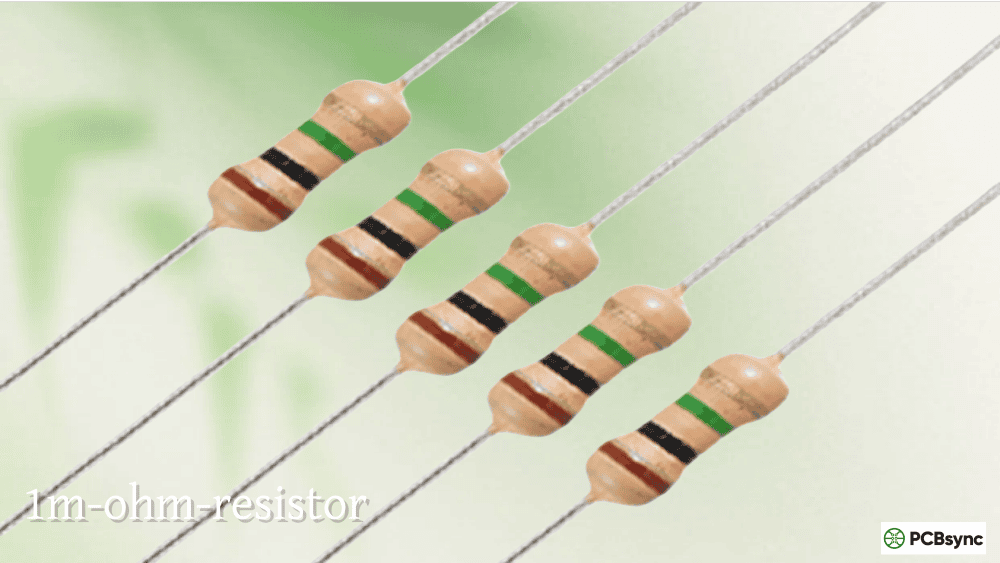
The standard 4-band code is Brown-Black-Green-Gold. Read it as: Brown (1) and Black (0) give you “10”, multiply by Green (100,000) to get 1,000,000Ω, with Gold indicating ±5% tolerance (950kΩ to 1.05MΩ range).
That green multiplier band is critical. Green means ×100,000 (or 10^5). Confuse green with blue (×1,000,000) and you’d think you have a 10MΩ resistor instead—a 10× error that will definitely cause circuit problems.
Pro tip from the field: The 1M ohm resistor has one of the most distinctive color patterns—brown, black, green. Learn to recognize this combination instantly, because these resistors show up constantly in high-impedance designs. I keep mine in a separate bin labeled “1M – Brown-Black-Green” because mistaking megaohm values can be catastrophic in sensitive circuits.
5-Band Precision 1M Ohm Code
Band Position
Color
Meaning
Value
1st Band
Brown
First Digit
1
2nd Band
Black
Second Digit
0
3rd Band
Black
Third Digit
0
4th Band
Yellow
Multiplier
×10,000
5th Band
Brown
Tolerance
±1%
For precision work, the 5-band version (Brown-Black-Black-Yellow-Brown) provides ±1% tolerance: 990kΩ to 1.01MΩ. The math works differently here: Brown-Black-Black gives “100”, multiply by Yellow (10,000) to reach 1,000,000Ω.
In instrumentation and measurement applications where 1% tolerance actually matters, these precision resistors are worth the extra cost. For capacitive touch sensors and general bias networks, ±5% works fine because other circuit tolerances (capacitor values, IC thresholds) exceed the resistor tolerance anyway.
6-Band High-Stability Code
Band Position
Color
Meaning
Value
1st Band
Brown
First Digit
1
2nd Band
Black
Second Digit
0
3rd Band
Black
Third Digit
0
4th Band
Yellow
Multiplier
×10,000
5th Band
Brown
Tolerance
±1%
6th Band
Brown
Temp Coefficient
100 ppm/°C
Six-band resistors add temperature coefficient information. The Brown sixth band indicates 100 ppm/°C. Over a 50°C temperature swing, your 1MΩ resistor might drift by ±5kΩ. For most digital and microcontroller applications this doesn’t matter, but for precision analog circuits or outdoor installations with wide temperature ranges, it becomes significant.
High Impedance Applications for 1M Ohm Resistors
Capacitive Touch Sensing: The Killer Application
This is where 1M ohm resistors truly shine in modern electronics. Capacitive touch sensing has become ubiquitous—from smartphones to Arduino projects—and 1MΩ is the sweet spot for DIY and educational implementations.
How it works: A capacitive touch sensor detects the change in capacitance when a finger approaches or touches a conductive pad. Human bodies have significant capacitance (typically 100-200pF) to ground. When you bring your finger near a sensor pad, you’re adding 5-20pF of additional capacitance.
The 1M ohm resistor’s role: In the charge/discharge method, you create an RC circuit with your 1M ohm resistor and the sensor capacitance. The microcontroller charges the sensor pad to logic high, then measures how long it takes to discharge through the 1MΩ resistor.
Example calculation:
Sensor pad alone: 10pF capacitance
RC time constant: τ = R × C = 1,000,000Ω × 10×10^-12 F = 10µs
Discharge time to 37%: ~10µs
Sensor with finger nearby: 13pF total capacitance
New time constant: 1MΩ × 13pF = 13µs
Change detected: 30% longer discharge time
The microcontroller can easily detect this 3µs difference by counting clock cycles. With a 100kΩ resistor, the time constant drops to 1µs—too fast for most microcontrollers to reliably measure. With 10MΩ, it works but becomes very sensitive to noise and stray capacitance.
Arduino implementation: The CapacitiveSensor library uses exactly this technique. You connect a 1M ohm resistor between two Arduino pins—one configured as output (sends charge pulses) and one as input (senses the capacitor voltage). Sensitivity increases with higher resistance, but 1MΩ provides the best balance between sensitivity and speed for typical applications.
I’ve built dozens of capacitive touch interfaces for museum exhibits and interactive installations. The 1M ohm resistor is always the specified value. Try substituting 470kΩ or 2.2MΩ and watch your carefully calibrated thresholds drift or your response time degrade.
RC Timing Circuits and Delay Networks
The 1M ohm resistor excels in timing applications where you need delays from microseconds to seconds without burning power.
555 Timer applications: In astable mode, a 1M ohm timing resistor combined with a 1µF capacitor creates a time period of approximately τ = 0.693 × R × C = 0.693 seconds per cycle. That’s useful for slow flashers, long-duration delays, and power-saving circuits.
Microcontroller delays: Many microcontroller applications use 1M ohm resistors for simple RC delays:
Power-on reset circuits: 1MΩ + 1µF = ~1 second delay
Switch debouncing: 1MΩ + 100nF = ~100ms time constant
Watchdog timer extensions: Long RC constants provide extended timeouts
Pulse stretching: When interfacing fast digital signals to slower systems, a 1M ohm resistor with appropriate capacitance stretches pulses to detectable widths without consuming significant current.
Oscilloscope Probe Input Impedance
Standard oscilloscope probes (10×) combine a 9MΩ resistor in the probe body with the scope’s 1M ohm input impedance to create 10MΩ total—the probe divides voltage by 10.
Why 1MΩ scope inputs?
Minimal circuit loading: High impedance draws minimal current from circuits under test
Preserves signal integrity: Doesn’t change the behavior of high-impedance nodes
Appropriate bandwidth: 1MΩ input with ~15pF capacitance provides reasonable bandwidth for signals up to several MHz
When measuring digital logic, bias networks, or high-impedance analog circuits, you want that 1MΩ (or 10MΩ with probe) input impedance. Switch to 50Ω input and you’ll load the circuit dramatically, potentially preventing it from functioning.
Bias Resistors and Pull-down Applications
In high-impedance digital inputs and analog bias networks, 1M ohm resistors provide a defined state without wasting power.
MOSFET gate bias: High-power MOSFETs have essentially infinite DC input impedance. A 1M ohm pull-down resistor ensures the gate stays at ground when not driven, preventing spurious turn-on from noise or static electricity. At 12V, this resistor draws only 12µA—negligible power consumption.
Op-amp bias networks: High-impedance instrumentation amplifiers often use 1MΩ resistors in bias networks to establish DC operating points without introducing significant noise or loading the signal source.
ADC input protection: Microcontroller ADC inputs are extremely high impedance. A 1M ohm resistor limits current during overvoltage events without significantly affecting normal signal measurement. This prevents latchup while maintaining measurement accuracy.
Piezoelectric Sensor Interfaces
Piezoelectric sensors (pressure sensors, knock sensors, piezo discs) generate high-impedance voltage signals. They act like tiny capacitors that develop charge in response to mechanical stress.
A 1M ohm resistor provides:
Bias path: Establishes DC bias without loading the sensor
Discharge path: Controls the decay rate of the signal
Noise filtering: Combined with sensor capacitance, creates low-pass filtering
Too low resistance (100kΩ) and you load the sensor, reducing sensitivity. Too high (10MΩ+) and you become susceptible to leakage currents and noise pickup.
Power Dissipation and Ratings
One advantage of 1M ohm resistors—power dissipation is almost never an issue.
Power Calculation Examples
Voltage Applied
Current Flow
Power Dissipated
Resistor Size Needed
5V
5µA
25µW
1/8W easily handles
12V
12µA
144µW
1/8W easily handles
24V
24µA
576µW
1/8W easily handles
50V
50µA
2.5mW
1/8W with margin
100V
100µA
10mW
1/8W comfortable
The standard 1/4W (250mW) through-hole 1M ohm resistor can withstand P = √(P × R) = √(0.25W × 1,000,000Ω) = 500V before exceeding its power rating. In practice, voltage breakdown of the resistor’s insulation limits you to the resistor’s voltage rating (typically 200-350V for 1/4W resistors) rather than power dissipation.
For typical 5V and 12V electronics, even 1/8W resistors provide enormous thermal headroom. I routinely use 1/8W 1M ohm resistors in battery-powered designs because they’re smaller and cheaper than 1/4W parts.
High Voltage Considerations
Where 1M ohm resistors do encounter power issues:
High-voltage dividers: In 120VAC or 240VAC voltage sensing, use 1W or 2W rated resistors
CRT circuits: Old TV and monitor circuits operated at 15-30kV
Industrial equipment: Motor drive and power supply sensing at high voltages
Always check both voltage rating and power rating when working above 50V.
Material Types and Package Selection
Metal Film vs Carbon Film
Property
Carbon Film 1MΩ
Metal Film 1MΩ
Tolerance
±5% typical
±1% typical
Tempco
±200-500 ppm/°C
±50-100 ppm/°C
Voltage Coefficient
Moderate
Very low
Noise
Higher
Lower
Cost
$
$$
Moisture Resistance
Good
Excellent
For capacitive touch and general high-impedance work, carbon film is perfectly adequate. For instrumentation, precision measurement, or circuits exposed to humidity, metal film provides better stability.
Important note on surface contamination: At megaohm resistances, surface leakage becomes significant. Fingerprints, flux residue, or moisture on the resistor body can create parallel leakage paths of hundreds of megaohms, effectively lowering your resistance value. Clean high-value resistors with isopropyl alcohol and avoid touching the resistor body.
SMD Package Options
Package
Dimensions
Power Rating
Typical Applications
0402
1.0mm × 0.5mm
1/16W
Ultra-compact production
0603
1.6mm × 0.8mm
1/10W
General SMD production
0805
2.0mm × 1.25mm
1/8W
Hand-solderable, good balance
1206
3.2mm × 1.6mm
1/4W
Easy rework, higher power
SMD marking for 1M ohm resistors typically uses: 105 (10 × 10^5 = 1,000,000Ω). Some manufacturers use different codes, so always verify with a multimeter.
For prototyping circuits with 1M ohm resistors, I prefer 1206 or even through-hole. The larger size makes them easier to probe with an oscilloscope, and you can measure them in-circuit more reliably.
Problem: Circuit behaves erratically, measurements drift, or 1MΩ resistor seems to measure lower than expected.
Causes:
Flux residue creating conductive paths
Moisture absorption in humid environments
Fingerprint oils on resistor body
PCB contamination creating parallel leakage paths
Solution: Clean thoroughly with isopropyl alcohol. In production, use conformal coating for humid environments. When breadboarding, avoid touching resistor bodies with bare fingers.
Stray Capacitance Effects
Problem: RC timing circuits don’t match calculated values, or circuit behavior changes with wire routing.
Cause: At 1MΩ impedance, even 5pF of stray capacitance creates a 5µs time constant that affects circuit behavior.
Solution: Keep leads short. Route high-impedance traces away from signal traces. Use guard rings on PCBs to shield high-impedance nodes.
Wrong Value Substitution
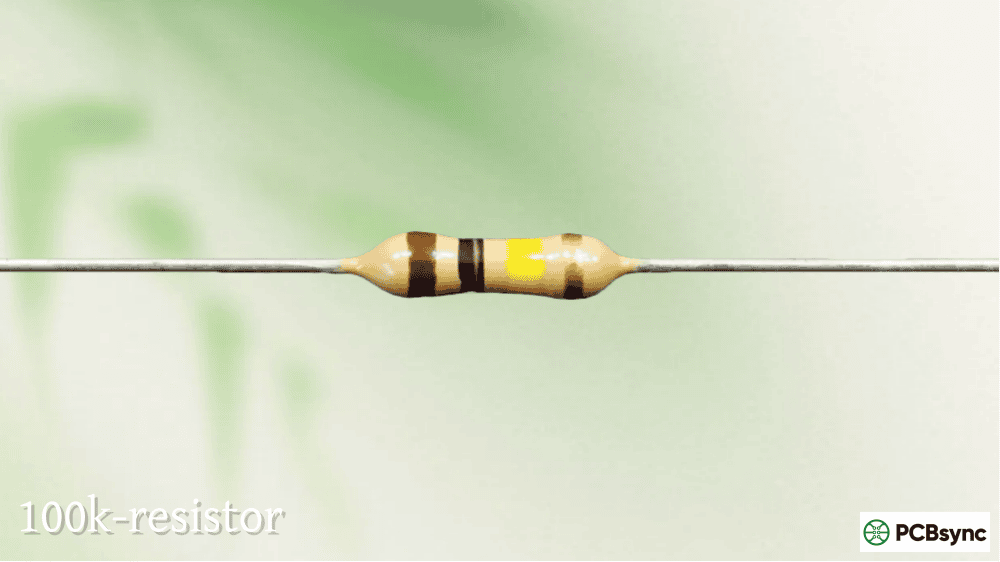
Problem: Mistaking 100kΩ (Brown-Black-Yellow) or 10MΩ (Brown-Black-Blue) for 1MΩ (Brown-Black-Green).
Solution: Always double-check with a multimeter. The color bands can appear different under various lighting conditions. Yellow, green, and blue can be surprisingly easy to confuse, especially on aged resistors.
Noise Pickup
Problem: High-impedance circuits pick up 50Hz/60Hz mains hum or radio frequency interference.
Solution: Use shielded cables for connections, add parallel capacitor (10-100pF) for RF filtering, implement proper PCB ground planes. High impedance amplifies any picked-up noise.
The standard 4-band 1M ohm resistor color code is Brown-Black-Green-Gold. Brown (1) and Black (0) form “10”, Green multiplier (×100,000) brings it to 1,000,000Ω, and Gold indicates ±5% tolerance (950kΩ to 1.05MΩ actual range). For precision ±1% versions, the 5-band code is Brown-Black-Black-Yellow-Brown, where Brown-Black-Black gives “100”, multiplied by Yellow (×10,000) equals 1,000,000Ω with ±1% tolerance (990kΩ to 1.01MΩ range). The green third band in 4-band resistors is the key identifier—don’t confuse it with yellow (100kΩ) or blue (10MΩ).
Why use 1M ohm for capacitive touch sensors instead of other values?
The 1M ohm value provides optimal balance between sensitivity, speed, and noise immunity in capacitive touch applications. Higher values like 10MΩ increase sensitivity but make the circuit extremely susceptible to electrical noise and slow down response time. Lower values like 100kΩ reduce sensitivity—the RC time constant becomes too short for most microcontrollers to accurately measure the small capacitance changes (typically 1-5pF) caused by finger proximity. At 1MΩ with typical sensor capacitances of 10-30pF, you get time constants in the 10-30 microsecond range—easily measurable by Arduino and similar platforms while remaining reasonably immune to electrical interference.
Can I use 1M ohm resistors in breadboard circuits reliably?
Yes, but with important caveats. The 1M ohm value itself works fine on breadboards, but high impedance makes circuits susceptible to several issues: (1) Breadboard contact resistance can add several ohms to several hundred ohms, which is negligible at 1MΩ. (2) Breadboard stray capacitance between adjacent rows is typically 2-5pF, which affects RC timing accuracy. (3) Long jumper wires create antenna effects that pick up noise. (4) Humidity and dust on breadboard surfaces create parallel leakage paths. For reliable breadboarding with 1MΩ resistors, keep connections short, clean the breadboard regularly, avoid running high-impedance traces parallel to power or signal lines, and add 10-100pF capacitors to ground for RF filtering where appropriate.
How do I measure a 1M ohm resistor accurately?
Use a quality digital multimeter with a dedicated high-resistance range (typically marked as 2MΩ, 20MΩ, or “Hi-Z”). Basic multimeters often struggle with megaohm measurements due to internal test current limitations and input impedance. When measuring: (1) Don’t touch both resistor leads simultaneously—your body resistance (typically 1-10MΩ) will appear in parallel with the resistor. (2) Clean the resistor with isopropyl alcohol first to remove surface contamination. (3) Let the reading stabilize for 5-10 seconds; high-value resistors take longer to measure. (4) Expect ±5% on standard resistors—a reading between 950kΩ and 1.05MΩ is within tolerance. (5) Check both ways by reversing the meter leads; significantly different readings suggest leakage or measurement issues.
What’s the difference between using 1M ohm vs 10M ohm in high-impedance circuits?
The 10× resistance difference has several important effects. Current flow: At 5V, 1MΩ draws 5µA while 10MΩ draws 0.5µA—both are tiny, so power consumption difference is negligible. RC time constants: With the same capacitor, 10MΩ creates 10× longer time constants, making timing circuits slower but potentially more sensitive to capacitance changes. Noise susceptibility: 10MΩ is far more susceptible to noise pickup, leakage currents, and stray capacitance effects. PCB design: 10MΩ circuits require careful layout, guard rings, and often conformal coating. Cost: 10MΩ resistors are less common and more expensive. For most applications including capacitive touch, oscilloscope probes, and bias networks, 1MΩ provides the best balance. Use 10MΩ only when you specifically need the higher impedance and are willing to handle the increased design challenges.
Conclusion
The 1M ohm resistor occupies a unique niche in electronics—high enough impedance to dramatically reduce current flow and power consumption, yet low enough to remain practical in most design environments. From capacitive touch sensors that let you interact with museum exhibits, to oscilloscope probes that preserve signal integrity, to timing circuits that extend battery life, the 1MΩ value proves its worth across diverse applications.
After two decades designing PCBs and debugging circuits, I’ve learned that high-impedance design requires different thinking than low-impedance work. Leakage currents matter. Stray capacitance matters. Surface contamination matters. The physics doesn’t change—Ohm’s law still applies—but the practical concerns shift dramatically when you’re working with microamperes instead of milliamperes.
Keep good stock of 1M ohm resistors in both through-hole and 0805 SMD packages. Store them properly to avoid moisture absorption. Clean your PCBs thoroughly—flux residue that’s invisible on a 100Ω circuit will create havoc on a 1MΩ circuit. When designing high-impedance circuits, think about shielding, guard traces, and proper grounding from the beginning rather than trying to retrofit them later.
And most importantly—verify every resistor value with a multimeter before installation. Brown-Black-Green looks very similar to Brown-Black-Yellow or Brown-Black-Blue under poor lighting or on faded resistors. That two-second measurement prevents hours of frustrating debugging when your carefully calculated RC timing circuit behaves mysteriously wrong. Trust me, I’ve been there more times than I care to admit.
Inquire: Call 0086-755-23203480, or reach out via the form below/your sales contact to discuss our design, manufacturing, and assembly capabilities.
Quote: Email your PCB files to Sales@pcbsync.com (Preferred for large files) or submit online. We will contact you promptly. Please ensure your email is correct.
Notes: For PCB fabrication, we require PCB design file in Gerber RS-274X format (most preferred), *.PCB/DDB (Protel, inform your program version) format or *.BRD (Eagle) format. For PCB assembly, we require PCB design file in above mentioned format, drilling file and BOM. Click to download BOM template To avoid file missing, please include all files into one folder and compress it into .zip or .rar format.