Inquire: Call 0086-755-23203480, or reach out via the form below/your sales contact to discuss our design, manufacturing, and assembly capabilities.
Quote: Email your PCB files to Sales@pcbsync.com (Preferred for large files) or submit online. We will contact you promptly. Please ensure your email is correct.
Notes: For PCB fabrication, we require PCB design file in Gerber RS-274X format (most preferred), *.PCB/DDB (Protel, inform your program version) format or *.BRD (Eagle) format. For PCB assembly, we require PCB design file in above mentioned format, drilling file and BOM. Click to download BOM template To avoid file missing, please include all files into one folder and compress it into .zip or .rar format.
When your design demands more than what a standard 8 or 10-layer board can deliver, an 18 layer PCB becomes the logical next step. I’ve worked on dozens of high-layer-count projects over the years, and I can tell you that jumping to 18 layers isn’t just about adding more copper—it fundamentally changes how you approach stackup planning, signal integrity, and manufacturing coordination.
This guide covers everything you need to know about 18 layer PCB design, from stackup configurations to material selection and the manufacturing challenges you’ll face. Whether you’re designing for telecommunications infrastructure, aerospace systems, or high-performance computing, the principles here will help you get your 18 layer board right the first time.
18-Layer PCB Stackup Selector
18-Layer PCB Stackup Selector 18LENTERPRISE
Configure layer thicknesses for enterprise-grade 18-layer server, HPC, AI accelerator, and high-speed networking PCB designs
Quick Presets
Layer Assignment (10 Signal + 4 GND + 4 PWR)
L1 SIG
L2 GND
L3 SIG
L4 PWR
L5 SIG
L6 GND
L7 SIG
L8 PWR
L9 SIG
L10 SIG
L11 GND
L12 SIG
L13 PWR
L14 SIG
L15 GND
L16 SIG
L17 PWR
L18 SIG
Copper Layers (18)
Prepreg Layers (9)
Core Layers (8)
Total Board Thickness
3.200mm
3200 µm
vs 3.2mm
+0 µm
Copper (18L)
630 µm
Prepreg (9L)
1211 µm
Core (8L)
1400 µm
10
Signal Layers
4
GND Planes
4
PWR Planes
8
Stripline
Stackup Visualization
SOLDER MASK (TOP)
L1 – Top SignalSIG35µm
PP1114µm
L2 – GNDGND35µm
Core 1100µm
L3 – SignalSIG35µm
PP2114µm
L4 – PWRPWR35µm
Core 2200µm
L5 – SignalSIG35µm
PP3114µm
L6 – GNDGND35µm
Core 3200µm
L7 – SignalSIG35µm
PP4114µm
L8 – PWRPWR35µm
Core 4200µm
L9 – SignalSIG35µm
PP5 (Center)185µm
L10 – SignalSIG35µm
Core 5200µm
L11 – GNDGND35µm
PP6114µm
L12 – SignalSIG35µm
Core 6200µm
L13 – PWRPWR35µm
PP7114µm
L14 – SignalSIG35µm
Core 7200µm
L15 – GNDGND35µm
PP8114µm
L16 – SignalSIG35µm
Core 8100µm
L17 – PWRPWR35µm
PP9114µm
L18 – Bottom SignalSIG35µm
SOLDER MASK (BOTTOM)
Outer SIG
Inner SIG
GND
PWR
Prepreg
Core
💡 18L Targets
2.8mm: High-density 3.2mm: Standard 18L 3.5-4.0mm: Server/HPC 4.5mm+: Backplane
📐 Impedance
Microstrip: L1→L2, L18→L17 Stripline: All inner SIG Center pair: L9↔L10
10 Signal Layers: L1, L3, L5, L7, L9, L10, L12, L14, L16, L18 — Maximum routing density for complex BGA fanout (0.35mm pitch), DDR5, PCIe Gen5/6, and 224G PAM4 SerDes. 4 GND Planes: L2, L6, L11, L15 — Distributed ground at ~4-layer intervals minimizes return path inductance and provides excellent EMI shielding. 4 PWR Planes: L4, L8, L13, L17 — Support 5+ voltage rails; consider split planes for VCore, VIO, VDDA, VDDQ, etc. Center Pair: L9-L10 share PP5 — ideal for broadside-coupled differential pairs (100Ω diff) or critical high-speed memory buses. Via Structure: Consider blind/buried vias and microvias for HDI; via aspect ratio typically 10:1 max for standard drilling. Symmetry: Structure is symmetric about PP5 center for optimal CTE matching, warpage control (<0.75%), and reliable BGA reflow.
What is an 18 Layer PCB?
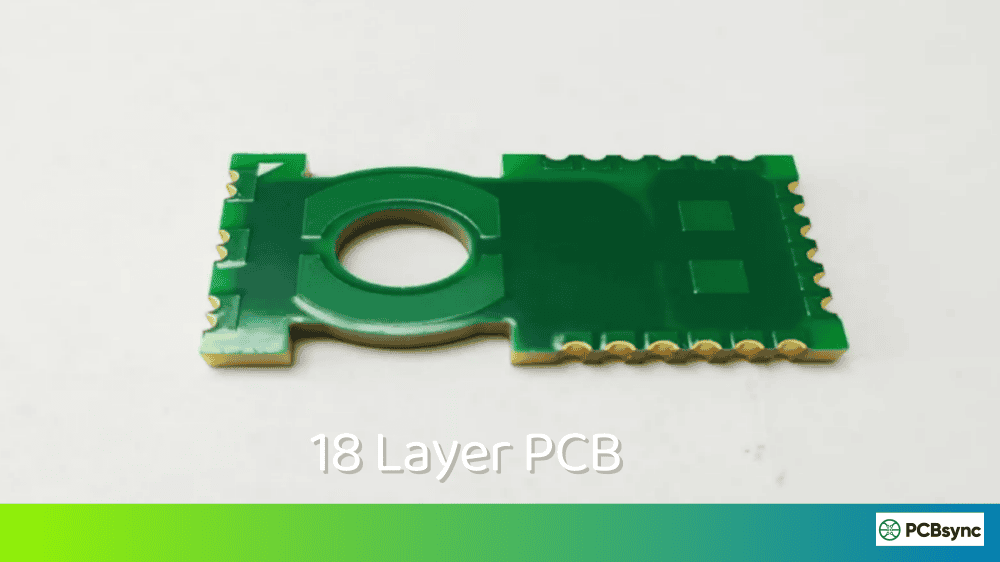
An 18 layer PCB is a high-density multilayer PCB consisting of 18 conductive copper layers separated by insulating dielectric materials. These layers are bonded together through a lamination process under high temperature and pressure, creating a single unified structure with complex interconnections.
Unlike simpler 4 or 6-layer boards, an 18 layer PCB provides extensive routing channels for dense component placement, multiple dedicated power and ground planes for superior power distribution, and enough signal layers to handle the most demanding high-speed interfaces.
Why Choose 18 Layers Over Other Configurations?
The decision to use 18 layers typically comes down to three factors: routing density, signal integrity requirements, and power distribution complexity.
Here’s when 18 layers makes sense:
Your BGA components have pin counts exceeding 1000 pins
You need isolated power domains for mixed analog/digital designs
Standard 12 or 14-layer boards can’t accommodate your routing requirements
EMI shielding is critical and you need multiple ground reference planes
The 18 layer configuration sits in a sweet spot—complex enough to handle serious high-speed designs, but still within the manufacturing capabilities of most tier-1 PCB fabricators without requiring exotic processes.
The stackup is where your 18 layer PCB design succeeds or fails. Get this wrong, and you’ll spend months chasing signal integrity issues that should never have existed in the first place.
Recommended 18 Layer Stackup Configuration
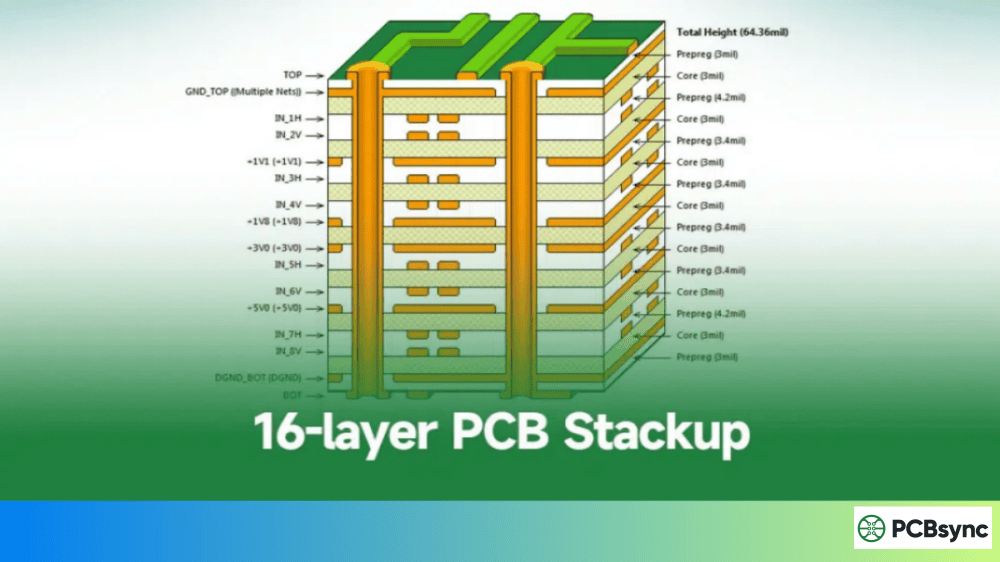
After working through numerous iterations on various projects, I’ve found that a well-balanced 18 layer stackup typically follows this structure:
Layer
Type
Function
Typical Thickness
L1
Signal
High-speed signals, component side
1.0 oz copper
L2
Ground
Reference plane for L1
1.0 oz copper
L3
Signal
Inner routing layer
0.5 oz copper
L4
Ground
Reference plane for L3/L5
1.0 oz copper
L5
Signal
Inner routing layer
0.5 oz copper
L6
Power
VCC core supply
1.0 oz copper
L7
Signal
Inner routing layer
0.5 oz copper
L8
Ground
Mid-board shielding
1.0 oz copper
L9
Signal
Inner routing layer
0.5 oz copper
L10
Signal
Inner routing layer
0.5 oz copper
L11
Ground
Mid-board shielding
1.0 oz copper
L12
Signal
Inner routing layer
0.5 oz copper
L13
Power
Secondary power rail
1.0 oz copper
L14
Signal
Inner routing layer
0.5 oz copper
L15
Ground
Reference plane for L14/L16
1.0 oz copper
L16
Signal
Inner routing layer
0.5 oz copper
L17
Ground
Reference plane for L18
1.0 oz copper
L18
Signal
High-speed signals, bottom side
1.0 oz copper
This configuration provides 10 signal layers and 8 plane layers (5 ground, 3 power), which gives you excellent signal-to-plane ratios for impedance control.
Stackup Symmetry Requirements
One principle that cannot be compromised in 18 layer PCB design is symmetry. An asymmetric stackup will warp during lamination, and a warped board is a rejected board.
The stackup must be balanced around the center axis in terms of:
Copper distribution (total copper weight above and below center)
Dielectric thickness distribution
Material types used on corresponding layers
I’ve seen projects delayed by weeks because someone tried to save a few mils of thickness by using asymmetric prepreg combinations. The fabricator rejected the design, and it had to be re-spun. Always verify symmetry before releasing to manufacturing.
Signal and Plane Layer Arrangement
The way you arrange signal layers relative to reference planes directly impacts your signal integrity performance.
Best practices for 18 layer stackup arrangement:
Every signal layer should have an adjacent ground or power plane serving as its reference. This gives you controlled impedance and a low-inductance return path. Avoid stacking two signal layers directly adjacent to each other—the crosstalk between them will be severe, especially at frequencies above 1 GHz.
When you must place two signal layers near each other (as in L9-L10 in the example above), route traces on those layers perpendicular to each other. This orthogonal routing reduces capacitive coupling between the layers.
Keep power and ground planes tightly coupled where possible. The closer these planes are, the more interplane capacitance you get—free decoupling that helps your power distribution network.
Materials for 18 Layer PCB
Material selection for an 18 layer PCB isn’t something you decide on a whim. The substrate you choose affects everything from signal loss to thermal performance to cost.
For most 18 layer PCB applications running signals above 5 Gbps, I recommend moving beyond standard FR-4. Materials like Megtron 6 or Isola I-Speed offer significantly lower dielectric loss, which translates directly to better eye diagrams and longer channel reach.
Hybrid Stackup Considerations
Sometimes a single material type won’t meet all your requirements cost-effectively. This is where hybrid stackups come in.
A hybrid 18 layer PCB might use low-loss material like Megtron 6 for the outer signal layers (where your highest-speed interfaces route) and standard high-Tg FR-4 for the inner layers. This approach can cut material costs by 30-40% compared to an all-low-loss construction while still meeting your signal integrity targets.
However, hybrid stackups require careful coordination with your fabricator. Different materials have different coefficients of thermal expansion (CTE), and mismatched CTEs can cause reliability issues. Always consult your PCB manufacturing partner before specifying a hybrid construction.
Designing an 18 layer PCB isn’t simply routing more traces on more layers. The increased complexity demands attention to factors that might be negligible on simpler boards.
Signal Integrity and Impedance Control
At the frequencies modern interfaces operate, your PCB traces are transmission lines, not simple wires. Impedance mismatches cause reflections that degrade signal quality and can cause bit errors.
Standard impedance targets for 18 layer PCBs:
Signal Type
Target Impedance
Tolerance
Single-ended signals
50Ω
±10%
Differential pairs (100Ω diff)
100Ω differential
±10%
DDR4/5 signals
40Ω single-ended
±10%
USB 3.x signals
90Ω differential
±10%
Achieving consistent impedance on an 18 layer board requires tight control over trace width, dielectric thickness, and copper weight. Work with your fabricator early to understand their process capabilities and get a stackup that’s manufacturable to your impedance requirements.
Via Structures and Their Applications
An 18 layer PCB will typically use multiple via types:
Through-hole vias connect any layer to any other layer but consume routing real estate on all 18 layers. Use these sparingly in high-density areas.
Blind vias connect an outer layer to one or more inner layers without passing through the entire board. Common configurations include L1-L4 and L15-L18 blind vias. These require sequential lamination, adding cost and lead time.
Buried vias connect inner layers only (for example, L4-L7) and don’t appear on external surfaces. Like blind vias, these require sequential lamination.
Microvias are laser-drilled vias typically spanning only one or two layers. They enable escape routing from fine-pitch BGAs and are essential for HDI designs.
For most 18 layer designs, I recommend minimizing blind and buried vias unless routing density absolutely requires them. Each sequential lamination cycle adds cost, lead time, and potential yield loss.
Aspect Ratio Guidelines
The aspect ratio—board thickness divided by minimum hole diameter—determines whether your vias can be reliably plated.
Board Thickness
Min Via Diameter
Aspect Ratio
Manufacturability
2.0mm
0.20mm
10:1
Standard
2.4mm
0.20mm
12:1
Advanced
3.0mm
0.25mm
12:1
Advanced
3.6mm
0.30mm
12:1
Advanced
Most 18 layer PCBs fall in the 2.4mm to 3.6mm thickness range. Keep your aspect ratio at or below 10:1 for standard manufacturing, and communicate with your fabricator if you need to push beyond that.
EMI and Electromagnetic Compatibility
The multiple ground planes in an 18 layer stackup provide excellent shielding—if you use them correctly.
Avoid splitting ground planes unless absolutely necessary. A split ground forces return currents to take longer paths, increasing loop area and radiated emissions. If you must split a plane (for analog/digital isolation, for example), route signals that cross the split on a layer that uses a different, continuous reference plane.
Place decoupling capacitors on the opposite side of the board from their associated IC when possible. The via inductance from the capacitor through the board to the IC’s power pins helps filter high-frequency noise.
18 Layer PCB Applications
The 18 layer configuration finds use across industries where complexity and performance requirements exceed what simpler boards can deliver.
Telecommunications and 5G Infrastructure
Base stations, network switches, and routers commonly use 18 layer PCBs to handle multiple high-speed serial interfaces. A typical 5G small cell might have dozens of 10G or 25G Ethernet channels, all requiring controlled impedance routing with tight skew matching.
High-Performance Computing and Servers
Server motherboards and GPU cards frequently use 18+ layer PCBs. The combination of high-pin-count processors, multiple memory channels, and numerous expansion slots demands extensive routing resources and robust power delivery.
Aerospace and Defense Systems
Avionics, radar systems, and satellite electronics use 18 layer boards for their ability to integrate complex functionality while meeting stringent reliability requirements. These applications often specify high-reliability materials and IPC Class 3 workmanship standards.
Medical Imaging Equipment
MRI machines, CT scanners, and diagnostic equipment contain sophisticated signal processing that benefits from the routing density and signal integrity of 18 layer PCBs. The medical industry’s reliability requirements align well with the controlled manufacturing processes used for high-layer-count boards.
Advanced Automotive Electronics
ADAS (Advanced Driver Assistance Systems), autonomous driving computers, and electric vehicle power management systems increasingly use 18 layer PCBs. The automotive industry’s push toward higher integration and faster data rates drives adoption of complex multilayer designs.
18 Layer PCB Manufacturing Process
Understanding the manufacturing process helps you design boards that fabricators can actually build reliably.
Inner Layer Processing
Manufacturing starts with the inner layers. Each inner layer begins as a copper-clad laminate that’s imaged with your circuit pattern and etched to remove unwanted copper. For an 18 layer board, 16 inner layers must be processed before lamination.
Automated optical inspection (AOI) checks each inner layer for defects before they’re stacked. Finding a defect after lamination is expensive—the entire board must be scrapped.
Lamination Process
Lamination bonds all layers into a single structure. The inner layers are stacked with prepreg (pre-impregnated fiberglass cloth with partially cured resin) between them. This stack goes into a lamination press where heat and pressure cure the prepreg, bonding everything together.
For 18 layer boards, lamination might occur in multiple cycles if blind or buried vias are required. Each cycle adds to the total manufacturing time and cost.
Drilling and Plating
After lamination, mechanical drilling creates through-holes and any remaining via holes. Laser drilling creates microvias if the design requires them.
The drilled holes are cleaned (desmeared) and then plated with copper to create electrical connections between layers. The plating process must deposit copper uniformly through the entire depth of each hole—a challenge that increases with aspect ratio.
Outer Layer Processing and Finishing
The outer layers are imaged, etched, and inspected similarly to inner layers. Solder mask is applied, legend is printed, and the specified surface finish is applied.
Common surface finishes for 18 layer PCBs:
Finish
Shelf Life
Flatness
Cost
Best For
ENIG
12+ months
Excellent
High
Fine-pitch, wire bonding
Immersion Silver
6-12 months
Excellent
Medium
High-frequency, aluminum wire bonding
OSP
3-6 months
Excellent
Low
High-volume, quick turn
HASL
12+ months
Poor
Low
Through-hole heavy designs
Hard Gold
12+ months
Excellent
Very High
Edge connectors, high wear
Testing and Quality Control
Every 18 layer PCB should undergo electrical testing to verify all connections are correct and no shorts exist. Flying probe testing works for prototypes; fixture-based testing is more cost-effective for volume production.
Impedance testing uses coupons built into the panel to verify that controlled impedance traces meet specifications. Cross-sectioning may be performed on sample boards to verify layer registration, via plating quality, and dielectric thicknesses.
Cost Factors for 18 Layer PCBs
18 layer PCBs are significantly more expensive than simpler boards. Understanding the cost drivers helps you make informed trade-offs.
Primary Cost Drivers
Layer count is the most obvious factor. Each additional layer requires more material, more processing steps, and more opportunities for defects. The relationship isn’t linear—doubling layer count more than doubles cost.
Material selection significantly impacts cost. High-performance materials like Megtron 6 can cost 3-5x more than standard FR-4. Hybrid stackups can reduce this impact while maintaining performance where needed.
Via complexity adds cost through additional processing. Through-hole only designs are cheapest. Adding blind/buried vias requires sequential lamination, which might double or triple the fabrication cost.
Feature size affects yield. Tighter trace/space requirements (below 4/4 mil) require more precise processing and result in lower yields, increasing per-board cost.
Typical Price Ranges
Configuration
Prototype (5 pcs)
Mid-Volume (100 pcs)
Production (1000+ pcs)
18L, Standard FR-4, through-hole only
$150-300/board
$40-80/board
$15-30/board
18L, High-Tg FR-4, blind/buried vias
$300-500/board
$80-150/board
$30-60/board
18L, Low-loss material, HDI
$500-1000/board
$150-300/board
$60-120/board
These are rough estimates—actual pricing depends on board size, quantities, lead time, and specific design requirements.
How to Choose an 18 Layer PCB Manufacturer
Not every PCB fabricator can reliably produce 18 layer boards. Here’s what to look for when selecting a manufacturing partner.
Key Capabilities to Verify
Ask potential fabricators about their maximum layer count capability. If they say “18 layers” when you ask, that’s concerning—a fabricator comfortable with 18 layers should be capable of 20+ layers with margin.
Verify their registration accuracy. Layer-to-layer registration of ±3 mils or better is necessary for 18 layer boards with blind/buried vias.
Confirm their aspect ratio capability matches your design requirements. Most quality fabricators can handle 10:1; advanced capabilities extend to 12:1 or higher.
Important Certifications
Look for ISO 9001 quality management certification as a baseline. For aerospace applications, AS9100 certification is typically required. Automotive applications may require IATF 16949.
IPC standards compliance matters. IPC-6012 Class 2 is standard for commercial electronics; Class 3 is required for high-reliability applications like medical, aerospace, and military.
Questions to Ask Your Fabricator
Before committing to a fabricator for your 18 layer PCB, ask these questions:
What is your first-pass yield on 18+ layer boards? (Look for 90%+ yields)
Can you provide stackup recommendations based on my impedance requirements?
What DFM checks do you perform before manufacturing?
What is your standard lead time for 18 layer prototypes? For production quantities?
Can you provide cross-section data from test coupons?
Useful Resources and Tools
Here are resources I’ve found valuable when working on 18 layer PCB designs:
IPC Standards:
IPC-2221: Generic Standard on Printed Board Design
IPC-6012: Qualification and Performance Specification for Rigid Printed Boards
IPC-2141: Design Guide for High-Speed Controlled Impedance Circuit Boards
Most 18 layer PCBs range from 2.0mm to 3.6mm in total thickness. The exact thickness depends on your stackup design—specifically the copper weights you specify and the dielectric thicknesses needed for impedance control. Thinner constructions (around 2.0mm) are possible with thin cores and prepregs but may limit your via aspect ratio. Thicker constructions (3.0mm+) provide more flexibility in layer spacing but increase via plating difficulty. Standard thickness for most applications is around 2.4mm to 2.8mm.
When should I use 18 layers instead of 12 or 20 layers?
Choose 18 layers when your routing density and signal count exceed what 12-14 layers can handle, but before you need the full complexity of 20+ layer boards. Specifically, 18 layers works well when you have multiple high-pin-count BGAs (500-1500 pins), need 8-10 dedicated signal layers after accounting for power and ground planes, or require extensive power plane segmentation for multiple voltage rails. If you can complete routing on 14 layers with reasonable via density, save the cost. If 18 layers feels cramped, move to 20+ layers rather than fighting density issues.
How much does an 18 layer PCB cost compared to an 8 layer board?
Expect an 18 layer PCB to cost roughly 3-4x more than a comparable 8 layer board in prototype quantities, and 2-3x more in production volumes. The exact multiplier depends on materials, via complexity, and feature sizes. A standard FR-4 18 layer board with through-hole vias only might cost $150-300 for prototypes, while an 8 layer board with similar specifications might cost $40-80. The cost premium decreases somewhat at higher volumes as fixed costs (tooling, engineering) are amortized across more units.
What materials are best for high-speed 18 layer PCBs?
For signals running above 5 Gbps, move beyond standard FR-4 to low-loss materials. Panasonic Megtron 6 is the industry workhorse for high-speed digital designs—it offers low Dk (3.4), very low Df (0.002), and good processability. Isola I-Speed and I-Meta are alternatives with similar performance. For the highest frequencies (10+ GHz) or where loss is absolutely critical, consider Rogers or Taconic PTFE-based materials, though these are significantly more expensive and harder to process. Many designers use hybrid stackups with low-loss materials on outer high-speed layers and standard high-Tg FR-4 for inner layers to balance cost and performance.
What is the lead time for 18 layer PCB manufacturing?
Standard lead times for 18 layer PCB prototypes range from 3-4 weeks from major fabricators. Expedited services can reduce this to 2 weeks or sometimes less, but expect premium pricing. Production quantities typically require 4-6 weeks depending on volume and complexity. Designs requiring sequential lamination (blind/buried vias) add 3-7 days to these timelines. HDI constructions with multiple lamination cycles may require 5-6 weeks even for prototypes. Always discuss lead time requirements with your fabricator early—18 layer boards have limited manufacturing capacity at most facilities, and scheduling conflicts can extend timelines unexpectedly.
Conclusion
Designing an 18 layer PCB successfully requires attention to stackup symmetry, material selection, signal integrity, and manufacturing constraints. The complexity is real, but so are the capabilities these boards provide for demanding applications.
Start your 18 layer design by working with your fabricator to establish a manufacturable stackup. Get impedance modeling done early. Plan your via strategy before you start routing. And leave margin in your design—the yield and reliability benefits of designing to 80% of capability rather than 100% are substantial.
The 18 layer configuration will continue to be a workhorse for complex electronics as component densities and signal speeds increase. Master these fundamentals, and you’ll be well-equipped to tackle whatever high-layer-count challenges come your way.
Inquire: Call 0086-755-23203480, or reach out via the form below/your sales contact to discuss our design, manufacturing, and assembly capabilities.
Quote: Email your PCB files to Sales@pcbsync.com (Preferred for large files) or submit online. We will contact you promptly. Please ensure your email is correct.
Notes: For PCB fabrication, we require PCB design file in Gerber RS-274X format (most preferred), *.PCB/DDB (Protel, inform your program version) format or *.BRD (Eagle) format. For PCB assembly, we require PCB design file in above mentioned format, drilling file and BOM. Click to download BOM template To avoid file missing, please include all files into one folder and compress it into .zip or .rar format.