Inquire: Call 0086-755-23203480, or reach out via the form below/your sales contact to discuss our design, manufacturing, and assembly capabilities.
Quote: Email your PCB files to Sales@pcbsync.com (Preferred for large files) or submit online. We will contact you promptly. Please ensure your email is correct.
Notes: For PCB fabrication, we require PCB design file in Gerber RS-274X format (most preferred), *.PCB/DDB (Protel, inform your program version) format or *.BRD (Eagle) format. For PCB assembly, we require PCB design file in above mentioned format, drilling file and BOM. Click to download BOM template To avoid file missing, please include all files into one folder and compress it into .zip or .rar format.
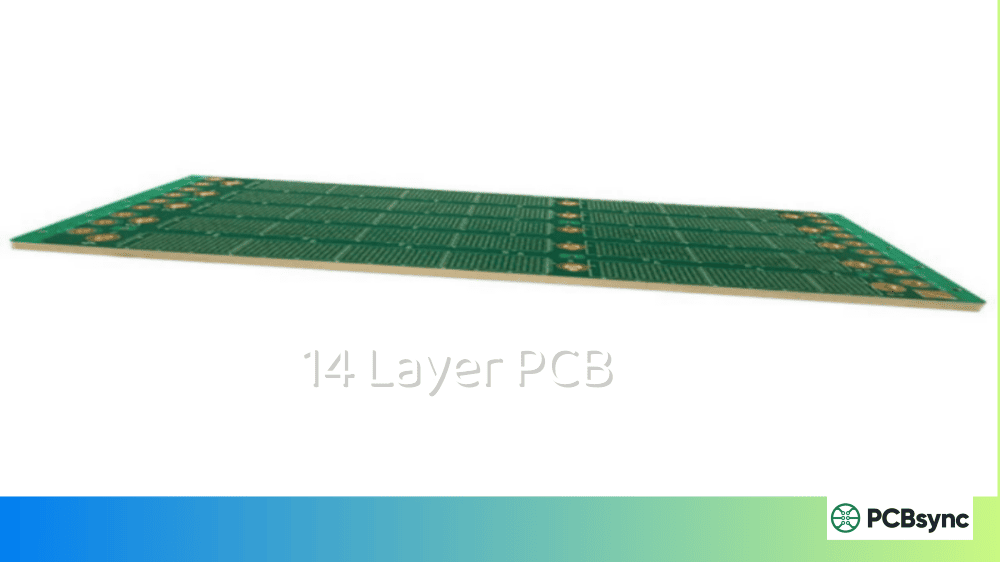
When your circuit design demands more than what an 8-layer board can handle, you’re looking at a 14 layer PCB. I’ve spent years working with high-density interconnect designs, and I can tell you that these boards aren’t just about adding more copper—they represent a significant leap in complexity, capability, and engineering precision.
A 14 layer PCB consists of fourteen distinct conductive copper layers separated by insulating dielectric materials. This configuration provides eight signal routing layers alongside dedicated ground and power planes, making it the go-to choice for applications requiring superior signal integrity, electromagnetic compatibility, and high-speed data transmission.
14-Layer PCB Stackup Selector
14-Layer PCB Stackup Selector 14L
Configure layer thicknesses for advanced 14-layer high-speed and server-grade PCB designs
Quick Presets
Layer Assignment (8 Signal + 4 GND + 2 PWR)
L1 SIG
L2 GND
L3 SIG
L4 PWR
L5 SIG
L6 GND
L7 SIG
L8 SIG
L9 GND
L10 SIG
L11 PWR
L12 SIG
L13 GND
L14 SIG
Copper Layers (14)
Prepreg Layers (7)
Core Layers (6)
Total Board Thickness
2.400mm
2400 µm
vs 2.4mm
+0 µm
Copper (14L)
490 µm
Prepreg (7L)
983 µm
Core (6L)
1000 µm
Stackup Visualization
SOLDER MASK (TOP)
L1 – Top SignalSIG35µm
PP1114µm
L2 – GNDGND35µm
Core 1100µm
L3 – SignalSIG35µm
PP2114µm
L4 – PWRPWR35µm
Core 2200µm
L5 – SignalSIG35µm
PP3114µm
L6 – GNDGND35µm
Core 3200µm
L7 – SignalSIG35µm
PP4 (Center)185µm
L8 – SignalSIG35µm
Core 4200µm
L9 – GNDGND35µm
PP5114µm
L10 – SignalSIG35µm
Core 5200µm
L11 – PWRPWR35µm
PP6114µm
L12 – SignalSIG35µm
Core 6100µm
L13 – GNDGND35µm
PP7114µm
L14 – Bottom SignalSIG35µm
SOLDER MASK (BOTTOM)
Outer Signal
Inner Signal
GND Plane
PWR Plane
Prepreg
Core
💡 Common 14-Layer Targets
2.0mm: High-density HDI/BGA breakout 2.4mm: Standard 14L (most common) 2.8-3.2mm: Server, networking, AI accelerators 3.5mm+: Backplanes, heavy copper designs
8 Signal Layers: L1, L3, L5, L7, L8, L10, L12, L14 — Maximum routing density for complex BGA fanout and high-speed interfaces. 4 GND Planes: L2, L6, L9, L13 — Distributed ground reference at regular intervals minimizes return path lengths. 2 PWR Planes: L4, L11 — Symmetric power distribution; add splits for multiple voltage domains. Center Pair: L7-L8 share PP4 — ideal for broadside-coupled differential pairs or high-speed memory routing. Symmetry: Structure is symmetric about PP4 center for optimal thermal expansion and warpage control.
Why Choose a 14 Layer PCB for Your Design?
The decision to use a 14 layer PCB typically comes down to specific design requirements that simpler boards cannot satisfy. When you need eight signal layers with proper shielding, dedicated power distribution networks, and controlled impedance routing for high-frequency applications, this layer count becomes essential rather than optional.
Key Advantages of 14 Layer PCB Technology
From my experience designing boards for telecommunications and automotive applications, the benefits of moving to a 14 layer PCB become evident quickly:
Enhanced Signal Integrity: With multiple ground planes positioned strategically between signal layers, return current paths remain tight and predictable. This tight coupling reduces electromagnetic interference and crosstalk between adjacent traces.
Superior Power Distribution: Dedicated power and ground planes create a low-impedance power distribution network. When you’re dealing with processors pulling several amps of current at switching frequencies in the megahertz range, this matters tremendously.
Compact Form Factor: High pin-count BGA packages with pitches below 0.8mm often require multiple signal escape layers. A 14 layer PCB provides the routing density needed to fan out from these complex packages without expanding board dimensions.
Shielding Critical Signals: Layers 6 and 9 in a typical 14 layer stack-up can isolate weak or sensitive analog signals, while high-speed digital routing on layers 3, 4, 11, and 12 benefits from adjacent reference planes.
The stack-up design determines everything about how your 14 layer PCB will perform. Getting this wrong means dealing with impedance discontinuities, EMI problems, and signal integrity failures that no amount of careful routing can fix.
Standard 14 Layer PCB Stack-Up Structure
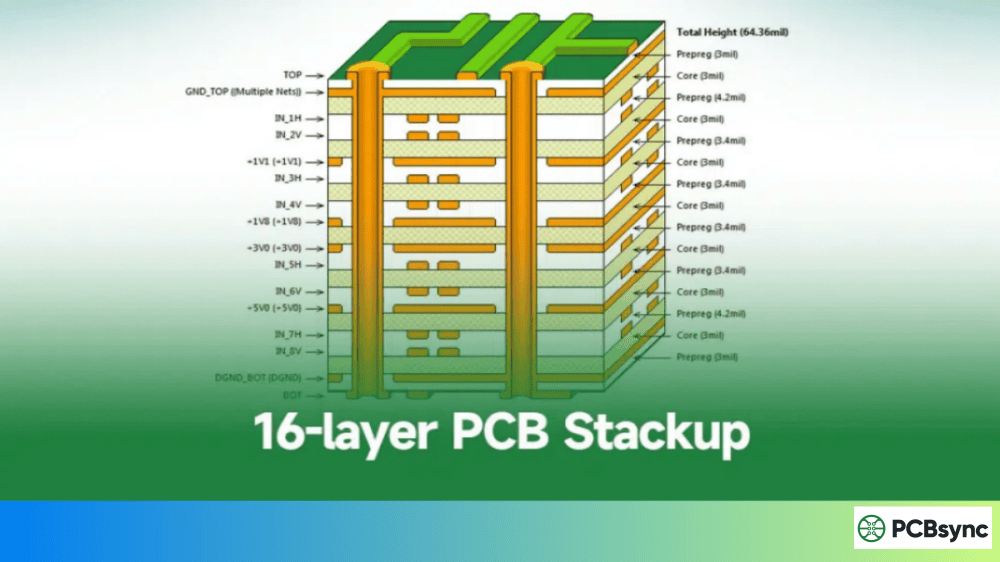
A well-designed 14 layer PCB stack-up follows specific principles that balance electrical performance with manufacturing feasibility. Here’s a typical configuration I recommend for most high-speed applications:
Symmetry isn’t just cosmetic—it prevents warping during lamination and thermal cycling. Your 14 layer PCB stack-up should mirror itself around the central axis. If layer 2 is a ground plane, layer 13 should be ground as well.
Adjacent Signal Layers: Never place more than two signal layers adjacent to each other without a reference plane between them. When signal layers are stacked without intervening planes, you’ll see impedance discontinuities of 20 ohms or more and significant crosstalk.
Tight Coupling for High-Speed: The dielectric thickness between a signal layer and its reference plane should be minimized for high-frequency signals. For multi-gigabit designs, aim for 3-5 mil dielectric thickness to achieve tight coupling and controlled impedance.
Power-Ground Plane Pairs: Place power and ground planes adjacent to each other with thin dielectric between them. This creates distributed decoupling capacitance that helps clean up power delivery at high frequencies.
Material Selection for 14 Layer PCB Fabrication
Material choice affects everything from signal propagation delay to thermal performance. For a 14 layer PCB operating at frequencies above 1 GHz, standard FR-4 might not cut it.
FR-4 vs High-Frequency Laminates
Property
Standard FR-4
High-Tg FR-4
Rogers 4350B
Rogers 4003C
Dielectric Constant (Dk)
4.2-4.5
4.2-4.5
3.48 ± 0.05
3.55 ± 0.05
Dissipation Factor (Df)
0.020-0.025
0.018-0.020
0.0037
0.0027
Glass Transition (Tg)
130-140°C
170-180°C
>280°C
>280°C
CTE (Z-axis)
50-70 ppm/°C
40-50 ppm/°C
46 ppm/°C
46 ppm/°C
Cost Factor
1x
1.2-1.5x
8-10x
8-10x
Best For
General purpose
Lead-free assembly
RF, microwave
High-speed digital
For most 14 layer PCB applications, high-Tg FR-4 (170°C+) provides adequate performance at reasonable cost. When designing for 5G base stations, radar systems, or 25 Gbps+ data links, consider hybrid constructions that use Rogers material for outer layers where RF traces reside and FR-4 for inner layers.
Prepreg and Core Thickness Selection
The prepreg in your 14 layer PCB acts as the adhesive that bonds layers during lamination. Common prepreg designations include:
1080: Thin (2.8 mil typical), high resin content, good for tight impedance control
2116: Medium thickness (4.5 mil typical), balanced properties
7628: Thick (7.0 mil typical), high glass content for mechanical strength
For a 14 layer PCB targeting 62 mil (1.57mm) overall thickness, you’ll need thin dielectrics—typically 5 mil or less between most layers. This pushes manufacturing toward HDI-capable facilities.
Signal integrity in high-speed 14 layer PCB designs depends heavily on maintaining consistent controlled impedance throughout the trace length. When a signal encounters impedance changes, reflections occur that corrupt the waveform.
Calculating Trace Geometry for Target Impedance
For a microstrip trace on the outer layer of your 14 layer PCB, impedance depends on trace width, copper thickness, dielectric thickness to the reference plane, and the material’s dielectric constant.
A typical 50-ohm single-ended microstrip on FR-4 (Dk=4.2) with 4 mil dielectric thickness requires approximately:
Trace width: 6.5-7.0 mils
Copper thickness: 1 oz (1.4 mils)
For 100-ohm differential pairs in stripline configuration between ground planes:
Trace width: 4.0-4.5 mils
Trace spacing: 5.0-6.0 mils
Dielectric thickness: 4 mils to each reference plane
Impedance Control Best Practices
Specify Tolerances: Standard impedance tolerance is ±10%, but high-speed designs may require ±5%. Tighter tolerances increase cost and manufacturing complexity.
Use Test Coupons: Every production panel should include impedance test coupons measured with Time Domain Reflectometry (TDR). This verifies that the actual board matches design intent.
Account for Trapezoidal Traces: Etching produces traces with non-vertical sidewalls. The actual cross-section is trapezoidal, which affects impedance. Good CAD tools account for this.
Plan Layer Transitions: When a controlled-impedance signal changes layers via a via, place stitching vias nearby to provide a clear return current path through the reference plane.
14 Layer PCB Manufacturing Process
Manufacturing a 14 layer PCB involves numerous sequential steps, each requiring precision to maintain layer-to-layer registration and electrical integrity.
Inner Layer Processing
The process begins with copper-clad laminate cores. For a 14 layer PCB, you’ll typically start with six double-sided cores:
Imaging: Photoresist is applied to each core, exposed through a photomask with the circuit pattern, and developed. Laser Direct Imaging (LDI) provides better resolution than traditional film-based exposure.
Etching: Unexposed copper is chemically removed, leaving the desired trace pattern. Alkaline etchants provide cleaner sidewalls for fine-pitch designs.
AOI Inspection: Automated Optical Inspection compares the etched pattern against the CAD data, catching opens, shorts, and width violations before lamination.
Oxide Treatment: Inner layer surfaces receive brown or black oxide treatment to improve adhesion with prepreg during lamination.
Lamination and Drilling
This is where your 14 layer PCB stack-up comes together:
Layup: Cores and prepreg sheets are stacked in the correct sequence on a lamination press. Alignment pins ensure layer-to-layer registration within ±2-3 mils.
Pressing: The stack is heated to 180-200°C under 300-400 PSI pressure. Prepreg resin flows, cures, and bonds all layers into a monolithic structure.
Drilling: Through-holes are mechanically drilled. For a 14 layer PCB with 62 mil thickness, minimum via diameter is typically 8-10 mils to maintain reasonable aspect ratios (board thickness to hole diameter).
Desmear: Drilling leaves resin smear on copper surfaces inside holes. Plasma or chemical desmear removes this material for reliable plating.
Plating and Outer Layer Processing
Electroless Copper: A thin seed layer of copper is deposited on all surfaces, including via barrels. This makes the holes conductive.
Pattern Plating: Photoresist masks areas that shouldn’t receive additional copper. Electrolytic plating builds up copper thickness on traces and through-holes.
Outer Layer Etching: After plating, photoresist is stripped and the seed copper is etched away from non-trace areas.
Solder Mask: Liquid photoimageable solder mask (LPISM) is applied, exposed, and developed to expose only pads and features requiring soldering.
Surface Finish: ENIG (Electroless Nickel Immersion Gold), OSP, Immersion Silver, or other finishes protect exposed copper and provide solderable surfaces.
Advanced Via Technologies for 14 Layer PCB
High-density 14 layer PCB designs often require more than simple through-vias:
Blind Vias: Connect outer layers to specific inner layers. Laser drilling can create blind vias as small as 3-4 mils diameter.
Buried Vias: Connect inner layers without extending to outer surfaces. Requires sub-lamination processes where some cores are drilled and plated before final lamination.
Via-in-Pad: Places vias directly in component pads, then fills them with conductive or non-conductive paste. Essential for high pin-count BGAs with tight pitch.
Back-Drilling: Stubs from through-vias cause resonance at high frequencies. Back-drilling removes unused via stubs to improve signal integrity above 5 GHz.
14 Layer PCB Applications Across Industries
The capability of a 14 layer PCB makes it suitable for demanding applications across multiple sectors.
Telecommunications and Networking
5G base stations, high-speed routers, and optical transceivers rely on 14 layer PCB technology for:
Multi-gigabit SerDes interfaces
mmWave frequency routing
Dense BGA fan-out for FPGAs and ASICs
Controlled impedance for LVDS, PCIe, and USB 3.0+
Automotive Electronics
Modern vehicles contain numerous electronic control units that benefit from Multilayer PCB technology:
Engine control units (ECUs)
Advanced driver assistance systems (ADAS)
Battery management systems for EVs
Infotainment and navigation systems
The automotive environment demands boards that can withstand thermal cycling, vibration, and extended operational lifetimes.
Medical Devices
Medical imaging equipment, patient monitors, and diagnostic instruments use 14 layer PCB designs for:
High-resolution imaging processing
Low-noise analog signal chains
Reliable power distribution
EMI compliance in RF-intensive environments
Aerospace and Defense
Radar systems, satellite communications, and avionics depend on 14 layer PCB boards meeting stringent requirements:
Temperature extremes (-55°C to +125°C)
Vibration and shock resistance
Conformal coating compatibility
IPC Class 3 reliability standards
Signal Routing Strategies for 14 Layer PCB
Effective routing strategy determines whether your 14 layer PCB meets performance targets. Random layer assignments and ad-hoc routing create problems that become apparent only during testing—when they’re expensive to fix.
Layer Assignment Methodology
Before placing a single trace, establish a clear routing strategy for your 14 layer PCB:
High-Speed Differential Pairs: Route on stripline layers (L3-L4 or L11-L12) sandwiched between ground planes. The symmetrical electromagnetic environment minimizes common-mode noise and provides consistent impedance.
Single-Ended High-Speed Signals: Outer layer microstrips (L1 and L14) work well for shorter runs where losses are acceptable. For longer traces, use internal stripline layers.
Low-Frequency Digital: Any available signal layer works, but maintain consistent reference planes throughout the trace path.
Analog Signals: Dedicate specific layers (often L9) for sensitive analog routing. Keep analog traces away from digital signals and provide guard rings where necessary.
Power Routing: Heavy current paths should use dedicated power plane copper pours. Avoid routing power as traces when plane copper is available.
Managing Return Current Paths
Every signal trace creates a return current in the adjacent reference plane. This return current follows the path of least inductance, which at high frequencies means directly beneath the signal trace. Understanding this behavior is critical for successful 14 layer PCB routing.
Reference Plane Continuity: Never route signals across reference plane splits unless you provide an alternative return path. Signals crossing plane splits experience impedance discontinuities and generate EMI.
Via Transitions: When a signal changes layers, its return current must also change planes. Place stitching vias near signal vias to provide low-inductance return paths. For differential pairs, place stitching vias symmetrically.
Plane Selection: The return current travels on the plane closest to the signal layer. For a stripline between two ground planes, return current splits between both planes based on their proximity to the trace.
Breakout Routing for High Pin-Count BGAs
Fine-pitch BGAs present routing challenges that drive many designs toward 14 layer PCB stack-ups. A 0.8mm pitch BGA with 400+ balls requires careful escape routing strategy.
Inner Via Rows: The innermost rows of BGA pads typically escape through blind or buried vias to inner signal layers. Plan which layers will handle inner ball escape routing.
Outer Via Rows: Outer rows often route directly on the surface layer, fanning out between via lands.
Via-in-Pad: Placing vias directly in BGA pads saves space but requires filled and planarized vias to prevent solder wicking during assembly.
Dog-Bone Patterns: Traditional escape routing places vias offset from pads, connected by short traces. This approach works for larger pitches but consumes routing channel space.
Thermal Management Considerations
A 14 layer PCB with multiple power planes and dense component placement generates significant heat. Proper thermal management prevents reliability problems and maintains performance.
Thermal Via Design
Thermal vias transfer heat from hot components through the board to cooling solutions:
Place thermal vias in arrays under power devices and processor thermal pads
Use 10-12 mil diameter vias with 25 mil pitch for effective heat transfer
Connect thermal vias to internal copper planes to spread heat laterally
Consider filled thermal vias for better heat conduction
Power Plane Thermal Relief
When traces or vias connect to power planes, thermal relief patterns prevent excessive heat sinking during soldering:
Four-spoke thermal relief for vias reduces heat flow during assembly
Direct connections (no thermal relief) improve electrical conductivity but make soldering difficult
Balance thermal and electrical requirements based on current levels and assembly process
Design for Manufacturing Guidelines
A successful 14 layer PCB project requires early collaboration with your PCB manufacturing partner. Here are critical DFM considerations:
Minimum Design Rules for 14 Layer PCB
Parameter
Standard Capability
Advanced HDI
Minimum trace width
4 mil (0.1mm)
2.5 mil (0.064mm)
Minimum trace spacing
4 mil (0.1mm)
2.5 mil (0.064mm)
Minimum via diameter
8 mil (0.2mm)
4 mil (0.1mm) laser
Via-to-trace clearance
6 mil (0.15mm)
4 mil (0.1mm)
Annular ring
5 mil (0.125mm)
3 mil (0.075mm)
Aspect ratio (board:hole)
10:1
12:1
Layer Registration and Alignment
For a 14 layer PCB, maintaining tight layer-to-layer registration becomes increasingly challenging. Manufacturing tolerance of 50µm (2 mils) is considered acceptable for most designs. If your BGA escape routing requires tighter tolerances, discuss this with your fabricator before finalizing the design.
Copper Balance and Plane Voiding
Uneven copper distribution across a layer causes warping and thickness variations. Add copper thieving patterns in sparse areas to balance residual copper ratio. Target 40-60% copper coverage on each layer.
When voiding reference planes under component pads or routing channels, keep voids small and localized. Large plane voids increase inductance and degrade signal integrity.
Testing and Quality Assurance
A 14 layer PCB requires thorough testing to verify electrical and mechanical integrity:
Electrical Testing: Flying probe or bed-of-nails testing verifies continuity and isolation. For complex boards, flying probe offers flexibility without custom fixture costs.
Impedance Verification: TDR measurements on dedicated test coupons confirm that controlled impedance traces meet specifications.
X-Ray Inspection: Internal structures, via fill quality, and BGA solder joints are inspected non-destructively with X-ray systems.
Cross-Section Analysis: Destructive testing on sample boards verifies layer thickness, via quality, and plating integrity.
Thermal Stress Testing: Solder float tests (288°C for 10 seconds) verify that the laminate can withstand assembly temperatures without delamination.
Useful Resources for 14 Layer PCB Design
Engineers working on 14 layer PCB projects benefit from these reference materials:
IPC Standards:
IPC-2221: Generic Standard on Printed Board Design
IPC-2141: Design Guide for High-Speed Controlled Impedance Circuit Boards
IPC-6012: Qualification and Performance Specification for Rigid PCBs
Panel Optimization: Work with your fabricator to maximize the number of boards per panel. Odd-shaped boards waste material; consider adjusting outline dimensions slightly.
Standard Materials: Unless your application specifically requires exotic laminates, stick with widely available FR-4 variants. Custom stack-ups with non-standard prepreg configurations increase setup costs.
Realistic Tolerances: Specifying ±5% impedance tolerance when ±10% would suffice increases yield loss and cost. Match tolerances to actual requirements.
Standard Processes: Avoid premium processes like controlled-depth back-drilling or sequential lamination unless the design truly requires them.
Prototype (1-10 boards): 5-10 business days for standard processes
Quick-turn prototype: 3-5 business days (significant cost premium)
Production volume: 15-20 business days for most quantities
Complex designs: Add 5-7 days for HDI, blind/buried vias, or exotic materials
Planning adequate lead time into your schedule avoids expensive expedite fees that can double or triple board costs.
Frequently Asked Questions About 14 Layer PCB
What is the typical thickness of a 14 layer PCB?
Standard 14 layer PCB thickness ranges from 1.6mm (62 mils) to 2.4mm (94 mils), depending on copper weights and dielectric requirements. Achieving 14 layers in a 62-mil board requires thin dielectrics (typically 5 mil or less) and manufacturing by HDI-capable facilities. Thicker boards of 2.0-2.4mm are easier to manufacture and may be preferable when space constraints permit.
How much does a 14 layer PCB cost compared to simpler boards?
A 14 layer PCB typically costs 3-5 times more than an equivalent 4-layer board. Factors affecting price include: layer count (linear relationship), minimum feature sizes (tighter rules increase cost), material choice (Rogers adds significant cost), via types (blind/buried vias add process steps), and order quantity. Prototype quantities of 5-10 boards might run $50-150 per board, while production volumes can drop below $20 per board depending on specifications.
When should I use a 14 layer PCB instead of 12 or 16 layers?
Choose 14 layers when you need eight signal routing layers with dedicated shielding for critical nets, or when your BGA fan-out requires more escape routing than 12 layers provide. If 12 layers are almost enough, consider design optimization before jumping to 14. If 14 layers feel cramped, evaluate whether 16 layers might simplify routing and improve yields. The layer count should match your actual routing density requirements—adding unnecessary layers wastes money.
What materials are best for high-frequency 14 layer PCB designs?
For signals above 3 GHz, consider hybrid stack-ups with Rogers 4350B or 4003C on outer layers where RF traces reside, combined with FR-4 for inner layers carrying lower-frequency signals. This approach balances performance with cost. Pure Rogers stack-ups are reserved for millimeter-wave applications above 20 GHz. For digital designs up to 10 Gbps, mid-loss FR-4 variants like Isola FR408HR often provide adequate performance.
How do I ensure reliable via connections in a 14 layer PCB?
Via reliability depends on proper aspect ratio management, thorough desmear processing, and adequate plating thickness. Keep aspect ratios below 10:1 for through-vias (8:1 is safer). Specify minimum 25µm copper plating in via barrels. For blind and buried vias, work with experienced fabricators who can demonstrate process capability. Request cross-section reports from your manufacturer to verify via quality on initial production lots.
Conclusion
Designing and manufacturing a 14 layer PCB represents a significant engineering undertaking that requires attention to stack-up configuration, material selection, impedance control, and manufacturing constraints. When executed properly, these boards enable the dense, high-speed, and reliable electronic systems that modern applications demand.
The key to success lies in early planning—define your layer stack-up before routing begins, collaborate with your fabricator to confirm manufacturability, and allocate time for thorough verification. A well-designed 14 layer PCB performs reliably for years, while a poorly planned board creates headaches throughout product development and beyond.
Whether you’re designing telecommunications infrastructure, automotive electronics, or medical devices, mastering 14 layer PCB technology opens doors to applications that simpler boards simply cannot address.
Inquire: Call 0086-755-23203480, or reach out via the form below/your sales contact to discuss our design, manufacturing, and assembly capabilities.
Quote: Email your PCB files to Sales@pcbsync.com (Preferred for large files) or submit online. We will contact you promptly. Please ensure your email is correct.
Notes: For PCB fabrication, we require PCB design file in Gerber RS-274X format (most preferred), *.PCB/DDB (Protel, inform your program version) format or *.BRD (Eagle) format. For PCB assembly, we require PCB design file in above mentioned format, drilling file and BOM. Click to download BOM template To avoid file missing, please include all files into one folder and compress it into .zip or .rar format.