Inquire: Call 0086-755-23203480, or reach out via the form below/your sales contact to discuss our design, manufacturing, and assembly capabilities.
Quote: Email your PCB files to Sales@pcbsync.com (Preferred for large files) or submit online. We will contact you promptly. Please ensure your email is correct.
Notes: For PCB fabrication, we require PCB design file in Gerber RS-274X format (most preferred), *.PCB/DDB (Protel, inform your program version) format or *.BRD (Eagle) format. For PCB assembly, we require PCB design file in above mentioned format, drilling file and BOM. Click to download BOM template To avoid file missing, please include all files into one folder and compress it into .zip or .rar format.
120 Ohm Resistor: Color Code, CAN Bus & RS-485 Termination Guide
The 120 ohm resistor might seem like just another value in your parts bin, but it serves a very specific and critical purpose that sets it apart from its neighbors. If you’ve worked with CAN bus networks in automotive or industrial applications, or set up RS-485 communication lines, you’ve encountered this resistor in its starring role: line termination.
I’ve debugged countless communication issues over the years where the root cause turned out to be missing or incorrect termination. Understanding when and how to use a 120 ohm resistor for termination can save you hours of troubleshooting frustration.
A 120 ohm resistor provides exactly 120 ohms of electrical resistance. While it works perfectly fine for general circuit applications like any other resistor value, its claim to fame lies in matching the characteristic impedance of standard twisted-pair communication cables.
Most twisted-pair cables used for differential signaling protocols like CAN bus and RS-485 have a characteristic impedance close to 120 ohms. This isn’t coincidence; it’s physics. When you place a 120 ohm resistor at the end of such a transmission line, it absorbs signal energy instead of reflecting it back, ensuring clean data transmission.
Key Specifications of 120 Ohm Resistors
Parameter
Typical Value
Notes
Resistance
120 Ω
E24 standard value
Common Tolerances
±5%, ±1%
Gold or Brown tolerance band
Power Ratings
1/8W, 1/4W, 1/2W
1/4W most common for termination
Temperature Coefficient
50-100 ppm/K
Metal film preferred for stability
Package Types
Through-hole, SMD
Both widely available
120 Ohm Resistor Color Code
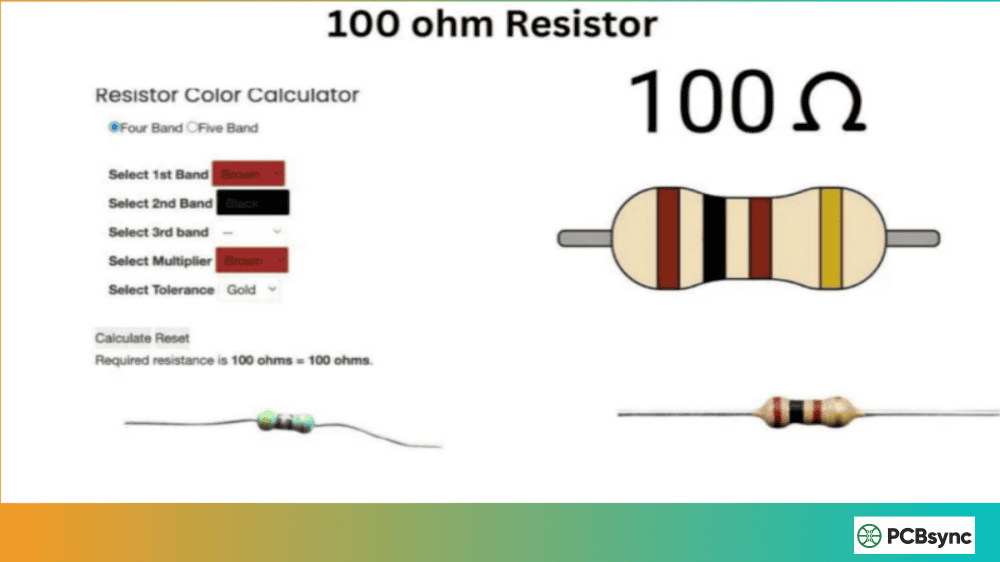
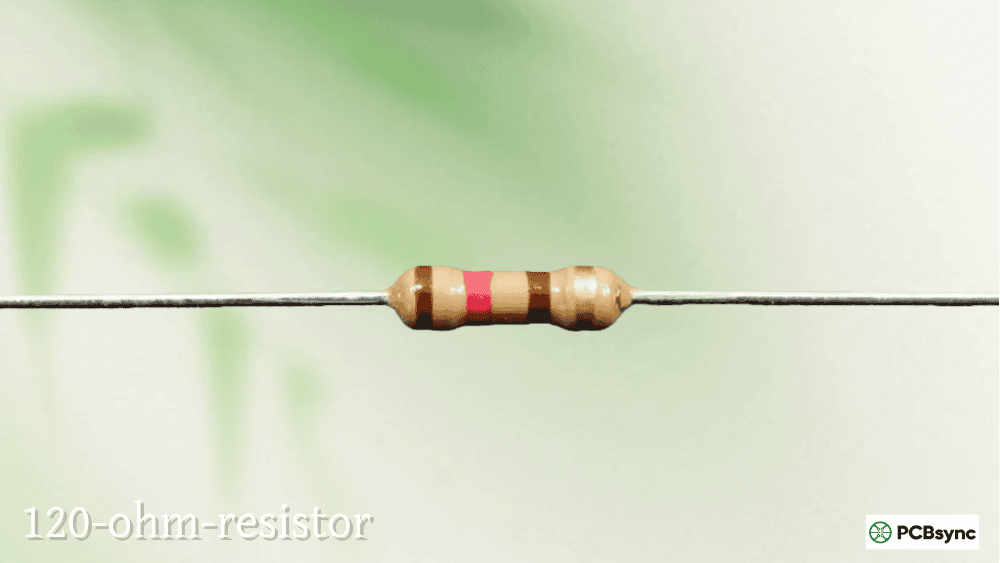
Identifying a 120 ohm resistor by its color bands is straightforward. The brown-red-brown pattern creates a distinctive look that’s easy to recognize once you know what to look for.
4-Band 120 Ohm Resistor Color Code
The standard 4-band configuration:
Band Position
Color
Value
Meaning
1st Band
Brown
1
First significant digit
2nd Band
Red
2
Second significant digit
3rd Band
Brown
×10
Multiplier
4th Band
Gold
±5%
Tolerance
Reading it: Brown-Red-Brown-Gold gives you 12 × 10 = 120Ω with ±5% tolerance.
That gold tolerance band means your actual resistance falls between 114Ω and 126Ω. For termination applications, this tolerance is perfectly acceptable.
5-Band 120 Ohm Resistor Color Code
For precision applications requiring tighter tolerance:
Band Position
Color
Value
Meaning
1st Band
Brown
1
First significant digit
2nd Band
Red
2
Second significant digit
3rd Band
Black
0
Third significant digit
4th Band
Black
×1
Multiplier
5th Band
Brown
±1%
Tolerance
The 5-band code Brown-Red-Black-Black-Brown represents 120 × 1 = 120Ω with ±1% tolerance.
6-Band 120 Ohm Resistor Color Code
When temperature stability matters for precision termination:
Band Position
Color
Value
Meaning
1st Band
Brown
1
First significant digit
2nd Band
Red
2
Second significant digit
3rd Band
Black
0
Third significant digit
4th Band
Black
×1
Multiplier
5th Band
Brown
±1%
Tolerance
6th Band
Brown
100 ppm/K
Temperature coefficient
Resistor Color Code Reference Chart
Color
Digit
Multiplier
Tolerance
Black
0
×1
–
Brown
1
×10
±1%
Red
2
×100
±2%
Orange
3
×1,000
–
Yellow
4
×10,000
–
Green
5
×100,000
±0.5%
Blue
6
×1,000,000
±0.25%
Violet
7
–
±0.1%
Gray
8
–
±0.05%
White
9
–
–
Gold
–
×0.1
±5%
Silver
–
×0.01
±10%
SMD 120 Ohm Resistor Markings
Surface mount 120 ohm resistors use numerical codes:
3-Digit SMD Code
A 120 ohm resistor in 3-digit format is marked 121.
Breaking it down:
First two digits (12) = significant figures
Third digit (1) = number of zeros to add = one zero
Result: 12 + one zero = 120Ω
4-Digit SMD Code
Precision SMD resistors use 1200 for 120 ohms:
First three digits (120) = significant figures
Fourth digit (0) = multiplier = ×1
Result: 120 × 1 = 120Ω
EIA-96 Code
For 1% tolerance SMDs, the EIA-96 system marks 120Ω as 09A:
09 = code for 121 (closest E96 value)
A = multiplier of ×1
SMD Marking System
Code for 120Ω
Typical Tolerance
3-Digit
121
±5%
4-Digit
1200
±1%
EIA-96
09A
±1%
CAN Bus Termination with 120 Ohm Resistors
This is where the 120 ohm resistor truly earns its keep. Controller Area Network (CAN) is a robust communication protocol used extensively in automotive systems, industrial automation, and robotics.
Why CAN Bus Needs Termination
CAN uses differential signaling over twisted-pair cables. When high-frequency signals reach the end of an unterminated cable, they reflect back like waves bouncing off a wall. These reflections interfere with incoming data, causing communication errors, corrupted messages, and system instability.
The 120 ohm resistor placed at each end of the CAN bus absorbs this signal energy, preventing reflections and ensuring clean waveforms.
Proper CAN Bus Termination Setup
Component
Requirement
Notes
Termination resistors
2 × 120Ω
One at each end of the bus
Placement
Between CAN_H and CAN_L
At physical endpoints only
Resulting impedance
60Ω total
Two 120Ω in parallel
Cable type
Twisted pair
Characteristic impedance ~120Ω
How to Verify CAN Bus Termination
Here’s a diagnostic technique I use regularly:
Power down all CAN nodes
Set your multimeter to resistance mode
Measure between CAN_H and CAN_L pins
Check the reading:
Measured Resistance
Interpretation
~60Ω
Correct termination (2 × 120Ω in parallel)
~120Ω
Only one termination resistor present
Very high (MΩ)
No termination resistors
<60Ω
Too many termination resistors
If you measure 120Ω, you need to add another 120 ohm resistor at the opposite end of the bus. If you measure significantly less than 60Ω, some nodes may have internal termination enabled that needs to be disabled.
CAN Bus Termination in Practice
Many modern CAN devices include built-in termination that can be enabled via DIP switches or software configuration. Before adding external 120 ohm resistors, check your device documentation. Common devices with selectable termination include motor controllers, ECUs, and CAN interfaces like those from Kvaser, PEAK, and Vector.
Scenario
Action
Two end nodes with built-in termination
Enable termination on both
End nodes without built-in termination
Add external 120Ω resistors
Node in middle of bus
Never enable termination
Short test setup (<1m cable)
One termination often sufficient
RS-485 Termination with 120 Ohm Resistors
RS-485 is another differential signaling protocol that benefits from proper termination using 120 ohm resistors. It’s widely used in industrial control systems, building automation, and long-distance serial communication.
Why RS-485 Requires Termination
Like CAN, RS-485 transmits data over twisted-pair cables with a characteristic impedance around 120 ohms. Without termination, signal reflections cause:
Data corruption and communication errors
Increased bit error rates
Unstable system behavior
False triggering during idle states
The 120 ohm resistor placed at each end of the RS-485 bus matches the cable impedance and absorbs signal energy.
RS-485 Termination Configurations
Configuration
Termination Location
Resistor Count
Half-duplex (2-wire)
Both ends of A/B pair
2 × 120Ω
Full-duplex (4-wire)
Receiver side of master and furthest slave
2 × 120Ω per direction
Point-to-point
Far end from transmitter
1 × 120Ω minimum
When Termination May Be Optional
For short cable runs at low data rates, you might get away without termination. However, I always recommend installing 120 ohm resistors as a best practice:
Condition
Termination Recommendation
Cable < 10m, baud < 9600
Optional but recommended
Cable > 10m or baud > 9600
Required
Cable > 100m
Absolutely required
Noisy industrial environment
Always required
Bias Resistors vs. Termination Resistors
Don’t confuse termination with biasing. RS-485 networks often need both:
Termination resistors (120Ω): Prevent signal reflections at cable ends
Bias resistors (560Ω-1kΩ): Hold the bus at a known state when idle
Some integrated RS-485 transceivers include failsafe biasing, reducing the need for external bias resistors. Termination, however, remains a physical cable property requirement.
Common Termination Problems and Solutions
Problem: Intermittent Communication Errors
Symptoms: Random CRC errors, dropped messages, devices going offline intermittently
Likely cause: Missing or incorrect termination
Solution: Verify 60Ω across differential pair with bus powered down. Add or adjust 120 ohm resistors as needed.
Problem: Communication Works at Low Speed But Fails at High Speed
Symptoms: System works at 125 kbps but fails at 500 kbps or 1 Mbps
Likely cause: Signal reflections becoming significant at higher frequencies
Solution: Ensure proper 120 ohm termination at both ends. Check for stub connections or improper star topology.
Problem: Only One Direction of Communication Works
Symptoms: Can transmit but not receive, or vice versa
Likely cause: Termination resistor shorting one of the differential lines
Solution: Verify resistor is connected between CAN_H and CAN_L (or A and B), not to ground.
Selecting the Right 120 Ohm Resistor for Termination
Power Rating
For most termination applications, 1/4W resistors are sufficient. The power dissipation depends on the differential voltage:
Protocol
Typical Differential Voltage
Power in 120Ω
CAN bus
2-3V
~50mW max
RS-485
2-5V
~200mW max
A 1/4W (250mW) 120 ohm resistor handles these levels comfortably.
Resistor Type
Type
Tolerance
Best For
Carbon film
±5%
General termination
Metal film
±1%
Precision applications
Wirewound
±5%
High-power termination
Metal film resistors offer better temperature stability, which can matter in automotive or industrial environments with wide temperature swings.
A 4-band 120 ohm resistor has the color code Brown-Red-Brown-Gold. Brown represents 1, Red represents 2, the second Brown is a ×10 multiplier, and Gold indicates ±5% tolerance. Multiply 12 by 10 to get 120 ohms. For 5-band precision resistors, the code is Brown-Red-Black-Black-Brown with ±1% tolerance.
Why is 120 ohms used for CAN bus termination?
The 120 ohm value matches the characteristic impedance of standard twisted-pair cables used in CAN networks as defined by ISO 11898-2. When a resistor matches the cable impedance, it absorbs signal energy at the line end instead of reflecting it. Two 120 ohm resistors, one at each end of the bus, create a 60 ohm parallel load that ensures proper signal levels and prevents data-corrupting reflections.
How do I test if my CAN bus is properly terminated?
Power down all CAN nodes, then measure resistance between CAN_H and CAN_L with a multimeter. Proper termination shows approximately 60 ohms (two 120 ohm resistors in parallel). A reading of 120 ohms indicates only one termination resistor is present. Very high resistance means no termination exists. Values significantly below 60 ohms suggest too many termination resistors are active.
Can I use a different resistor value instead of 120 ohms for termination?
While 120 ohms is the standard, small variations (110-130 ohms) typically work acceptably. The value should match your cable’s characteristic impedance. Using significantly different values causes impedance mismatch, leading to partial reflections. For reliable communication, especially at high speeds or long distances, stick with 120 ohm resistors as specified by CAN and RS-485 standards.
What is the SMD code for a 120 ohm resistor?
For standard tolerance SMD resistors, a 120 ohm value is marked 121 using the 3-digit code (12 with one zero added). For precision 1% resistors using the 4-digit code, look for 1200. The EIA-96 code for approximately 120Ω is 09A. Always verify with a multimeter if you’re uncertain, as proper termination resistance is critical for communication reliability.
Summary
The 120 ohm resistor serves a specialized but critical role in differential communication systems. While you can certainly use it for general circuit applications, its true value lies in terminating CAN bus and RS-485 networks where proper impedance matching prevents signal reflections and ensures reliable data transmission.
Remember the key diagnostic: measure 60 ohms across your differential pair when the system is powered down. If you don’t see that value, you likely have a termination problem that a pair of 120 ohm resistors can solve.
Keep a supply of these resistors in your toolkit, both through-hole for prototyping and SMD for production boards. When communication problems arise, proper termination should be one of your first checks.
Inquire: Call 0086-755-23203480, or reach out via the form below/your sales contact to discuss our design, manufacturing, and assembly capabilities.
Quote: Email your PCB files to Sales@pcbsync.com (Preferred for large files) or submit online. We will contact you promptly. Please ensure your email is correct.
Notes: For PCB fabrication, we require PCB design file in Gerber RS-274X format (most preferred), *.PCB/DDB (Protel, inform your program version) format or *.BRD (Eagle) format. For PCB assembly, we require PCB design file in above mentioned format, drilling file and BOM. Click to download BOM template To avoid file missing, please include all files into one folder and compress it into .zip or .rar format.